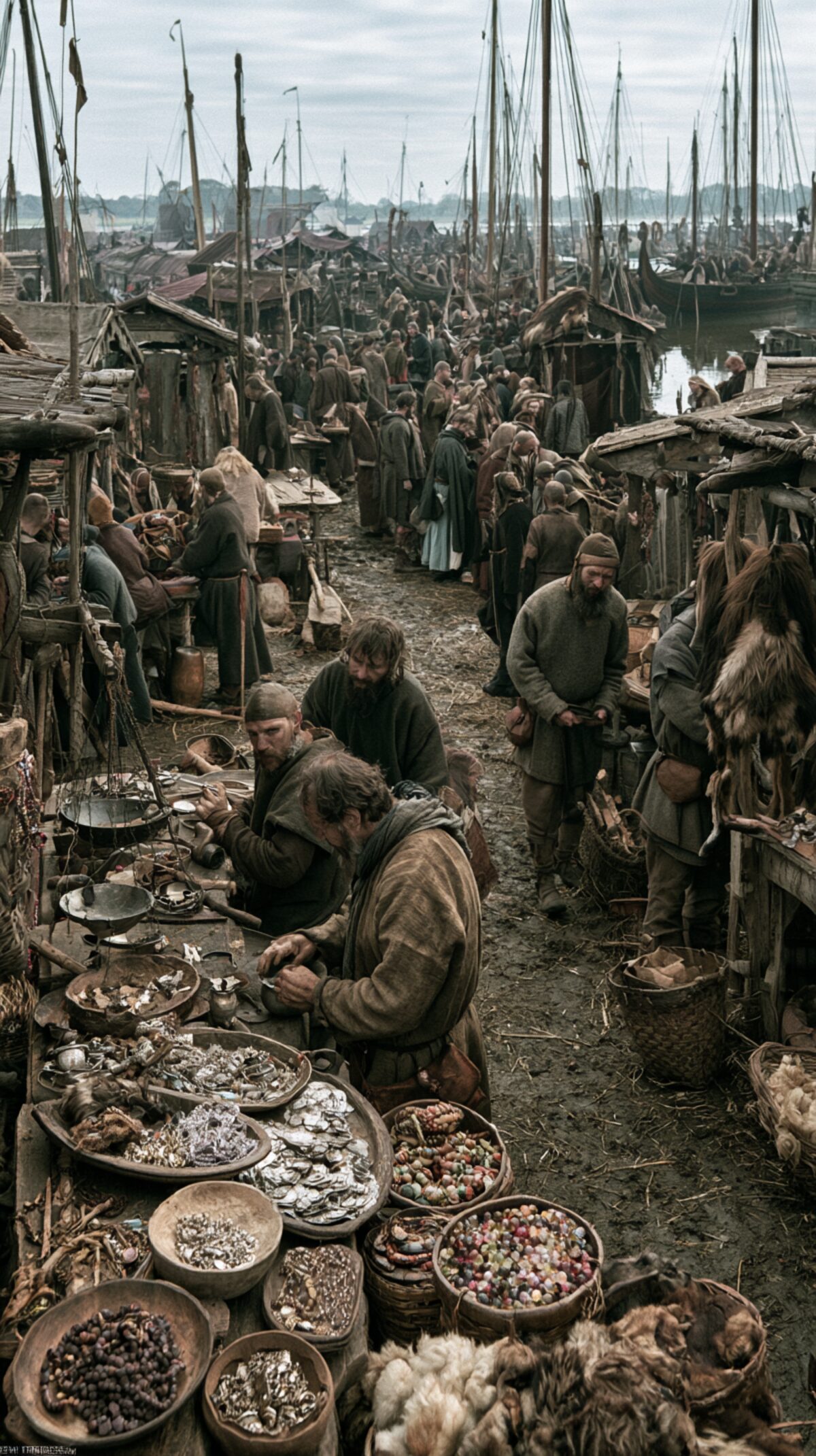
Hedeby was not a fortress and not a royal seat. It was a place where goods changed hands – the most important one in northern Europe, for three hundred years. Anyone who wants to understand how the Viking Age actually worked should look not at Valhalla but at this harbour on the Schlei.
And the best of it: few places of the Viking Age are so well documented. Frankish royal annals, an Anglo-Saxon seafarer's report, an Arab traveller, Icelandic sagas, four runestones – and beneath all of it, ground that preserves wood.
Hedeby lay at the innermost end of the Schlei, a narrow Baltic inlet reaching some forty kilometres into the land. The town of Schleswig stands opposite today.
The decisive point is geography. From there to the Treene, which runs by way of the Eider to the North Sea, is roughly twenty kilometres overland – a short haul compared with the alternative. The alternative meant sailing around the whole Jutland peninsula, through the Skagerrak and the Kattegat, along a coast notorious for its shoals and its weather.
Anyone moving goods between the Baltic and the North Sea could sail that passage, or could tranship. Hedeby was the place where goods were transhipped.
That is the entire explanation for the town. Not wealth, not power, not a sanctuary – a bottleneck in the landscape.
The name reaches us in several languages, and each form says something.
Old Norse Heiðabýr or Heiðabœr: the settlement on the heath. The runestones on the spot carry the dative at Haiþabu. In Old English it is æt Hæþum, "at the heaths" – the landscape, not the religion.
The Frankish sources call it something else: Sliesthorp in the royal annals, later Sliaswich. That is the name taken from the Schlei, and from it came Schleswig – the name that moved to the successor settlement on the far bank once Hedeby was abandoned.
The beginning is recorded with unusual precision – and by the other side.
The Frankish royal annals report for the year 808 that the Danish king Godfred destroyed the Slavic trading place of Reric on the Baltic coast and brought its merchants with him to Sliesthorp. In the same passage we read that he had a rampart drawn across the land.
This is no foundation legend but the note of a Frankish court scribe about an enemy. It shows something essential: Hedeby was a political decision. A king moved trade to where he could control it and tax it.
Archaeologically the settlement begins a little earlier, in the late eighth century. Godfred did not invent the place; he upgraded it – by forced resettlement.
A few decades later the next report comes from another direction. Rimbert, in his life of the missionary Ansgar, describes how around 850 he was permitted to build a church at Schleswig. Trade and mission ran side by side; the merchants who came from the Christian Frankish empire brought their faith with them.
Two eyewitness accounts survive, and they could hardly differ more.
The first is by Ohthere, a Norwegian trader who came to the court of King Alfred around 890 and described his voyages there. His report was inserted into the Old English translation of Orosius. Ohthere sailed from Skiringssal in the Oslofjord to Hedeby, five days, with Denmark to port. Sober, precise, a seaman giving distances. In the same text follows the account of Wulfstan, who sailed from Hedeby to Truso at the mouth of the Vistula in seven days.
The second comes from Ibrāhīm ibn Yaʿqūb, a traveller from al-Andalus who journeyed in the north in the 960s. He describes Schleswig as a large town at the far end of the world-ocean, mentions wells of fresh water, an abundance of fish, and that the inhabitants mostly worshipped Sirius, with only a few Christians among them. Then come the passages quoted everywhere: a festival with sacrifice and feasting; women who could divorce whenever they wished; an artificial eye-paint that kept beauty from fading; and that he had never heard a more repellent singing – a droning from the throat, worse than the barking of dogs.
With that second account caution is needed, for a solid reason: Ibrāhīm's original text is lost. We know it only through quotations in later Arabic authors, above all al-Bakrī in the eleventh and al-Qazwīnī in the thirteenth century. The most lurid passages appear in the latest versions.
And here comes the real stroke of luck. The subsoil at Hedeby is wet and starved of oxygen. In such ground organic material does not rot – wood, leather, textiles and wickerwork survive.
Excavation has gone on since 1900, with major campaigns in the 1930s and again from the 1960s to the 1980s. Only a fraction of the area has been examined. What is known is still enough for a surprisingly sharp picture.
The settlement was enclosed by a semicircular rampart, some 1,300 metres long and in places up to ten metres high, meeting the Schlei at both ends. It encloses about 24 hectares. In its core the rampart belongs to the tenth century and is therefore younger than the settlement.
Inside ran a stream, and the plots lay along it: small, strictly divided parcels with timber houses in wattle and stave construction, plank walkways between them. Towards the water stood wooden landing bridges reaching far out into the shallows so that ships could tie up without grounding.
A ship lay in the harbour basin. Hedeby 1 was a longship of a good thirty metres, built of oak felled around 985. It was not scuttled but burnt – most likely used as a fireship against the harbour. It is one of the largest known warships of the Viking Age.
And there is a chamber grave with a boat above it, weapons and horse harness: the grave of a man of rank, dated to around 850.
This question is often answered with large numbers, and that is not serious.
Scholarly estimates mostly fall between one thousand and fifteen hundred people living there at any one time. Some calculations run higher, others lower. They rest on the built-up area, the number of house plans per plot and the cemeteries – and each of those foundations carries a margin of error.
By modern standards that is a village. By the standards of the tenth-century north it was one of the largest settlements anywhere. For comparison: contemporary Córdoba probably held well over a hundred thousand people.
Hedeby was not only a place of transit. It was a town of workshops, and the refuse layers tell us who did what.
Combs of red-deer antler, made in series – composite combs of tooth plates and connecting bars, riveted, often decorated. Comb-makers' waste is among the commonest finds of all.
Glass beads, drawn from melted raw glass and mosaic glass, partly from Mediterranean stock. Bronze casting for oval brooches and mounts, attested by moulds and crucibles. Amber, raw and worked. Textiles – woollen cloth in various grades, with loom weights and spindle whorls in quantity.
Beyond that ironworking, leatherwork and wood-turning. And imports that show the reach: querns of basalt lava from the Eifel, soapstone vessels from Norway, Rhenish pottery, Frankish sword blades, whetstones of schist.
Payment was not made in coin in the modern sense, at least not chiefly.
The medium was silver by weight. Hacksilver – fragments of arm-rings, cut coins, ingots – was weighed on small folding balances. With them go the characteristic cubo-octahedral bronze weights, often marked with dots, and spherical weights with flattened poles.
Much of that silver came from far away: dirhams from the caliphate, by way of the Russian rivers and the Baltic. Scandinavian hoards contain them in the tens of thousands.
Hedeby also struck its own. As early as the first half of the ninth century, imitations of Carolingian coins from Dorestad were produced there, later issues of its own with ship, stag and face motifs. It is the earliest known coinage in the Danish area.
Runestones stand around Hedeby, and that makes the place special: here the people of the time speak in their own cause, not through Frankish or Arab intermediaries.
Two of the stones were raised by a woman. Ásfríðr, daughter of Óðinkárr, set them up for Sigtryggr, her son and King Gnúpa's. Both name Hedeby. They belong to the early tenth century and attest a royal line about which we would otherwise know almost nothing.
The Skarði stone was raised by King Sveinn for his retainer who – so the inscription – had travelled west and now met his death at Hedeby. A single sentence containing a whole life: the voyage, the return, the end at the harbour.
The Eiríkr stone names a ship's captain and the siege of the town. It belongs to the same period of fighting over the place.
Hedeby does not stand alone. It is the harbour of a system.
The Danevirke is a chain of ramparts, ditches and walls running across the Jutland peninsula, from the Schlei to the marshes in the west. In its full extent it reaches some thirty kilometres. Hedeby's semicircular rampart ties directly into that system – the town sits in the gateway.
For a long time Godfred's rampart of 808 was taken as the beginning. Dendrochronology has shifted the picture: parts of the Danevirke are considerably older and reach back into the fifth or sixth century. Godfred therefore extended an existing frontier work; he did not create it.
Building continued later, among other things with a fieldstone wall in the twelfth century under Valdemar I. Since 2018 Hedeby and the Danevirke have stood together on the UNESCO World Heritage list.
Ansgar's church of about 850 is attested, and it was not the last. A hundred years later Ibrāhīm ibn Yaʿqūb writes that there are Christians there, but that they are in the minority.
The cemeteries show the same coexistence: cremations and inhumations, graves with goods and without, chamber graves and simple earth graves. There is no point at which one stops and the other begins.
That is typical of trading places. Anyone wanting to do business with Christian merchants might undergo prima signatio, a provisional form of baptism that made trade possible without demanding full conversion. The sources mention the practice more than once.
Religion here was partly a question of being able to do business. More on this in our article on burial.
Hedeby does not end with a bang but with three – and one slow cause.
The Heimskringla reports that the Norwegian king Harald Hardrada burnt the town around 1050; a skaldic stanza describes the fire standing over the houses. The ground confirms a burnt layer. In 1066, according to the sources, another raid followed, this time by Wends.
But the real cause was less dramatic. Ships grew larger and drew more water, the shallow harbour basin silted up, and the trade routes shifted. On the other side of the Schlei Schleswig grew up – deeper water, connected to the new conditions. People moved there.
What remained was a meadow with a rampart around it. That is precisely what saved the place: because nothing was ever built there again, the evidence lies undisturbed in the ground. A town centre over which, for a thousand years, only grass has grown.
"A purely Viking town." It was under Danish rule, but the population was mixed. The finds show Frisian, Saxon, Slavic and Frankish elements – in the pottery, in dress fittings, in building methods. Godfred had brought Slavic merchants there in 808; they were not the last to arrive. A place of exchange attracts whoever trades.
"Hedeby is modern Schleswig." No. Schleswig lies on the northern bank of the Schlei and is the successor settlement, founded as Hedeby was given up. The name travelled; the place did not. The meadow with the semicircular rampart lies on the southern side, near Busdorf.
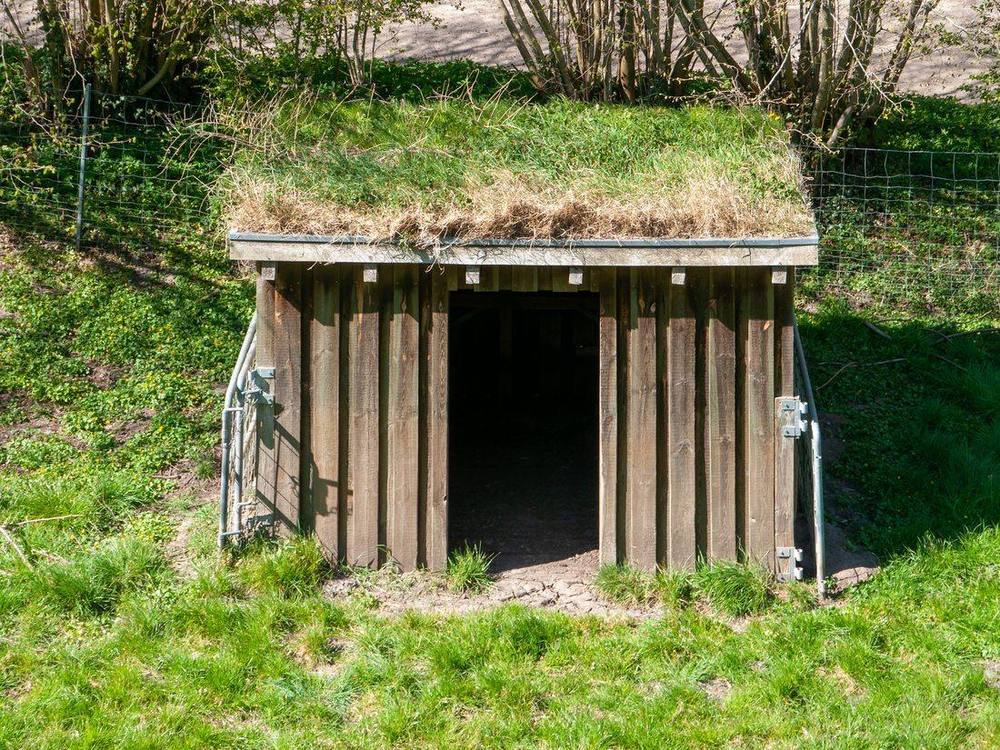
"The houses there are originals." The seven buildings at the harbour are reconstructions, raised from 2005 on the site, following the plans of excavated houses and using period techniques. That is well-made interpretation – but every detail not preserved in the ground is a reasoned assumption. Roof form, interior fittings and colour are among them.
Hedeby corrects the picture most people carry of the Viking Age. No war camp, no place of raiders. A town of workshops with comb-makers, bead-makers, bronze casters and traders weighing silver and moving goods.
And it shows how far the north reached. Basalt from the Eifel, soapstone from Norway, glass from the Mediterranean, silver from Samarkand – all in a harbour of two dozen hectares.
When we look for evidence behind a motif, places like this are the measure. Not what looks good, but what lies in the ground.
Read more with us: Boat burial · Sutton Hoo · The Thing · Runes
For courage. For remembrance. For legends that live on.
All History & Finds articles →
Long before the Vikings, a Roman writer describes a Germanic tribe that defeats its enemies not by number or strength …
Read more →The most famous eyewitness account of the Vikings comes not from the North, but from Baghdad. In 921 the Caliph sent …
Read more →Carved in stone over 1,000 years ago, a king proclaims the unification and baptism of Denmark – the same king whose …
Read more →Long before the Vikings they settled between the Eifel and the Danube, leaving behind gold hoards and princely graves …
Read more →