Yule (Old Norse jól) was the great midwinter feast of the pre-Christian North: three nights of ale, sacrificial meat, toasts and solemn vows held in the darkest part of the year. Its exact date is debated – probably not the solstice itself. What is certain is that King Hákon the Good moved it to the date of Christian Christmas in the tenth century, which is why Christmas in Scandinavia is still called jul. Here is what the sources actually say – and which "ancient" Yule customs turn out to be surprisingly young.
Picture a hall in Trøndelag, central Norway, some time in the tenth century. Outside it has been pitch dark since mid-afternoon; inside, farmers stand with folded arms before their king. They want him to eat horse meat. He refuses. The king is a Christian, the farmers are not, and the feast is called Yule. The scene comes – with every caveat owed to a thirteenth-century text – from Snorri Sturluson's Heimskringla, and it captures Yule better than any romantic painting: community, harvest and peace, plenty of ale, and the question of whom you serve.
So: what do words, laws and sagas say – and what did the nineteenth century add?
The word is our oldest witness. Old Norse jól is a plural noun – a festive season, not a single day. Linguists trace it to a Germanic form like *jehwla-, whose deeper origin is unknown. Jacob Grimm thought of the "wheel" of the year, an idea the sound changes do not support; Anatoly Liberman finds a link with a word for "merriment, festivity" more plausible. Anyone selling "Yule means sun wheel" as fact is selling a nineteenth-century hypothesis.
What is striking is how far back the word goes. The earliest record is not Scandinavian at all. A fragment of a Gothic church calendar from the fourth or fifth century, preserved in the Codex Ambrosianus in Milan, calls November fruma jiuleis – "the month before Yule". So the Goths already knew a period called Yule, and it fell around the turn of the year. Finnish borrowed the word early too: juhla simply means "festival", while the Finnish word for Christmas, joulu, is a later re-borrowing from Norse.
Our second major witness was a monk in Northumbria. Around 725, the Venerable Bede wrote a textbook on time-reckoning, De temporum ratione (The Reckoning of Time). In chapter 15 he lists the old month names of the heathen English, and he gives December and January a shared name: Giuli. Paraphrasing Bede, the months took their name from the day the sun turns back and begins to lengthen the days; one month comes before it, the other after. Later Old English texts call them Ærra Geola and Æfterra Geola, "earlier" and "later Yule".
The same chapter contains a sentence that still fires imaginations: the heathen English began their year on the day "we now celebrate the birth of the Lord" and called that night Modranecht, "Mothers' Night". Which mothers – goddesses, dísir, the Matronae of the Lower Rhine? Bede does not say. And he was writing a century after the English conversion about rites he had never seen.
In the North itself, medieval Icelandic calendars even have two months with Yule in their names: Ýlir (roughly mid-November to mid-December) and Jólmánuðr, the Yule month, which ran into January. For the wider festive year, see our overview of Germanic festivals.
This is where things get tricky, and where pop culture most often goes wrong. Many people simply equate Yule with the winter solstice on 21 December. Bede does link the name with the solstice – but as an explanation of a month name, not as a festival date. The Norse sources speak instead of miðsvetr, "midwinter". In the Old Norse calendar that is not the astronomical turning point but the middle of the winter half-year, which began with the Winter Nights in mid-October. Counted that way, midwinter falls closer to mid-January.
In 2006 the Swedish historian of religion Andreas Nordberg argued that heathen Yule was held at the full moon of the first lunar month after the winter solstice – between early January and early February. Thietmar of Merseburg offers support: around 1015 he described a great sacrifice at Lejre in Denmark, held every nine years in January, after the feast of the Epiphany. Nordberg's model is well argued but not universally accepted. The honest summary: Yule fell in the darkest season, probably a little after the solstice. For the solstice as a festival in its own right, see our article on solstice celebrations.
The key narrative source for Yule is Hákonar saga góða, the saga of Hákon the Good, part of the Heimskringla that Snorri Sturluson compiled around 1230. Hákon, a son of Harald Fairhair, had been raised as a Christian at the court of King Æthelstan of England and ruled Norway from roughly 934 to 961. His problem: the country was heathen, and the powerful farmers of Trøndelag most of all.
In the chapter on Hákon's Christianity (chapter 13 in the standard Icelandic edition, chapter 15 in Samuel Laing's old English translation), Snorri tells us that the king made a law: Yule should begin at the same time as among Christians. Every household had to brew a fixed measure of malt into ale and keep Yule for as long as the ale lasted – under penalty. Before that, Snorri says, Yule had begun on hǫkunótt, "Hǫku-night", which was midwinter night, and was kept for three nights.
The word hǫkunótt occurs at this single point in the whole of Old Norse literature. Its meaning is uncertain. A popular suggestion links it with hǫggva, "to hew, to slaughter" – the night when the animals were killed for the feast – and Laing duly translated it "slaughter night" in 1844. That cannot be proved, but it fits everything else we know: in deep winter, when fodder ran short, people slaughtered and feasted on the meat.
Hákon's ale law has a remarkable afterlife. The medieval Norwegian provincial laws, such as the Gulathing Law, oblige farmers to join together and brew ale to be blessed at Christmas "to Christ and Saint Mary" – til árs ok friðar, for a good year and peace. That is exactly the formula we know from heathen sacrificial toasts. The Church did not abolish Yule ale; it rebaptised it. For the brewing itself, see beer and brewing in the Viking Age.
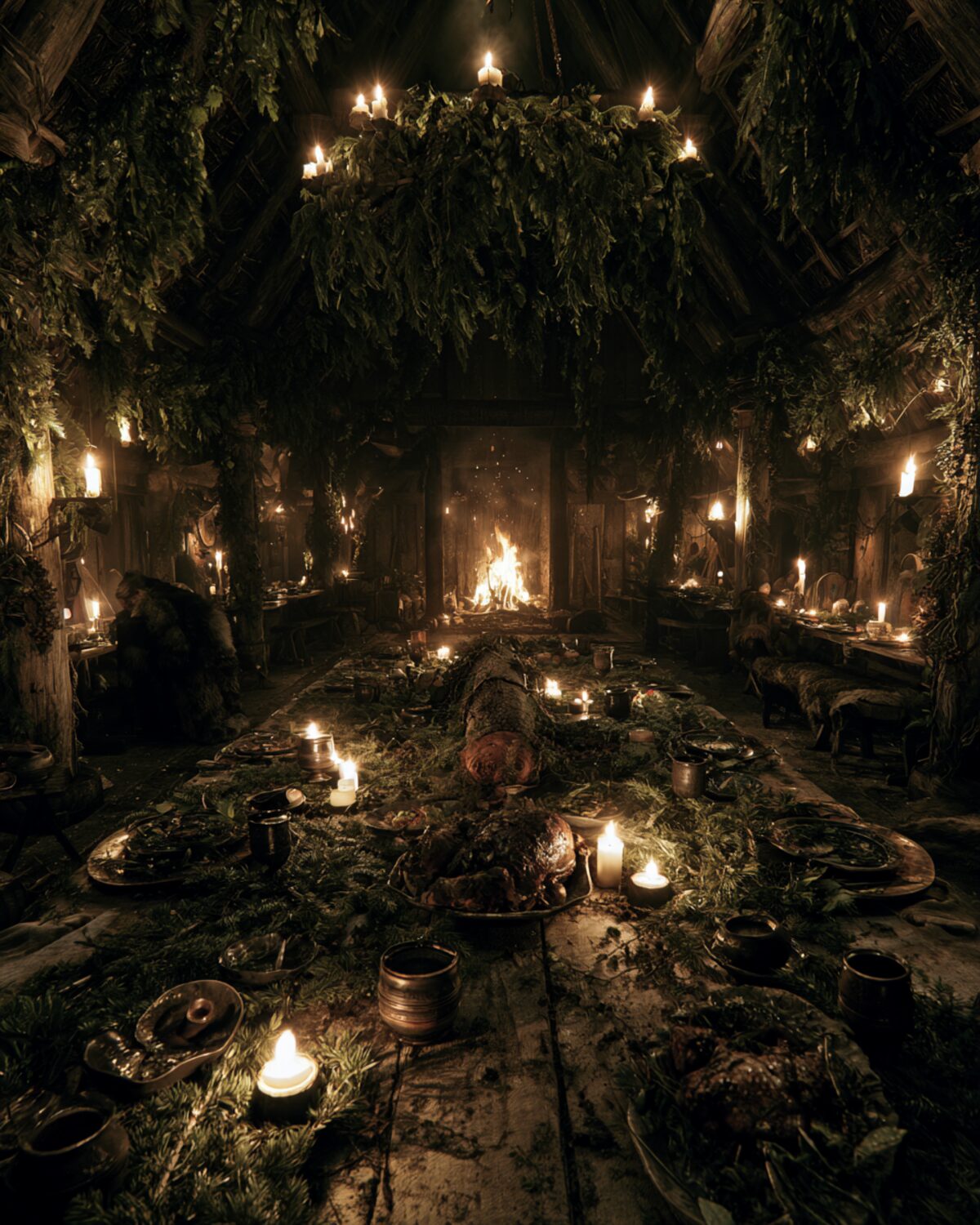
Right after this, Snorri describes how a sacrificial feast (blót) worked. The farmers came to the temple bringing ale and provisions. Livestock of every kind was slaughtered, horses included. The blood was called hlaut; with twigs, the hlautteinar, people sprinkled the altars, the walls and each other. The meat was boiled in cauldrons over fires down the middle of the hall. Then the host blessed the cups: first Odin's cup, for victory and power to the king; then the cups of Njǫrðr and Freyr til árs ok friðar. After that many drank the bragafull, the chieftain's cup, and finally the minni, the memorial cups for dead kinsmen.
Two caveats. Snorri is describing a sacrificial feast in general, not specifically Yule. And he was an educated thirteenth-century Christian reconstructing a world long gone. Details such as the grand temple are debated; archaeology points to cult halls on high-status farms rather than free-standing temples (more on that in our article on blót sites). But the core – slaughter, a shared meal, toasts, remembrance of the dead – matches other sources.
Then comes the scene from the beginning. At an autumn sacrifice at Hlaðir (Lade, near Trondheim), the seat of the powerful Earl Sigurðr, the farmers press the king to eat horse meat. To Christians, horse meat was the badge of heathendom; the Church later banned it outright. Hákon refuses and will not even drink the broth. Sigurðr rescues the situation with a compromise: the king opens his mouth over the greasy handle of the cauldron without eating anything. When Hákon then makes the sign of the cross over Odin's cup, the farmers grumble – and Sigurðr smoothly explains that the king has made the sign of Thor's hammer over the ale.
The compromise does not last. The following winter the king holds a Yule feast at Mærin (Mære, in inner Trøndelag). Eight chieftains have agreed to force him to sacrifice. This time Hákon eats a few bites of horse liver and drains the cups without crossing them. For a baptised king, a humiliation – and a lesson that Yule in the tenth century was not a cosy family occasion but politics.
Snorri wrote late. Are there older voices? Yes – and they mostly talk about drinking. In Haraldskvæði (also Hrafnsmál), a praise poem on Harald Fairhair attributed to Þorbjǫrn hornklofi around 900, the prince is said, in paraphrase, to want to "drink Yule" out at sea and wage Freys leikr, "Freyr's game". Drekka jól, "to drink Yule", is simply Old Norse for "to celebrate Yule". Whether "Freyr's game" is a Yuletide ritual or a poetic phrase for battle is disputed.
The Norwegian royal history Ágrip af Nóregs konunga sǫgum (c. 1190) adds more. It says King Óláfr Tryggvason abolished sacrifices and sacrificial drinking and put in their place the Christian feast-drinking at Yule, Easter and other church festivals. The same text claims that jól is named after Jólnir, one of Odin's names. Scholars see it the other way round: the feast is not named after Odin; Odin bears a byname taken from the feast, "the Yule one". In the tenth century the skald Eyvindr skáldaspillir even calls the gods collectively jólnar, "the Yule beings".
Yule was a feast for the gods in general, with special weight on the Vanir Njǫrðr and Freyr, who stood for fertility and a good year, and on Odin as lord of victory, poetry and the dead. If someone describes Yule as "the feast of the sun god", the Norse sources give them no support – they do not even know a sun god at the centre of anything.
Perhaps the most striking Yule ritual is the heitstrenging, the solemn vow. You stood up, raised your cup and swore to accomplish a particular deed in the coming year. Fail, and you were without honour. Two sources tie these vows explicitly to Yule Eve and to a special animal: the sónargǫltr, a boar whose name is usually interpreted as "atonement boar" or "sacrificial boar", though the etymology is not secure.
The first is the prose in Helgakviða Hjǫrvarðssonar, a heroic lay of the Poetic Edda. Henry Adams Bellows translated it in 1923:
"Hethin was coming home alone from the forest one Yule-eve, and found a troll-woman … That evening the great vows were taken; the sacred boar was brought in, the men laid their hands thereon, and took their vows at the king's toast."Helgakviða Hjǫrvarðssonar, prose after st. 30, trans. H. A. Bellows (1923)
Heðinn, Helgi's brother, has rejected the troll-woman, and she curses him: he will pay for it at the king's toast. And so he does. That evening he vows to win Sváva, the beloved of his own brother – and is instantly seized by remorse. What was said over the boar on Yule Eve could not be unsaid.
The second is Hervarar saga ok Heiðreks. King Heiðrekr has a huge boar raised. On Yule Eve it is led into the hall, and the men lay their hands on its bristles and swear their vows. One group of manuscripts adds that the boar was dedicated to Freyr and sacrificed afterwards. The boar fits perfectly: it is Freyr's animal, like the golden Gullinbursti, and it is the feast animal of the North par excellence. More in our article on the boar in the Norse world.
Both texts are thirteenth-century literature about a legendary past. They do not prove that every farm led a boar indoors on Yule Eve – only that Yule, ale, vows and a boar belonged together as a matter of course.
Yule was not only a feast of the living. The memorial cup, the minni, belongs to every sacrificial meal, and in the folk belief of many regions the dark midwinter weeks were a time when the dead were abroad. How far that reaches back into the Viking Age is hard to say; most of the evidence comes from early modern and modern folklore. We have given the topic its own article: honouring the ancestors at Yule.
In Norway people still told stories in the nineteenth century about the Oskoreia, a noisy ghostly procession that sweeps across the land at Yuletide and rides horses out of their stables. Germany knew similar ideas as the Furious Army or Wild Hunt during the "rough nights" between Christmas and Epiphany. Jacob Grimm built these into a grand picture of Odin leading the host of the dead. The link is attractive, but it is a reconstruction – the details are in our article on the Wild Hunt.
Iceland went its own way. There the troll-woman Grýla and her thirteen sons, the Jólasveinar or Yule Lads, haunt the Christmas season; from 12 December one lad a night comes down from the mountains to steal sausages or slam doors. Grýla is tied to Christmas only from the seventeenth century, and the thirteen names were fixed above all by Jóhannes úr Kötlum's 1932 poem. Meet the family in Grýla and the Yule Lads – and their cat in Jólakötturinn.
Now to the figures happily sold as "Viking customs".
The Yule goat. The straw goat tied with red ribbon is the emblem of Swedish Christmas. The most famous has stood in Gävle since 1966 and is regularly set on fire. In writing, the Yule goat appears only in the sixteenth and seventeenth centuries, and then as a disguise: young people dressed as goats went from farm to farm demanding food and drink and playing pranks – the Norwegian julebukk custom still lives on. In the nineteenth century, a family member dressed as a goat often brought the presents; in Finland, Father Christmas is still called Joulupukki, "Yule goat".
The julklapp. The Swedish word is recorded from 1741 and originally meant the "knock" on the door: you knocked, pushed a small present inside – often with a teasing verse – and vanished before anyone opened. The custom probably reached the German Baltic coast via Swedish Pomerania, and the word survives in northern Germany to this day, now mostly as a name for Secret Santa. There is nothing Viking about it – it is an early modern custom, and a rather charming one.
The jultomte. The tomte or nisse is an old farm spirit who guards house and livestock and is kept happy with a bowl of porridge on Yule Eve. That belief is old, though how old cannot be said. The tomte became a red-capped gift-bringer only in the nineteenth century: in Denmark the julenisse appeared around mid-century, and in Sweden Viktor Rydberg's poem "Tomten" (1881) and the paintings of Jenny Nyström created the image every child knows today. Meet the farm spirit himself in Nisse and Tomte.
Perhaps the strongest proof of the old feast's staying power is linguistic. In Denmark, Norway and Sweden, Christmas is still jul; in Iceland and the Faroes jól; in Finland joulu; in Estonia jõulud. English keeps Yule in the Yule log and old carols, and in Scots Yuil was long the everyday word for Christmas. Hákon's plan worked, just the other way round: the feast became Christian, but the name stayed heathen.
The julbord, the groaning Christmas table, and the Christmas beer that every brewery in Norway and Denmark still releases each autumn belong to a tradition of communal midwinter drinking that we can follow from the early Middle Ages. An unbroken line to Hákon's compulsory ale cannot be proved – but the Gulathing Law shows that there is no gap in between.
And then there is a consciously heathen Yule. Since the 1970s, Ásatrú communities – such as Iceland's Ásatrúarfélagið, founded in 1972 – have again held a Yule blót. They draw on the sources you have just read: toasts to gods and ancestors, vows, a shared meal. Many celebrate at the winter solstice, for practical reasons and because the date is easy to fix. How such celebrations look today is described in How do heathens celebrate today?
So what is left of Yule once the legends are stripped away? Quite a lot: a name older than the Viking Age; three nights in deep winter of slaughtering, brewing and drinking; cups for Odin, Njǫrðr and Freyr, for a good year and peace – and finally for the dead. If you celebrate your own Yule, drink the last cup for those no longer at the table. Of all the parts of the feast, that is the best attested.
What is the meaning of Yule? Yule (Old Norse jól) was the great midwinter feast of the Germanic peoples, a festival lasting several nights with sacrificial meals, ale, toasts to gods and ancestors, and vows. The ultimate origin of the word is unknown.
When did the Vikings celebrate Yule? According to Snorri, Yule began on hǫkunótt at midwinter and lasted three nights. It probably fell a little after the winter solstice – at the first full moon after it, according to Andreas Nordberg – until King Hákon the Good moved it to Christmas in the tenth century.
Is Yule the same as the winter solstice? Not quite. Bede links the name of the Yule months with the solstice, but the Norse sources speak of midwinter, which in the old calendar meant roughly mid-January. Equating Yule with 21 December is largely modern.
Why is Christmas called jul in Scandinavia? Because the Christian feast took over the date and customs of the old Yule, and the name came along with them. Christmas is jul in Danish, Norwegian and Swedish and jól in Icelandic.
Is the Yule goat a Viking tradition? There is no evidence for that. The Yule goat first appears in writing in the sixteenth and seventeenth centuries; the link to Thor's goats is a modern guess.
What was a Yule vow? A heitstrenging: a solemn oath sworn over the cup on Yule Eve – according to Helgakviða Hjǫrvarðssonar and Hervarar saga, with hands laid on a consecrated boar. Breaking it brought disgrace.
For courage. For remembrance. For legends that live on.
All Everyday Life & Craft articles →
When archaeologists open a Viking-age grave, one find is almost always there: a comb. The comb was the most personal …
Read more →Among silver and glass, glowing red beads keep appearing in the rich women's graves of the Viking Age: carnelian. The …
Read more →How did people heal in a world without a pharmacy? With herbs, with knowledge – and with a charm to go with it. An Old …
Read more →The shining swords, the fine brooches, the carved ships – behind all of it stood a craftsman with his tools. What those …
Read more →