Before runes became oracle stones in a pouch, they were the North's first alphabet – used for names, ownership marks, trade, remembrance and now and then a cheeky remark on a wooden stick. This piece goes through the sources in order: where the signs come from, how many inscriptions survive, what rune poems and finds say about names and use, where magic is attested and where only the modern age invented it.
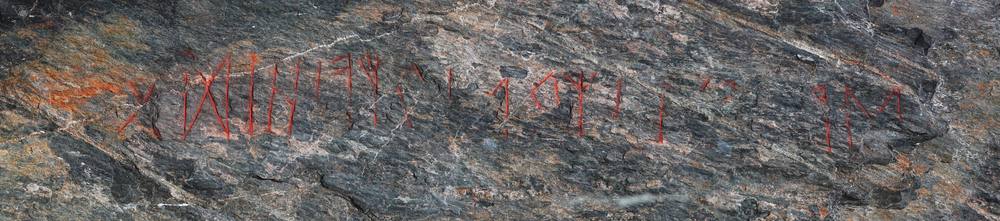
The Gothic word rūna means "secret" or "private counsel", and Old High German rūnēn means "to whisper". The name alone shows that runes were never just letters: they carried a note of knowledge not open to everyone. One of the oldest uses of the word is on the Einang stone in Norway, dated to AD 350–400; its inscription "…dagastiR runo faihido" means roughly "…dagastiR painted the rune". The Noleby stone (about 450) contains the word as well.
The script is named after its first six signs, futhark: f, u, þ, a, r, k. Less of it survives than one might think. Scholars count about 350 inscriptions in the Elder Futhark, some 267 of them in Scandinavia and about 81 on the Continent, plus about 100 Anglo-Frisian inscriptions and nearly 6,000 in the Younger Futhark. Estimates suggest that at least 40,000 and perhaps as many as 400,000 inscriptions were made originally, of which only about 0.1 per cent survive. That is the basis of every statement about runes: we see a tiny sample, skewed by chance survival. Wood rots; stone and metal last.
That the runes derive from a Mediterranean alphabet is considered certain. Which one is disputed, and research has several candidates. The Latin alphabet is favoured above all by Scandinavian scholars (Odenstedt 1990, Williams 1996). For a North Italic source speaks the fact that only five Elder Futhark runes lack a counterpart in the Raetic alphabet of Bolzano (Mees 2000). Evidence for a North Etruscan link is seen in the inscription on helmet B from Negau, second century BC, which bears the Germanic name Harigast in North Etruscan letters (Markey 2001). In 2002 Giuliano and Larissa Bonfante added the proposal that Germanic speakers might have taken over the Venetic alphabet as early as the third century BC.
The finds cannot settle the argument. It does have a practical consequence, though: anyone claiming the runes arose "from nothing" or "from Odin" ignores that the signs plainly had a model. Their shapes are adapted for cutting in wood, with straight and slanting strokes instead of curves. As to early proof, the Vimose comb from the Danish island of Funen, about AD 150–160, bears the word harja, probably a personal name. The Meldorf fibula (about AD 50) is sometimes cited as older still; whether its signs are runes or Latin letters is disputed. Tacitus reports around AD 98 lot-casting with twigs bearing "marks", without calling them runes – more on that below.
Early inscriptions are short. Spearheads and shield bosses with runes from around AD 200 come from Schleswig, Funen, Zealand, Jutland and Scania. Often a name stands there, presumably of the owner or maker. Beside it appear formula words, of which alu is the best known; its meaning is generally sought in the sphere of protection and blessing, but is not proved. More on this in our piece on rune magic.
An example of the carver's formula is the bone piece from Lindholm in Scania, found in 1840 while peat was being cut in a bog. The inscription begins: ek erilaz sa wilagaz hateka, roughly "I, an erilaz, I am called the cunning one", or alternatively "I am called Sawilagaz". Erilaz in many inscriptions denotes the rune-master himself. The second line is a string of signs ending in alu and showing, among others, three Tiwaz runes and eight Ansuz runes, read by some as invocations of gods. The dating swings between the second to fourth century and the later fourth to sixth.
The inscription of the golden horns of Gallehus in Jutland (about 400) is famous too: ek Hlewagastiz … horna tawido, "I, Hlewagastiz … made the horn". The horns were stolen and melted down in 1802 and are known only from drawings and replicas (Gallehus). The Björketorp stone of the sixth century uses the word "rune" in a curse. On the gold bracteates of the Migration Period, one-sided stamped pendants, formulas such as alu and laukaʀ occur, along with rhyming groups like salusalu. Their meaning is disputed; "protection" or "blessing" are hypotheses that suit the setting but are not proved. The whale-bone box known as "Franks Casket", about 700, also carries runes, and one of its panels is thought to be magically significant (Franks Casket). Even the early period thus knows three uses: names and ownership, consecration and blessing, curse.

There is no such thing as "the" runes. Anyone planning an engraving should keep the rows apart: the Elder Futhark with 24 signs (about 150 to 800), the Anglo-Saxon futhorc, extended to 29–33 signs because Old English had developed new sounds, and the Younger Futhark with only 16 signs, which became the script of the Viking Age from the late eighth century. We compare them in the article on the futhark comparison.
The paradox: the Vikings, of all people, used the fewest signs, although their language had more sounds than Proto-Norse. One rune now stood for several sounds, ᛒ for both b and p, and the reader had to fill in from context. Within the Younger Futhark one distinguishes long-branch (Danish) and short-twig runes (Swedish-Norwegian); by a widespread view going back to Jacobsen and Moltke (1942), long-branch runes served mainly stone monuments and short-twig runes everyday use on wood.
The names of the runes we use today are not written on the stones. For the Elder Futhark they are not attested directly; linguists reconstruct Proto-Germanic names such as fehu ("cattle, wealth") or ansuz ("god") from later sources and from the letter names of the Gothic alphabet. The main later sources are four rune poems, short mnemonic verses in which each rune gets a stanza.
The Old English rune poem names 29 runes and was probably composed in the seventh century. Its only manuscript, Cotton Otho B.x, burned in 1731 in the fire at the Cotton library; we know the text only through a copy made by George Hickes in 1705. The Norwegian poem with 16 runes in skaldic metre survives in a seventeenth-century copy of a lost thirteenth-century manuscript. The Icelandic poem with 16 runes is regarded as the most systematic; it stands in four manuscripts of the Arnamagnæan collection, the oldest (AM 687 d 4°) from about 1500. Then there is the Abecedarium Nordmannicum of the ninth century in Codex Sangallensis 878, which gives names only and may come from Fulda.
Fé er frænda róg. Úr er skýja grátr. Þurs er kvenna kvöl.
Wealth is the quarrel of kinsmen. Shower is the weeping of the clouds. The giant is the torment of women.Icelandic Rune Poem, manuscript of about 1500 (opening lines of three stanzas, own translation)
These verses show two things. First, every rune had a name that denoted a thing or concept, and the stanza interprets it in a sentence. Second, the "meanings" that modern rune books give for each rune build on such lines – and they are poetic memory aids, not divination texts. The poems are medieval and reach us only through copies. That Viking Age rune names were these is plausible for the Younger Futhark and a reconstruction for the Elder.
The greatest misunderstanding about runes is that they were above all magical. The most important runic find of the twentieth century says otherwise: in Bergen, since 1955, some 670 medieval runic texts have turned up at the Bryggen wharf and nearby, mostly on pine sticks, plus bone. Their content is gloriously ordinary. Many follow the ownership formula Eysteinn á mik, "Eysteinn owns me" (B001), like a name tag. Others are business letters, Latin prayers such as "Ave Maria" (B003), love messages (B017 asks for a kiss) or the odd coarse remark.
There are also texts you would not expect at a harbour: B145 contains a complete skaldic stanza in dróttkvætt, names the Norns and quotes a line of Virgil; B368 is a message hidden under wax on a wax tablet urging someone to change sides in a civil war; B380 is a heathen blessing that invokes Þórr and Óðinn. B257 (about 1335) is a poetic love charm reminiscent of a curse in the Eddic poem Skírnismál.
The famous runestones are mainly a Viking Age phenomenon, concentrated in Uppland, and mostly memorials to the dead. They were public and often painted, as paint traces on the Jelling stone show. The finest example of political writing in stone is the great Jelling stone in Denmark. King Harald Bluetooth had it raised for his parents Gorm and Thyra; the smaller, older stone is Gorm's for Thyra. Both belong to the tenth century and have been on UNESCO's World Heritage list since 1994.
King Harald ordered this monument made in memory of Gorm his father and Thyra his mother – that Harald who won for himself all Denmark and Norway and made the Danes Christian.Jelling stone, Rundata DR 42, tenth century (own translation)
The text makes a claim: the inscription announces a founding of the realm and a conversion in a single sentence, and the reverse shows the crucified Christ. More on the king is in the piece on Harald Bluetooth and on the Jelling stones.
The Rök stone in Östergötland carries about 760 signs, the longest surviving pre-Christian runic inscription. A man called Varinn raised it for his dead son Vémóðr. The text mixes Younger and Elder Futhark, uses secret runes, and contains riddles, mythical allusions and a reference to Theoderic the Great. Research still argues about its sense: Lars Lönnroth and Joseph Harris see a riddle game, Otto von Friesen (1920) read a call to vengeance, and Per Holmberg (2015) suggested that the riddles concern only the making of the stone. For readers of the Rhineland one reading of the Theoderic passage is especially tempting: the reference is probably to Theoderic's equestrian statue at Ravenna, which Charlemagne had moved to Aachen in 801. That is an interpretation, not a proof. If it holds, Aachen has an echo on a Swedish stone. More in the article on the Rök stone and, for the region, Vikings in Aachen.
Some stones are signed. The rune-master Öpir ("the screamer") carved around fifty stones in the Urnes style in the eleventh and twelfth centuries. The Ingvar runestones form a group of their own, naming men of Ingvar's ill-fated eastern expedition.
A magical and religious side did exist, and the sources fall into three layers: poetry, sagas and finds. The most famous passage stands in the Rúnatal of the Hávamál. Odin speaks of his self-sacrifice:
I know that I hung on a windy tree nine nights long, wounded with a spear, given to Odin, myself to myself, on the tree that no one knows from what root it grows. No one gave me bread or horn; I peered down, I took up the runes, shrieking I took them, and fell back from there.Hávamál, stanzas 139 and 140, after Henry Adams Bellows's English translation (1923), adapted
The passage explains the origin of the runes as a gift dearly paid for, and ties them to Odin. It was written down in the thirteenth century (Codex Regius), though its core is thought to be older. More on the verses in the piece on the Runatal, and on the god himself under Odin. Egils saga tells how Egill examines a drinking horn holding poisoned ale: he cuts runes into the horn, reddens them with his blood, and the horn bursts. The saga dates from the thirteenth century (Egill). The Sigrdrífumál of the Edda name victory runes, ale runes and help runes and say where to carve them.
The finds show something similar, but more soberly. The Ribe skull in Denmark, about 725, is a piece of human skull six by eight and a half centimetres with a drilled hole. The proposed reading calls on Odin and two further beings, an Ulfʀ and Hō-Tiwʀ (Týr), and conjures against dwarfs, to whom illnesses were ascribed. The piece was found in 1973 on a market place; Marie Stoklund (1996), Ottar Grønvik (1999) and Jackie Nordström (2021, with a digital microscope) have interpreted it. It is one scholar's reading, not a certain wording. Further examples are in the piece on rune magic.
That leaves the question of the oracle. In chapter 10 of the Germania Tacitus describes a simple lot procedure: a branch is cut from a fruit-bearing tree into small rods, marked with certain signs and scattered on a white cloth; the priest or the head of the household lifts three of them in turn and interprets them. Whether the "signs" were runes he does not say. Snorri's Ynglinga saga and Rimbert's Vita Ansgari perhaps describe related customs, but nowhere a rune oracle. The Vikings knew lot oracles, then, but that they used our modern interpretation cards is not attested.
That we think we know so much about runes has a history of its own. In the seventeenth century the Swede Johannes Bureus (1568–1652) founded the modern study of runes and saw Kabbalah and magic in the signs; Olof Rudbeck the Elder (1630–1702) continued it in his "Atlantica", Anders Celsius (1701–1744) recorded Swedish runestones, and Wilhelm Grimm wrote on German runes in 1821. Sophus Bugge (1833–1907) became the great philologist of the runes; by the usual account he deciphered the Elder Futhark in 1865, whose reading had been lost. His great edition of inscriptions (1905–13) and his work on the Rök stone (1910) appeared in part after his death.
An esoteric line developed alongside. Guido von List published "Das Geheimnis der Runen" in 1908, with his eighteen "Armanen runes"; Karl Maria Wiligut derived his own "Wiligut runes" from it, which turn up in SS insignia. Sigurd Agrell proposed the "Uthark" theory in 1932, which Thomas Karlsson spread in modern occultism in 2002. These rows are twentieth-century inventions, not historical rune rows.
A few runes were misused in the twentieth century: the Sig or Sowilo rune as the SS double flash, the Odal rune and the Tyr rune. Their names are historically harmless: Sowilo means "sun", Odal "inherited property", Tyr (Tiwaz) is a god. The signs themselves are some 1,800 years old, their use as party symbols barely a hundred. Anyone planning an engraving should know the context and ask when in doubt. We speak about it openly rather than avoiding or hushing up a sign.
Runes were not a purely Scandinavian phenomenon. About 81 Elder Futhark inscriptions come from the Continent. Most Alemannic finds (some 70 in all, mainly from the period 520–620, about half on brooches) lie in Baden-Württemberg and Bavaria, fewer in Hesse and Rhineland-Palatinate. Among the best known is the brooch of Nordendorf I with the inscription logaþorewodanwigiþonar, read as three divine names. The buckle of Pforzen perhaps tells of Aigil and Ailrun who "fought". In Bad Ems in Rhineland-Palatinate a brooch with madali umbada was found, interpreted as "Madali, protection"; a buckle from Osthofen near Worms carries, in Christian times (about 660–690), the phrase god fura dih deofile. An example from the present Netherlands is the inscription from Bergakker, proposed as Old Frankish.
Some early inscriptions are read by scholars (Looijenga 1997) as tribal names from the Rhineland: wagnijo, niþijo and harija are linked with the Vangiones, the Nidenses and the Harii. This reading is uncertain; we introduce the Vangiones in a piece of their own (Vangiones, also Germanic peoples in the Rhineland). For the Eifel and the Aachen area we can name no runic find. The link we can draw is the Rök reading above.
The commonest beginner's mistake: replacing the Latin alphabet letter for letter. Runes represent sounds. "Christian", then, is not built with a silent "h" but transferred by its sound. Anyone wanting historical consistency picks the row deliberately: the Younger Futhark with 16 signs for a Viking link, the Elder Futhark with 24 for the archaic sound. A name in runes is always a transcription; the Vikings had no fixed spelling rules, and one rune stood for several sounds.
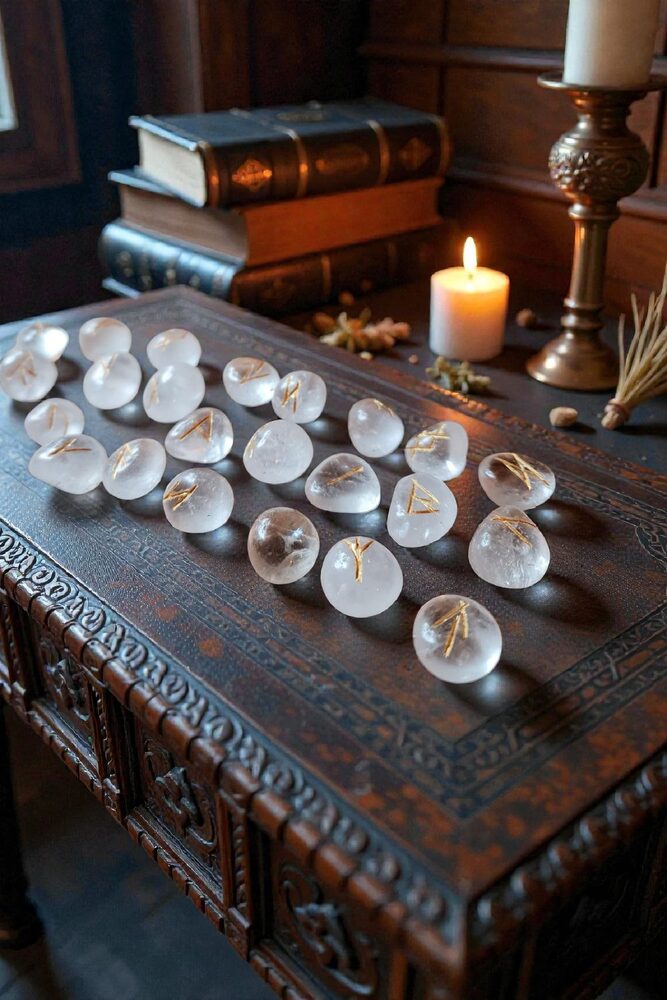
If you want to get to know the signs, the rune lexicon shows all 24 runes, and the rune name generator converts your name. For a finished piece we do the phonetic transfer and engrave it by laser: through the custom engraving or in the engraving configurator. For the rune oracle with the 24 runes of the Elder Futhark there is a set in the shop, which we mean as illustration and food for thought, not as prophecy. Which rune suits which occasion is discussed in Which rune to engrave?; more background is in the pieces on runology and the runes overview.
Secure is that runes were used as script from about AD 150 into the late Middle Ages, that the order of the futhark was fixed early (Kylver, about 400) and that there were three major rows. Well founded are the reading of the Bryggen inscriptions as everyday writing and the classification of Ribe as an incantation. Open remain the origin of the script, the meaning of formula words such as alu, and the question whether runes were used for lots in the Viking Age. The rune names are a reconstruction for the oldest period, and the written sources on magic and origin (Hávamál, Sigrdrífumál, Egil's saga) date from the thirteenth century and later. And of all inscriptions only about 0.1 per cent survive.
A simple rule follows for all we do with runes: where a find or text shows a use, we say so. Where an oracle, a protective sign or a table of meanings is modern, we say that too. Runes carry no promise of protection or success, and we give none.
Which rune row did the Vikings use? The Younger Futhark with 16 signs, in use from about 800 to 1100. The Elder Futhark with 24 signs is older (about 150–800); the Anglo-Saxon futhorc belongs to England and Frisia.
Where do the runes come from? From a Mediterranean alphabet; which one is disputed. Latin, Raetic (Bolzano), North Etruscan and Venetic scripts are named.
Can modern words be written in runes? Yes, best transcribed by sound and not letter for letter. The choice of row determines the result.
Are runes an oracle? Above all they were script. There are hints of ritual use and formula words, but the fixed fortune-telling set with a table of meanings is modern, shaped above all by Ralph Blum (1982).
What do most runic inscriptions say? Names, ownership marks and memorial formulas. Magical texts are the exception in volume, though they are famous (Lindholm, Ribe).
How many runic inscriptions survive? About 350 in the Elder Futhark, about 100 in the Anglo-Saxon futhorc and nearly 6,000 in the Younger Futhark; by estimates that is only about 0.1 per cent of all ever written.
For courage. For remembrance. For legends that live on.
There is no single set of „the" runes. Over the centuries several rune rows developed, and it is worth not mixing them up if an engraving is meant to be coherent. Three matter most for us.
The Elder Futhark is the original form: 24 characters, in use from roughly 150 to 800 AD. It is the rune row of the early Germanic peoples, long before the Viking Age proper. Its name simply comes from the first six characters: f, u, þ, a, r, k. Those who love runes for their archaic, full sound often reach for this one.
The Younger Futhark is the actual Viking rune row. Between about 800 and 1100 the alphabet shrank to just 16 characters, even though the language had more sounds, not fewer. A single rune therefore had to cover several sounds. The vast majority of surviving runestones in Scandinavia use exactly this row.
The Anglo-Saxon Futhorc went the opposite way: in England and the Frisian region the row grew to as many as 33 characters in order to capture additional Old English sounds. Even the name shifted phonetically to „Futhorc". Famous witnesses are the Franks Casket and the Ruthwell Cross.
The honest answer: first and foremost, runes were an ordinary writing system. By far the largest share of surviving inscriptions is remarkably down to earth: memorial stones for the dead, ownership marks („X owns this comb"), trade notes, the names of rune carvers, and the occasional bit of crude everyday humour. Standing before a runestone in a museum, you are usually reading an obituary, not a spell.
At the same time, there is genuine evidence of ritual and incantatory use. Amulets and bracteates carry formula words such as alu and laukaʀ, most likely meant as blessing or protection. The Sigrdrífumál of the Poetic Edda devote whole stanzas to „victory runes", „ale runes" and „birth-helping runes". And in Egil's Saga, Egill scratches out badly carved runes on a drinking horn meant to reveal poison and cuts them correctly anew. Runes as powerful signs are therefore not pure invention.
Myth check: the popular image of an all-purpose magical „rune oracle", in which every rune has a fixed esoteric meaning and is drawn like a card, is young in that form. Systematic rune divination sets and fixed interpretation tables stem largely from the romantic and esoteric revival of the 19th and 20th centuries, not from the Viking Age. The Vikings knew lot-casting, but there is no evidence they used our modern meaning cards. That makes runes no less fascinating, only more honest.
The most common beginner's mistake: swapping the Latin alphabet letter for letter. But runes represent sounds, not our spelling. „Christian" is therefore not built with a silent „h" but transferred by how it sounds. A „c" becomes k or s depending on pronunciation, a „v" often becomes f. If you want it historically coherent, you also choose the row on purpose: the Younger Futhark for a Viking connection, the Elder Futhark for the archaic, fuller set with more characters.
If you would like to try out your name, our rune oracle helps you get to know the characters. For a finished piece of jewellery or a slate, we handle the phonetic transfer and engrave it cleanly by laser: via Individual Engraving, or you can put your own design together in the engraving configurator. That way the right runes end up on the material, not the tempting wrong ones.
The Younger Futhark with 16 characters, in use from roughly 800 to 1100. It appears on the vast majority of Scandinavian runestones. The Elder Futhark with 24 characters is much older (around 150–800) and belongs to the early Germanic peoples; the Anglo-Saxon Futhorc went to England and Frisia.
Yes, sensibly transferred by sound rather than letter for letter. You follow how the word is pronounced and pick a rune row. That is exactly the transfer we carry out for an engraving so the result stays coherent and readable.
First and foremost they were writing. There is evidence of ritual use and formula words, but the fixed rune divination set with an interpretation table is largely a modern idea of the 19th and 20th centuries. You are welcome to use runes as a quiet prompt for reflection, but they should not be mistaken for a documented Viking practice.
Principle: runes were writing first. Where find and text show magical use, we say so; where the oracle is modern, we say that too.
All Runes & Writing articles →
Some runic inscriptions form no smooth sentence, but only single, recurring words: alu, laukaʀ, laþu. They stand on …
Read more →Some runestones move us across a thousand years. The Skarpåker stone in Södermanland is one: a father casts his grief …
Read more →A Danish stone from the early 9th century carries two riddles at once: a symbol of three interlocking drinking-horns …
Read more →A runestone from Jutland reveals how closely the North was interwoven with the southern shore of the Baltic – through a …
Read more →