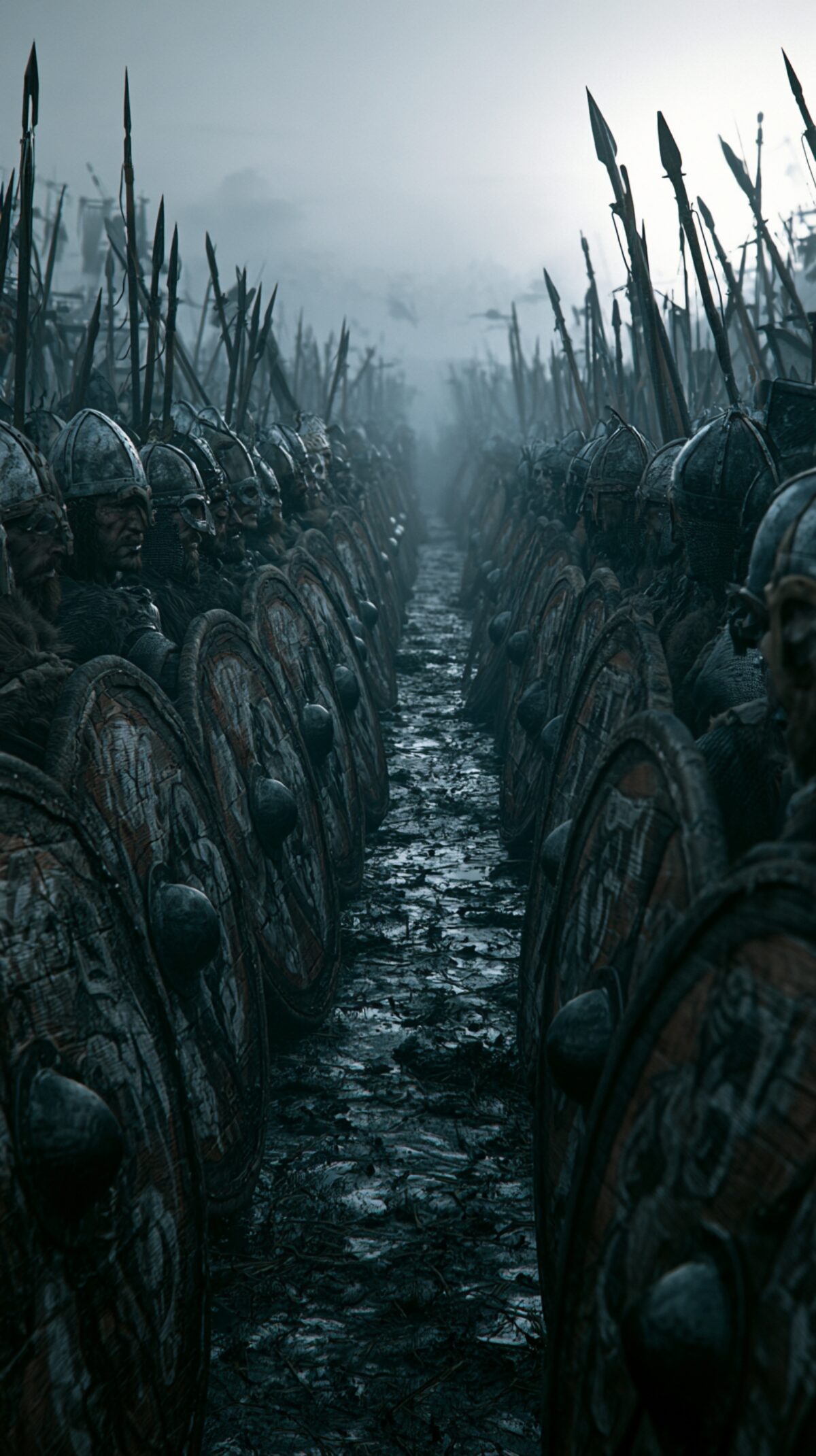
The shield wall was the basic battle formation of the Viking Age: a dense line of warriors holding their round wooden shields side by side and fighting from behind them with spear, axe and sword. The Norse called it skjaldborg, "shield-fort"; the Anglo-Saxons called it bordweall – because both sides fought the same way. Here is what real shields from Gokstad and Trelleborg reveal, what Maldon, Brunanburh, Stamford Bridge and Hastings tell us about shield-wall fighting, and why the famous "boar's head" wedge is more myth than manual.
August 991, the estuary of the Blackwater in Essex. The tide is going out and a narrow causeway rises from the mud. On one side wait the Vikings; on the other, the men of Essex under their ealdorman, Byrhtnoth. He orders them to form the wihaga, the "war-hedge". Shield beside shield. What happens next survives in one of the most gripping battle poems of the Middle Ages – and it shows, better than any film, what the shield wall was really about: not the wildest hero, but the man who holds his ground.
A shield wall is a close-order line of infantry holding their shields side by side so that the front forms one continuous barrier. From behind that barrier men thrust, cut and throw. Ranks behind the front give weight, fill gaps and replace the fallen. As a rule, the side that made the enemy line waver won: once a wall split and men turned to run, the real killing began.
The Vikings did not invent this. Close formations with shield and spear go back to the Greeks and Romans. In the Viking Age (roughly 793 to 1066) it was simply the normal way to fight a pitched battle across north-western Europe – for Scandinavians, Anglo-Saxons, Irish and Franks alike. When a Viking army met an English one, both sides were fighting in essentially the same way.
In Old Norse the formation is the skjaldborg, literally "shield-fort". The word appears in the saga literature of the twelfth and thirteenth centuries: Cleasby and Vigfússon's Icelandic-English Dictionary cites it from, among others, the saga of St Olaf, Njáls saga, Egils saga and the saga of Harald Hardrada. Keep in mind what kind of evidence this is. These sagas were written two or three centuries after the events. They tell us how high-medieval Icelanders imagined the battles of their ancestors – and that they had a fixed term for this formation.
Closer in time to the events are the Old English poems. The poem on the Battle of Brunanburh (937), preserved in the Anglo-Saxon Chronicle, opens with King Æthelstan and his brother Edmund splitting the bordweal – bordweal clufan, the "board-wall". Bord means both plank and shield. The Maldon poem uses several expressions: wihaga ("war-hedge", line 102), scyldburh ("shield-fort", line 242) and bordweall (line 277). Beowulf uses bordweal too. Having so many words for one thing shows how ordinary it was.
No shields, no shield wall. Fortunately, the Viking Age has left us not just descriptions but actual shields – surprisingly few, though. Wood rots, and graves usually yield only the iron shield boss: the domed metal cap in the centre that protects the hand on the grip. Bosses are so common that archaeologists use their shape for dating.
The biggest find comes from the Gokstad ship in Vestfold, Norway, a lavish ship burial from the early tenth century. It held 64 round shields, 32 on each side of the ship, painted alternately yellow and black. They measure about 94 centimetres across and are made from a single layer of butt-joined softwood planks, roughly 7 millimetres thick at the centre and thinned towards the rim. Small holes near the edge suggest a rim of leather or rawhide, which itself has not survived.
For a long time the Gokstad shields were seen as mere grave goods, too thin and light for real fighting. The Danish combat archaeologist Rolf Fabricius Warming re-examined them and argued in the journal Arms & Armour in 2023 that they could well have been used in battle: the tapered edges made them lighter and more agile, and a rawhide covering would have bound the thin planks together and stiffened them against blows.
The second key find is Danish. In 2008, trial excavations at the ring fortress of Trelleborg on Zealand turned up a shield in a wet area about 40 metres from the south gate. It dates to the fortress period, around 980, and according to the National Museum of Denmark it is the only Viking Age shield ever found in Denmark. Five glued planks, around 80 to 85 centimetres in diameter (the museum gives both figures), 4 millimetres thick at the edge and 8 at the centre. Analysis found traces of a calfskin covering and red and white paint. The boss was missing.
Together with other finds, the picture is fairly clear. The typical Viking Age shield was round, usually somewhere between about 70 and 95 centimetres, made of thin boards with a central boss and a horizontal grip behind it. It was held in the fist, not strapped to the forearm. That makes it mobile – you can turn it, punch with it, angle it. For the shield wall this means the barrier was not rigid. It was alive.
No source tells us in manual form how a shield wall was drawn up. What we have are hints in poems and sagas, images like the Bayeux Tapestry, and the logic of the weapons. From these we can sketch a plausible, but reconstructed, picture.
The front rank held the best-equipped men: helmet, perhaps a mail shirt, certainly a shield. The main weapon was the spear, by far the most common weapon in Viking Age graves. It lets you strike over and between shields without giving up your cover. The second and third ranks could join in with longer spears over the shoulders of the men in front. Behind them came throwing spears, arrows and stones.
The axe had its own job. The "beard" – the downward extension of the blade – could hook an enemy shield and drag it down to open a gap. This is a widespread reconstruction that fits the shape of the blades well; we know of no explicit contemporary source describing it. The sword, meanwhile, was expensive – blades like the famous Ulfberht swords were probably carried mostly by retainers and leaders. In the press of a line, it came into its own when the wall was already breaking up.
Piecing together many separate sources, a rough sequence emerges. First came the missiles: arrows, javelins, stones. Then the lines closed. Whether this turned into an actual shoving match, shield against shield, as some accounts suggest, or whether the lines stood at spear's length and worked at each other, is debated among historians and reenactors alike. Probably both happened, depending on terrain, situation and morale.
Cohesion decided everything. A shield wall is only as strong as the nerves of the men in it. When several men fell in one place, the gap had to be closed at once. When one side lost its leader or a group gave way, the whole line could fall apart in minutes. And then came the most dangerous moment: a man who runs turns his unprotected back to the enemy. Most of the dead in a battle fell not in the clash of the walls but in the pursuit that followed.
That is why the poetry puts such weight on standing firm. The Hávamál, the collection of wisdom verses in the Poetic Edda, sums up the attitude in a few lines:
"Silent and thoughtful should a prince's son be, and bold in battle; glad and cheerful should every man be until he meets his death."Hávamál 15, our own translation
Then there are the exceptions: the berserkers of the sagas, said to rage in front of the line, biting their shields and fearing no steel. Whether they ever existed as a distinct fighting group is disputed. In an ordinary battle, a man who broke ranks usually endangered his own side more than the enemy.
No Viking Age formation is quoted as often as the svínfylking, the "swine array", often called the boar's head or wedge. The idea: a narrow point, with ranks widening behind it, driving into the enemy line like a ram. The evidence is thinner – and far more mythical – than video games suggest.
The key passage is in the Poetic Edda. In Reginsmál, the mysterious Hnikarr – one of Odin's names – gives young Sigurd advice for battle. One piece of advice is that victory belongs to those who can see, or who hamalt fylkja, draw up their troops in wedge form:
"Win he shall who well can see, / And wedge-like forms his men for the fray."Reginsmál 23, numbering and translation Bellows 1923 (public domain)
Around 1200, Saxo Grammaticus tells in his Gesta Danorum how an old man – unmistakably Odin – teaches the legendary king Hadding how to draw up his army; for Saxo, Odin is the inventor of the wedge array. Later Saxo has the god favour the Danish king Harald Wartooth too, before letting him fall at the battle of Brávellir. The wedge appears here as divine knowledge: myth, not a drill manual.
Interestingly, the wedge also turns up in classical writing about the Germanic peoples. Tacitus says in Germania (ch. 6) that the Germani drew up their battle line "in wedges" (per cuneos), and in chapter 7 that such a wedge was formed not by chance but from families and kinsmen. The late Roman military writer Vegetius notes that soldiers nicknamed the wedge caput porcinum, "pig's head".
The popular image of a "Viking wedge" with precise ranks and rules owes a lot to the nineteenth century, especially Paul Du Chaillu's two-volume The Viking Age (1889), which read the sagas very literally. Current scholarship is more cautious. A wedge-shaped attack, say to force a gap, is plausible. A standardised special formation used routinely by Viking armies cannot be demonstrated from contemporary sources.
In 937 King Æthelstan of England defeated a coalition of Olaf Guthfrithsson, Norse-Irish king of Dublin, Constantine II of Scotland and Owain of Strathclyde. Where Brunanburh lay is still disputed; Bromborough on the Wirral is the candidate many scholars find most likely. The 73-line poem in the Anglo-Saxon Chronicle celebrates the victory with all the tools of heroic verse: the brothers split the board-wall, hewed the linden shields, and the fugitives were hunted all day long. It names five young kings and seven of Olaf's jarls among the dead – a poetic count, but one that reflects a crushing defeat. Note where the losses came: in the pursuit, after the losing shield wall broke.
Back to the Blackwater. The Battle of Maldon survives only as a fragment of 325 lines, missing its beginning and end. The manuscript burned in the Cotton Library fire of 1731; the text survives only thanks to a transcript made a few years earlier. The sources date the battle itself to 10 or 11 August 991.
The Vikings were camped on an island – probably Northey Island – reachable at low tide only by a narrow causeway. Byrhtnoth had his men hold the crossing. Then, says the poet, "in his ofermod" (line 89) he allowed the Vikings to cross and form up on the shore – presumably to force a decision at all. Whether ofermod means blameworthy pride or magnanimous daring is still argued over.
The walls clash. Byrhtnoth falls. Some of his men flee, one of them on his lord's horse – which makes others think the leader himself is running, and the shield-fort (scyldburh) breaks. But the loyal men stay. The old retainer Byrhtwold speaks the poem's most famous lines:
"Hige sceal þe heardra, heorte þe cenre, / mod sceal þe mare, þe ure mægen lytlað." – Will shall be the harder, heart the bolder, courage the greater, as our strength grows less.The Battle of Maldon, lines 312–313, our own translation
The poem is not an eyewitness report but a celebration of loyalty to one's lord. Precisely for that reason it shows what mattered in a shield wall: a line breaks when men believe others are running. After the defeat England paid the Vikings 10,000 pounds of silver; read more in our article on Danegeld and Maldon.
In autumn 1066 the shield wall appears twice within three weeks – once as the end of a Viking army, once as a stubborn English defence.
On 25 September 1066 King Harold Godwinson surprised the army of the Norwegian king Harald Hardrada at Stamford Bridge, east of York. According to Snorri Sturluson's Heimskringla (c. 1230), many Norwegians had left their mail shirts at the ships because the day was hot and nobody expected a fight. Snorri describes how Harald drew up a long, thin line and bent the wings back until they formed a wide ring, closely set with shields – a shield-fort against the English horsemen. Many historians doubt that the English really attacked on horseback there, as Snorri claims; English armies usually fought on foot. Harald fell, struck in the throat by an arrow according to the saga. With him ended the last great Norwegian invasion of England.
Just nineteen days later, on 14 October, Harold's own army stood on a ridge at Hastings, again in a dense shield wall, facing William of Normandy. The Bayeux Tapestry shows the English shield to shield, many with long, pointed kite shields rather than the older round ones. The wall held for hours against archers, infantry and cavalry. The Norman chronicler William of Poitiers describes the English as packed so tightly that the dead could barely fall. The line finally broke when groups of English chased fleeing Normans – feigned flights, according to Norman sources – and were ridden down in the open. In the end Harold fell too.
On Good Friday, 23 April 1014, the Irish high king Brian Bóruma fought at Clontarf north of Dublin against an alliance of Leinster under Máel Mórda, King Sigtrygg Silkbeard of Dublin, and Norse allies such as Earl Sigurd of Orkney and Bróðir. Brian's army won, but Brian himself was killed – according to tradition in his tent, at prayer, by Bróðir. Sigurd also fell; Njáls saga says he carried the raven banner, whose bearer was always doomed. More in our article on the Battle of Clontarf.
Clontarf is a lesson in layers of evidence. The Annals of Ulster and of Inisfallen briefly list the dead. The Irish Cogadh Gáedel re Gallaib ("The War of the Irish with the Foreigners"), about a century later, turns it into an epic. Modern scholarship also stresses that Clontarf was not a simple "Irish versus Vikings" clash but partly an Irish power struggle, with Scandinavians on both sides. Of the actual battle lines, these sources tell us little we can rely on.
Archaeology shows the size, material and weight of shields, but not how men stood. Contemporary poetry names the formation and describes moments, but it aims to praise, not to document. Chronicles are terse. The sagas and Saxo are rich in detail but centuries younger and shaped as literature.
Everything in between – how deep the ranks were, how far apart the men stood, whether they pushed or stabbed, how long a battle lasted – we reconstruct from the logic of the weapons, from comparison with better-documented periods and from practical experiment. Anyone who explains a precise "Viking order of battle" down to the metre is telling you more than the sources can.
Part of what we know today comes from experimental archaeology. In 2017 an exact wooden copy of the Trelleborg shield was made, and in the 2019 Viking Shield Project the National Museum of Denmark and the Society for Combat Archaeology, with Rolf Warming, tested a reconstruction against arrows, spears, swords and two-handed Danish axes. Such tests show what a shield can take.
Some lessons from experiment and reenactment, stated with caution: a thin, hide-covered round shield is light enough to be used actively – to catch, deflect and strike. It behaves more like a weapon than a door. Light reconstructions weigh around five kilograms, thicker leather-faced versions considerably more. Hold one up for an hour and you understand why exhaustion must have mattered so much in battle. And shields break: the poems speak of hacked shields, and the tests confirm that axes and spears can go through thin boards.
Two images shape how we picture Viking shields: rows of colourful shields along the sides of the longships, and shields covered in elaborate designs. Both have a real core.
The shield wall is the opposite of the Hollywood Viking. It asks for no heroic pose, only trust in the man on your left, whose shield covers your right side. It is an image of fellowship, loyalty and the courage to stay where you are when everything in you wants to run. The poets of Maldon and Brunanburh knew that, and that is why they wrote it down.
For us in the workshop in Alsdorf, the round shield with its boss is one of the finest motifs there is: clear, strong, ancient. When we engrave it in slate or wood, we think of those men on the Blackwater, at Stamford Bridge and at Hastings – not fantasy warriors, but people who stood together.
What is a Viking shield wall? A dense line of infantry holding their round shields side by side and fighting from that cover with spear, axe and sword. The Old Norse term is skjaldborg, "shield-fort".
How big was a Viking shield? Surviving round shields usually measure about 80 to 95 centimetres; the Gokstad shields about 94 cm, the Trelleborg shield about 80 to 85 cm. They were made of thin wooden boards with an iron boss in the centre.
Did the boar's head formation (svínfylking) really exist? The wedge appears in the Poetic Edda and in Saxo as knowledge taught by Odin. A wedge-shaped attack is plausible, but a standardised Viking special formation cannot be proven from contemporary sources.
Why were most warriors killed while fleeing? As long as the wall holds, men are covered by their shields and their neighbours. Once it breaks, the fugitives turn their backs – in the sources, most casualties occur in that pursuit.
Did Vikings hang their shields on the side of the ship while sailing? Shield racks along the gunwale are attested at Gokstad and on Skuldelev 5. Shields were probably displayed like that mainly in harbour or on arrival and departure, not permanently at sea.
For courage. For remembrance. For legends that live on.
All History & Finds articles →
Long before the Viking Age and before the Icelandic Edda there was Germanic cult – and one of the most striking stood …
Read more →Silver was the lifeblood of Viking trade – weighed, chopped up, buried. Three of the greatest hoards show how far the …
Read more →A horse, a golden disc, six little spoked wheels: the Trundholm Sun Chariot is one of the most beautiful images the …
Read more →One late-summer day in 1066, a Norwegian army marched through northern England certain of victory – and a few hours …
Read more →