In the summer of 1939, weeks before the war began, a man with no academic degree dug into a mound in Suffolk and struck something that rewrote the history of early medieval England: a ship of twenty-seven metres, buried in the earth – and inside it a treasure reaching as far as Byzantium and Scandinavia.
The strangest part: the ship was no longer there.
On the estate of Edith Pretty near Woodbridge, above the river Deben, lay eighteen burial mounds. She had long wondered what was inside them, and in 1938 she engaged a local excavator: Basil Brown, self-taught, employed by Ipswich Museum, with a feel for soil that cannot be learned.
In 1938 he opened three mounds. All had been robbed in earlier times. In May 1939 he began on the largest.
What he found at first were rivets. Iron ship rivets, in regular rows, exactly where they had sat. The timber had decayed completely in the acid sand – what remained was an impression: a dark stain in the sand tracing the precise form of the hull.
Once the scale of the find became clear, specialists from Cambridge and London took over. A treasure trove inquest under English law declared the find the property of the landowner in August 1939. Edith Pretty gave it to the British Museum – to this day one of the largest gifts that museum has received from a living person.
A few days later the war began. The finds were stored away, among other places in a disused London Underground tunnel. Serious study began only after 1945.
The ship measured about 27 metres, clinker-built, with overlapping planks fastened by some two thousand iron rivets. It was broad amidships, rising at both ends, and apparently had no mast step – it was rowed, not sailed. That is not certain, because only the impression survived.
The effort is worth picturing: a seaworthy ship hauled up the slope, set into a dug trench, a burial chamber built amidships, the whole thing covered with earth. That is not a burial. That is a demonstration.
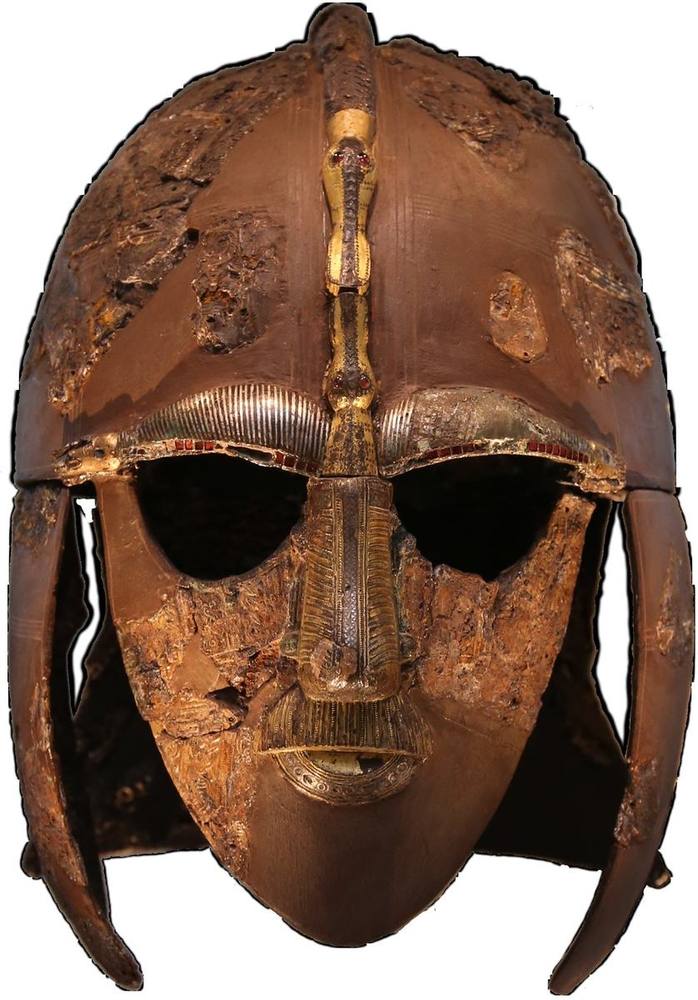
The most famous piece is a helmet, and it is also the best illustration of how archaeology works.
It was found in more than five hundred fragments. What stands in the British Museum today is an assembly – and the second one at that. The first reconstruction was made in 1945/46 under Herbert Maryon. Doubts grew through the 1960s, and Nigel Williams rebuilt it entirely in 1970/71. The present form is well argued, but it is an interpretation of broken pieces.
The helmet has a solid cap, cheek pieces, a neck guard and – most striking – a face mask. Nose, brows and moustache together form the shape of a flying bird or dragon: the nose is the body, the brows are the wings, and above sits an animal head. Anyone looking at the wearer's face was looking at a beast as well.
The cap was covered with tinned bronze panels carrying stamped figural scenes: two dancing warriors with crossed spears and horned headgear, and a rider leaping over a fallen enemy who stabs upward from below.
Anglo-Saxon helmets are extremely rare – only a handful are known from the whole of England. This one's closest relatives are not in England but in Sweden.
In Uppland, north of Stockholm, lie the boat-grave cemeteries of Vendel and Valsgärde. They date from the sixth to the eighth century – partly contemporary with Sutton Hoo, partly later.
The correspondences are striking: helmets with caps and stamped panels, the same manner of figural scene, shield mounts with bird-of-prey and dragon motifs, boat burial as a form. Many specialists regard the Sutton Hoo shield as Swedish work, or as work made to a Swedish model.
What that means is open. Some see a dynastic link between the East Anglian royal family and Scandinavia; others simply a shared formal world among the elites around the North Sea – the same fashion, the same workshop traditions, and no proof of kinship.
All that is certain: these people knew one another. More on the grave form in our article on boat burial.
The burial chamber was full, and almost every piece points in a different direction.
The great gold buckle weighs 412 grams and is covered across its whole surface with interlaced animal ornament, picked out in niello. It is hollow and can be opened – for what purpose, nobody knows.
The shoulder clasps are goldsmith's work of the highest order: hundreds of individually cut garnets set in cloisonné, with millefiori glass between them and interlocking boars in the fields. The garnets most probably came from India or Sri Lanka.
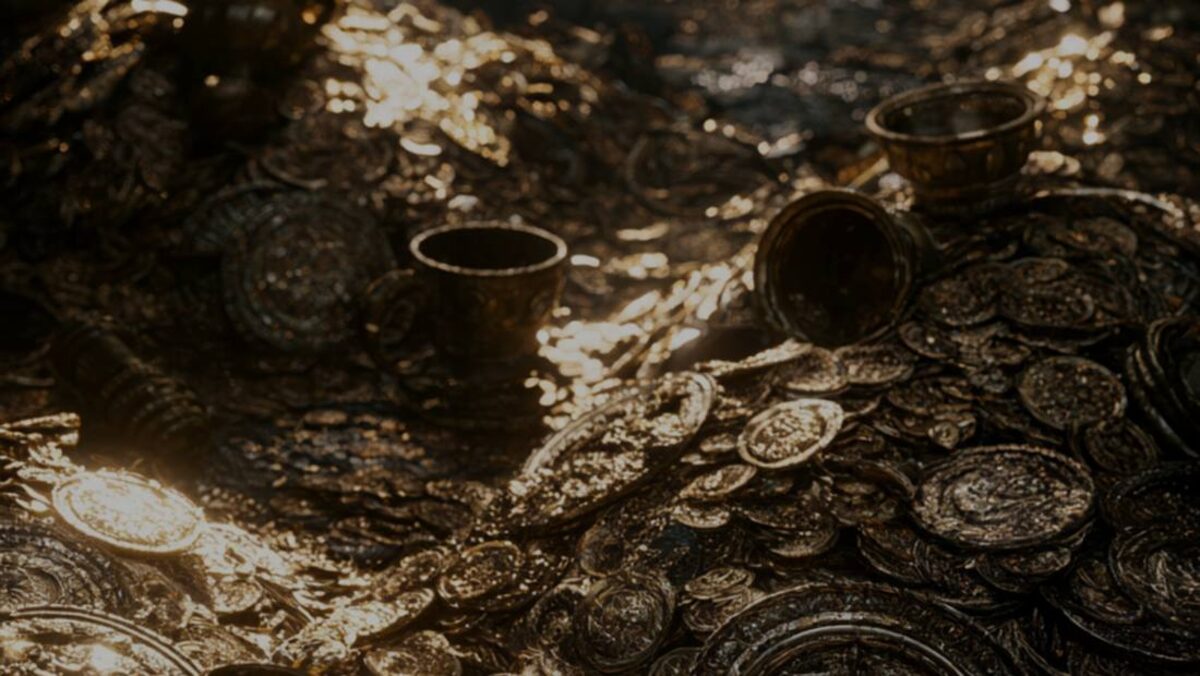
The purse lid held 37 Merovingian gold coins, together with three blanks and two small ingots. Those coins supply the date: their striking reaches into the first half of the seventh century, and the deposition is usually placed around 620 to 625. The numismatic dating has been revised more than once over the decades – it should be read as a range, not a year.
Beyond that a stone sceptre with carved faces and a bronze stag on its top; an iron stand read as a standard; the remains of a lyre; drinking horns with silver mounts.
And finally the silver, which had travelled furthest: a large silver dish with the control stamps of the Eastern Roman emperor Anastasius (reigned 491–518), already more than a century old at the time of burial; a nest of silver bowls; and two silver spoons with Greek inscriptions, SAULOS and PAULOS.
The spoons are often read as a baptismal gift – Saul becoming Paul. The reading of the first name is disputed, however; a miscut second Paulos is equally possible.
No body was found. For a long time that supported the idea of a cenotaph, an empty memorial grave.
Phosphate analyses in the 1960s produced raised values in the area between the grave goods – an indication that a body had been present and had dissolved entirely in the acid sand. The arrangement of the objects fits: they lie as they would have lain around a corpse.
The most frequently named candidate is Rædwald, king of East Anglia, who died around 624/625. In his favour: the date, the rank of the equipment, and a remark by Bede, that Rædwald kept two altars in one temple – one for Christ and one for the old gods. That suits a grave in which Christian spoons lie beside a heathen ship burial.
Except that nothing in this grave names a name. No stone, no inscription, no coin portrait. Rædwald is the best guess, not the answer.
Hardly any find is brought together with a poem as often as this one.
Beowulf opens with a ship burial: Scyld Scefing is laid out loaded with treasure and set upon the water, and the poet says no one knows who received that cargo. Later in the poem a hero is buried under a mound by the sea, with gold that will serve nobody. Add to that helmets with boar crests, ring-givers and mead halls – much of what Sutton Hoo shows in the ground.
The temptation to couple the two is strong. It should be resisted, at least in part.
The problem is the dating. The only manuscript of Beowulf dates from around the year 1000. When the poem was composed is one of the most fiercely argued questions in Old English studies – proposals run from the eighth to the eleventh century. If the poem is late, it describes a past it knew only from stories.
What can be said: Sutton Hoo and Beowulf describe the same world – an aristocratic culture between England and Scandinavia in which ships, gold and retinue belong together. What cannot be said: that either one proves the other.
Sutton Hoo is not a single grave but a cemetery, and the later excavations widened the picture.
Mound 2 also held a ship burial, but had been cleared out in the nineteenth century. Mound 17, found undisturbed in 1991, held a young man with sword and equipment – and beside him, in a pit of its own, his horse with its harness.
Along the eastern edge lies a group of graves of an entirely different kind: sand bodies, stains in unusual postures, some without heads. They are read as an execution site and belong to a considerably later period, when the place was no longer a royal cemetery but a place of judgement.
The same ground, two centuries apart, two completely different meanings.
"A Viking grave." No – and by roughly two hundred years. Sutton Hoo is Anglo-Saxon and dates to the early seventh century. The first Viking raid on England, at Lindisfarne, falls in 793. Boat burial is a shared north European tradition, not a Viking-Age invention.
"That is what the helmet looked like." Roughly. A helmet was built twice out of five hundred fragments, and the second version contradicts the first on essential points. Anyone looking at the replicas in the museum shop is looking at the state of research in 1971.
"The Dark Ages were poor and cut off." A grave in Suffolk held Byzantine silver, Merovingian gold, Indian garnets and jewellery made to a Swedish model. The term "dark ages" describes the state of the sources, not the state of the age.
Sutton Hoo pulled an era out of the dark for which written sources barely exist. It shows craftsmanship at a level nobody had credited to seventh-century England, and connections across half a continent.
And it shows something that concerns us with every motif: much of what we think we see is reconstruction. The ship is an impression. The helmet is assembled. The dead man is an inference. That does not weaken the find – it only has to be said out loud.
Read more with us: Boat burial · Hedeby · Burial · Runes
For courage. For remembrance. For legends that live on.
All History & Finds articles →
Some Vikings raided, others had Danegeld paid to them – Sweyn Forkbeard did both and then reached for the crown itself …
Read more →The Vikings had no central state power. Law and politics arose at the assembly of free people – the Thing.
Read more →A handle that turned out too short, a fly at the bellows and over a thousand silver amulets in the earth: Thor's hammer …
Read more →A king raises a stone for his wife and calls her on it “Denmark's adornment.” A son sets both parents an even greater …
Read more →