Our most comprehensive work in one volume: the three great runic rows with real runes, examples, a comparison table, famous finds, exercises and an honest separation of evidence from myth.
Runes fascinate – and few writing systems carry more myth. This book wants both: to show the beauty and depth of the old signs, and to separate honestly what is historically attested from what was added later.
Its heart is the Elder Futhark, the oldest runic row of the Germanic peoples; but the Viking-Age Younger Futhark and the Anglo-Saxon Futhorc are given full voice too. Where names, sound values or meanings are uncertain, we say so – not a flaw, but honesty.
Rune-poem quotations follow public-domain sources. The runes are set in the Unicode runic block. May this book be a faithful companion – by the hearth and at the workbench alike.
Runes are not dead knowledge. They come from an age when every sign was cut by hand into stone, wood and bone – lasting, personal, meaningful. That same idea lives on in a good engraving: a name, a saying, a mark that stays. This book gives you the knowledge to understand runes, not merely to decorate with them.
A rune is first a letter with a sound value. At the same time nearly every rune carries a name beginning with its own sound (acrophony): *fehu for f, *īsaz for i. These names are the bridge between writing and meaning.
The Elder Futhark is divided into three groups of eight, each an ‘ætt’ (Old Norse ‘family, group’). This threefold division is ancient, attested on the Vadstena and Grumpan bracteates (c. 500).
The Vimose comb bears just one word: harja. Whether name, people or warrior-cry is still unclear – yet it proves that as early as c. 160 CE people entrusted runes to everyday objects. A comb inscription, not a heroic lay: that is how humbly runic writing began.
Where runes come from is not fully settled. Most scholars derive them from a North Italic (Old Italic) alphabet, perhaps with Latin influence; about a dozen runes are of uncertain origin. The Negau helmet B (before the Common Era) bears an inscription in such an alphabet and is a landmark of the debate.
The oldest datable runes are on objects from bogs: the Vimose comb (c. 160 CE) with the word harja. Even these early forms are confident and mature – runes were in use earlier still. The ability to read them was later lost and only recovered in 1865 by Sophus Bugge.
For centuries no one could read runes. Only scholars like the Norwegian Sophus Bugge and the Dane Ludvig Wimmer decoded them in the 19th century – sign by sign, by comparing hundreds of inscriptions. What people had shunned as ‘magic marks’ became legible again. Today scholarship knows over 6,000 runic inscriptions.
Elder Futhark, Younger Futhark and Anglo-Saxon Futhorc are not three different scripts but three stages of one family. Knowing the differences lets you date an inscription almost at a glance.
Same sounds, different signs: where the Younger Futhark merges (k/g) and the Futhorc adds new vowels, the shift shows up row by row.
| Sound | Elder | Younger | Futhorc |
|---|---|---|---|
| f | ᚠ | ᚠ | ᚠ |
| u | ᚢ | ᚢ | ᚢ |
| þ / th | ᚦ | ᚦ | ᚦ |
| a | ᚨ | ᚬ | ᚪ |
| r | ᚱ | ᚱ | ᚱ |
| k | ᚲ | ᚴ | ᚳ |
| g | ᚷ | ᚴ | ᚷ |
| h | ᚺ | ᚼ | ᚻ |
| n | ᚾ | ᚾ | ᚾ |
| i | ᛁ | ᛁ | ᛁ |
| s | ᛊ | ᛋ | ᛋ |
| t | ᛏ | ᛏ | ᛏ |
| m | ᛗ | ᛘ | ᛗ |
| z / R | ᛉ | ᛦ | ᛉ |
The fourth rune shows the shift best: ansuz (a) in the Elder row becomes nasal a/o in the Younger and splits in the Futhorc into three signs – os (o), ac (a) and æsc (æ).
ᚨ → ᚬ → ᚩ ᚪ ᚫ
The row-name itself tells the tale: Fu-th-ark became Fu-th-orc.
The strangest twist in runic history: as Viking-Age speech grew more sounds, the script grew smaller – from 24 to 16 signs. One sign now had to stand for k and g, t and d, b and p at once. Reading became a matter of context. Why they cut it down is still unknown – perhaps the urge for fast, terse carving in a busy trading age.
Twelve waymarks from the first carvings to rediscovery – broad, with the usual scholarly ranges.
The Elder Futhark is ordered in three groups of eight, each an ætt. This division is old and attested on bracteates; it aided memory and secret writing – branch-runes point to ætt- and place-number.
ᚠ ᚢ ᚦ ᚨ ᚱ ᚲ ᚷ ᚹ
Fehu, Uruz, Þurisaz, Ansuz, Raido, Kaunan, Gebo, Wunjo. From wealth and primal force through danger and the god-word to gift and joy.
ᚺ ᚾ ᛁ ᛃ ᛇ ᛈ ᛉ ᛊ
Hagalaz, Naudiz, Isaz, Jera, Eihwaz, Perþ, Algiz, Sowilo. The row of natural forces and turns: hail, need, ice, good year, yew, protection, sun.
ᛏ ᛒ ᛖ ᛗ ᛚ ᛜ ᛞ ᛟ
Tiwaz, Berkanan, Ehwaz, Mannaz, Laguz, Ingwaz, Dagaz, Othala. From law and growth through man and water to day and inheritance.
24 runes · ~150–800 CE · the original row
The Elder Futhark is the oldest, pan-Germanic runic row. It is named after the sound values of its first six runes: f, u, þ, a, r, k.
Movable wealth – cattle were riches one must grow and share. The name is well secured (OE feoh).
The wild aurochs: raw, untamed strength. The name *ūruz is likely but not fully certain.
Giant or thorn – the name differs by tradition (OE þorn, Gothic þiuþ, ON þurs). Danger and warding force.
A god, one of the Æsir; in Old English reinterpreted as ós (mouth). Word, breath, divine inspiration.
Riding, journey, wagon – movement with direction and right measure.
In the North ulcer, in the OE poem cēn (torch). Both readings circulate; the Proto-Germanic form is uncertain.
The gift – giving and receiving, hospitality, alliance. The X-shape.
Joy and bliss (OE wynn).
Hail – the destructive grain-shower that melts to water. Early single-, later double-barred (ᚺ/ᚻ).
Need, constraint, want – yet wholesome to whoever meets it in time.
Ice – standstill, clarity, danger.
Good year and harvest – reward of patience. Source of English year.
The yew. Its sound value is disputed; only a front vowel is certain. Rare in early inscriptions.
Meaning unknown – OE peorð is itself obscure (dice-cup? fruit?). One of the least secure names.
Protection, often read elk or sedge; the original name is unknown. Value z (later ʀ), never word-initial.
The sun – victory, life-force. Also in the lightning form ᛋ.
The god Týr / *Tīwaz, also an old word for god. Attested stacked as a magical sign (Lindholm).
The birch – growth, new beginnings, protection of the home.
The horse – partnership of steed and rider (Lat. equus).
Man, humankind – community and mortality.
Water/lake – or leek (*laukaz), a word of healing and protection. Both readings are defended.
The god Ing/Yngvi(-Freyr). Value ŋ, never word-initial; unattested in the earliest inscriptions.
The day – light, turning point, clarity.
Ancestral property, homeland, inheritance – bond to kin and soil.
16 runes · ~800–1100 · the Viking Age
In the 8th century the row was cut from 24 to 16 runes – even as the language developed more sounds. The result: one sign must carry several values (k/g, t/d, b/p, i/e). Only the medieval dotted runes later distinguished them again.
Three main variants: long-branch (Danish, for stone), short-twig (Swedish-Norwegian, for wood/everyday) and the staveless Hälsinge runes. Around 3,000 runestones survive from the Viking Age, densest in Uppland.
Wealth is a source of discord among kinsmen – the wolf lives in the forest.
Norwegian Rune Poem: Fé vældr frænda róge; føðesk ulfr í skóge
Dross from bad iron / weeping of the clouds. One sign, many vowels.
Norwegian Rune Poem: Úr er af illu jarne; opt løypr ræinn á hjarne
The giant torments women; misfortune makes few men glad.
Norwegian Rune Poem: Þurs vældr kvinna kvillu; kátr værðr fár af illu
Estuary is the way of most journeys – in the Icelandic poem aged Gautr (Odin).
Norwegian Rune Poem: Óss er flæstra færða för; en skalpr er sværða
Riding is said worst for horses; Reginn forged the finest sword.
Norwegian Rune Poem: Ræið kveða rossom væsta; Reginn sló sværðet bæzta
One sign for k and g. Ulcer is fatal to children.
Norwegian Rune Poem: Kaun er barna bölvan; böl gørver nán fölvan
Hail is the coldest grain; Christ shaped the world of old.
Norwegian Rune Poem: Hagall er kaldastr korna; Kristr skóp hæimenn forna
Constraint gives scant choice; a naked man is chilled by the frost.
Norwegian Rune Poem: Nauðr gerer næppa koste; nøktan kælr í froste
Ice, the broad bridge; the blind must be led. Stands for i and e.
Norwegian Rune Poem: Ís köllum brú bræiða; blindan þarf at læiða
Plenty is a boon to men; generous, they say, was Fróði.
Norwegian Rune Poem: Ár er gumna góðe; örr var Fróðe
Sun is the light of the lands; I bow to the holy doom.
Norwegian Rune Poem: Sól er landa ljóme; lúti ek helgum dóme
Týr, the one-handed god; often the smith must blow. Stands for t and d.
Norwegian Rune Poem: Týr er æinendr ása; opt værðr smiðr blása
Birch, greenest-leaved of shrubs; Loki was lucky in deceit. Stands for b and p.
Norwegian Rune Poem: Bjarkan er laufgrønstr líma; Loki bar flærða tíma
Man is augmentation of the earth; great is the hawk's claw.
Norwegian Rune Poem: Maðr er moldar auki; mikil er græip á hauki
Water, the torrent from the mountain; yet ornaments are of gold.
Norwegian Rune Poem: Lögr er fælr ór fjalle foss; en gull ero nosser
Yew, greenest of woods in winter; it crackles when it burns. Value ʀ (old z), mostly word-final.
Norwegian Rune Poem: Ýr er vetrgrønstr viða; vænt er, er brennr, at sviða
~26–33 runes · 5th–11th c. · England & Frisia
In England and Frisia the Elder Futhark grew to fit the sounds of Old English. From the a-rune (ansuz) came three signs (os, ac, æsc); further runes were added. The very name shows the sound shift: Futhark became Futhorc (a→o).
Four further runes – calc, gar, cweorð, stan – stand without a stanza; cweorð and stan are manuscript-only signs. The total is not fixed (28/29/31/33).
Wealth is a comfort to all men; yet each must bestow it freely, would he gain honour before the Lord.
OE Rune Poem: Feoh byþ frofur fira gehwylcum
The aurochs is proud and great-horned, a savage beast that fights with its horns, a ranger of the moors.
OE Rune Poem: Ur byþ anmod ond oferhyrned
The thorn is exceedingly sharp, an evil thing to touch, severe to all who rest among them.
OE Rune Poem: Ðorn byþ ðearle scearp
Os is the source of all language, a pillar of wisdom (OE mouth; perhaps Latin os).
OE Rune Poem: Os byþ ordfruma ælere spræce
Riding seems easy indoors, and very bold to him who rides the highroads on a stout horse.
OE Rune Poem: Rad byþ on recyde rinca gehwylcum
The torch is known to every living man by its bright flame; it burns where princes sit within.
OE Rune Poem: Cen byþ cwicera gehwam, cuþ on fyre
Generosity brings credit and honour; it gives help and subsistence to all broken men.
OE Rune Poem: Gyfu gumena byþ gleng and herenys
Bliss he enjoys who knows little woe, and has prosperity and a good house.
OE Rune Poem: Wenne bruceþ, ðe can weana lyt
Hail is the whitest grain; whirled from heaven, tossed by wind, it melts into water.
OE Rune Poem: Hægl byþ hwitust corna
Trouble oppresses the heart; yet often it becomes help to those who heed it in time.
OE Rune Poem: Nyd byþ nearu on breostan
Ice is very cold and slippery, glistening like glass and gems, a floor wrought by frost.
OE Rune Poem: Is byþ ofereald, ungemetum slidor
Summer is a joy to men, when God lets the earth bring forth shining fruits.
OE Rune Poem: Ger byþ gumena hiht
The yew has rough bark, hard and fast in the earth, a guardian of flame, a joy at home.
OE Rune Poem: Eoh byþ utan unsmeþe treow
Peorth is play and laughter of the proud in the beer-hall. Meaning disputed.
OE Rune Poem: Peorð byþ symble plega and hlehter
The elk-sedge grows in the fen, wounds grimly, covers with blood whoever grasps it.
OE Rune Poem: Eolh-secg eard hæfþ oftust on fenne
The sun is the seafarers' hope, until the sea-steed bears them to land.
OE Rune Poem: Sigel semannum symble biþ on hihte
Tiw is a guiding star, keeps faith with princes, ever on its course above night's mists.
OE Rune Poem: Tir biþ tacna sum
The poplar bears no fruit, yet without seed it brings forth shoots – high and fair its crown.
OE Rune Poem: Beorc byþ bleda leas
The horse is a joy to princes, proud of hoof, a comfort to the restless.
OE Rune Poem: Eh byþ for eorlum æþelinga wyn
The joyous man is dear to kin – yet every man must one day fail his fellow.
OE Rune Poem: Man byþ on myrgþe his magan leof
The sea seems endless, when men dare the rolling boat and the waves dismay them.
OE Rune Poem: Lagu byþ leodum langsum geþuht
Ing was first seen among the East-Danes, then went eastwards over the waves.
OE Rune Poem: Ing wæs ærest mid East-Denum
Home is dear to every man, can he there in right and plenty dwell.
OE Rune Poem: Eþel byþ oferleof æghwylcum men
Day, the Creator's light, is dear to men, hope for rich and poor.
OE Rune Poem: Dæg byþ drihtnes sond
The oak fattens the swine; often it sails the sea – which tests the oak's faith.
OE Rune Poem: Ac byþ on eorþan elda bearnum
The ash is exceedingly high, precious to men, firm in trunk though many attack it.
OE Rune Poem: Æsc biþ oferheah, eldum dyre
Yr is joy and honour to every noble, fair on a horse, reliable on a journey – war-gear (a bow?).
OE Rune Poem: Yr byþ æþelinga and eorla gehwæs
Iar is a river-fish, yet feeds on land; a fair abode, encompassed by water.
OE Rune Poem: Iar byþ eafix
The grave is horrible to all, when the flesh grows cold and the pale earth becomes its bed.
OE Rune Poem: Ear byþ egle eorla gehwylcun
Runes are not theory – they stand on stone, bone, gold and wood. A selection of the key witnesses, with dating and significance.
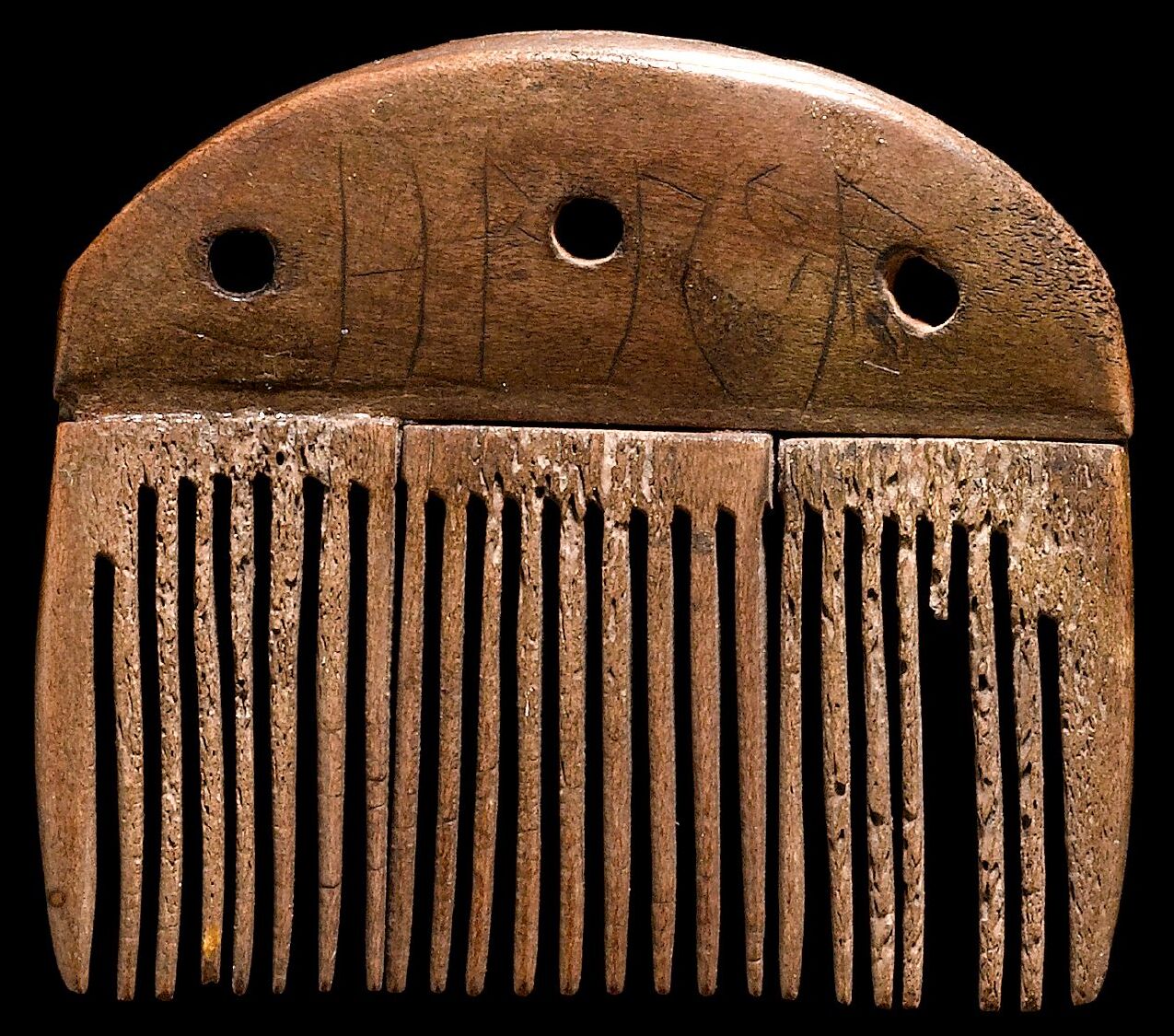
Bears the word harja – the oldest datable runic inscription. Already confident in form: runes were in use before.
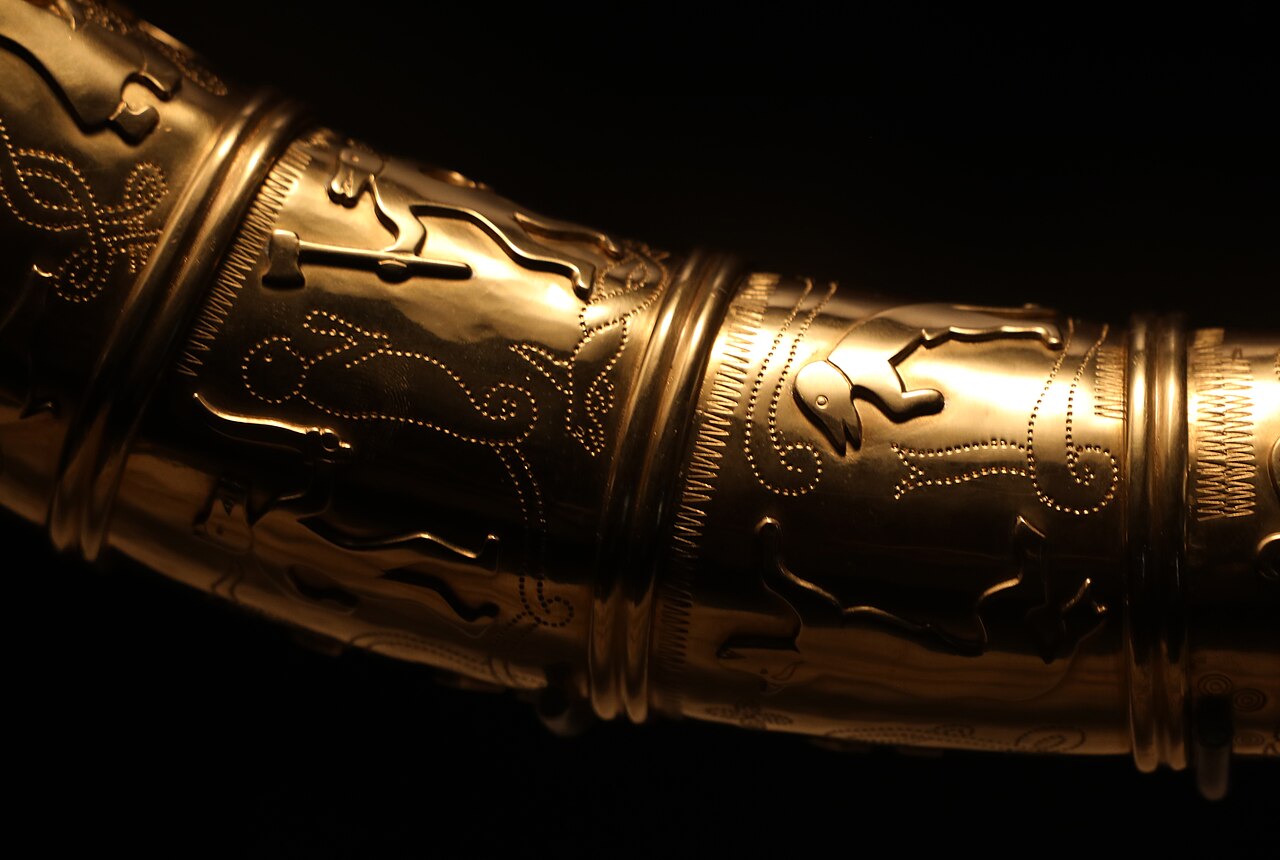
ek hlewagastiz holtijaz horna tawido – I, Hlewagast, [son] of Holt, made the horn. First full sentence, alliterative. The originals were melted down in 1802; the text survives only in old drawings.
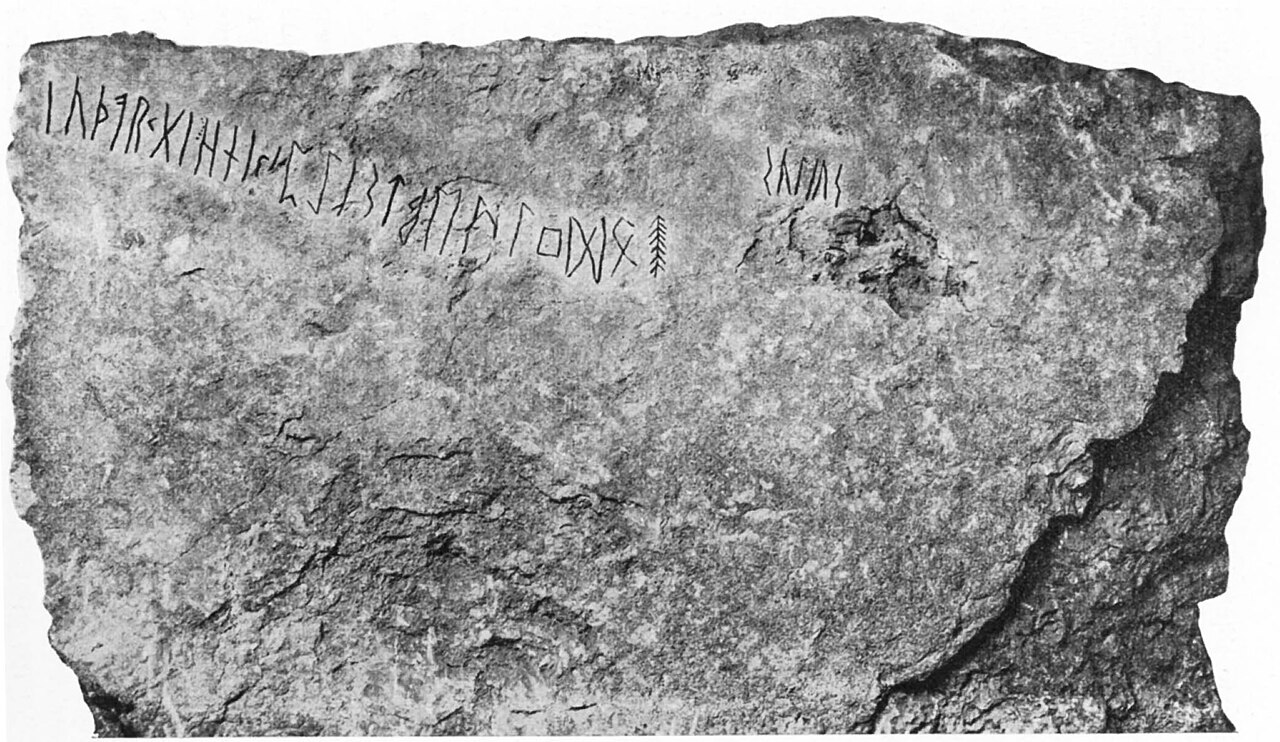
The oldest complete Futhark row (all 24), followed by the palindrome sueus and a stacked Týr-rune – often read as a magical sign.
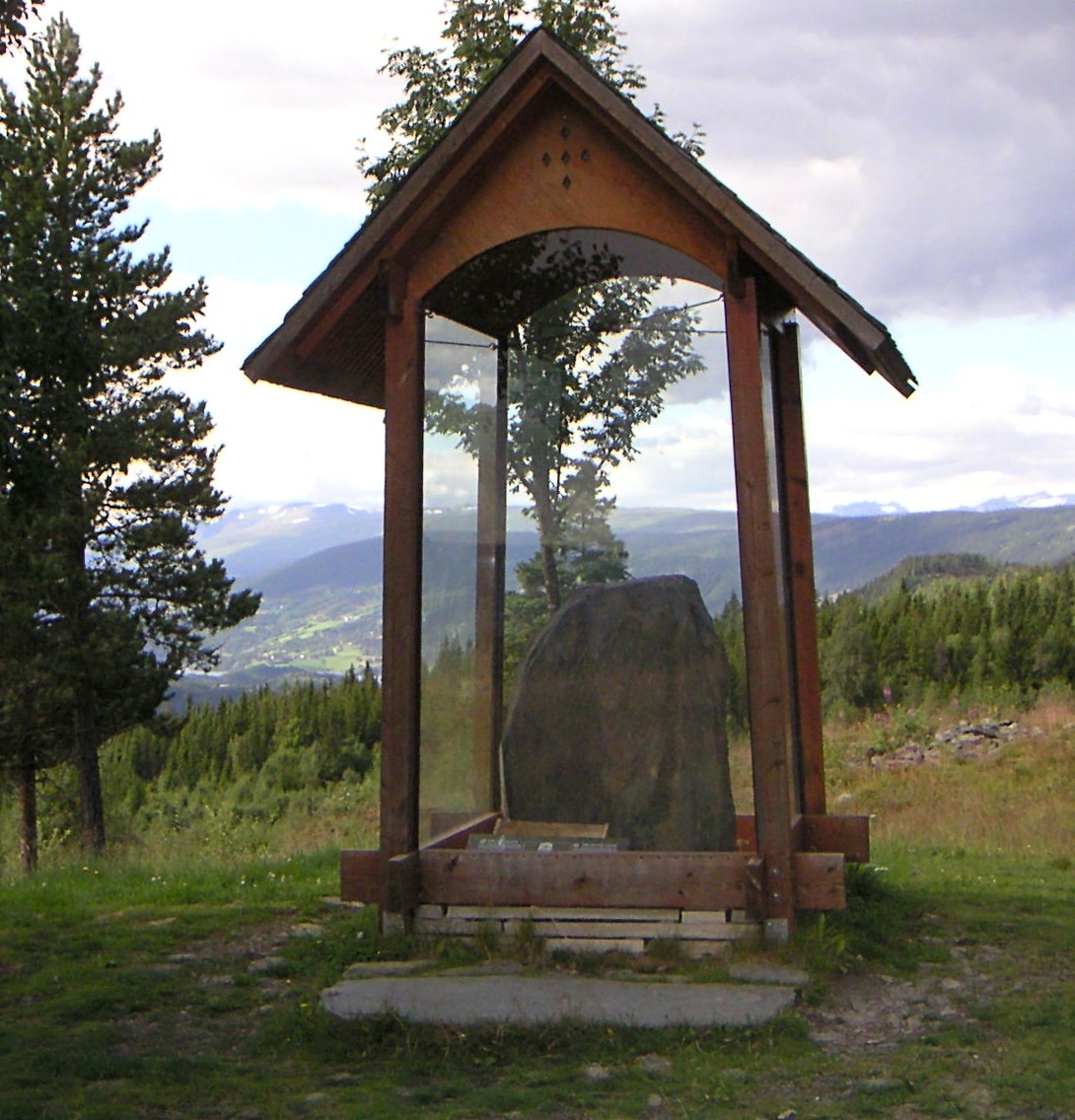
…faihido – painted the rune. The oldest runestone still in place; runes were originally coloured.
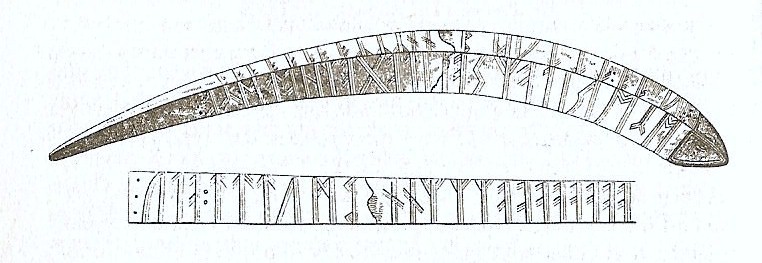
ek erilaz… – a rune-master names himself; plus a magical formula ending in alu, with eight Ansuz and three Tiwaz runes (disputed).
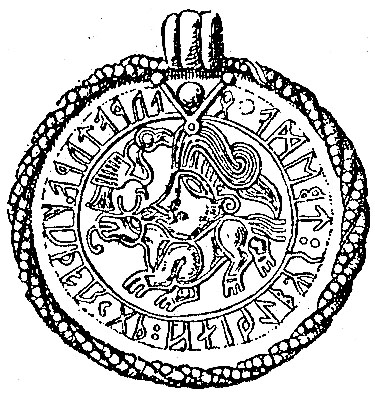
Best early evidence of the threefold ætt division (separated by dots). Proves the division – not the deity-names.
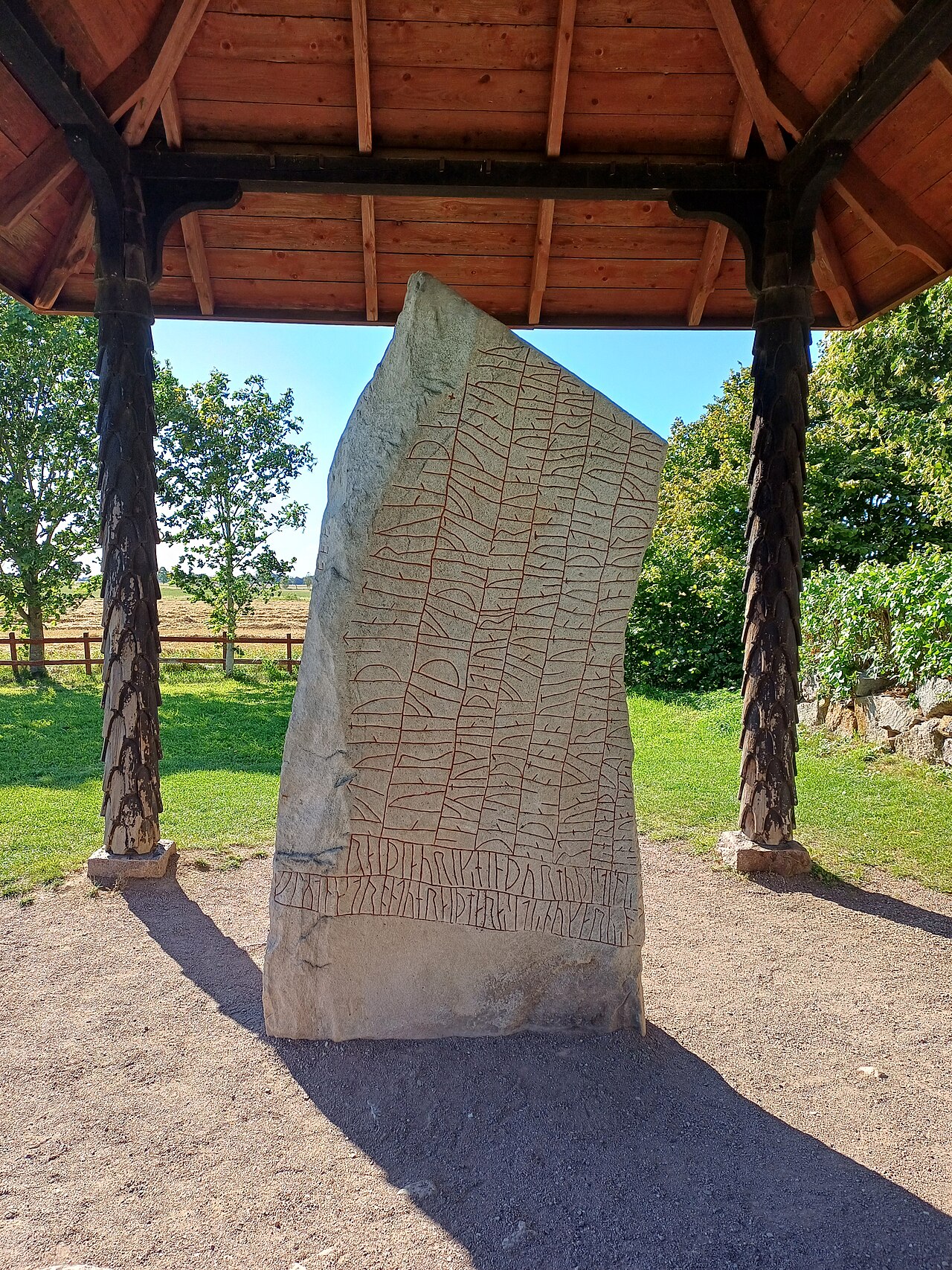
The longest known runic inscription (~700 characters). Dense with heroic allusion; its meaning is debated to this day.
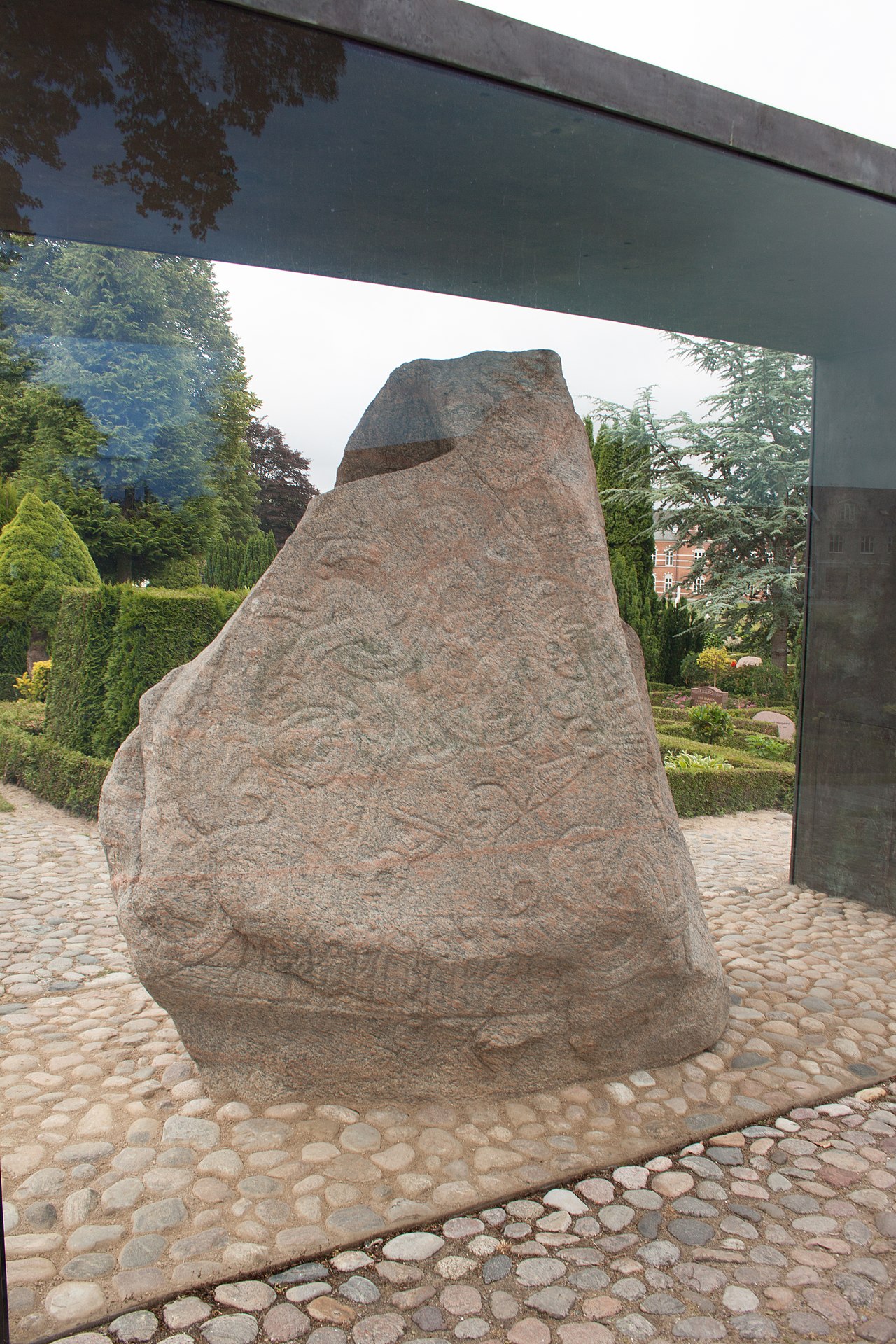
Harald Bluetooth commemorates his parents and boasts of having made the Danes Christian. Denmark's birth certificate; UNESCO site.
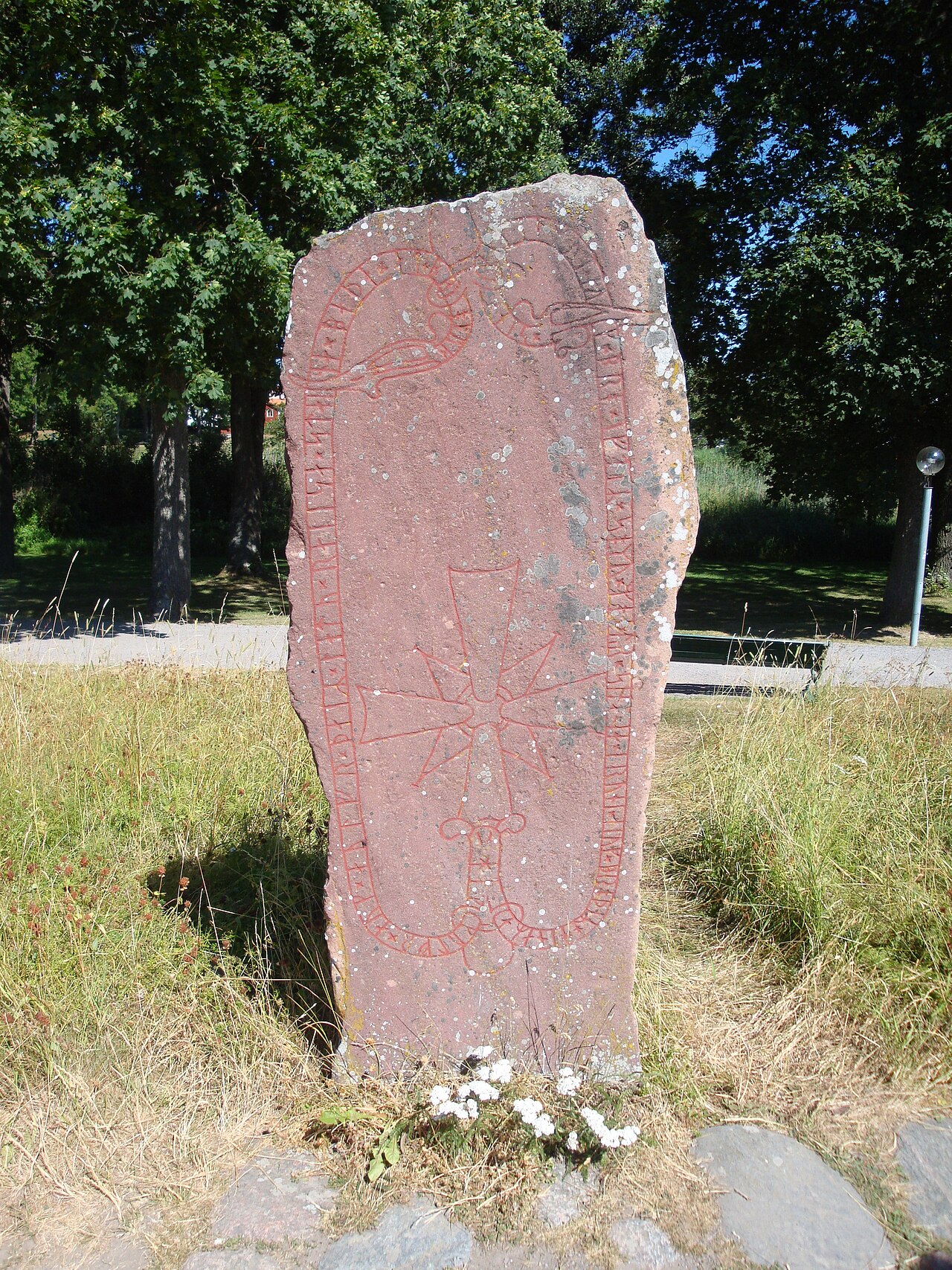
An Ingvar stone: …they died in the south in Serkland. A witness to the ill-fated Ingvar expedition east.
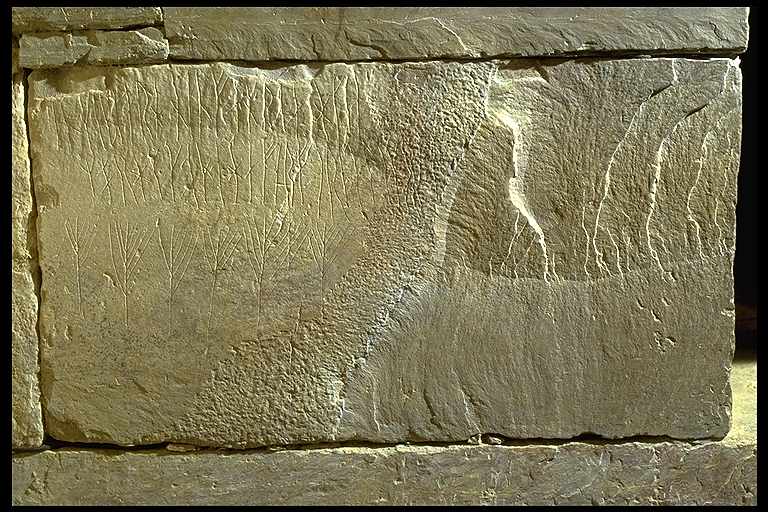
Some 30 Viking graffiti inside a Stone-Age tomb – boasts of treasure, women and travel. Everyday runes at their most human.
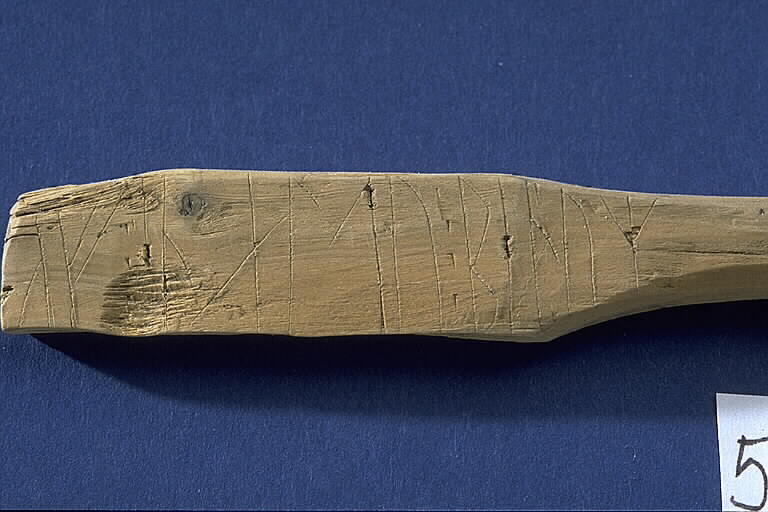
Hundreds of rune-sticks: business notes, name-tags, love messages. Proof that runes were ordinary everyday writing.
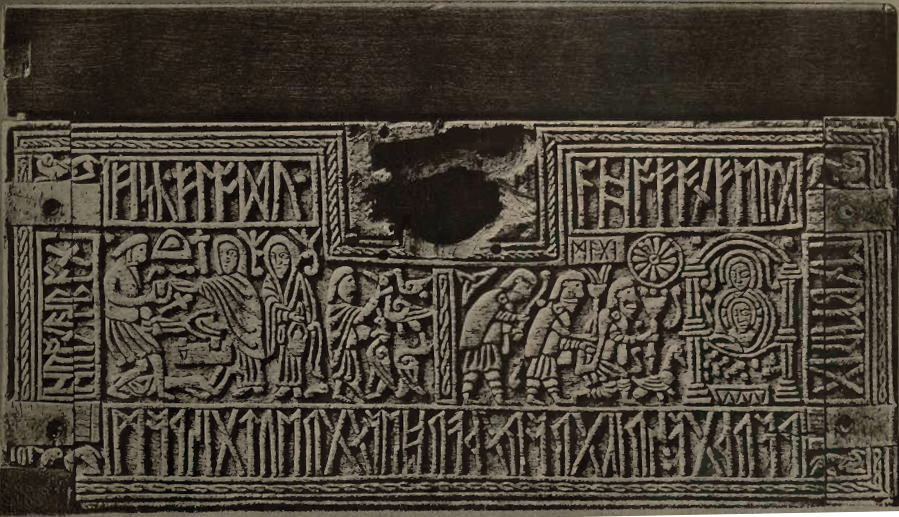
Whalebone chest with runes and Latin; scenes from Weland the Smith to the Magi – pagan, Roman and Christian at once.

An iron knife bearing the only complete 28-rune futhorc on a single object – plus the name Beagnoth.
Inscription in a North Italic alphabet – a central piece in the debate over the origin of runes.
The earliest Anglo-Saxon runic inscription; its image adapts a Roman coin (wolf with Romulus & Remus).
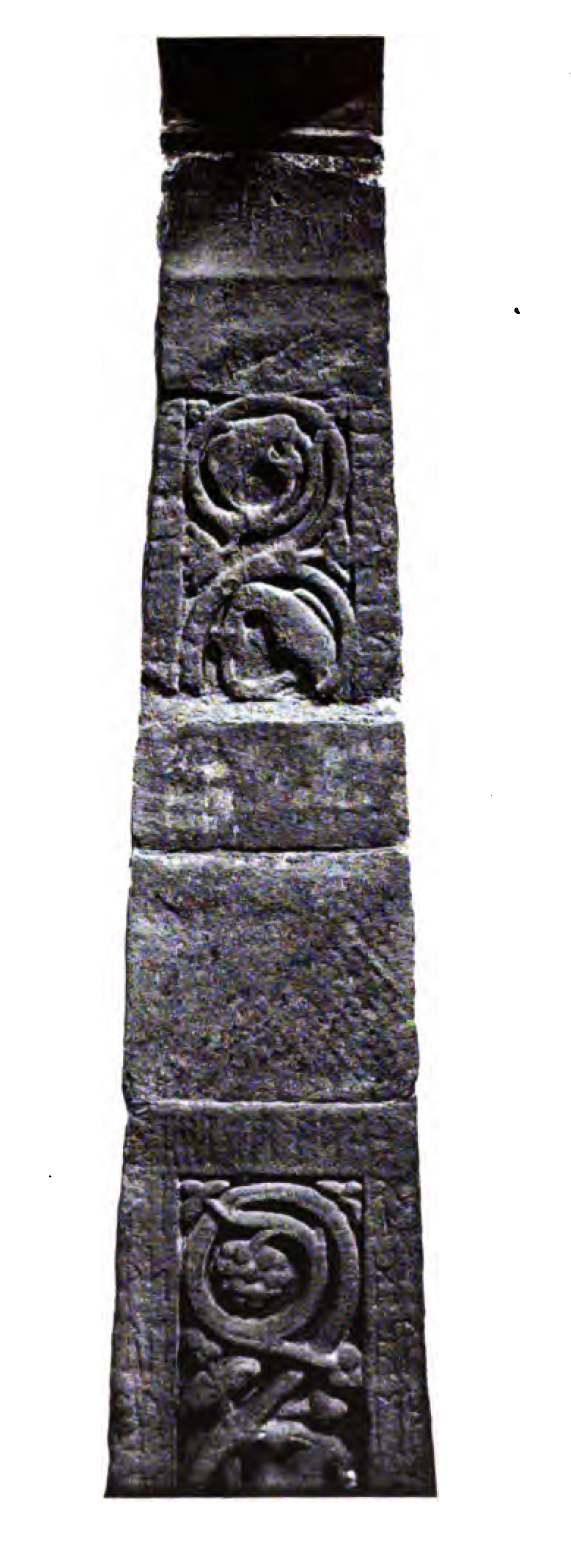
Stone cross bearing runic verses of the Dream of the Rood; carries the special runes calc & gar.
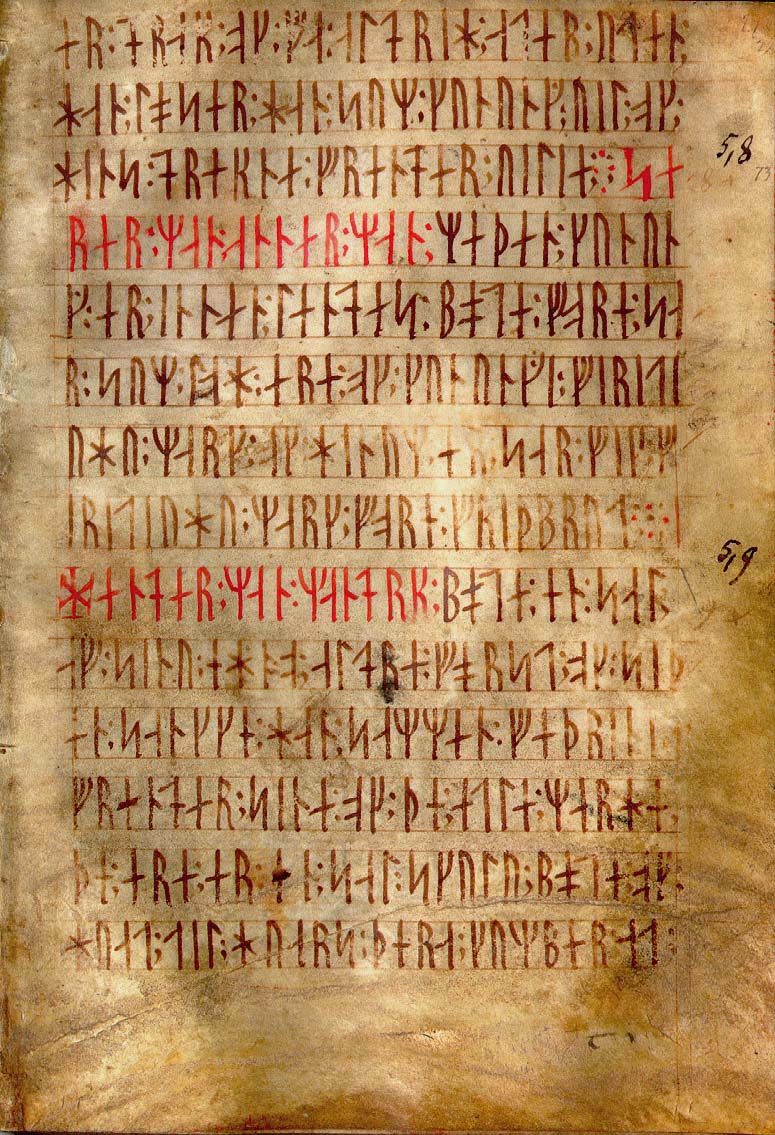
An entire manuscript (the Scanian Law) written in runes – proof that runes served even for long books.
Runes are written by sound, not by the modern alphabet. There are no own signs for c, q, x – use k, kw, ks. Long and doubled sounds were often carved only once. Word dividers are dots (·) or colons (:).
To engrave a name you transcribe it sound by sound. An example in the Elder Futhark:
ᚷᛚᚨᚾᛉ · ᚢᚾᛞ · ᚷᚱᚨᚢᚱ
Glanz und Gravur in the Elder Futhark (v written with the u-rune).
For Viking-Age Old Norse names use the Younger Futhark – there one sign often carries several values. Never mix two rows in one word if you want it to look authentic.
Two sounds can elegantly share one stave – fine for monograms and initials. Attested already in antiquity (Gallehus, bracteates).
Runes were writing – but they also stood in ritual use. On bracteates and amulets enigmatic words recur: alu, laukaz, laþu. Their meaning is uncertain; they are read as formulas of protection, thriving or consecration.
This myth explains why runes were held sacred: Odin wins them through pain and sacrifice. But it implies no fixed oracle system – historical use remained writing, memorial and single magic words.
Early on we meet the title erilaz – a rune-skilled master who names himself on stone and amulet (Lindholm: ek erilaz…).
A good rune book separates evidence from embellishment. Three points often confused:
There is no historical evidence that the Elder Futhark was used as a fixed 24-card oracle. Inscriptions are mostly names, maker-formulas, memorials and short (sometimes magical) words. The popular rune meanings (Fehu = abundance, etc.) are 20th-century systematizations. The old word-meanings (cattle, hail, ice) are scholarly; the oracular meanings are a modern overlay.
A row of 18 pseudo-runes seen in a vision by the occultist Guido von List. Modern invention, not a historical alphabet; loosely tied to the 18 charms of the Hávamál, and later fed into völkisch and Nazi-era symbolism.
The blank 25th rune (Wyrd, Odin) was introduced in Ralph Blum’s The Book of Runes (1982). It has no ancient precedent. Many modern rune sets include it only because of that book.
Runes never wholly vanished. In Dalarna (Sweden) they survived as Dalecarlian runes into the 19th century. And they reappear in surprising places:
The Bluetooth logo is a bind-rune of the Younger runes ᚼ (Hagall) and ᛒ (Bjarkan) – the initials of Harald Bluetooth (Blåtand), who once united Danish tribes. The wireless technology unites devices – hence the name.
J. R. R. Tolkien used real Anglo-Saxon runes in The Hobbit, but invented his own signs (Cirth/Angerthas) for The Lord of the Rings. These are fiction, not a historical alphabet.
Most Viking-Age stones follow a fixed memorial formula. Know the pattern and the same building-blocks jump out – even before you read a single rune.
A typical example, in sense, in the Uppland style:
“Gunnarr and Holmgeirr had the stone raised after Sveinn, their father. May God help his soul.”
The closing Christian prayer is standard on many late stones – a fine witness to how runes and the new faith met.
Runes are made for hard materials. Their angular, slanting shapes arose because they were cut across the wood grain – horizontal lines would vanish in the grain. That is why no rune has purely horizontal strokes.
In our workshop the laser takes the place of knife and chisel: we engrave runes and motifs into slate, teak, wood discs and glass. The principle stays the same – a lasting sign in a lasting material.
No. Runes are Germanic. The Celts wrote, where at all, in Ogham or the Latin alphabet. Runes and Ogham are unrelated.
These terms (for Algiz upright and inverted) come from the 20th century, not the runic age. Historically the sign is *algiz, probably meaning ‘protection / elk-sedge’.
Runes stood in ritual use (amulets, formulas like alu), but they were writing first. No fixed spell- or card-system is attested.
The threefold division is old; the names ‘Freyr’s, Heimdall’s, Týr’s ætt’ are a modern mnemonic.
The Anglo-Saxon Rune Poem (preserved through George Hickes, 1705) describes each rune in a short stanza. A selection in Bruce Dickins’ public-domain translation (1915):
“Wealth is a comfort to all; yet must every man bestow it freely, if he wish to gain honour in the sight of the Lord.”
“The aurochs is proud and has great horns; it is a very savage beast and fights with its horns, a great ranger of the moors.”
“The thorn is exceedingly sharp, an evil thing for any knight to touch, uncommonly severe on all who sit among them.”
“The mouth is the source of all language, a pillar of wisdom and a comfort to wise men.”
“Riding seems easy to every warrior while he is indoors, and very courageous to him who traverses the high-roads on a stout horse.”
“The torch is known to every living man by its pale, bright flame; it always burns where princes sit within.”
The Younger Futhark had only 16 signs for ever more sounds. In the Middle Ages a dot came to the rescue: a set point told voiced from voiceless – the stungnar rúnir, the ‘dotted runes’.
Thus a nearly complete alphabet returned. Medieval runes long stood beside the Latin script; the Codex Runicus (~1300) even writes a whole law-book in runes.
Here is how to transcribe a name into the Elder Futhark – sound by sound, not letter by letter. There are no own runes for c, q, x: use k, kw, ks.
ᚨ ᛒ ᚲ ᛞ ᛖ ᚠ ᚷ ᚺ ᛁ ᛃ
a b c/k d e f g h i j
ᚲ ᛚ ᛗ ᚾ ᛟ ᛈ ᚱ ᛊ ᛏ ᚢ
k l m n o p r s t u
ᚹ ᚲᛊ ᛃ ᛉ ᚦ ᛜ
v/w x→ks y→j z þ (th) ng
Doubled sounds are often carved only once. For Viking-Age Old Norse names use the Younger Futhark – there one sign carries several sounds.
Runes are written by sound, not by the alphabet. Transcribe each sound; for c, q, x use k, kw, ks; carve doubled sounds only once.
Example — the name Erik, sound by sound (e-r-i-k):
ᛖ ᚱ ᛁ ᚲ
Erik in the Elder Futhark
Now you: say your name slowly, write the sounds, and place the runes beneath. The overview plate on page 11 is your cheat-sheet.
(in the PDF: lines to write on)
Six short words in the Elder Futhark. Transcribe rune by rune into letters. Solutions are below — try first!
The word alu (no. 7) is among the most common of all runic words. It appears on bracteates and amulets across northern Europe; its exact meaning is uncertain, read as a formula of protection, consecration or thriving. Perhaps the oldest Germanic ‘good-luck’ word.
A few signs reveal the row. Rule of thumb: 24 runes = Elder Futhark; only 16 = Younger (Viking Age); with os/ac/æsc = Anglo-Saxon. Which line is which?
Archaeologists often date an inscription from a few signs: the nasal óss-rune ᚬ points to the Viking Age; os, ac and æsc place you in England. From a handful of strokes, scholars read whole centuries.
Every rune is built from an upright stave and slanting branches. Horizontal lines are almost always missing: cut across the wood grain they would barely have shown.
ᚠ
Stave (vertical) + branches (slanting) – no horizontal lines
A bind-rune (Old Norse / Icelandic bandrún) joins two – rarely three – runes into a single sign, usually sharing one upright stave. It is attested already in the Migration Period and common in the Middle Ages; in the Viking Age, however, it is rare.
Here is how it forms: you set the branches of one rune on the left, those of the other on the right of a shared stave.
ᚠ + ᚦ
Construction: Fehu and Þurisaz share one stave.
The normal bind-rune joins adjacent runes on one stave (e.g. a doubled d in the name Hadda). The same-stave rune (samstavruna) instead strings several runes along a single long stem-line – typical of Scandinavia, unknown in Anglo-Saxon. On stones this line even becomes part of the picture: a ship's mast (Sö 158, Sö 352) or a wave beneath a ship (DR 220).
This is exactly what makes bind-runes appealing for an engraving: two initials sharing a stave make an unmistakable mark. Take two runes with an upright stave – say Tiwaz and Raido – and let their branches point left and right. A monogram that looks a thousand years old and is entirely your own.
Futhark / Futhorc – Name of the runic row after its first sounds (f-u-þ-a-r-k / f-u-þ-o-r-c).
Ætt – One of the three groups of eight in a runic row (Old Norse ‘family, group’).
Acrophony – The rune-name begins with its sound value (*fehu → f).
Bind-rune – Two or more runes sharing a single stave.
Boustrophedon – Writing that alternates direction line by line.
Bracteate – A thin, single-sided stamped gold disc; often runic.
Erilaz – An early title for a rune-skilled master.
Stungnar rúnir – Medieval dotted runes for finer sound distinction.
alu / laukaz / laþu – Recurring, probably magical words of uncertain meaning.
