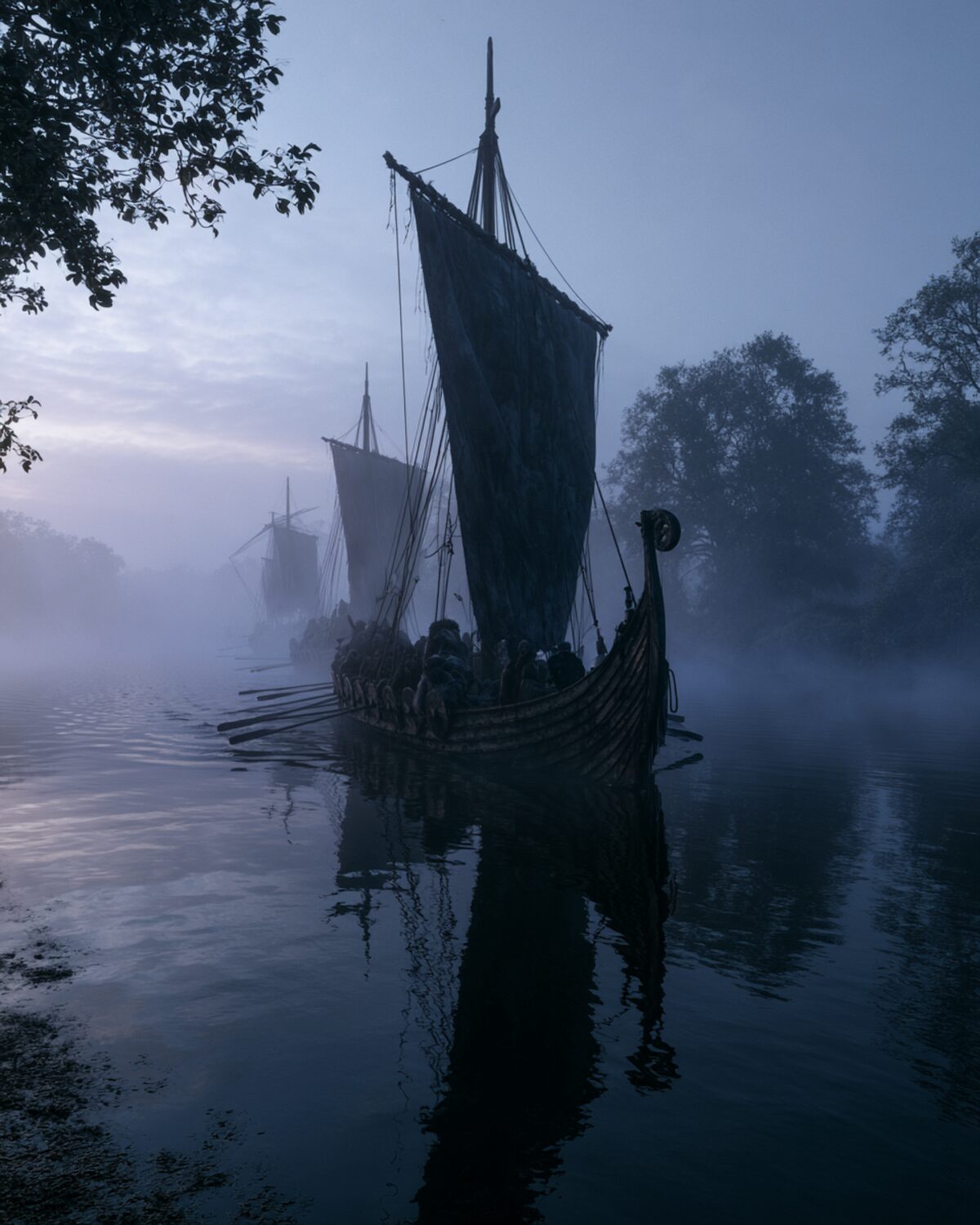
A Viking longship was a long, narrow, clinker-built warship that could be both sailed and rowed and carried up to a hundred fighting men; the largest excavated examples measure about 30 to 37 metres. Here you will find what Norse speakers called their ships, what Skuldelev 2, Roskilde 6 and Hedeby 1 reveal, how fast reconstructions really are, what lies behind the famous dragon heads, and why Olaf Tryggvason's Long Serpent still looms so large.
Picture a summer morning at a river mouth somewhere in England or Frisia. Mist on the water, then a sound you cannot quite place: dozens of oar blades dipping at once. A few minutes later a long, dark hull grinds onto the beach and sixty men vault over the side. That moment is what the Viking longship was made for. Not cargo, not comfortable crossings, but speed, surprise and as many armed men as a narrow hull could carry.
This article is about the longship as a warship: the words people of the Viking Age used for their own ships, the great finds from Skuldelev, Roskilde and Hedeby, oarsmen and oar ports, the record runs of modern reconstructions, dragon heads, and the most famous ship of the sagas, Olaf Tryggvason's Long Serpent. How clinker planks were split and riveted is covered in detail in our article on Viking shipbuilding, and the difference between warships, cargo ships and boats is laid out in our guide to Viking ship types. Here we stay with war.
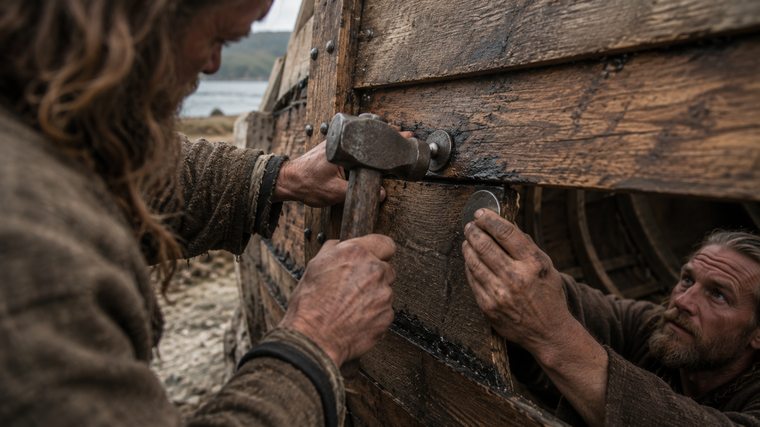
Archaeologically, a longship can be defined quite soberly: a long, narrow clinker-built hull that could be both sailed and rowed, carrying far more people than were needed to handle the sail and the steering oar. In the big warships, the ratio of length to beam is often around seven to one, sometimes slimmer still. Compare that with an ocean-going cargo ship like the knarr, which was much beamier, had only a few oars for manoeuvring in harbour and relied on its sail.
The difference lies in the job. A trader needs hold space and a small crew. A warship needs the opposite: room for oarsmen who are also fighters, and a hull so shallow that it can run straight up a beach or far up a river. That is precisely what made raids on monasteries and trading places so dangerous. The fleet arrived before any warning could travel overland.
The Old Norse word langskip simply means "long ship". In the thirteenth-century sagas it is the usual umbrella term for warships, as opposed to the merchant ship (kaupskip). For the Viking Age itself, though, we depend mostly on two other kinds of evidence: runic inscriptions and skaldic verse, the intricate praise poems often composed in the tenth and eleventh centuries and later quoted in the sagas. Judith Jesch studied this vocabulary systematically in her book Ships and Men in the Late Viking Age. Her broad conclusion: the poets knew plenty of ship words, but they did not use them like a naval handbook.
The snekkja (later Danish snekke) is regarded as the typical medium-sized warship; the word survives in place names and in Scandinavian boat terminology. The skeið was, as far as the texts allow us to tell, a large, fast warship, the ship of kings and great lords. Remarkably, the word was borrowed into Old English. In his will, drawn up between 1008 and 1012, Bishop Ælfwold of Crediton left his king "ænne scegð" of 64 oars. That is a contemporary English record showing that big oared warships of this kind were treated as instruments of power, and were worth bequeathing to a king.
The dreki, "dragon", is a loanword from Latin draco. In skaldic verse and the sagas it denotes particularly splendid large ships, probably those with an animal head on the stem. Whether a "dragon" was a distinct type or rather an honorific for a big, decorated ship cannot be decided with certainty. Most of the evidence points to the latter.
In Roskilde Fjord on Zealand, several ships were deliberately sunk in the second half of the eleventh century to block the channel to Roskilde. They were raised between 1957 and 1962, and two of them turned out to be warships. Both were dated by dendrochronology, the analysis of tree rings in the timber. We tell the full story of the barrier in our article on the Skuldelev ships.
The larger of the two, Skuldelev 2, is the star of the collection. The ship was about 30 metres long and only around 3.8 metres wide, with room for 60 oars and a crew of 65 to 70. The real surprise came from the wood: the oak grew in the Dublin area, and the ship was built there around 1042. A warship from Scandinavian Ireland, then, which ended its days decades later as blocking material in a Danish fjord.
The smaller warship, Skuldelev 5, is a far more modest vessel at around 17 metres: a ship for about 26 oarsmen, built in Denmark around 1030 and evidently repaired several times with reused timber. It is probably exactly the kind of ship a village or district could provide for coastal defence.
In 1996 and 1997 the Viking Ship Museum in Roskilde was simply meant to be extending its grounds to create a museum island. During the construction work, archaeologists came across nine shipwrecks. One of them, Roskilde 6, is still the longest known ship of the Viking Age: roughly 37 metres, built for 39 pairs of oars and probably a crew of more than a hundred.
Dendrochronologists Niels Bonde and Frans-Arne Stylegar examined the timber and published their results in the Danish journal Kuml in 2011. The ship was built around 1025/26 from oaks growing around the Oslofjord, most likely in Norway itself. That places it in the years when Cnut the Great was fighting for control of Norway. Whether Roskilde 6 actually belonged to his fleet cannot be proven, though it is a tempting thought. Only about a fifth of the hull survives. In the major Viking exhibition of 2013/14 in Copenhagen, London and Berlin, the original timbers were mounted in a steel frame that traced the full length of the ship, and visitors could finally see what the sagas mean when they talk about giant ships.
Germany has a genuine longship too. In the harbour of the trading town of Hedeby (Haithabu) on the Schlei, divers found timbers from a wreck in 1953; it was excavated in 1979 and 1980 under the direction of Ole Crumlin-Pedersen inside a cofferdam. Hedeby 1 was about 31 metres long but only around 2.7 metres wide, one of the slimmest longships known. It was built around 985 with wood from the Hedeby area itself. The quality of the workmanship suggests a high-ranking owner, perhaps someone in the circle of the Danish king.
Its end was dramatic. The timbers show traces of burning. According to the excavators' interpretation, the ship was used as a fire ship during an attack on Hedeby, perhaps only ten to twenty years after it was built: set alight and driven against the harbour installations. Who was attacking whom, we do not know. Today the wreck is on display at the Viking Museum Haithabu.
The three famous ship burials belong in this story, with one important caveat: they are not pure warships. They were rulers' ships that had to impress as well as sail, and they were altered again when they became burial chambers. You can read more about the custom in our article on boat and ship burials.
The Ladby ship on Funen is Denmark's only known ship burial of this kind. Around 925 a man was laid in it, together with eleven horses and several dogs. What survives is mainly the ship's imprint in the soil with its iron rivets: almost 22 metres long, about three metres wide, built for some 30 to 32 oarsmen. At the bow lay iron spirals, interpreted as the mane of an animal head on the stem. It is one of the very few pieces of archaeological evidence for a real ship's dragon.
The Gokstad ship from Vestfold is almost 24 metres long and just over five metres wide, built around 890 and used as a grave a few years later. It has 16 pairs of oars, which passed through round holes in the side that could be closed with small wooden shutters when the ship was under sail. A versatile, seaworthy vessel, but with 32 oarsmen not a troop carrier on the scale of Skuldelev 2.
Finally the Oseberg ship, about 21.5 metres long, built around 820 and used in 834 as the grave of two women, is the most lavish of them all. With its low freeboard and richly carved stem, it was more a showpiece for sheltered coastal waters than a warship for the open North Sea.
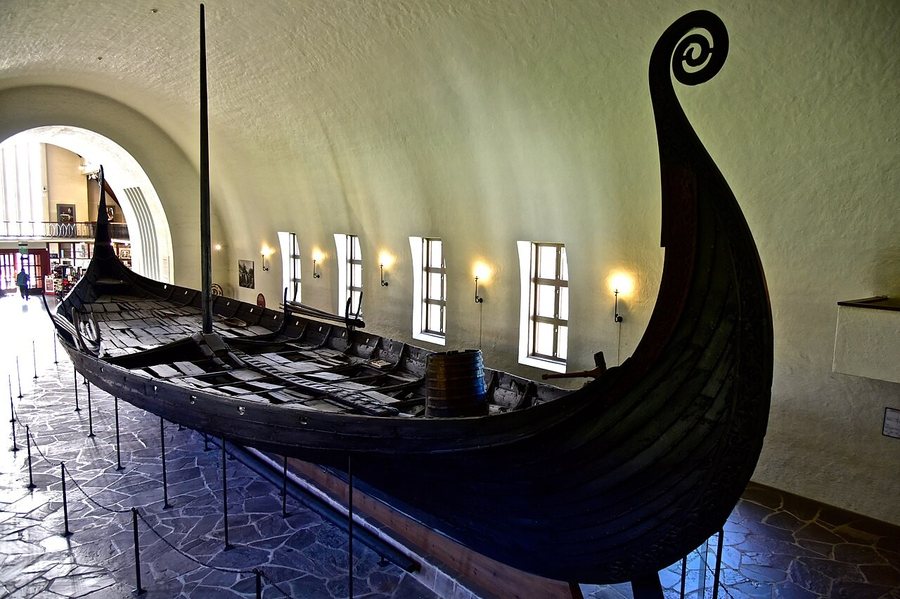
A warship lived on its oarsmen. On the Gokstad and Oseberg ships, the oars passed through holes in one of the upper planks, the oar ports. No fixed rowing benches were found, so the men probably sat on their sea chests or on movable benches. Every rower was also a warrior, and the number of oars was, in effect, the strength of the fighting unit.
This is also what makes the size statements in the sagas meaningful. If a ship had "thirty rooms", any listener knew that it carried a good sixty oarsmen, plus a helmsman, a leader and perhaps spare men. On the Roskilde 6 scale, the crew would have topped a hundred. Wherever possible, crews went ashore at night to sleep and cook. A longship was a tool for short, fast passages with a lot of people, not a floating barracks.
No contemporary measurements exist. What we know comes from experimental archaeology, from full-scale reconstructions of excavated ships sailed in real conditions. The most important of these is the Havhingsten fra Glendalough ("Sea Stallion from Glendalough"), a reconstruction of Skuldelev 2 built at the Viking Ship Museum's boatyard in Roskilde and launched in 2004. Its name honours the Irish origin of the original timber.
The museum gives these figures for the reconstruction: 29.3 metres long, 3.8 metres wide, a draught of just under a metre, 112 square metres of sail, 60 oars and a crew of 60 to 70. Under sail, the average speed was six to eight knots, with a maximum of about 17 knots. Under oars, the crew managed an average of about 2.5 knots, with short bursts of up to 4.2 knots. The sail was the engine. Oars were for calms, manoeuvres, rivers and the final run onto the beach.
In 2007 the Sea Stallion sailed from Roskilde around the north of Scotland to Dublin, returning in 2008 through the English Channel and across the North Sea. The ship proved fast and seaworthy, but for the crew the voyage was an ordeal of wet, cold and cramped conditions.
A different category altogether is the Draken Harald Hårfagre, launched in 2012 in Haugesund, Norway: 35 metres long, about eight metres wide, 260 square metres of sail and 25 pairs of oars. In 2016 she crossed the Atlantic via Shetland, the Faroes, Iceland and Greenland to Newfoundland, and later sailed on into the Great Lakes. For context, the Draken is not a copy of any excavated ship but a modern construction that scales up the proportions of the Gokstad ship and draws on Norwegian boatbuilding tradition and saga descriptions. That makes her an impressive experience but not archaeological evidence.
As early as 1893, the Gokstad replica Viking, under Captain Magnus Andersen, sailed from Bergen across the Atlantic to the World's Columbian Exposition in Chicago, reporting speeds of around ten knots. How Norse sailors found their way at sea is explained in our article on Viking navigation.
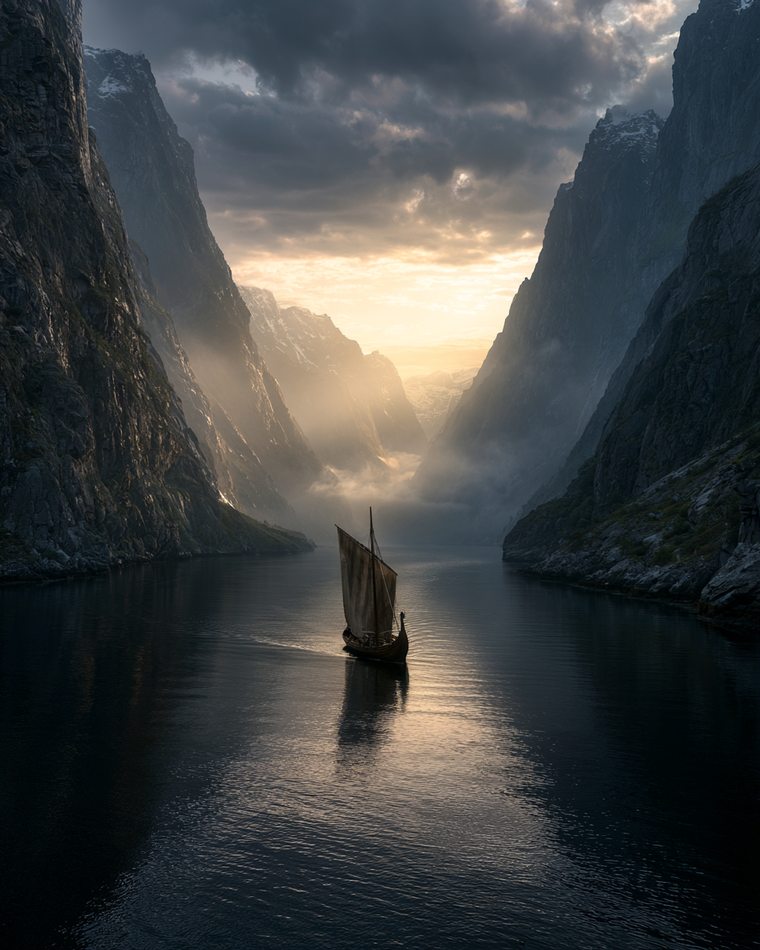
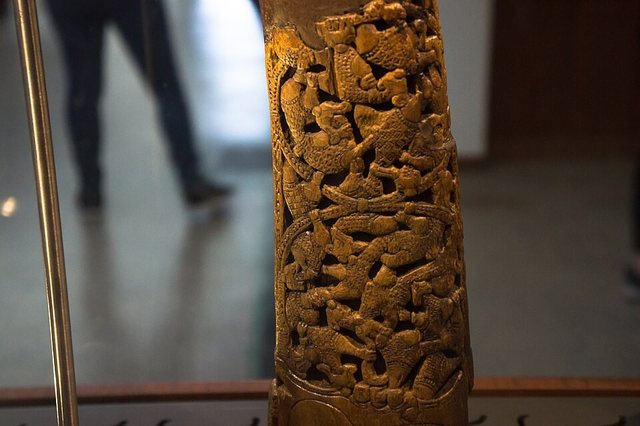
No image shapes our idea of the Viking ship as strongly as the carved dragon head on the stem. All the more surprising, then, is the archaeological record: genuine, securely Viking Age stem heads from warships have hardly survived at all. The famous animal-head posts from the Oseberg grave are not ship heads; their function is unclear. The Oseberg ship's own stem ends in a coiled serpent, not a head with gaping jaws. At Ladby, the iron spirals point to a mane, but the wooden head itself has decayed.
The well-known carved head dredged from the river Scheldt near Appels in Belgium, now in the British Museum, is often shown as a Viking dragon. The museum's radiocarbon date, however, places it roughly in the fifth to seventh centuries, well before the Viking Age, and the museum itself notes that it is still widely published with a Viking date.
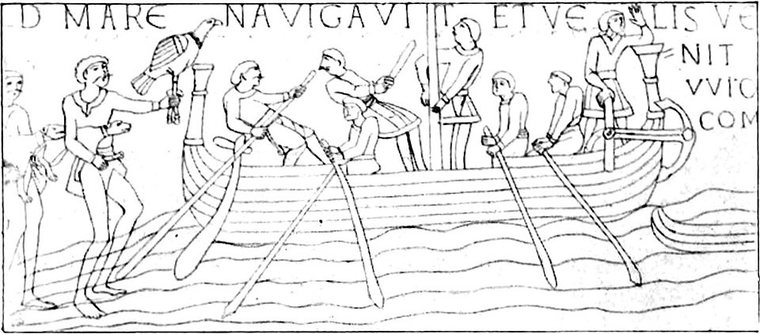
The heads are better attested in pictures and texts. The Bayeux Tapestry, probably made in the 1070s, shows the Norman fleet with animal heads on the stems. The Encomium Emmae Reginae, written around 1041/42 for Queen Emma, describes Cnut's fleet with lions, dragons, bulls and human figures gleaming with gold. A stick found in the Bryggen harbour quarter of Bergen, dated to the thirteenth century, bears an incised fleet that includes ships with animal heads. And then there are the gilded bronze weather vanes, which probably sat on mastheads or stems.
Finally, there is the Icelandic law. The Hauksbók version of Landnámabók, a manuscript of the early fourteenth century, records the opening of the pagan law of Úlfljótr, said to have applied in Iceland from around 930. In paraphrase (our own rendering): people should not have head-ships at sea; if they did, they should take the heads off before they came within sight of land, and not sail towards the land with gaping heads and yawning snouts, so that the land spirits would not be frightened.
The passage is valuable because it shows that the heads were removable and were felt to be threatening, both to enemies and to the unseen guardians of the land. But be careful: whether the wording really goes back to the tenth century or is a later embellishment is disputed. The text is secure only for the period around 1300.
The most famous longship in Norse tradition has never been excavated. It is Ormr inn langi, the Long Serpent of the Norwegian king Olaf Tryggvason. According to Snorri Sturluson's Heimskringla, written around 1230, Olaf had the ship built near Nidaros, today's Trondheim, a short time before his death, conventionally around 999. The shipwright was a man named Thorberg, who earned the nickname Skafhögg ("plane-stroke"): in the saga he hacked notches into the finished gunwale and then planed them away so skilfully that the plank looked better than before.
Snorri gives the ship 34 rooms, which means 34 pairs of oars, putting it in the same size range as Roskilde 6. Its head and tail were gilded, and its sides rose as high as those of an ocean-going ship. Before that, Olaf had built a ship called the Crane (Trana) and captured another named Ormr inn skammi, the Short Serpent.
In the year 1000, at Svolder, a place whose location is still debated, Olaf fought a naval battle against an alliance of the Danish king Sweyn Forkbeard, the Swedish king Olof and the Norwegian jarl Eric Hákonarson. According to Snorri, Olaf had his ships lashed together with the Long Serpent in the middle, turning the battle into a fight on floating platforms. Eric attacked with his ship Járnbarði ("Iron Beard"), and the defenders were overwhelmed ship by ship. In the end Olaf leapt overboard and vanished beneath the waves.
In the Faroe Islands, the story lives on in the ballad "Ormurin langi" by Jens Christian Djurhuus, written in the nineteenth century and still sung today.
A single longship was expensive; a fleet was a matter for the state. Scandinavia developed a naval levy for this, called leiðangr in Old Norse, leding in Danish and ledung in Swedish. Coastal regions were divided into ship districts, in Norway called skipreiða. When the king called out the levy, each district had to provide a ship with crew, weapons and provisions for a fixed period. Beacon fires on mountain tops were part of the system, allowing the levy to be raised along the coast.
The catch: the law codes that describe the system date from the twelfth and thirteenth centuries. How far back into the Viking Age it reaches is disputed. Most likely there were first looser retinues of kings and jarls, which only gradually turned into a fixed obligation on the population. We explain the terms lið, hirð and leiðangr and how they developed in our article Lið, Hirð and Leiðangr.
Ships like Skuldelev 5, medium-sized, patched again and again, built partly from reused timber, fit such a levy well: not a showpiece but a workhorse that a district had to keep afloat. Giants like Roskilde 6, by contrast, were royal ships.
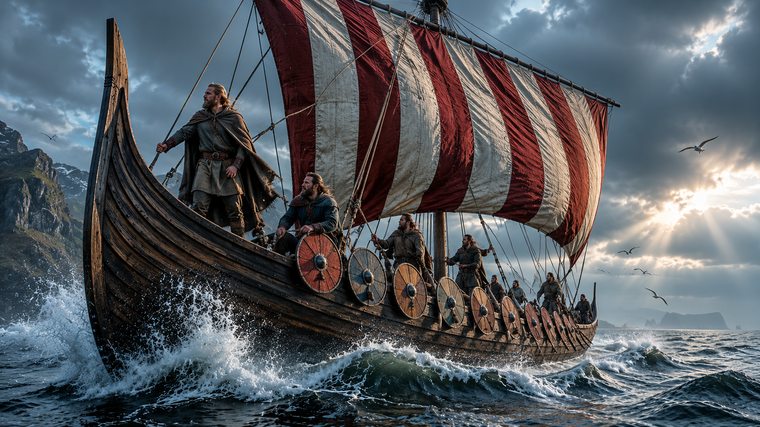
The image is burned into our minds: a longship under full sail with a row of brightly painted round shields along each side. And it is not entirely invented. The Gokstad grave contained 64 shields, painted yellow and black, which had been fastened overlapping along a batten on the outside of the hull. A new study published in the journal Arms & Armour in 2023 even suggests that these shields may have been covered with rawhide and fit for combat.
But at Gokstad the shields were mounted so that they partly covered the oar ports. With the shields hung up, nobody could row. Under sail on the open sea, they would have taken spray and wind and been easily lost. The likeliest interpretation is that the shield row was a display in harbour, on arrival or at ceremonies, perhaps also protection for the crew in a fight at anchor. The Bayeux Tapestry does show shields along the sides of ships under way, but it is a narrative image, not a technical report. For more on the shield itself, see our article on the Viking shield.
Skuldelev 2 and 5 are in Roskilde, Hedeby 1 is in the Viking Museum Haithabu near Schleswig, Ladby has its own museum on Funen, and the Gokstad and Oseberg ships belong to the Museum of the Viking Age in Oslo. Check opening times before you travel, as several of these sites have been under renovation.
Standing in front of these narrow, shallow hulls, you may grasp the greatest truth about the longship: it was no monster from legend but a masterfully built, delicate tool in which sixty men sat with wet feet.
What fascinates us at Glanz & Gravur is exactly this bond between craft and meaning. A longship's stem was technology and symbol at once, just as a good engraving does more than shape material: it tells a story.

How long was a Viking longship? The excavated warships range from about 17 metres (Skuldelev 5) to about 37 metres (Roskilde 6). Typical large warships such as Skuldelev 2 or Hedeby 1 were around 30 metres long.
How many men did a Viking longship carry? That depended on the number of oars. Skuldelev 2 had 60 oars and probably a crew of 65 to 70; Roskilde 6 likely carried more than a hundred.
How fast could a Viking longship sail? The reconstruction Sea Stallion from Glendalough averaged six to eight knots under sail and reached about 17 knots at best. Under oars it averaged roughly 2.5 knots.
Did all Viking ships have dragon heads? No. Removable animal heads are attested in texts and pictures, mainly for large royal and prestige ships. Dragon heads surviving in the ground are extremely rare.
What is the difference between a longship and a dragon ship? "Dragon ship" is a modern umbrella term. In Old Norse, a particularly splendid longship was called a dreki, "dragon", while the general word for a warship was langskip.
What was the Long Serpent? King Olaf Tryggvason's warship, which according to Heimskringla had 34 pairs of oars and was lost at the Battle of Svolder in the year 1000. It is known only from the sagas, not from archaeology.
For courage. For remembrance. For legends that live on.
All History & Finds articles →
It is not two centimetres tall and weighs nine grams – and yet it set off one of the most exciting debates in Norse …
Read more →To a farmer from Uppland, „the great city" was as unimaginable as another planet. Constantinople had walls that fire …
Read more →Whoever won did not always keep the spoils. In the Roman Iron Age, Germanic victors sank the entire equipment of …
Read more →While Uppsala is famous above all from a text, Thuringia holds the best-excavated Germanic sanctuary in the ground: the …
Read more →