Horned helmet, blond giant, bloodthirsty barbarian: few images of history are so wrong – and so beloved. Here we set things straight, told with a light touch, but with evidence instead of gut feeling.
Knowledge · The Big Picture
Say "Viking" and a film instantly rolls in your head: a horned helmet, a wild beard, bellowing from a dragon ship. A lovely image – only, sadly, almost entirely made up. "Viking" was not an ancestry but a job. Most Scandinavians of the period never raised a sword for a raid; they tilled fields, traded goods and built ships. And the horned helmet? A costume designer put it on them – nearly a thousand years later. Let's dive in.
A quick word on the ground rules. Much of what "everyone knows" comes from two murky sources: from the laments of the victims (monks whose monasteries burned) and from Icelandic sagas, which were written down only centuries later in a Christian setting. On top of that comes the hard science of today – archaeology, dendrochronology, DNA. So we keep things strictly separate: Evidence (well attested) from Myth (popular, but uncertain or simply wrong).
And the research says so itself. In November 2025, Scandinavianists at the University of Münster (Cluster of Excellence "Religion and Politics", Roland Scheel & Simon Hauke) made it clear: our present-day image of the Vikings is "in many respects not scientifically verifiable". At its core it rests on the reports of Christian scholars written "well over a hundred years later" – because apart from short runic inscriptions, almost nothing written survives from the period itself. In other words: much of what looks like knowledge is really remembered history.
1. "Viking" was a job, not a people
Two Old Norse words lie behind it: víkingr was a person – someone who set out on a raiding or trading voyage – and víking the activity: "í víking fara" meant "to go on a voyage". So one was not a Viking by birth; one went on a Viking voyage and then came home again to the farm. The vast majority of people in the North never did this at all.
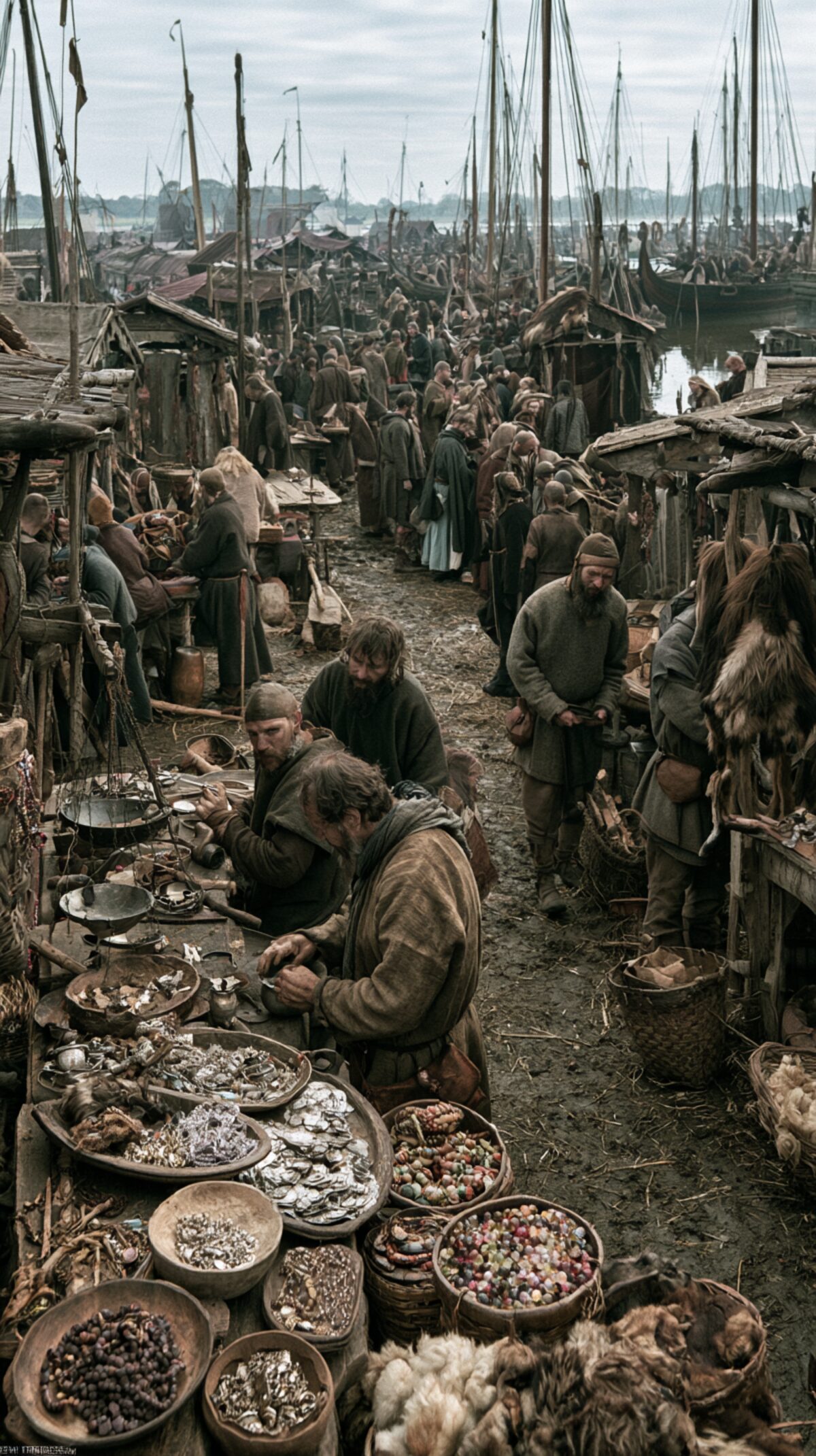
This is what daily life really looked like: a trading place like Hedeby, people in plain wool and leather clothing – no horned helmets, no shoulder furs. (Reenactment mood image)
So whoever says "the Vikings were not a people" is right. There were Danes, Swedes, Norwegians, Geats, a swarm of small kingdoms and clans. "Viking" is a collective name for an era and a way of life – not an ethnicity.
Staying honest: where the word comes from exactly, no one knows for sure. In the running are vík ("bay"), the region "Vík" by the Oslofjord, Old English wīc ("trading place") and vika ("nautical mile / rowing shift"). You're not allowed to pick one yet.
2. 793 to 1066 – nice round numbers
By the textbook, the Viking Age begins in 793 with the raid on the monastery of Lindisfarne and ends in 1066, when the Norwegian king Harald Hardrada fell at Stamford Bridge. Handy dates to remember – but only that. Scandinavians had been on the move long before (the Salme ship burials date to around 700–750), and in 1066 not everything stopped overnight either. The frame is a Western European lens: it starts with a raid on England.
3. Who they really were – farmers, farm and hall
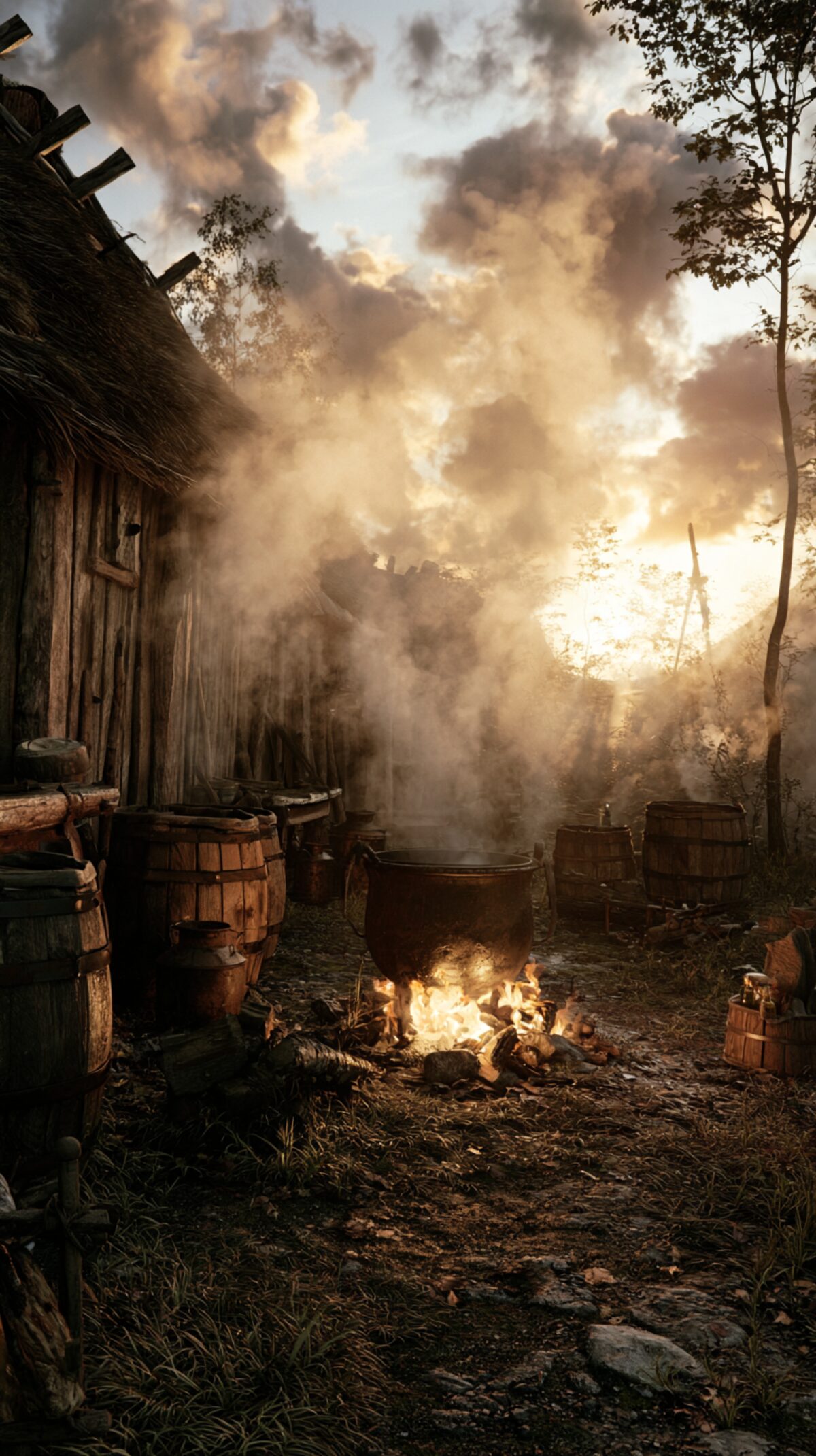
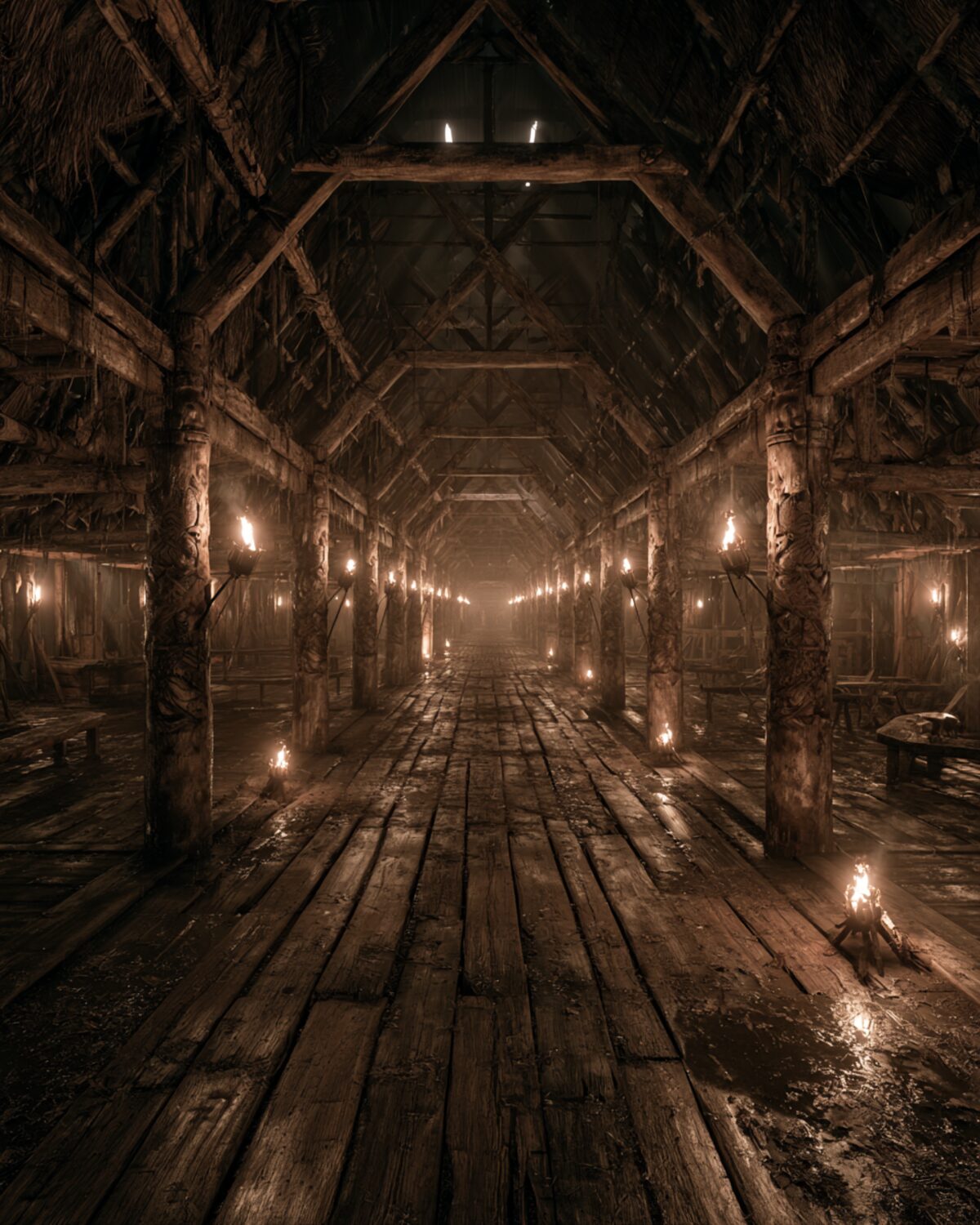
The majority were farmers in small villages of often only six or seven farmsteads. The main crop was barley (for bread and beer), along with rye and oats; they kept cattle, sheep, pigs, goats and horses. People lived in the longhouse with gently curved walls – one long room with a long fire in the middle, no chimney and no windows, only a smoke hole in the roof. On cold nights people and livestock stood under one roof, the animals as living heating. In the trading towns, sunken pit houses served as workshops.
Farms and villages like this were everyday life – livestock, craft, mead and trade. We engrave their tools and motifs onto wood and slate today. Visit the Shop →
Socially there were the free and the unfree: at the top the jarls (nobility, leaders), below them the great mass of free farmers and craftspeople (Old Norse karlar) – they were allowed to carry weapons and attend the Thing – and at the very bottom the thralls, the unfree servants and slaves.
A small myth on the side: the neat three-estates scheme "jarl–karl–thrall" comes literally from the poem Rígsþula, in which a god begets the social classes. That is a literary-mythical idealisation, not a constitution. The social reality (nobility, free farmers, the unfree) did exist – but the tidy scheme is poetry.
And the women? More nuanced than either camp would like. Evidence: women could own property, inherit, run the farm and the finances – especially when the man was away for months – and obtain a divorce. That was more legal standing than in many neighbouring cultures.
But let's not romanticise: women were not legally equal – at the Thing they generally could neither vote nor appear as witnesses. And the "shieldmaiden" as a widespread female type is above all a literary figure. The flashy image of the feminine warrior goes back heavily to Richard Wagner's "Valkyrie" (1876) – in the old sources, Valkyries had quite different roles, from choosing who dies in battle to serving as a cup-bearer.
And yet – the famous woman's grave. There is a genuine bombshell: the richly furnished warrior grave Birka Bj 581 (Sweden) contained a sword, an axe, spears, armour-piercing arrows, two shields, two horses and a complete set of gaming pieces – the equipment of a high-ranking warrior. For over a century it was taken for granted as a man's grave. Then a DNA study from 2017 (Hedenstierna-Jonson et al., American Journal of Physical Anthropology) showed: the buried person was biologically female. That is real and significant. But it is an outstanding individual case, not a shieldmaiden army – and whether she herself fought or was regarded as a strategist/leader (the gaming pieces argue for tactics) remains a matter of scholarly debate.
4. Craft, trade and that precious silver
The Viking Age was a hive of craftsmanship. In the towns, specialised masters worked: the smith (weapons, tools, keys – Swedish iron was an export hit), the comb-maker working antler (in Hedeby some 340,000 antler fragments were found as production waste), along with weavers at the warp-weighted loom, glass-bead and amber grinders, turners of soapstone vessels and, of course, the boat-builders working in clinker technique (overlapping, iron-riveted planks – "shell first", flexible and strong).
In halls and pit houses people lived, feasted, judged and worked. (Mood image)
Trade reached across half of Eurasia. From the North went – honestly speaking – above all slaves and furs, along with walrus ivory, eiderdown, whetstones, soapstone pots, honey, wax, amber, iron and stockfish. In came cloth, glass, ceramics, millstones, wine and salt from the West – and from the East Arab silver, silk and spices. Payment was usually not in coins but by weight: silver was hacked into pieces ("hacksilver") and weighed on small folding scales. How much silver flowed is shown by Gotland: over 700 hoards, well over 80,000 Islamic dirhams – the Spillings hoard alone held around 14,200 coins.
Not to be glossed over: the slave trade was a core business, not a fringe phenomenon. People abducted on raids were sold through hubs like Hedeby and Bolghar on the Volga as far as the Arab and Byzantine worlds. The envoy Ibn Fadlan described in 922 the mistreatment and even the sacrifice of a slave woman. The "freedom-loving Vikings" had a very unfree dark side.
5. Law, faith and death
Law was spoken at the Thing, the assembly of free men – the basic unit of politics and justice. The most famous is Iceland's Althing, founded in 930 and thus one of the oldest parliaments in the world still in existence; there the lawspeaker (lögsögumaðr) recited the law from memory from the rock (Lögberg).
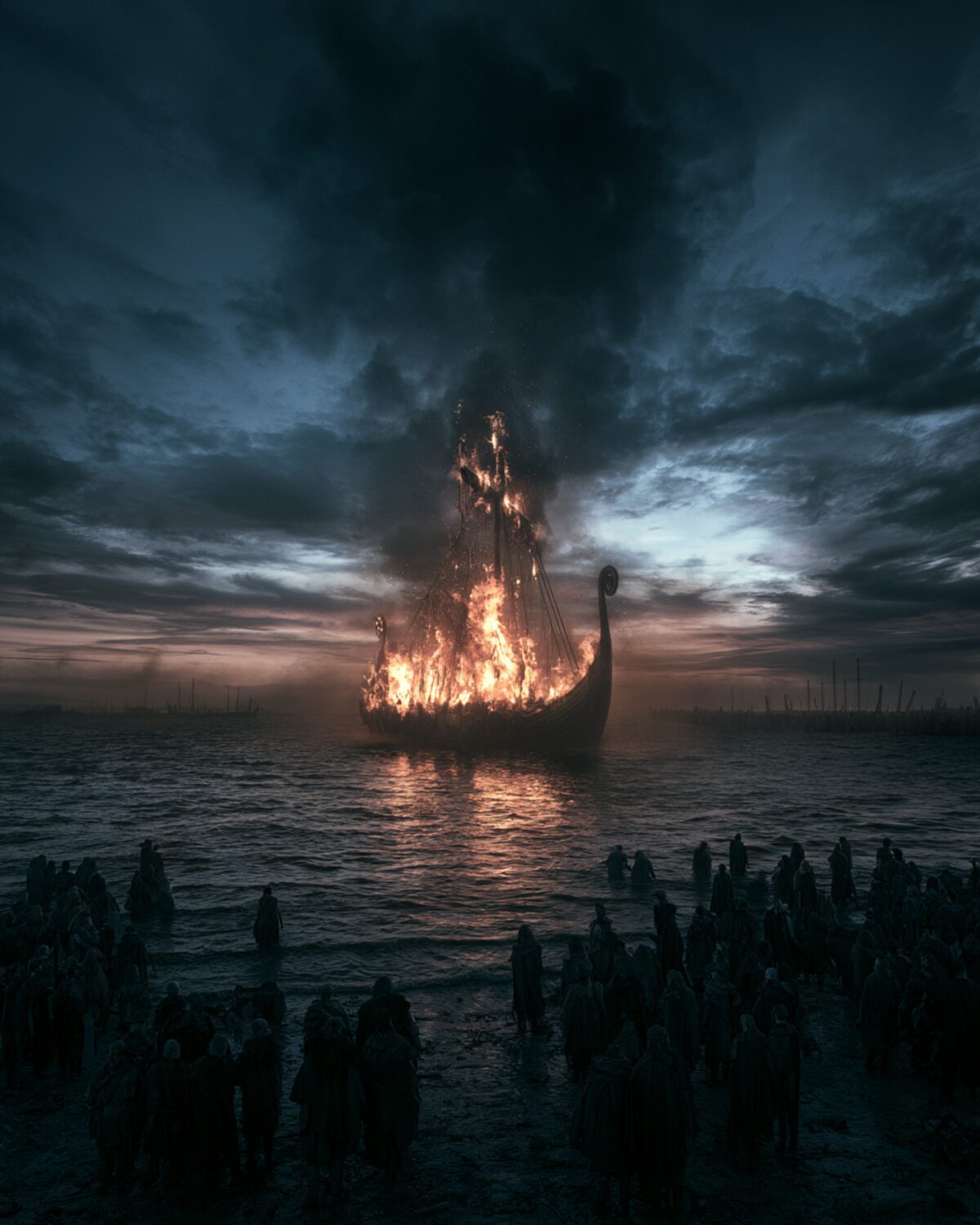
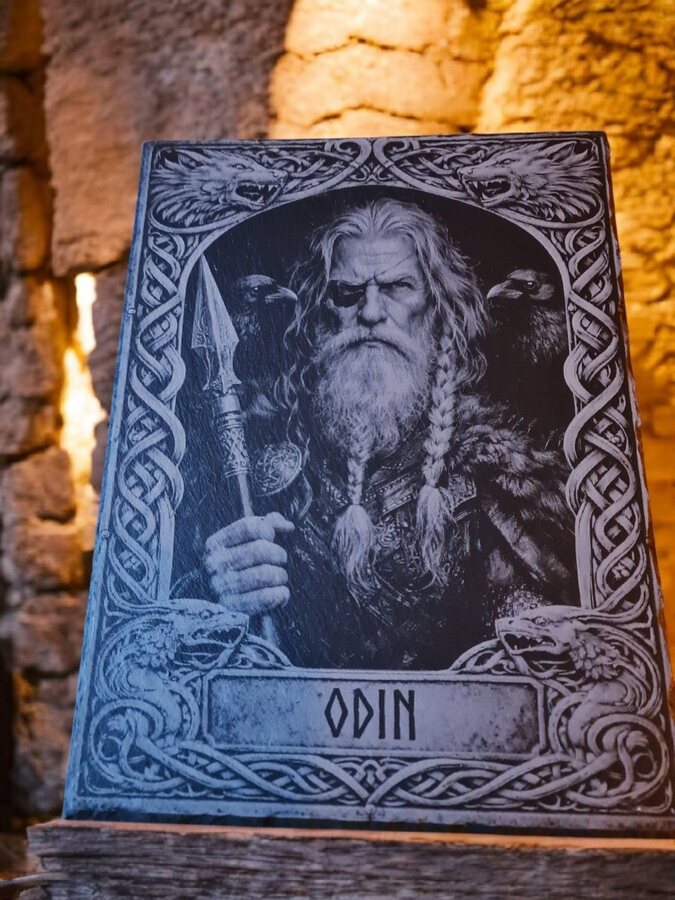
They believed in many gods – Odin, Thor, Freyr and Freyja foremost – and celebrated at the Blót, the sacrificial feast, at which above all pigs and horses were slaughtered. Burial was astonishingly varied: cremation graves and inhumation graves side by side, plus rich ship burials (Oseberg around 834 with two noble women, Gokstad around 900, the Danish Ladby) and stone ships – ship-shaped stone settings.
From the plain cremation grave to the magnificent ship burial: death was as varied as life. (Mood image)
Careful with the gruesome stories:human sacrifice is archaeologically attested (in the sacrificial well of the ring fortress Trelleborg lay skeletons, four out of five of them children between four and seven years old). But the concrete figures given by the chroniclers – Thietmar names 99 victims at Lejre, Adam of Bremen describes bloody feasts at the temple of Uppsala – are tricky from a source-critical standpoint: Adam was no eyewitness, and whether the Uppsala "temple" even existed is an open question. The notorious "blood eagle" is very probably a literary misreading (Roberta Frank) – not a fact. Even if it counts as one of the most striking scenes in the series "Vikings" and one almost – admittedly – sometimes wishes it back. ;-)
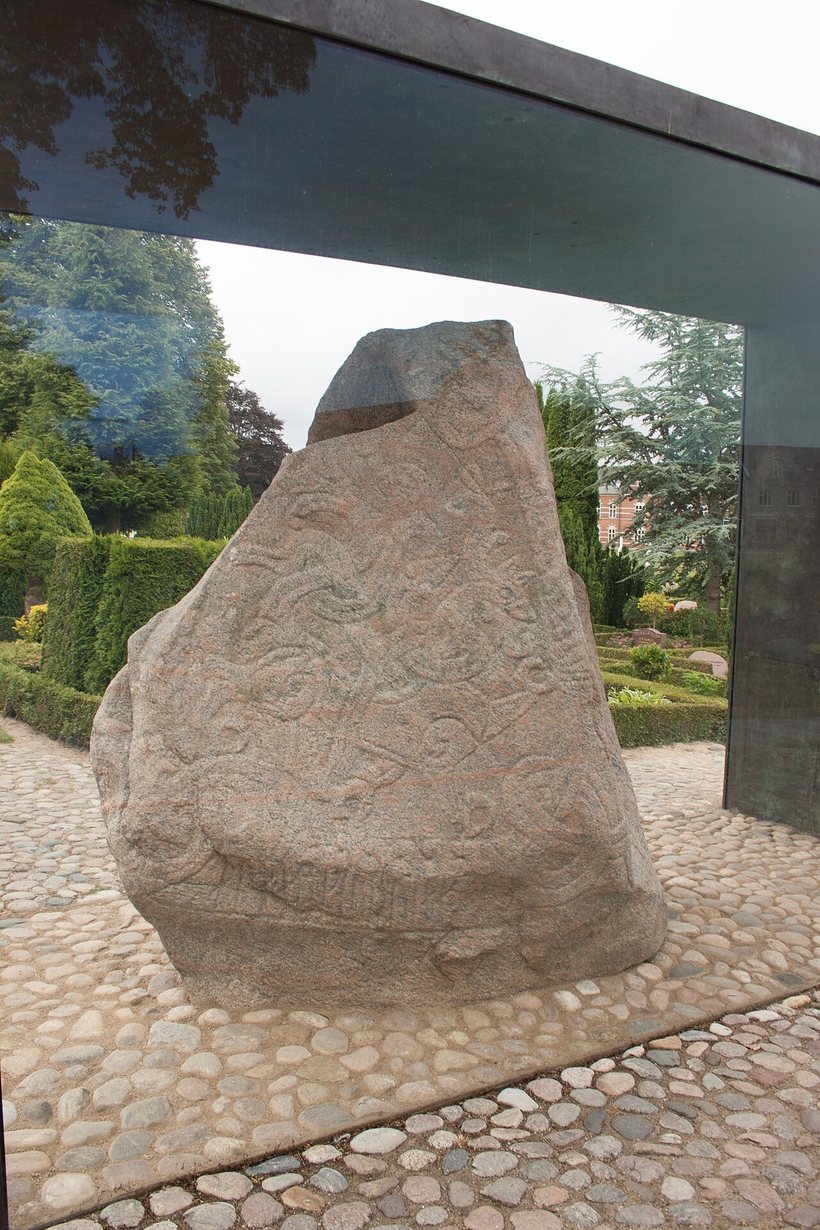
Two things remain visible to this day: the art styles, which over some 350 years moved from pure animal ornament to plant tendrils (Oseberg → Borre → Jellinge → Mammen → Ringerike → Urnes), and the runestones, mostly memorial stones in the Younger Futhark. The great Jelling Stone, raised by Harald "Bluetooth" around 965, is considered the "birth certificate of Denmark" and bears the oldest depiction of Christ in Scandinavia – today a UNESCO World Heritage Site.
The "birth certificate of Denmark": the great Jelling Stone, raised by Harald "Bluetooth" around 965. Photo: Szilas, Wikimedia Commons, CC0.
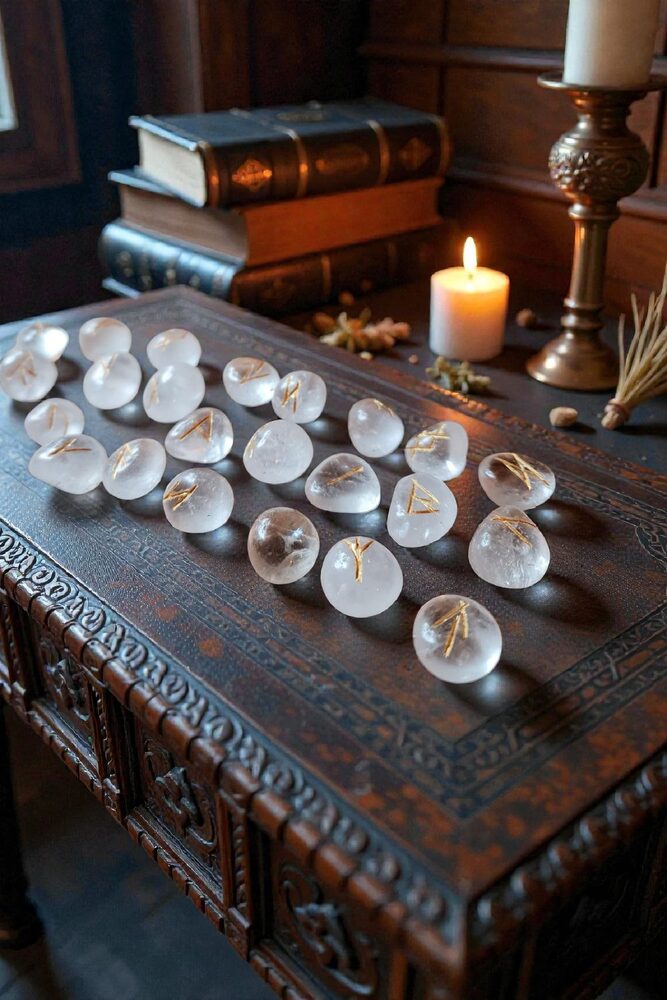
The runes are the only written testimony the Northern peoples left behind themselves. Our rune oracles bring them tangibly back. View the rune oracle →
6. Why they set out in the first place
The honest answer: no one knows for sure, and it was probably a cocktail. Up for discussion are land shortage and population pressure (doubted, though, by the historian Anders Winroth), a marriage backlog caused by the polygamy of rich men, simply the greed for silver, the power politics of ambitious kings that drove the losers out of the country – and the ship technology that made open-sea voyages possible in the first place. The research consensus: no single cause, but several at once.
7. The fleet – far more than two types of ship
"Longship or freighter" – it wasn't that simple. The Vikings built a whole range, depending on purpose. Important to note first: the Northern peoples had no fixed system of types. Ships were usually counted by the number of rowing rooms, not by labels. Our tidy classification is an aid to ordering provided by research – the wrecks and dimensions are certain, the type names are interpretation.
Snekkja – the smallest longship, from about 26 rowers. Fast, nimble, the "standard Viking".
Skeið – the large longship (30+ rowing benches), the actual warship of the fleet commanders.
Dreki ("dragon") – a particularly large skeið with a carved dragon's or serpent's head at the prow. Splendour, not a building type of its own.
Knörr / Knarr – the broad-bellied, deep ocean-going freighter for the Atlantic to Iceland and Greenland.
Byrðingr – the smaller coastal and Baltic freighter for short-haul trade.
Karvi – a versatile middle ground (up to ~16 pairs of oars) for cargo, travel and representation. The famous ships from Oseberg and Gokstad are karvi types.
Færing – the small open rowing boat with four oars, the everyday dinghy.
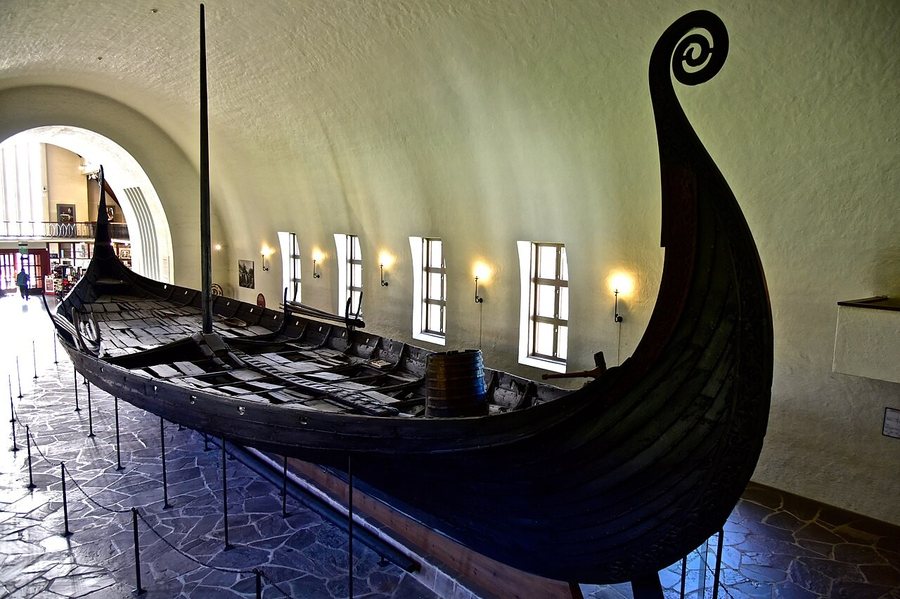
Probably the most beautiful find of the Viking Age: the almost completely preserved Oseberg ship (burial ship, around 834) with its spiral-carved prow. Museum of the Viking Age, Oslo. Photo: Larry Lamsa, Wikimedia Commons, CC BY 2.0.
The five ships of Skuldelev (recovered from the Roskilde Fjord, today in the Viking Ship Museum Roskilde) show this range in a single place. They did not sink in battle but were deliberately scuttled around 1070 as a harbour barrier:
· Skuldelev 1 – ocean-going freighter (Knörr), ~16 m, from western Norway.
· Skuldelev 2 – large warship (Skeið), ~30 m, built around 1042 in the Dublin area from Irish oak; reconstruction "Sea Stallion".
· Skuldelev 3 – small coastal freighter (Byrðingr), ~14 m, the best-preserved wreck.
· Skuldelev 5 – small warship (Snekkja), ~17 m.
· Skuldelev 6 – fishing and multipurpose boat, ~11 m.
(A "number 4" is missing: two salvaged parts were at first thought to be a ship of their own – they were part of Skuldelev 2.)
Two popular errors: the giant dragon ship "Ormen Lange" (Olav Tryggvason, around 1000) we know only from Snorri's Heimskringla (over 200 years later) – there is no wreck, all the dimensions are saga. And the word "Drakkar" is not an Old Norse word at all, but a French invention of 1840 with a groundlessly doubled "k". The Northern peoples said dreki or ormr ("worm/serpent").
8. How far they reached – from Vinland to Baghdad
The reach is staggering – and well attested: the British Isles and Ireland (Dublin is a Norwegian foundation), Normandy (the "Northmen"), Iceland and Greenland, and via the Russian rivers as the Rus all the way to the Black and Caspian Seas.
North America, the year 1021: at L'Anse aux Meadows (Newfoundland) stood a Norse settlement. A 2021 Nature study dated the building timber – thanks to a solar storm of 993 – to exactly 1021, almost 500 years before Columbus. Read more →
To the East, silver beckoned. Via the Volga route the Northern peoples did business with the Caliphate of Baghdad; in Constantinople ("Miklagard") Northmen served as the imperial bodyguard – the Varangian Guard. And in the West, whole tracts of the Frankish Empire burned in the 880s.
9. The places they shaped – and the Vikings in Germany
The backbone of this world was not the raids but a network of trading towns, the emporia: Ribe (oldest town in Denmark), Kaupang (Norway), Birka (Sweden), Truso and Wolin (today Poland), Dorestad (Netherlands) – and right in the middle, the most important western hub, which today lies in Germany.
Hedeby (Haithabu) near Schleswig was one of the largest trading centres of Northern Europe. Its position was ingenious: on the Schlei, at the narrowest point between the Baltic and the North Sea – anyone bringing goods from one sea to the other saved here the dangerous circumnavigation of Jutland. The walled settlement (semicircular rampart, around 24–26 ha) numbered in its heyday an estimated 1,000 to over 2,000 inhabitants: smiths, comb-makers, bead-turners, traders from half of Europe. In 1066 Hedeby was destroyed by a West Slavic army; the inhabitants moved across the Schlei to Schleswig, which took over its role. Because the site was never built over afterwards, around 95 % remains unexcavated to this day – a stroke of luck for archaeology.
This border region was protected by the Danevirke (Danework), an enormous rampart running across the isthmus. Its oldest timbers are dendrochronologically dated to 737 – decades before the first written mention in 808. Hedeby and the Danevirke together have been a UNESCO World Heritage Site since 2018.
There were further sites on present-day German soil, above all along the southern Baltic: Reric (usually identified with Groß Strömkendorf near Wismar), Menzlin on the Peene and Ralswiek on Rügen – mixed Slavic-Scandinavian trading settlements. At Füsing near Schleswig a settlement with over 200 house structures was found, possibly a fleet base (linked by research to the "Sliasthorp" mentioned in 804).
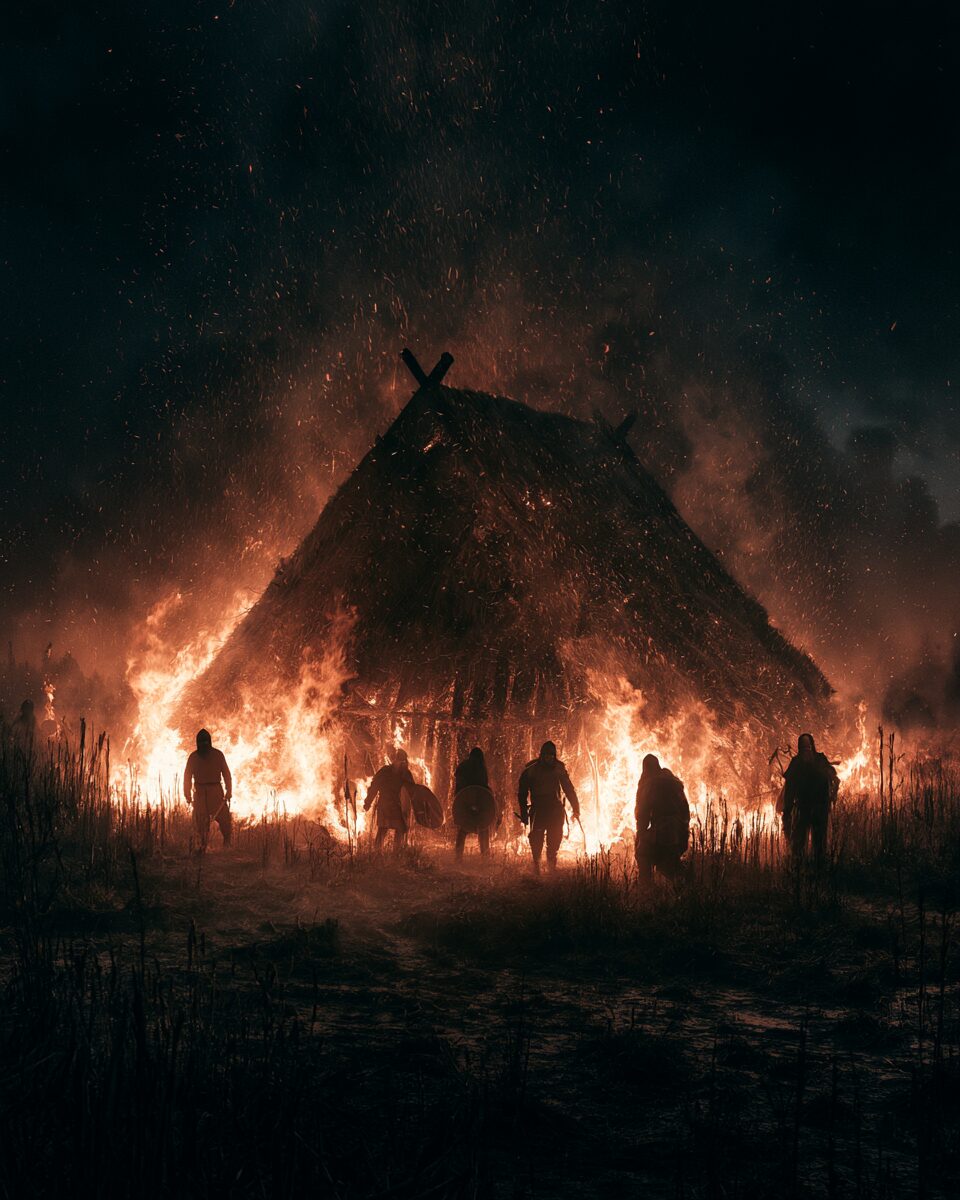
Winter 881/882: Vikings move up the Rhine through the Frankish Empire. (Mood image)
And yes, they reached the Rhineland. In the winter of 881/882 the "Great Army" under Godfrid plundered up the Rhine: attested in the Frankish annals are Cologne, Bonn, Neuss, Jülich, Andernach and – at the end of 881 – Aachen; on Epiphany 882 the Eifel abbey of Prüm fell, and in Holy Week Trier. The popular story that they used Charlemagne's Palatine Chapel in Aachen as a horse stable, however, is a later narrative tradition – the devastation is attested, the stable detail is not. (More on this in our blog articles on Aachen and the winter camps.)
10. What the genes reveal – the great DNA study
In 2020 the largest Viking DNA study to date appeared in the journal Nature (Margaryan et al., led by Eske Willerslev): 442 genomes from over 80 sites across Europe and as far as Greenland. It overturned the image of the Vikings more thoroughly than any saga.
The core findings (Nature 2020): · "Viking" was an activity and culture, not a pure ancestry: in Scottish Viking graves lay people without Scandinavian genes who had adopted the way of life – in Norway even individuals of Sámi descent.
· Scandinavia at the time was genetically more diverse than today: gene flow from southern and eastern Europe and from the British Isles, already before and during the Viking Age.
· Clear routes: Danish ancestry to England, Swedish to the Baltic, Norwegian to Ireland, Iceland and Greenland.
· Most had darker hair and eyes than the present-day Scandinavian average.
A second major work in the journal Cell (2023) confirmed the gene flow from the eastern Baltic, from the British-Irish Isles and from southern Europe – carried predominantly by women. In 2025 further genome research even suggests that Scandinavians came to Britain long before the Vikings and Anglo-Saxons – so the story is still being written.
This puts paid to a favourite myth: the "pure blond Nordic race" does not exist scientifically. The Viking Age was an era of mixing and mobility – not a closed people.
What remains are their stories and signs – not "blood", but culture. We burn them onto real natural slate. View the slate plaques →
11. Myth check – what Hollywood invented
The horned helmet. Doesn't exist – in combat horns would have been life-threatening. The image comes from the 19th century: costume designer Carl Emil Doepler designed the helmets in 1876 for Richard Wagner's "Ring of the Nibelung" in Bayreuth. The famous horned helmets of Viksø are from the Bronze Age, around 2,000 years older.
The dirty barbarians. Rather the opposite: combs, tweezers, ear spoons and razors are among the most common grave finds. People bathed weekly on the "laugardagr" (washing day) – which is where the Nordic word for Saturday comes from. An English chronicler even grumbled that the Danes combed their hair daily and bathed on Saturdays, and were thereby too popular with the women.
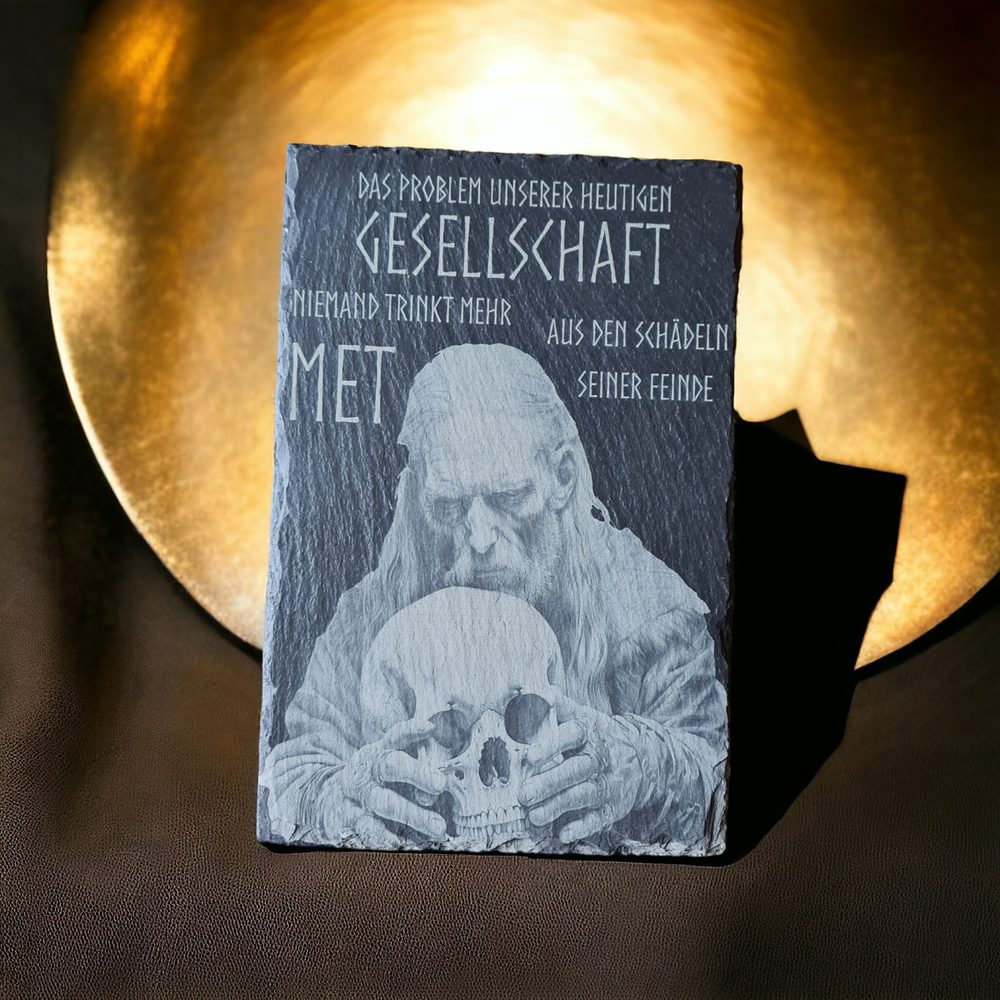
Drinking from skulls. A translation blunder by the scholar Ole Worm (1636): a skaldic verse meant drinking from "the curved branches of skulls" – that is, from animal horns. Worm turned this into the skulls of the slain. Scientifically speaking: a myth.
... and yet (with a wink): we found the line too good to let it lie – so we promptly burned it onto slate. After all, one needn't take everything dead seriously, and a smile has never been forbidden. Knowing how it really was – and still being allowed to grin at the old nonsense: both are possible. ;-)
A wink in stone: "The problem with our society today – nobody drinks mead from the skulls of their enemies anymore." Knowing how it really was, and still having a chuckle. View in the shop →
12. How we know all this – and why you're allowed to doubt
Our witnesses are rarely neutral. Ibn Fadlan, an Arab envoy, described in 922 the Rus on the Volga and a ship burial first-hand – a treasure, but exactly who the "Rūs" were (purely Scandinavian or mixed with Slavs and Finns) is disputed. The Anglo-Saxon Chronicle writes from the victims' point of view. Adam of Bremen (around 1070) reports on the temple at Uppsala – but with a churchly slant and from hearsay. Runestones are genuine primary sources, only rather terse. And the Icelandic sagas are literarily magnificent, but written down only in the 13th/14th century and in Christian Iceland – no eyewitnesses, but late storytelling.
Beware, politically abused: precisely because the evidence is so thin, the "heathen North" image was easy to bend to one's own ends. The most appalling of these were the Völkisch movement and the National Socialists, who abused the medieval writings for their racial ideology (so the University of Münster, 2025). That is exactly why a cool, evidence-based look pays off.
In short: the Vikings were not a race and not a closed people, but people of an era – farmers, traders, craftspeople, seafarers and occasionally warriors, genetically a colourful mix, groomed rather than louse-ridden, and without a single horned helmet. Does that make them more boring? On the contrary.
Sources include: University of Münster, Cluster of Excellence "Religion and Politics", press release 04.11.2025 (R. Scheel / S. Hauke); Margaryan et al., "Population genomics of the Viking world", Nature 2020 (German report: grewi.de, 22.09.2020); Rodríguez-Varela et al., "The genetic history of Scandinavia", Cell 2023; derStandard, "Genome research could rewrite British history" (2025); Hedenstierna-Jonson et al., "A female Viking warrior confirmed by genomics" (Birka Bj 581), Am. J. Phys. Anthropology 2017; Kuitems et al., Nature 2021 (L'Anse aux Meadows, the year 1021); Viking Ship Museum Roskilde (the Skuldelev ships); UNESCO World Heritage "Hedeby and the Danevirke" (2018) and Jelling (1994); National Museum of Denmark, Copenhagen (daily life, craft, slavery, religion, burial); Annales Fuldenses / Regino of Prüm on the Rhineland raids of 881/882; Smithsonian and HISTORY on the horned-helmet myth; R. Frank on the "blood eagle" (Speculum). All contested points are marked above as "Myth" or "disputed".