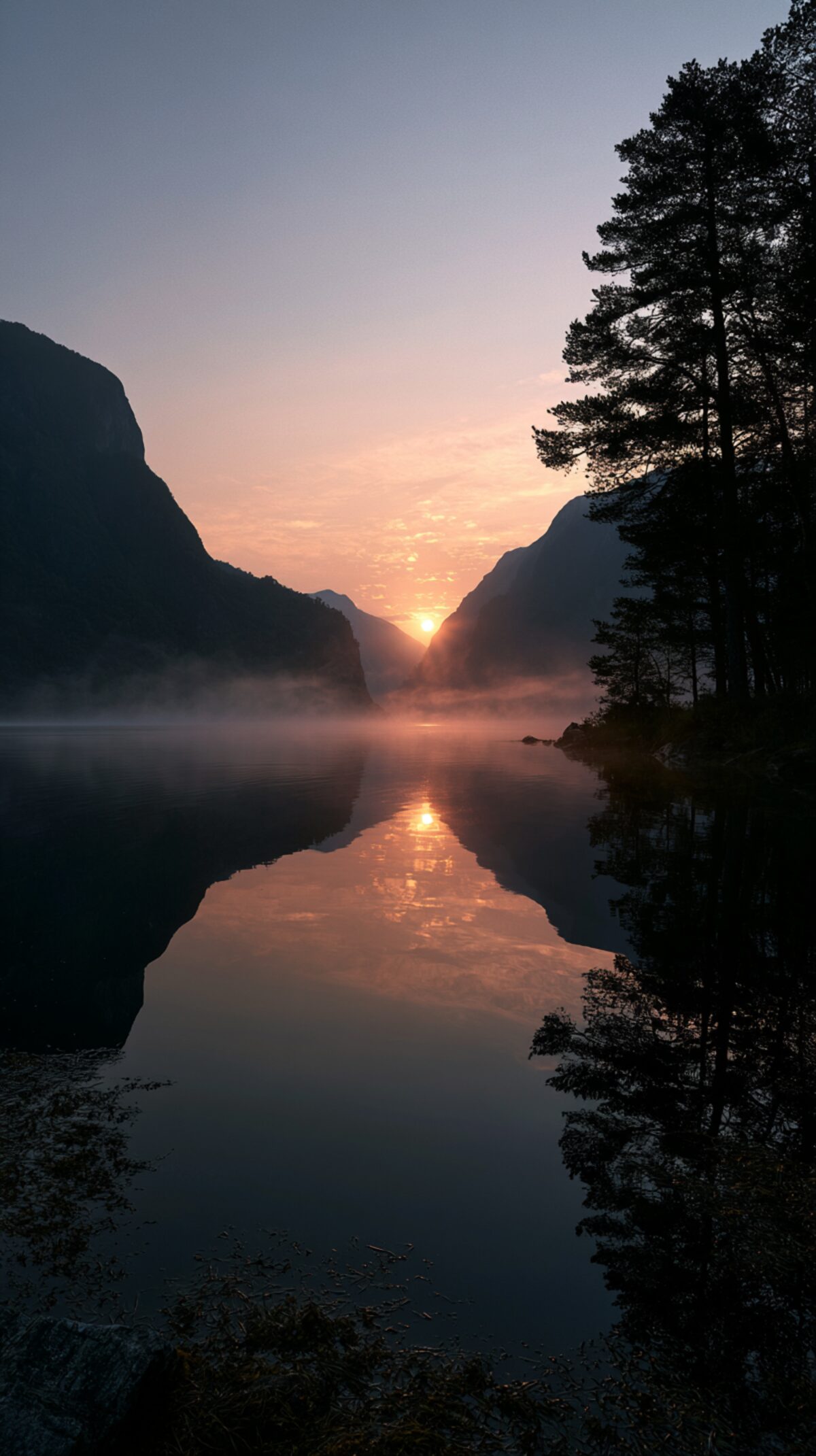
Vinland is the name Norse sailors from Greenland gave to a stretch of North American coast around the year 1000 – and their presence there is no longer a matter of faith: the proof lies in the ground at L'Anse aux Meadows in Newfoundland, where wood was demonstrably cut with metal tools in the year 1021. Here you will find which texts mention Vinland first, what the two Vinland sagas really say, what the excavations revealed, where the Wineland most likely lay – and which famous "Viking" finds in America are simply fakes.
Picture Bremen, around 1075. A cathedral canon called Adam is writing up everything he has learned about the far North, and one detail must have sounded to his readers about as remote as the far side of the moon. Out in the ocean, beyond Greenland, he writes, lies an island where vines grow wild and grain springs up unsown. This is no fable, he insists – he has it on good authority from the Danes. The island's name is Winland.
For almost nine hundred years that Vinland stayed a riddle. It was finally found in 1960, on a windswept meadow at the northern tip of Newfoundland that hardly anyone had considered.
This article is about the place and the evidence. The people behind the voyages have their own posts on our blog: Leif Erikson, who gave Vinland its name, and his father Erik the Red, whose settlement of Greenland made the westward leap possible. Here we ask the question underneath: how do we actually know the Norse reached America – and which parts are certain, which probable, and which pure legend?
The oldest written reference to Vinland does not come from Iceland at all but from northern Germany. Adam of Bremen wrote his history of the archbishops of Hamburg-Bremen, the Gesta Hammaburgensis ecclesiae pontificum, around 1075/76. Its fourth book is a description of the northern islands, and chapter 39 contains this passage (our own translation from the Latin):
"Moreover, he spoke of yet another island discovered by many in that ocean, which is called Winland because vines grow there of their own accord, yielding the best wine. That unsown grain also abounds there we have learned not from fanciful opinion but from the reliable report of the Danes."Adam of Bremen, Gesta Hammaburgensis IV, 39 (own translation)
The "he" is the Danish king Sweyn Estridsson, whom Adam had met in person and whom he cites as his informant on much of the North. So roughly seventy years after the voyages, Vinland was a familiar name at the Danish court – explicitly as a land of wine. Beyond it, Adam adds, there is nothing habitable, only ice and impenetrable fog.
Adam was no eyewitness, of course. He wrote at second hand, and his Vinland is an island in the world ocean, not a continent. But his testimony is independent of the Icelandic sagas and older than they are. Anyone who claims that Vinland was a late Icelandic invention has to get past Adam first.
The second source is shorter but nearly as important. The Icelandic priest Ari Þorgilsson, known as Ari the Wise, wrote his Íslendingabók ("Book of the Icelanders"), a sober little history of Iceland, between about 1122 and 1133. In the chapter on the settlement of Greenland he notes that Erik the Red and his people found traces of earlier inhabitants there: dwelling sites, fragments of boats and worked stone. From this, Ari says in effect, one can see that the same kind of people had lived there as those who lived in Vinland and whom the Greenlanders call Skrælingar.
Ari does not tell the Vinland story – he takes it for granted. He also gives us the word the Norse used for the native peoples of America: skrælingar. Its origin is uncertain; scholars have linked it to skrá, "dried skin", or to a verb meaning "to shout". It was not a compliment either way.
Iceland's medieval annals add one more early note. Under the year 1121 they record that Eiríkr Gnúpsson, bishop of Greenland, "went to look for Vinland". Nothing more is said – but again, Vinland is a real place that could be sought.
The colourful stories everyone associates with Vinland come from two texts, together called the Vinland sagas: Grænlendinga saga (the Saga of the Greenlanders) and Eiríks saga rauða (the Saga of Erik the Red). Both belong to the wider family of Sagas of Icelanders, were composed in the thirteenth century – some 200 to 250 years after the events – and survive only in later manuscripts: the Greenlanders' saga in Flateyjarbók from the late fourteenth century, Erik's saga in Hauksbók (early fourteenth century) and the younger Skálholtsbók.
At their core, both tell the same story. Norse sailors from Greenland headed west and south, found three lands they called Helluland ("land of flat stones"), Markland ("forest land") and Vinland, tried to settle, met the local people and gave up. In the details, though, they disagree too sharply to be simply merged.
The Saga of the Greenlanders begins with a mistake. Around 986 Bjarni Herjólfsson, bound for Greenland, is blown off course and sights unknown wooded coasts but never goes ashore. Leif later buys his ship, retraces the route, and winters in houses known as Leifsbúðir, "Leif's booths". His old companion Tyrkir, a "southerner", finds grapes – hence the name. More voyages follow: Leif's brother Thorvald is killed by an arrow in a clash with the natives and buried on a headland; Thorfinn Karlsefni arrives with settlers, women and livestock, trades with the Skrælings at first and is forced to leave after fighting; finally Leif's half-sister Freydís sails west and ends her voyage by having her partners murdered.
The Saga of Erik the Red tells it differently. Here Leif stumbles on the new land by accident when he is driven off course on his way home from Norway, and returns to Greenland straight away. The great expedition belongs to Karlsefni and his wife Guðríðr. They winter at a place called Straumfjörðr ("current fjord"), move south in summer to Hóp ("lagoon"), where vines and wild wheat grow, trade with natives arriving in skin boats, and are finally attacked. Thorvald dies here from the arrow of a "uniped", a one-legged creature – medieval wonder-geography rather than travel report.
And then there is Freydís, who plays two utterly different roles. In Erik's saga she is the heavily pregnant woman who drives off attackers by baring her breast and slapping a sword against it; in the Greenlanders' saga she is the instigator of a massacre. That contrast alone shows how much literary shaping went into these texts.
One figure links both versions: Snorri Þorfinnsson, son of Karlsefni and Guðríðr. According to both sagas he was born in Vinland, which would make him the first child of European parents born on American soil – nearly six centuries before Virginia Dare, who is often given that title in the United States. The claim rests on the sagas alone, but Snorri is no minor character: the Greenlanders' saga traces several Icelandic bishops back to him and his mother.
Guðríðr herself crosses the North Atlantic several times, lives in Vinland and, according to the Greenlanders' saga, goes on pilgrimage to Rome late in life – a woman who walked the whole network from America to Europe (more in our post on women in the Viking Age). For the question of location, the sagas offer landscapes, sailing days and resources, but no chart.
In 1960 the Norwegian explorer and writer Helge Ingstad arrived at the northern tip of Newfoundland, convinced that Vinland lay further north than most people believed. In the fishing village of L'Anse aux Meadows a local man, George Decker, led him to some overgrown ridges near the shore.
The archaeologist of the couple was Helge's wife, Anne Stine Ingstad. From 1961 to 1968 she directed excavations with an international team from Norway, Iceland, Sweden and the United States. What emerged were sod walls over timber frames, built exactly as people built in Iceland and Greenland. From 1973 Parks Canada continued the work, first under Bengt Schönbäck and then under Birgitta Wallace, whose interpretation of the site still shapes the debate today.
The excavators found the remains of eight buildings: three large halls, a smithy and several smaller workshop huts, along with around 800 objects of wood, bronze, bone and stone. The decisive pieces are unassuming but unmistakably Norse:
No iron, no seaworthy clinker boat; no boat, no way home. How those ships were built is explained in our posts on the dragon ships and on Viking smithing.
How many people lived here? The halls could house roughly 70 to 90 people. For comparison, the entire Greenland colony at the time may have numbered around 400. The refuse layers are thin and there are no signs of rebuilding, so researchers think the site was used only briefly – on most estimates for about a decade.
L'Anse aux Meadows was inscribed on the UNESCO World Heritage List in 1978. The original foundations were reburied for protection, and reconstructed sod houses now stand nearby – much like the buildings in our post on the Viking longhouse.
Perhaps the most important find weighs only a few grams. In the waterlogged ground beside the houses lay three butternuts and a piece of worked butternut wood. The butternut (Juglans cinerea) is a North American walnut – and it does not grow on Newfoundland. Its northern limit lies in eastern New Brunswick and along the St Lawrence.
So someone carried those nuts up from the south, at least from the Gulf of St Lawrence. And where butternuts grow, wild grapes grow too. Birgitta Wallace has called the nuts a "smoking gun": they tie the northern site to the saga landscape in which grapes ripen.
That leads to an interpretation many specialists now share. L'Anse aux Meadows is not "Vinland" in the sense of a single dot on the map but a base camp, a gateway. Here people wintered, repaired ships and stored goods; in summer they sailed south to the area the sagas call Hóp, which is usually placed in eastern New Brunswick. Wallace identifies L'Anse aux Meadows with the Straumfjörðr of Erik's saga, and Leif's booths in the other saga may refer to the same base.
Not everyone agrees, but the direction is clear: Vinland was a region rather than a point – the shores around the Gulf of St Lawrence, with Newfoundland as the entrance.
For decades radiocarbon could only place the site "around the year 1000". That changed in October 2021, when a team led by Margot Kuitems and Michael Dee of the University of Groningen published a result in Nature that names an actual year: 1021.
The method is elegant. In the year 993 a burst of cosmic radiation, probably triggered by a massive solar storm, struck the Earth. Atmospheric carbon-14 jumped sharply, and that spike shows up in the same tree ring in trees all over the world. If you find that ring in a piece of wood, you have a fixed anchor and can count the rings outwards to the bark.
The team examined pieces of wood from the excavations that had been worked with metal tools, recognisable by clean, low-angle cuts that local stone tools could not produce. In three pieces from three different trees, including fir, the outermost ring beneath the bark had survived. All three gave the same felling year: 1021.
What the study does not claim matters just as much. 1021 is not the founding date of the site, nor automatically the year of Leif's voyage. It is a year in which work was done there – which fits comfortably with the saga chronology.
Old Norse vín, with a long í, means "wine". But there is also an old word vin, with a short i, meaning "meadow, pasture", which survives in Norwegian place names. Around 1900 the Swedish philologist Sven Söderberg suggested that Vinland really meant "Pasture Land". That would have solved an awkward problem: grapes do not grow on Newfoundland, grass does. Helge Ingstad himself found the idea attractive.
Most linguists and historians reject it today, for good reasons:
Some have suggested that the saga "grapes" were really currants or cranberries; Wallace considers that untenable too. A dash of marketing may also have played a part. Erik had already named Greenland "Green Land" so that settlers would come, and "Wineland" sells just as well.
The sagas describe the natives as numerous, travelling in skin boats, willing to trade and dangerous. They swap furs for red cloth or dairy products, and later they attack. On Newfoundland and in Labrador around 1000 lived groups that archaeologists see as ancestors of the later Beothuk and Innu; further south, around the Gulf, the ancestors of the Mi'kmaq. The L'Anse aux Meadows site itself was used by Indigenous peoples again and again over thousands of years.
A very different trail runs through genetics: a maternal lineage found in some Icelandic families may point to Indigenous American ancestry, though whether it really goes back to someone brought from Vinland is disputed. We weigh the arguments in a separate post: Indigenous DNA in Iceland – a trail back to Vinland?
In spring 2016 a second Norse site seemed to have turned up. The American archaeologist Sarah Parcak, known for finding sites with satellite imagery, had spotted rectangular features at Point Rosee in southwestern Newfoundland. A television documentary showed a possible turf wall and a hearth for roasting bog iron ore.
The disappointment came quickly. The supposed slag turned out to be natural bog ore, the "turf wall" a natural soil formation. In their final report of November 2017, Parcak and her colleague Gregory Mumford stated themselves that there was no evidence whatsoever of a Norse presence, or of any human activity before the historic period. An honest result – but not Vinland.
Few subjects have generated as many forgeries and wishful readings as Vinland. Three classics:
The Vinland Map. In 1965 Yale University unveiled a world map supposedly from the fifteenth century, showing an island called "Vinilanda" in the west; doubts were raised from the start. In September 2021 Yale's Beinecke Library announced the results of new analyses: a titanium compound used in inks only from the 1920s runs through the map's lines and lettering, and a note on the back had been overwritten in modern ink to link the map to a genuine medieval volume. The map is now confirmed as a deliberate twentieth-century forgery.
The Kensington Runestone. Found in Minnesota in 1898, it describes a voyage in the year 1362. Its language, rune forms and numerals belong to nineteenth-century Scandinavia, not the fourteenth century. We tell the whole story in our post on the Kensington Runestone.
The Newport Tower. This round stone tower in Newport, Rhode Island, was declared a "Viking tower" in the nineteenth century. Radiocarbon dating of its lime mortar, published in 1997 by Jan Heinemeier and Högne Jungner, instead points to construction in the seventeenth century, most probably between 1635 and 1698. That fits a windmill, such as the one mentioned in the 1677 will of colonial governor Benedict Arnold.
Helluland, the land of flat stones, is usually identified with Baffin Island, and Markland, the forest land, with Labrador. Vinland, in the view of most researchers today, takes in the northern tip of Newfoundland, with L'Anse aux Meadows as the base, and the shores of the Gulf of St Lawrence, where butternuts and grapes grow. Further south, in New England for instance, there are no confirmed traces.
It is worth asking how the Icelanders themselves understood Vinland. To them it was no "new continent". Medieval Icelandic geography imagined the western lands as an extension of the known world; in some texts from around 1300, Vinland is even joined to Africa. Even the late sixteenth-century chart by the Icelander Sigurður Stefánsson shows a "Promontorium Winlandiae", a Vinland cape, at roughly the latitude of northern Newfoundland.
How sailors found their way there without a compass is explained in our post on Viking navigation.
The settlement at L'Anse aux Meadows was abandoned after a short time. The sagas name the main reason openly: the Skrælings. The Norse were few, reinforcements were weeks away, and Greenland, with only a few hundred inhabitants, could not support a second colony. What it needed above all was timber.
Yet the westward voyages did not stop entirely. Under the year 1347, Icelandic annals record a small Greenland ship that had sailed to Markland and was driven by storms to Iceland on the way back; its crew is given as about seventeen men, and it had lost its anchor. The entry is terse, and its very casualness speaks volumes: a trip to Markland was evidently nothing that needed explaining. Greenlanders probably fetched timber there for generations.
That fits with Norse objects such as fragments of mail and ship rivets found at Thule-culture sites in the Canadian Arctic, pointing to contact or exchange in later centuries. How the Greenland settlements themselves faded out in the fifteenth century is told in our post on the Greenlanders; for the wider story of expansion across the ocean, see the Vikings in the North Atlantic.
What remains is a story confirmed from three sides: by a canon in Bremen, by Icelandic storytellers and by an archaeologist in Newfoundland. In the end, a tree that fell under an iron axe in 1021 supplied the date. In our workshop we know how much a single cut in wood can tell – rarely as much as this.
Where was Vinland located? Most researchers now place Vinland at the northern tip of Newfoundland, with L'Anse aux Meadows as a base, and along the shores of the Gulf of St Lawrence. Butternuts from the excavation prove voyages to areas where wild grapes grow, such as eastern New Brunswick.
When did the Vikings reach America? The sagas place the voyages around the year 1000. The securely dated year is 1021, when Norse people felled trees with metal tools at L'Anse aux Meadows.
What does the name Vinland mean? Most specialists translate it as "Wineland", as Adam of Bremen already did around 1075. The alternative reading "Pasture Land" is now considered linguistically unlikely.
Is L'Anse aux Meadows the only Viking site in America? Yes, it is the only confirmed Norse settlement site in North America. Point Rosee was ruled out in 2017, and the Kensington Runestone and the Vinland Map are forgeries.
Who discovered L'Anse aux Meadows? Helge and Anne Stine Ingstad identified the site in 1960; it has been a UNESCO World Heritage Site since 1978.
For courage. For remembrance. For legends that live on.
All History & Finds articles →
Vikings and Aachen? Sounds like two worlds with nothing to do with one another. Yet in the winter of 881/882 the …
Read more →The Vikings came, raided – and stayed. Over the winter, at least. Instead of sailing home after every raid, they …
Read more →Many call the Varus battle the „big bang of Germany". Yet another battle shaped our lands far more deeply – one in …
Read more →High above the world of humans, beyond the burning rainbow bridge, lies Asgard – the fortified home of the Æsir. It is …
Read more →