What did the north taste like? Not a single Viking-age cookbook survives – yet from food remains, sagas and grain traces the everyday diet can be reconstructed surprisingly well. Five simple dishes to make yourself.
Rule of thumb: about 1 part honey to 3 parts water. Dissolve honey in warm (not boiling) water, cool to room temperature, add wine yeast and let it work in a fermenter with an airlock for 4–6 weeks. Then rack off and let it mature. Less honey for dry, more for sweet.
More on this: Met – Honigwein zwischen Halle und Mythos →The staple of the north: knead barley flour (with a little rye if you like), water and a pinch of salt into a firm dough, roll flat and bake on a hot stone or in a pan on both sides. Unleavened and quick – the way it was baked by the hearth.
More on this: Kräuter & Heilkunde der Wikinger →The forerunner of Icelandic skyr: gently warm fresh milk, inoculate with a little soured milk or yoghurt as a culture and leave it warm overnight until it thickens. Strain for firmer skyr. With honey and berries it's a feast.
More on this: Heidrun und Eikthyrnir: Met und Flüsse →The daily pot: simmer pearl barley soft in water or milk, salt it, and season with herbs or – sweet – with honey, apples and berries. Filling, cheap, different every day.
More on this: Moorbutter – Vorrat oder Opfer? →From folk medicine: an infusion of kitchen herbs like mugwort, ribwort plantain and leek – pour over hot, steep, drink warm. The Old English Nine Herbs Charm shows how closely herbs, runes and belief sat together. Not a substitute for medical advice.
More on this: Kräuter & Heilkunde der Wikinger →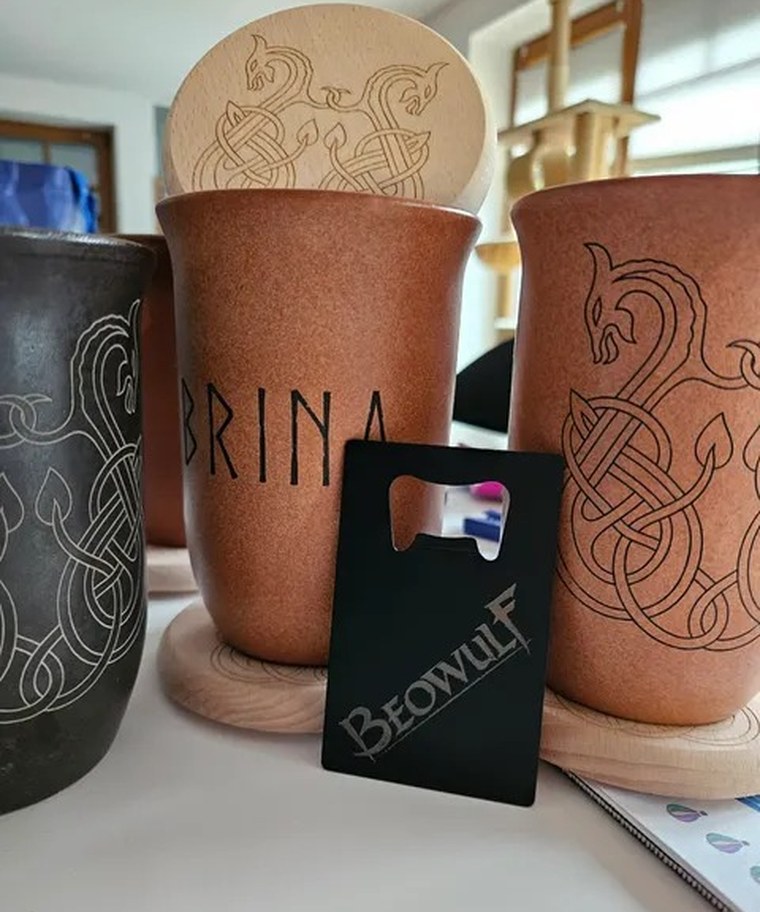
Handmade Westerwald clay cups and laser-engraved lanterns bring the Norse table into today.
Visit the shop →No Viking-age recipes survive verbatim. These are modern reconstructions based on ingredient finds (barley, honey, dairy, herbs) and written sources – meant for experimenting, not as historically exact quantities.
