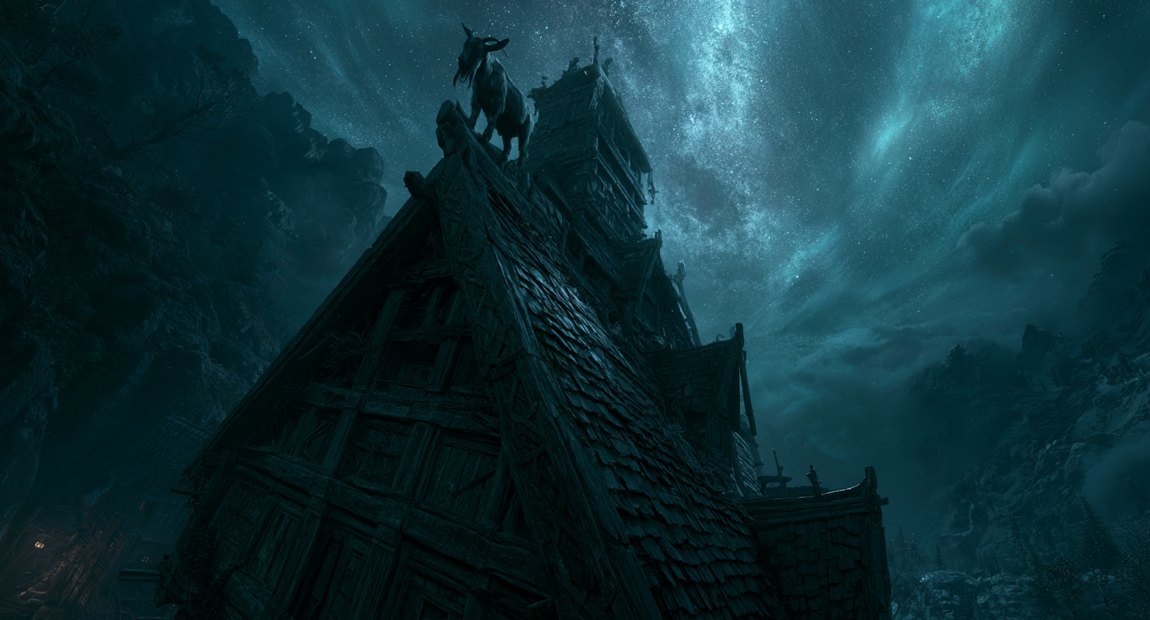
On the roof of the hall of the slain stands a goat, and from her udder flows not a drop of milk but clear, bright mead. Beside her a stag lowers its antlers, from which so much moisture drips that all the rivers of the world spring from it. Heidrun and Eikthyrnir are two of the quietest and yet grandest images in Norse tradition. They speak of an abundance that never ends, and of a single tree that binds the hall of fallen warriors to the water cycle of the entire world.
When we picture Valhalla, we think first of the hall itself: the roof of shields, the spears for rafters, the many doors through which the Einherjar will one day march to the final battle. Yet the Poetic Edda also lifts our gaze upward, to the roof, and there stand two creatures easily overlooked. They are no ornament, no whim of the poets, but two carefully placed images: the goat Heidrun and the stag Eikthyrnir. Both feed on the foliage of the same tree, which the source calls Laeradr, and both turn that foliage into something that reaches far beyond the hall.
The tree Laeradr grows up over or beside the hall, so close that the beasts on the roof can reach its branches. From its leaves they live, and out of what they eat comes, on the one hand, the drink of the dead, and on the other, the water of the world. It is an image of great calm: no battle, no thunder, only two grazing animals and a tree from which abundance steadily wells up.
Heidrun is the more famous of the two. She stands on the roof of Heerfather's hall, that is, Odin's, and browses the branches of the tree. Yet instead of ordinary goat's milk she gives clear mead from her udder. Day after day she fills a pitcher with it, and that pitcher is so vast that all the Einherjar can drink their fill from it. One must keep in mind the sheer number of these fallen warriors to feel the force of the image: they are countless, gathered every night at the feast, and still the mead never runs out. What Heidrun gives does not fail.
Here lies the true wonder. In a world where stores were scarce, where a good winter meant the difference between life and death, the notion of a drink that renews itself is a dream of paradise-like plenty. Heidrun is the larder that never empties, the hospitable hall in animal form. Mead, the most precious drink of the Viking Age, flows here not from a barrel painstakingly brewed but directly from the life of the tree itself.
“Heithrun is the goat who stands o'er the hall of Heerfather, and browses on Lærath's branches; the pitcher she fills with the clear, bright mead, that drink shall never fail.” Grímnismál 25, transl. H. A. Bellows (public domain)
One may smile at this: the most venerable place in the Norse afterlife, the hall of the glorious dead, depends for its supply on a goat. Yet the wink takes nothing from the image's dignity. It shows how grounded Norse thought was. Even the warriors' paradise needs an animal that gives nourishment, only one that bursts the limits of the possible. Anyone who has ever savoured the first sip after a long day understands why the abundance of mead became a symbol of the blessed life.
Beside Heidrun stands the stag Eikthyrnir, whose name means “oak-thorn," an echo of the thorny, antler-like branching. He too gnaws at the leaves of the tree Laeradr, yet what proceeds from him takes an even longer road. From his antlers moisture drips ceaselessly, so much that it gathers and falls into the well Hvergelmir. That well lies deep below, beneath one of the roots of the world tree, in cold Niflheim, the realm of mist and primal chill.
From Hvergelmir, however, spring all the rivers of the world. The water that falls above from the stag's antlers becomes, below, the source of every stream that runs across the earth. Thus a mighty arc is drawn: from the highest point of the hall of the slain to the deepest root-chamber, from the roof above the warriors to the brooks and rivers along which the living build their farms. A single tree feeds them both.
Here is the heart of why Heidrun and Eikthyrnir belong together and should not be told apart. Both live on the same foliage, and both return it in transformed shape: the one as mead for the fallen, the other as water for the whole world. It is the same principle spoken twice. From a single source flows enough for all, and that source is never exhausted.
So this image binds the hall of the dead to the cosmic water cycle. The warriors' mead and the earth's streams come from the same origin. Whoever drinks in Valhalla, and whoever draws water from the river below, ultimately drinks from the same abundance. It is this vision of a shared, inexhaustible spring that lends the two beasts their quiet grandeur. They are not marvels for the sake of marvel, but the calm heart of a world order in which everything is nourished from a single point.
Heidrun and Eikthyrnir are clearly attested in the Poetic Edda: Grímnismál stanza 25 names the goat who stands on the roof of Heerfather's hall, browses Laeradr's leaves, and fills the pitcher with clear mead from which all the Einherjar drink. Stanza 26 names the stag Eikthyrnir, from whose antlers moisture drips into the well Hvergelmir, out of which the rivers spring. Snorri Sturluson takes up both images in his Gylfaginning and fits them into his picture of the cosmos. The Grímnismál text survives in the Codex Regius. That the mead never fails and that Hvergelmir is regarded as the origin of the rivers thus belongs to the firm stock of Eddic tradition.
Not everything commonly added is found in the sources. The tree Laeradr is often equated outright with Yggdrasil; that is a plausible but unproven interpretation, for the Edda names it in its own right, and whether it is truly the same tree remains open. The ever-flowing mead, by contrast, is Eddic and attested. A real background may be considered with care: goat's milk and mead were precious goods of the Viking Age, and the image of the pitcher that never empties reflects the very human wish for abundance in the hall, for a winter in which the jug does not run dry. The beasts, then, should not be read as a naturalist's description but as a symbol that gives shape to a longing.
Heidrun and Eikthyrnir are perhaps so appealing precisely because they need no grand gesture. No god wrestles here, no wolf devours the sun. They are two grazing animals, and yet they carry one of the finest ideas of the Norse world: that abundance is possible, that from a single origin enough can come for all, for the dead in their hall as for the living along their rivers. Whoever raises a cup today and says “Skål" calls up, without knowing it, a very old promise, the promise of the pitcher that never fails. In that sense the two beasts on the roof stand not only over Valhalla but over every table where people gather and trust that there will be enough.
Valhalla · Sæhrimnir – Valhalla's boar · Thor's goats · The roosters of Ragnarök · Yggdrasil – the world tree.
All Beings & Creatures articles →
Two black birds perched on the shoulders of a one-eyed god - few images are as tightly bound to Odin as this one. Their …
Read more →Before Brokkr and Sindri forged the hammer, others were at work: the sons of Ívaldi. Three wonders came out of their …
Read more →Far below, where the roots of the World Tree reach down into cold and darkness, lies a creature that never rests …
Read more →Between crown and root of the World Ash Yggdrasil scurries a small, restless creature: Ratatoskr, the squirrel. It …
Read more →