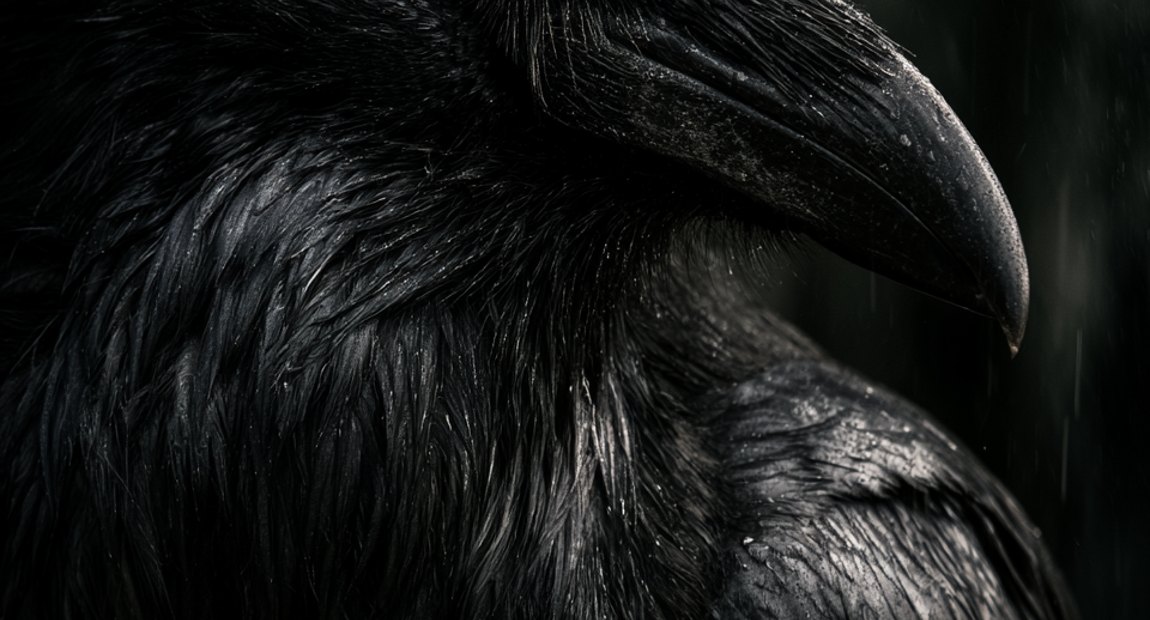
Huginn and Muninn are the two ravens of the Norse god Odin: according to the Eddas they fly out over the world every day and come back to tell him everything they have seen and heard. Their names roughly mean "thought" and "memory" (or "mind"). In this guide we look at what the medieval sources actually say, which finds from Vendel-period Sweden to the Isle of Man show ravens beside a god, why Odin fears more for Muninn than for Huginn, and where solid evidence turns into modern interpretation.
Picture a god who wants to know everything. He has given an eye for a drink of wisdom, hung himself on a tree for nine nights to win the runes, and sits on a high seat from which all worlds can be seen. And this god admits that he is afraid every single day. Not of giants, not of the wolf, but of two birds failing to come home.
That confession comes from Grímnismál, "The Lay of Grímnir", one of the mythological poems of the Poetic Edda. The collection survives in an Icelandic manuscript of the later 13th century, the Codex Regius, although the poems themselves are older; how much older can only be estimated poem by poem. In Grímnismál, Odin sits disguised as "Grímnir", the Masked One, tormented between two fires in the hall of King Geirröd, and reveals the structure of the divine world in a long monologue. Right after his wolves Geri and Freki, the ravens appear. In Old Norse:
Huginn ok Muninn / fljúga hverjan dag / Jörmungrund yfir; / óumk ek of Hugin, / at hann aftr né komi-t, / þó sjámk meir of Munin.Grímnismál 20, Old Norse text after the edition of Guðni Jónsson
O'er Mithgarth Hugin and Munin both / Each day set forth to fly; / For Hugin I fear lest he come not home, / But for Munin my care is more.Grímnismál 20, translated by Henry Adams Bellows, 1923
Bellows renders the rare word Jörmungrund ("mighty ground") as Midgard, the world of humans. The word occurs elsewhere in eddic verse only in the late poem Hrafnagaldr Óðins, so its precise meaning is not certain; most translators take it to mean the earth. For the god behind the voice, see our main article Odin – wisdom at any price.
Around 1220 the Icelandic scholar and politician Snorri Sturluson wrote his Prose Edda, a handbook for poets. In its first part, Gylfaginning ("The Beguiling of Gylfi"), a king called Gylfi questions three mysterious figures about the gods. In the section on Odin's food and companions (chapter 38 in the usual numbering) Snorri explains the ravens, and he clearly knew Grímnismál, because he quotes the stanza right afterwards:
Two ravens sit on his shoulders and speak into his ears all the news they see or hear; they are called Huginn and Muninn. He sends them out at daybreak to fly over the whole world, and they come back by breakfast time. Thus he learns much news. That is why people call him the raven god.Snorri Sturluson, Gylfaginning 38, our own translation from the Old Norse
Three details matter here. First, in Snorri the ravens sit on Odin's shoulders. Grímnismál only says they fly. The famous image of a god with one bird on each side is therefore first found in writing in Snorri, although, as we will see, pictures suggest it is older. Second, the timing. They leave í dagan, at dawn, and return at dögurðarmál, the time of the first main meal, which in medieval Iceland fell in the morning. Retellings that have them return "in the evening" get this wrong: this is a morning flight. Third, Snorri gives Odin the byname Hrafnaguð, "raven god", and explicitly explains it by this story.
Snorri wrote as a Christian and a systematiser, more than two centuries after Iceland accepted Christianity. He collected, arranged and filled gaps. Read him as a clever, late synthesis, not as a transcript from a pagan temple.
Snorri describes Odin a second time, very differently. At the start of his history of the Norwegian kings, Heimskringla, stands Ynglinga saga. Here Odin is not a god but a powerful chieftain from Asia who leads his people north and is worshipped only later. Explaining gods as deified humans is called euhemerism, after the Greek writer Euhemerus.
In chapter 7 Snorri lists this Odin's magical arts. He could change his shape: his body would lie as if asleep or dead while he himself travelled to distant lands as a bird or beast, fish or serpent. A few sentences later we read about the ravens:
He had two ravens which he had taught to speak; they flew far and wide over the lands and told him much news.Ynglinga saga 7, our own translation
Notice what is missing: the ravens have no names here. Nor are they spirit beings; they are tame, talking birds, something a medieval reader could imagine as the trick of a clever king. What is striking is the company they keep in the text. Shape-shifting, a body lying lifeless while the mind travels, and right next to it two birds that fetch knowledge from afar. That combination is the starting point for the shamanic reading we discuss below.
The quick answer: Huginn means "thought", Muninn means "memory". The honest answer is a little more tangled, and that is what makes it interesting.
Huginn is formed from Old Norse hugr, a word with a broad range: thought, mind, mood, intention, courage, even foreboding. Its relatives are Old English hyge and Gothic hugs.
Muninn belongs to the family of munr ("mind, desire, longing, delight") and the verb muna ("to remember, to keep in mind"). English mind comes from the same root, as does German Minne, courtly love. Whether you translate Muninn as "memory" or rather as "mind, desire, will" is therefore a judgement call. English and German tradition settled on "memory", which suits the Grímnismál stanza well, but it is not the only possible reading.
Some scholars stress that the two names overlap heavily and describe two aspects of the same mind rather than a neat pair of "thinking" versus "remembering". Rudolf Simek also considers the names fairly young, more likely a creation of the later Viking Age than ancient heritage. The pair of ravens may well be older than the names we know.
The stanza invites reflection, and that is fine as long as we know we are interpreting. Three readings come up again and again. Psychologically: thoughts can be thought anew, memories cannot, and for a god whose power rests on knowledge, losing memory would be worse. Ritually: if the ravens are parts of Odin's own mind sent out on a journey, every flight is a risk, because a spirit outside the body can lose its way. Poetically: "I fear for one, but more for the other" is simply effective escalation, the kind of build-up eddic verse loves. All three are possible. Only the wording is certain.
The written sources are late. The pictures are early.
Gold bracteates. Bracteates are thin gold discs stamped on one side, worn as pendants during the Migration Period, mostly in the 5th and 6th centuries. A common type, the so-called C-bracteate, shows a large male head above a four-legged animal, often with a bird. Many scholars, above all Karl Hauck, saw Odin, or his earlier form Woden, healing a horse. That recalls the second Merseburg Charm, in which Woden heals a horse's sprained leg. Rudolf Simek suggests the birds may be Odin's helpers in this healing role. Whether they are ravens, and whether they were already two named ravens, the bracteates do not tell us.
Vendel and Valsgärde helmets. The rich boat graves of Vendel and Valsgärde in central Sweden (6th to 8th centuries) contained parade helmets covered with pressblech: thin bronze foils into which figural scenes were pressed over a die. On a helmet plate from the boat grave Vendel I, a warrior with helmet, spear and shield rides along while two birds fly with him. Simek and John Lindow read the scene as Odin with his ravens. Related rider plates are known from Valsgärde. For the wider period, see our article on the Vendel Period.
And Torslunda? The four bronze dies from Torslunda on Öland, found in a cairn in 1870, were made precisely to produce such helmet foils. But they do not show a rider with two birds. They show warriors in boar-crested helmets, a man between two bears, an axe-bearer with a leashed beast, and a dancing man with a horned headdress beside a warrior in a wolf skin. One of the dancer's eyes has been deliberately struck out, which is why he is read as Odin. No ravens, but the one-eyed god is there. The full story is in our article on the Torslunda plates.
The Viking Age proper (roughly 790 to 1066) adds more images that are regularly linked with Huginn and Muninn.
Raven brooches. From Bejsebakke in northern Jutland comes a pair of identical bird-shaped brooches, worn one on each shoulder. The archaeologist Peter Vang Petersen pointed out that their beaks and fan-shaped tails mark them as ravens and suggested the masks on them may portray Odin. A raven on each shoulder: it matches Snorri's description remarkably well. Whether the wearer meant it that way, we cannot know.
Ribe. In the trading town of Ribe, casting moulds were found for pendants showing a moustached, helmeted head with two bird heads on top. Stig Jensen read them as Huginn and Muninn and the head as Odin. Plausible, not provable.
Oseberg. On fragments of the tapestry from the Oseberg ship burial, two black birds hover above a horse in a wagon procession. Anne Stine Ingstad interpreted them as Huginn and Muninn over a cart carrying an image of the god. The reading is debated.
Lejre. In 2009 a small silver figure was excavated at Lejre on Zealand: a figure on a throne, flanked by two birds. The museum identifies it as Odin on his high seat Hliðskjálf with the ravens. Why that is debated (the figure wears female dress) is explained in our article on the silver figure from Lejre.
Thorwald's Cross. At Kirk Andreas on the Isle of Man, a cross-slab fragment raised by a man named Þorvaldr shows a figure with a spear and a bird on his shoulder, his foot in the jaws of a wolf: very probably Odin being devoured by Fenrir at Ragnarök. The bird is usually read as one of his ravens. Dates proposed in the literature range from the 10th to the 11th century. More in our article on Gosforth and Thorwald's Cross.
You will often read online that coins from Hedeby show Odin's raven. The early 9th-century coins attributed to Hedeby mainly show ships, stags, masks and pairs of facing cockerels. Birds occur, but we know of no bird there that can be securely identified as a raven with a clear link to Odin. If you see a picture labelled "Hedeby raven coin", ask for the find number and the identification.
The truly famous raven coin comes from England. Anlaf Guthfrithsson, a Norseman of the Dublin dynasty, also ruled York from 939 to 941. One of his silver pennies shows a raven with spread wings and the legend ANLAF CVNVNC, "King Anlaf". CVNVNC renders Old Norse konungr, "king", in Latin letters. A Viking king putting a raven on his coin in a Christian city is usually read as a deliberate statement of Norse identity. Whether the moneyer had Odin's ravens, the raven banner or both in mind is recorded nowhere.
That brings us to the most famous real raven of the Viking Age: the banner. The contemporary source is the Anglo-Saxon Chronicle. Under the year 878 it reports that a brother of Ivar and Halfdan landed in Devon with 23 ships and was killed there with many of his men, and that the war banner they called "Raven" was captured. The Old English word is Hræfn. That was the same year in which King Alfred defeated Guthrum's army.
Later writers embroidered the story. The so-called Annals of St Neots, from the 12th century, claim that three daughters of Lodbrok wove the banner in a single midday, and that before a victory a raven seemed to flutter in it as if alive, while before a defeat it hung limp. The Encomium Emmae Reginae (around 1041) tells a similar tale of a plain white silk banner of Cnut the Great on which a raven appeared in battle. Legends, but they show how firmly the raven was fixed in enemy minds as the Northmen's sign of victory.
In the North itself the best-known banner belongs to Sigurd the Stout, Earl of Orkney. According to Orkneyinga saga, his mother, a woman skilled in magic, made him a raven banner: it would bring victory to the man it was carried before, but death to the man who carried it. Njáls saga tells the end. At the Battle of Clontarf in 1014 Sigurd's standard-bearers fall one after another, no one will take up the banner, and finally the earl carries it himself and is killed. Both sagas were written down in the 13th century, about two hundred years after the battle. That Sigurd fell at Clontarf is confirmed by Irish annals; the tale of the cursed banner is saga storytelling. More on the family in the Earls of Orkney.
In the court poetry of the skalds, the raven is above all the bird of the battlefield. Skaldic verse works with kennings, poetic circumlocutions, and one of the most common ways to praise a warrior is to say that he feeds the raven and the wolf. A good king is a "raven-feeder", a battle is a feast for the carrion birds. To the skalds that was the highest praise.
In this world even the names of Odin's ravens became ordinary poetic words. In Skáldskaparmál, the second part of his Edda, Snorri lists poetic terms for the raven, including Huginn and Muninn, and in verses by the 12th-century skald Einarr Skúlason Muninn simply means "raven". An anonymous verse quoted in the Third Grammatical Treatise of Óláfr Þórðarson even gives the pair a division of labour: Huginn seeks out the hanged, Muninn the slain. That fits Odin as lord of the dead, who is also called the god of the hanged.
A particularly fine example is Haraldskvæði, also called Hrafnsmál ("The Raven's Speech"), usually attributed to Þorbjörn hornklofi, a poet at the court of Harald Fairhair in the late 9th century. In it a valkyrie questions a raven, and the raven tells her about Harald, his battles and his retinue. The poem survives only in fragments quoted in kings' sagas, and some stanzas are assigned to other poets. But the core idea is clear: the raven knows what happened on the battlefield because it was there. In miniature, that is exactly the role of Huginn and Muninn.
The Anglo-Saxons knew the image too. In The Battle of Maldon (991), just before the fighting, a cry goes up, the ravens circle and the eagle is eager for carrion. Raven, eagle and wolf form a fixed trio in Old English verse, the "beasts of battle". More on the poem in Danegeld and the Battle of Maldon.
Common ravens are no random choice. They are among the most intelligent birds there are: they solve problems, remember hiding places, and can imitate sounds and even human words. A raven "taught to speak", as in Ynglinga saga, was a skill to the storyteller, not a miracle.
Then there is their behaviour around hunters and battlefields. Ravens follow wolves and people because that is where food is left behind. The biologist Bernd Heinrich has suggested that the image of Odin with his wolves Geri and Freki and his two ravens reflects an ancient experience of this hunting partnership. It is a hypothesis, but a vivid one: where warriors fight, first the ravens come, then the wolves, and the god who owns the fallen keeps both at his side. For a wider look at ravens in Norse tradition, including Hrafna-Flóki, who according to the Icelandic settlement tradition released ravens to find land, see The raven in the Norse world. Flóki's ravens were navigation aids, not Odin's ravens.
Now we move into speculation, and we say so openly. The best-known interpretation sees Huginn and Muninn not as real birds but as parts of Odin's soul sent out into the world. The clues: the names denote mental faculties; Ynglinga saga places the ravens next to Odin's shape-shifting, during which his body lies as if dead; and Grímnismál voices the fear that they will not return. Many cultures of northern Eurasia know of ritual specialists whose soul travels in animal form and faces danger on the way.
John Lindow put the connection cautiously: Odin's anxiety about his ravens would be consistent with the danger a shaman faces on a soul journey. Others link the ravens with the fylgja, the "follower" spirit that can appear in animal form. Still others, Simek among them, think the reading as "personified intellect" goes too far and see the ravens simply within the wider Germanic symbolism of ravens, battlefield and war banner.
Whether the word shamanism fits the North at all is itself a lively debate. Neil Price, in The Viking Way, has shown how much of Norse ritual magic, especially seiðr, resembles practices known from Sámi and Siberian neighbours. Others warn against applying a broad modern label to a 13th-century text. For you, that means: the shamanic reading is a serious hypothesis, not a source text.
Ravens are kept at the Tower of London, and legend says the kingdom will fall if they ever leave. The custom is often credited to King Charles II. The raven historian Boria Sax, however, found that the earliest depictions of captive ravens at the Tower date only from 1883; much of the "ancient" legend is Victorian. Historically, the Tower has nothing to do with Odin. That two of its ravens in recent years were named Huginn and Muninn is a charming nod to the North.
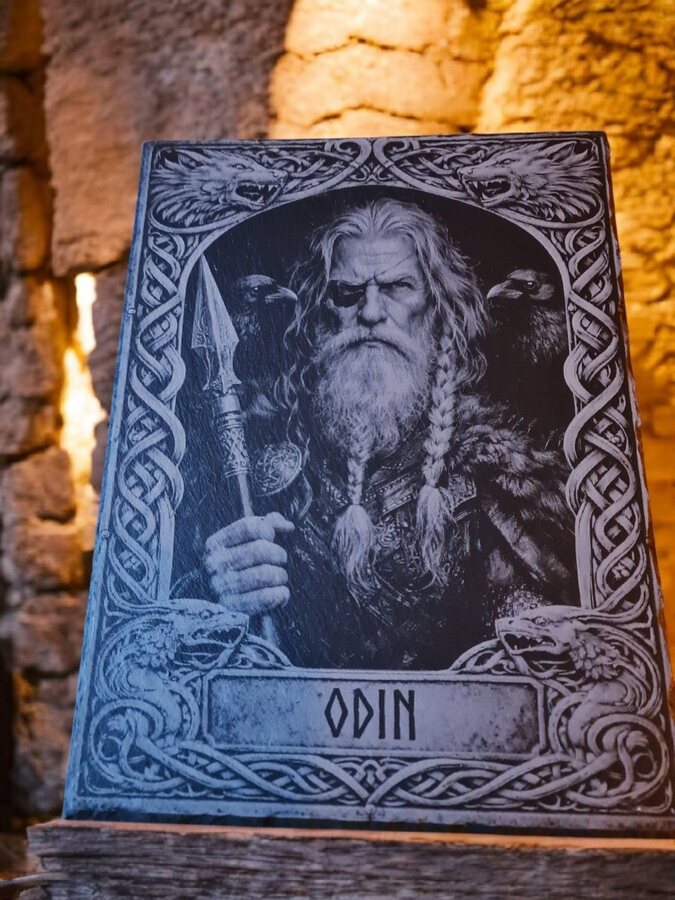
If you would like Odin's ravens on slate, wood or glass, we suggest working from real historical models rather than fantasy logos.
First, the composition of the Bejsebakke brooches: two ravens, mirrored as if on two shoulders, compact and calm. Second, the Lejre image: a seated figure with a bird on either side, as a suggestion rather than a copy. Third, the line work of the Viking animal styles such as Ringerike or Urnes, with long, interlaced wing and tail lines. If you want text, choose a real line instead of an invented "rune spell", for instance the opening of the Grímnismál stanza, Huginn ok Muninn fljúga hverjan dag. If you want runes with a Viking Age flavour, the Younger Futhark fits better than the Elder.
A pair of ravens also makes a fine gift for two people who belong together: two who fly different ways and still return to the same place. That is not in the Edda. It is our own reading, and we tell you so.
What do Huginn and Muninn mean? Huginn comes from Old Norse hugr ("thought, mind, courage"); Muninn belongs with munr and muna ("mind, desire" and "to remember"). The usual translation is "Thought" and "Memory", though the two meanings overlap considerably.
Where are Odin's ravens mentioned? By name in the eddic poem Grímnismál (stanza 20), in Snorri's Gylfaginning (chapter 38) and in the list of poetic terms in Skáldskaparmál. Without names, they appear in Ynglinga saga, chapter 7.
When do Huginn and Muninn fly out? According to Snorri, Odin sends them out at daybreak and they return by breakfast time, in the morning. Then they sit on his shoulders and report into his ears.
Is there archaeological evidence for Odin's ravens? There are images that very probably show Odin with birds: helmet plates from Vendel, bracteates, the Lejre figure, Thorwald's Cross and raven brooches. No inscription naming the birds Huginn and Muninn is known.
What was the Viking raven banner? A war banner that the Anglo-Saxon Chronicle records as captured in 878 under the name "Raven". Later legends and sagas, for example about Sigurd of Orkney at Clontarf in 1014, credit such banners with magical power.
For courage. For remembrance. For legends that live on.
Odin · Sleipnir – Odin's steed · Geri & Freki – Odin's wolves · Valhalla · Seiðr – the magic.
All Beings & Creatures articles →
Before Brokkr and Sindri forged the hammer, others were at work: the sons of Ívaldi. Three wonders came out of their …
Read more →Far below, where the roots of the World Tree reach down into cold and darkness, lies a creature that never rests …
Read more →Between crown and root of the World Ash Yggdrasil scurries a small, restless creature: Ratatoskr, the squirrel. It …
Read more →Without the giants there would be no Norse world – in the most literal sense. Out of a giant it arose, against the …
Read more →