For three centuries Orkney was ruled by earls who served two kings and fully obeyed neither. They fought in Ireland, in Scotland and against each other; one was cut down by his cousin and venerated as a saint, another built him a cathedral. Almost everything we read about them comes from a single source: a saga written down by an Icelander around 1200, far away and long afterwards. That does not make it worthless. But it means every sentence has to be tested – against annals, against runes, against what lies in the ground.
Orkneyinga saga, the "history of the Orkney men", tells the story of the earls from the settlement to the late twelfth century. It was written by an unknown Icelander, probably around 1200; the version read today is a reworking from the early thirteenth century. It survives complete mainly in Flateyjarbók, a great compilation manuscript of the late fourteenth century. In the Middle Ages it was usually just called "Jarla saga", the saga of the earls. Snorri Sturluson knew it and used it for his histories of the kings.
The saga works with genealogies, oral tradition and above all skaldic verse that is older than the prose. The closer it comes to its own time, the more reliable it becomes. For the ninth and tenth centuries, however, three hundred years lie between event and writing. The historian Alex Woolf has put the problem roughly like this: it is like writing a history of the Second World War from Hollywood films. That is pointed. But it hits the mark.
According to the saga it all begins with Harald Fairhair. On an expedition west the king subdued the islands and gave them to Rögnvald, earl of Møre, in compensation for a son killed in the fighting. Rögnvald passed them to his brother Sigurd, the first earl. Sigurd conquered large parts of northern Scotland together with Thorstein the Red. His end is famous: he killed a Scottish opponent, Máel Brigte the Tusk, tied his head to his saddle – and the protruding tooth grazed his leg as he rode. The wound festered and Sigurd died.
It is a good story and a warning at once. Whether Harald Fairhair was ever in the west is disputed among historians; no contemporary text says so. The founding of the earldom by royal gift fits above all the claims of Norwegian kings of the twelfth and thirteenth centuries, when the saga was written. All that is certain is that Scandinavians settled in Orkney in the ninth century. When and how that became an earldom lies in the dark.
An earl of Orkney only becomes truly tangible with Sigurd Hlöðvisson, called the Stout. The saga tells how Olaf Tryggvason gave him a choice in 995: baptism or death. It also tells of a raven banner woven by his mother, which brought victory to the army but death to the man who carried it. Both stand only in Icelandic texts.
But then Sigurd appears in a source that could have seen him with its own eyes. The Annals of Ulster list among the dead of the battle of Clontarf in 1014:
Siuchraid mac Loduir, iarla Innsi Orcc
"Sigurd son of Hlöðver, earl of the Orkney Isles"Annals of Ulster, entry for 1014; our rendering
This is the oldest contemporary mention of the earldom at all. Sigurd had crossed to Ireland with warriors from the isles to help Leinster and Dublin against Brian Boru, and fell on Good Friday at Clontarf. More on the towns he fought for under the Ostmen.
Sigurd's son Thorfinn, born around 1009, is said to have been a grandson of the Scottish king Malcolm II through his mother. He counts as the mightiest of all the earls, and here the saga has a witness: the Icelandic skald Arnórr, called Jarlaskáld, composed a praise poem on Thorfinn whose stanzas the saga quotes word for word. They tell of sea battles and campaigns in Scotland. Other details – the extent of his realm, an opponent named Karl Hundason whom no Scottish source knows – cannot be checked.
According to the saga Thorfinn travelled to Rome late in life, then settled at Birsay and built a Christ Church there, the first bishop's seat in Orkney. Here an outside source helps: around 1075 Adam of Bremen reports that Archbishop Adalbert consecrated a bishop Thorolf for Orkney, with his seat at Blascona – generally taken to be Birsay. The Orkney people, Adam says, had asked for him themselves.
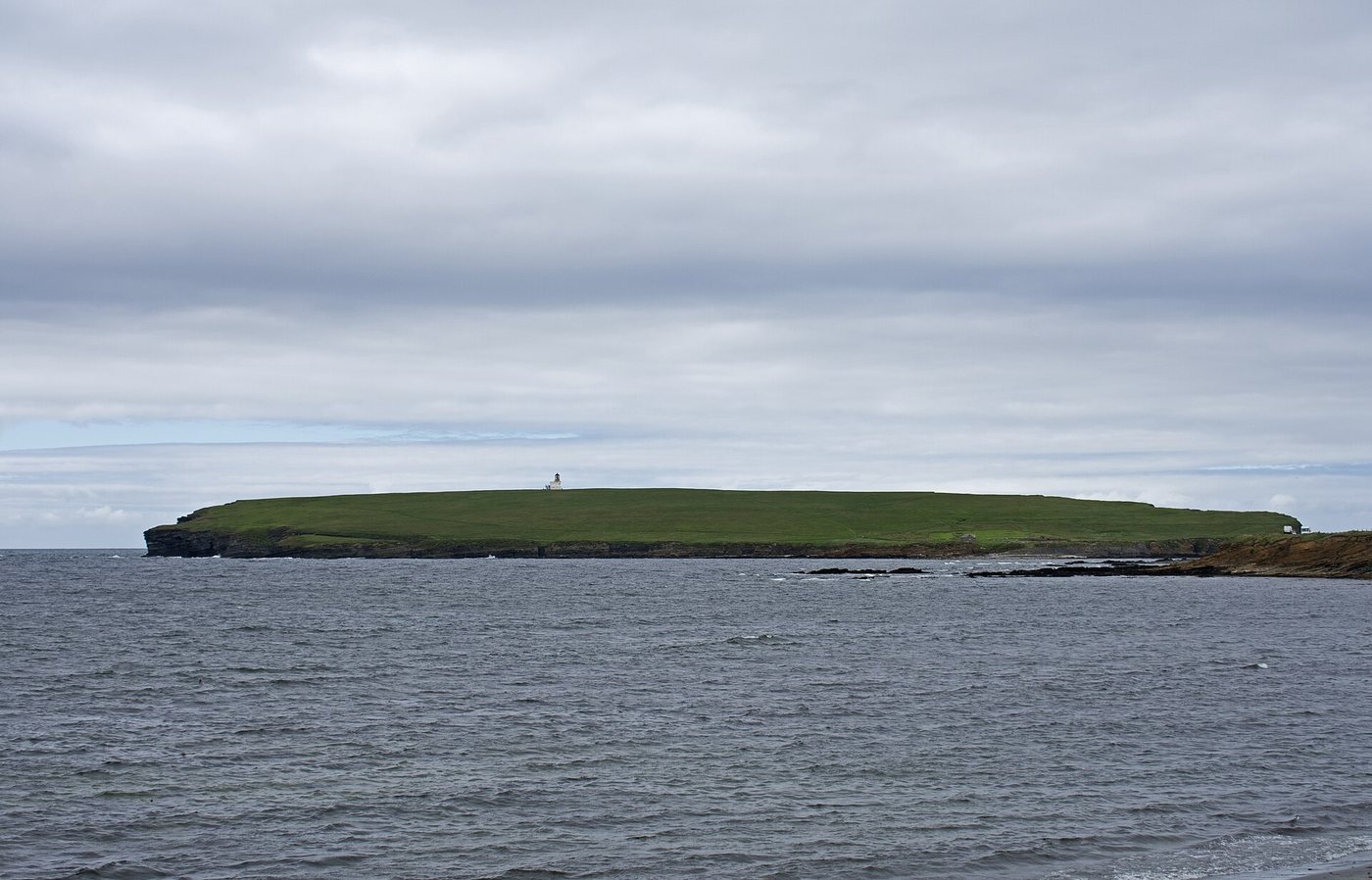
Where exactly Thorfinn's seat lay is open. For a long time it was placed on the Brough of Birsay, a tidal island that can be reached dry-shod only at low water. There are Pictish traces, Norse longhouses and a twelfth-century church. Today many scholars rather place Thorfinn's hall on the main island opposite, in the present village of Birsay.
After Thorfinn's death two earls usually shared the islands, and it rarely went well. Magnus Erlendsson and his cousin Hákon Pálsson at first ruled jointly. The saga portrays Magnus as a different kind of man early on: in 1098, on the expedition of the Norwegian king Magnus Barelegs, he refused to fight and sang psalms on board during the battle in the Menai Strait.
Around 1117 the cousins met for peace talks on the island of Egilsay. Hákon came with more men than agreed. Magnus was seized and killed; the axe struck his head. Tradition has Hákon's cook Lífólfr deliver the blow because none of the retainers would. Soon miracles were reported at the grave; in the 1130s Bishop William raised the bones, and Magnus was venerated as a saint.
In 1919 workmen in Kirkwall cathedral found a wooden box of bones behind a loose stone in a choir pillar. The skull shows a severe cut wound. In 2025 the wood of the box, pine, was radiocarbon-dated: the tree was most likely felled between 1034 and 1168. That fits Magnus. It proves nothing – medieval relics are not always what they claim to be. But here saga and evidence do not contradict each other.
Magnus's nephew Kali Kolsson came from Agder in Norway. In 1129 the Norwegian king made him earl, and he took the name Rögnvald. To actually win Orkney, the saga says, he vowed a stone church for his uncle, finer than any other in the islands. In 1137 building began on St Magnus Cathedral in Kirkwall, in red and yellow sandstone, in the Romanesque style. The masons probably came from the circle of Durham Cathedral. The church still stands and is counted the northernmost medieval cathedral in Britain.
Rögnvald is also the earl who wrote verse himself. In 1151 he set out on a pilgrimage to Jerusalem and came back in 1153; the saga tells of it with much fighting, feasting and poetry but little of the Holy Land. In 1158 he was killed in Caithness. He is said to have been canonised in 1192, though no papal document confirms it.
How well the saga knows its places shows at Orphir. It describes a Yule feast around 1136 in the earl's drinking hall, before whose door stood a magnificent church. At Orphir there are indeed the remains of a twelfth-century round church, modelled on the Holy Sepulchre in Jerusalem, and next to it the foundations of a great farm, the Earl's Bu. The scene in the hall may be embroidered. The setting is real.
Maeshowe on Mainland is a Neolithic chambered tomb built around 2800 BC. When James Farrer opened it in 1861 he found some thirty twelfth-century runic inscriptions on the walls, one of the largest collections in a single place. They are not dedications but graffiti: names, boasts, praise of a beautiful woman, a carver who thinks himself the most rune-skilled man west of the ocean.
Jórsalafarar brutu Orkhaug.
"Jerusalem-farers broke into the Orkhaug."Runic inscription at Maeshowe, 12th century; normalised reading after Michael P. Barnes, our rendering
The saga knows the mound as Orkahaugr. It tells how Earl Harald Maddadsson and his men took shelter there at Yule during a snowstorm in the 1150s, and that two of them lost their wits. Whether the "Jerusalem-farers" of the inscription were men from Rögnvald's pilgrim fleet is tempting but unproven. What is certain is that twelfth-century Norsemen climbed into a five-thousand-year-old tomb and left their names there.
Orkney's archaeology tells a different story from the saga – less about earls, more about settlers. On Sanday in 1991 a boat burial was excavated that a farmer had spotted on the shore at Scar in 1985: a man of about thirty, a woman of about seventy and a child, buried between about 875 and 950, with sword, arrows, combs, gaming pieces and a whalebone plaque. At Skaill a boy found in 1858 the largest Viking-age silver hoard in Scotland, more than a hundred pieces of jewellery, coins and hacksilver, buried around 950 to 970.
Such finds show wealth, long-distance trade and an elite that buried its dead in the Scandinavian way. They do not show an earl. That there was one is proved by the annals from 1014, by Adam of Bremen, the skaldic verse and in the end the cathedral. The Norse line of earls ended in 1231; Scottish earls followed. In 1468 the Dano-Norwegian king pledged Orkney to Scotland as a dowry, and Shetland followed in 1469. The pledge was never redeemed.
Contemporary evidence is Sigurd's death at Clontarf in the Annals of Ulster, the Orkney bishop in Adam of Bremen, and Thorfinn's deeds in Arnórr's stanzas, as far as one trusts verses that only the saga preserves.
Archaeological evidence is Norse settlement and graves such as Scar, hoards such as Skaill, the buildings at Birsay and Orphir, the cathedral of 1137, the Maeshowe runes and a skull with a cut wound in a box of the eleventh or twelfth century.
Later tradition is almost everything else: the gift by Harald Fairhair, Máel Brigte's tooth, the forced baptism, the raven banner, the psalms in the Menai Strait, the details of Magnus's death.
Modern interpretation covers the exact site of Thorfinn's hall, the link between the Jerusalem-farers and Rögnvald, and the attribution of the bones to Magnus. What remains is an island realm between Norway, Scotland and Ireland whose church still stands. For courage. For memory. For legends that live on.
The Vikings in Ireland, Scotland & the Isles · The Gall-Goídil · The Ostmen · The Faroese · The Icelanders · Cnut the Great.

