Cnut the Great (Old Norse Knútr inn ríki, Danish Knud den Store) was the Danish Viking prince who conquered England in 1016, became King of Denmark in 1018/19 and took Norway in 1028 – the realm historians call the North Sea empire. Son of Sweyn Forkbeard and grandson of Harald Bluetooth, he married his English predecessor's widow and stood in the front row at an imperial coronation in Rome. Here is what the sources really say about him – and what the famous story of Cnut and the tide actually means.
Picture a young man, perhaps in his early twenties, crossing the North Sea with a fleet in the summer of 1015. His father is dead, the English have chased him out, and his elder brother sits on the Danish throne. Twenty years later this man is buried in Winchester as King of England, Denmark and Norway, a friend of the emperor and a benefactor of monasteries from Canterbury to Saint-Omer. No Viking ever went further.
At Glanz & Gravur we engrave runes, ships and Norse kings on slate, wood and glass. Cnut is a special case: he stands exactly on the threshold between the longship and the bishop's crozier. So we keep contemporary sources, later storytelling and legend clearly apart.
Cnut belonged to the Jelling dynasty, the first Danish royal house we can trace with any confidence. His great-grandfather was Gorm the Old, his grandfather Harald Bluetooth – the king who boasted on the great Jelling stone that he had made the Danes Christian, and whose nickname now lives in every smartphone (see Your Phone Carries a Viking King). His father was Sweyn Forkbeard, who had pushed Harald off the throne around 986/87.
Nobody knows exactly when Cnut was born; estimates range roughly from 990 to 1000. His mother is just as elusive. Later Scandinavian sagas name a Gunnhild, daughter of a Wendish king, while the chronicler Thietmar of Merseburg speaks of a daughter of the Polish ruler Mieszko I. Whether both refer to the same woman is debated. What is certain is that Cnut had an elder brother, Harald, who succeeded their father in Denmark.
Around the year 1000, England was the richest kingdom in north-western Europe – and had been a target for Danish fleets for decades. King Æthelred II paid ever larger sums to make the raiders go away, the tribute we now call Danegeld. In 1013 Sweyn Forkbeard came not to collect but to conquer. Cnut came with him; according to the Anglo-Saxon Chronicle he was left in charge of the ships and hostages at Gainsborough on the Trent while his father subdued the country. Æthelred fled to Normandy, to the family of his wife Emma.
Then Sweyn died on 3 February 1014. The Danish fleet proclaimed Cnut king, but the English recalled Æthelred, and Cnut had to withdraw. The Chronicle reports that at Sandwich he put his father's English hostages ashore with their hands, noses and ears cut off. Not the start you would expect of a future model king – but an honest reminder of where this man began.
In late summer 1015 Cnut returned, with around 200 ships according to later estimates. Seasoned men stood at his side: Thorkell the Tall, a commander whom saga tradition links with the Jomsvikings, and Earl Eiríkr Hákonarson of the Norwegian Earls of Lade. Soon Eadric Streona, one of the most powerful English ealdormen, defected to him – not the last time that man would change sides.
On 23 April 1016 Æthelred died in London. The Londoners chose his son Edmund as king, a fighter whose stubbornness earned him the name "Ironside". Battles followed at Penselwood, Sherston, Brentford and Otford, along with repeated sieges of London. Edmund won more than once but never managed to break the Danes.
The decision came on 18 October 1016 at Assandun. Whether that is Ashingdon in south-east Essex or Ashdon in the north of the county is still argued over. The Chronicle is clear on one point: Eadric Streona and his men fled in the middle of the battle, and Edmund's army was crushed. The Encomium Emmae Reginae, written in 1041/42, adds that the Danes carried a raven banner of white silk that supposedly showed a raven in wartime – a lovely detail, but one from a work of praise.
After Assandun the two kings met on an island in the Severn near Deerhurst in Gloucestershire and divided the kingdom: Edmund kept Wessex, Cnut took the land north of the Thames, and London paid tribute to the Danes. Whether they really agreed that the survivor would inherit everything, as later chroniclers claim, is not certain.
The partition did not last anyway. Edmund died on 30 November 1016, only weeks after the battle. The Chronicle gives just the date. Twelfth-century writers tell of murder, some in decidedly lurid versions, but none of it is proven; a battle wound or illness is just as plausible. What we do know is that Cnut now became king of all England and was crowned in London in 1017.
The first months were bloody. In 1017 Cnut had Eadric Streona and several other English magnates executed. Edmund's younger brother Eadwig was killed, and Edmund's infant sons were sent abroad; one of them, Edward "the Exile", grew up in Hungary. Cnut divided the country into great earldoms: Thorkell received East Anglia, Eiríkr of Lade Northumbria, Eadric briefly Mercia.
In July 1017 Cnut married Emma, Æthelred's widow and sister of the Duke of Normandy. Normandy was the legacy of Rollo – a Viking principality itself, by then French-speaking. The match killed several birds with one stone: it gave Cnut legitimacy at the English court, and it gave the Normans less reason to back Emma's sons by Æthelred, Edward and Alfred, with an army.
Family life was not simple. Cnut already had a partner, Ælfgifu of Northampton, from a powerful Midlands family, and two sons by her, Sweyn and Harold (later nicknamed "Harefoot"). With Emma he had a son, Harthacnut, and a daughter, Gunnhild, who in 1036 married the future Emperor Henry III. Two women, two lines of sons – a charge waiting to go off after Cnut's death.
In 1018 Cnut levied a tribute that dwarfed everything before it: according to the Anglo-Saxon Chronicle, 72,000 pounds from the whole of England plus a further 10,500 pounds from London. With it he paid off most of his army and sent it home, keeping forty ships as a standing fleet. In Scandinavia you can still read about that money in stone.
The same year, Danes and English met at Oxford and agreed to live under "Edgar's law", the code of the tenth-century King Edgar that stood for good order. The message was plain: the new king meant to rule as heir to English tradition, not as a foreign occupier.
In 1018 or 1019 Cnut's brother Harald died. Cnut sailed to Denmark and took the crown. From this time comes a letter to the English, preserved as an entry in a gospel book at York, in which he assures them he has averted a danger threatening England and orders his officials to judge justly.
In Denmark he installed his brother-in-law Ulf, husband of his sister Estrid, as regent. Around 1026 Cnut fought at the mouth of the Helgeå in Scania against an alliance of King Olaf Haraldsson of Norway and the Swedish king Anund Jacob. The Anglo-Saxon Chronicle says the Swedes held the field; even so, Cnut remained the dominant power in the North. At Christmas 1026 he was killed at Roskilde – on Cnut's orders and in church, according to later tradition. Ulf's son Sweyn Estridsen later became King of Denmark and told Adam of Bremen much of what we know about this era.
At Easter 1027 Cnut was in Rome. Pope John XIX crowned Conrad II emperor, and among the guests were the King of England and Denmark and King Rudolf III of Burgundy. Harald Bluetooth's grandson had arrived in the inner circle of Christian Europe's princes.
The journey had hard-nosed aims. In his letter to the English of 1027, preserved by John of Worcester and William of Malmesbury, Cnut styles himself "king of all England and Denmark and of the Norwegians and of part of the Swedes". He reports that he negotiated with emperor, pope and princes so that English merchants and pilgrims on the road to Rome would be spared tolls and harassment, and so that English archbishops would no longer pay huge sums for their pallium – the woollen band of office granted by the pope. Then comes a remarkable line: he vows to amend his life, to rule justly, and to put right whatever wrongs he committed in his youth.
Genuine remorse or clever self-presentation? Probably both. Rome brought a practical gain as well: according to later reports, Conrad II ceded to Cnut the March of Schleswig north of the Eider, the river that would mark Denmark's southern border for centuries.
In 1028 Cnut sailed to Norway with a fleet. Olaf Haraldsson, the future saint, had lost the backing of most of the magnates, many of whom Cnut had won over with gifts. Olaf fled through Sweden to the Rus. Cnut was acclaimed king at Trondheim and installed Håkon Eiriksson of the Lade family as his regent. Skalds such as Óttarr svarti praised Cnut in court poems that survive only in later Icelandic manuscripts.
But Håkon drowned in the Pentland Firth around 1029/30. Olaf saw his chance, returned – and fell on 29 July 1030 at the Battle of Stiklestad against an army of magnates and farmers loyal to Cnut. Fighting on Olaf's side was his fifteen-year-old half-brother Harald. He survived wounded, fled east and returned decades later as Harald Hardrada – the man who in 1066 would fight at Stamford Bridge for Cnut's old prize, England.
Cnut now handed Norway to his son Sweyn and Sweyn's mother Ælfgifu. Their rule was remembered as harsh; new dues and obligations made them hated, and later saga tradition calls these years "Ælfgifu's time". Meanwhile the cult of the dead Olaf grew fast. Around 1035 the Norwegians drove Sweyn out and brought back Olaf's son Magnus. Cnut's Norwegian kingship lasted only a handful of years.
This is where it gets exciting for us as engravers. In Sweden there are around thirty runestones mentioning England – the so-called England runestones. A few of them name Cnut outright. Here the North Sea empire appears from the perspective of the men who crossed the sea for silver.
Even terser is U 194 from Väsby: a man named Alli raised it in memory of himself and proudly noted that he "took Knútr's payment in England", followed by a Christian "May God help his spirit". English silver and the salvation of the soul in two short lines – that is Cnut's era in a nutshell.
Norway has a witness too: the stone N 184 from Galteland (Aust-Agder) commemorates a man who "died in the retinue when Knútr attacked England". Other stones, such as the Lingsberg pair (U 240/241), also record gelds in England but do not name Cnut. Cnut's name, then, appears on only a few stones.
A striking contrast is offered by the stones for the Ingvar expedition, which set out eastwards around 1036–1041 and mostly never came back. The money lay west; the east mostly brought death far from home.
Cnut's most important tool in England was not a sword but a bishop: Wulfstan, Archbishop of York and a famous preacher who had already drafted laws for Æthelred. He wrote the great codes now known as I Cnut and II Cnut, probably promulgated at a Christmas assembly in Winchester around 1020/21.
I Cnut deals with church matters: protection of churches, dues, feast days, the duties of clergy. II Cnut covers secular law: keeping the peace, theft, compensation, the rights of widows, abuse of official power. Notably, it bans heathen practices – the worship of idols, sun and moon, fire and flood, wells, stones and trees. That such a clause was still written down around 1020 suggests that old customs had not vanished entirely among the Danes of the Danelaw and beyond – or at least that Wulfstan feared they had not.
Cnut knew how much his rule depended on the Church. In 1020 he had a minster consecrated on the battlefield of Assandun – atonement and memorial in one. In 1023 he had the remains of Archbishop Ælfheah, killed by a Danish army at Greenwich in 1012, solemnly translated from London to Canterbury. A Dane honouring the Danes' martyr: a procession can hardly be more political.
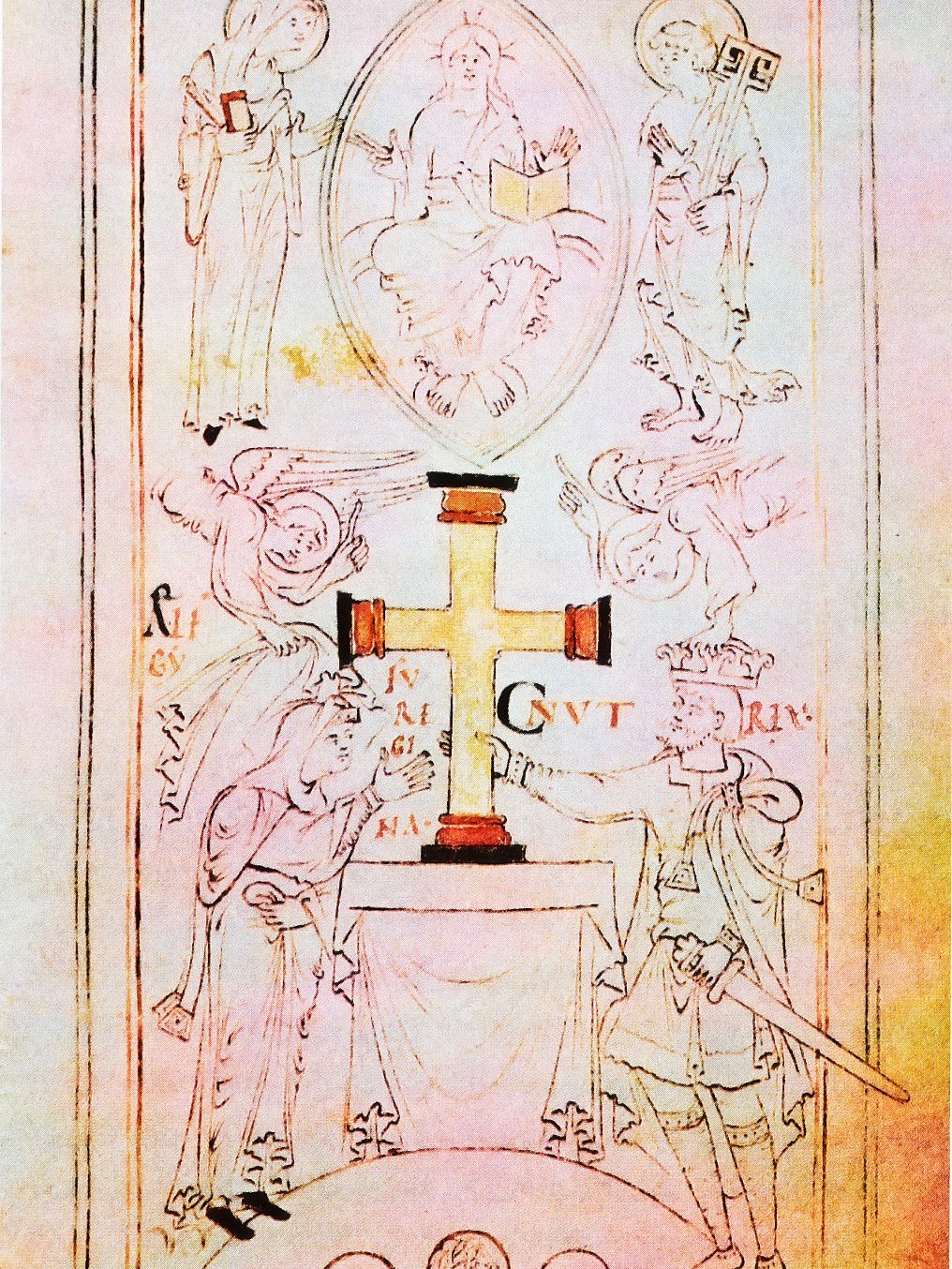
The finest image of this self-presentation is in the New Minster Liber Vitae from Winchester, a manuscript made in 1031 (now British Library, Stowe MS 944). On its opening page Cnut and Emma together place a great golden cross on the altar while angels bring down a crown and a veil and Christ sits enthroned above them. It is one of the very few contemporary images of Cnut – and it shows not a sea-warrior but a Christian king.
A pious man? The sources disagree. Cnut had opponents killed and kept two wives at once. He understood that piety was part of power – which does not rule out that he meant it.
Around 1000, England had probably the best-organised coinage in Europe: dozens of mints, regular recoinages with changing designs, and the moneyer's name on every coin. Cnut took this system over without breaking it. In the usual numismatic classification his reign produced three main types of silver penny: the Quatrefoil type, the Pointed Helmet type showing the king in a pointed helmet, and the Short Cross type, all bearing his name, usually as CNUT REX.
In Denmark, too, Cnut had coins struck on the English model, among other places at Lund, partly by English moneyers. The beginnings of Scandinavian coinage lie earlier, though – see Ribe and the North's first coins.
And now the most famous story of all. Nearly everyone has heard it: the megalomaniac king sits on the beach and orders the sea to retreat. In British politics "King Canute" is still shorthand for anyone trying to hold back the inevitable.
The oldest version comes from the Historia Anglorum of Henry of Huntingdon, an English cleric who began his history around 1130, roughly a century after Cnut's death. In it Cnut has his throne set on the shore as the tide comes in and commands the water not to wet his feet and robes. The sea, of course, ignores him. Cnut jumps back and declares:
"Let all the inhabitants of the world know how empty and worthless is the power of kings, and that none deserves the name of king but He whose will heaven, earth and sea obey by eternal laws."— after Henry of Huntingdon, Historia Anglorum VI, own translation
Henry adds that Cnut never wore his golden crown again but hung it on a crucifix. He names no place. Only later did Westminster, Bosham, Southampton and even Gainsborough on the Trent claim the scene – Southampton still has a sign on Canute Road.
Cnut died on 12 November 1035 at Shaftesbury in Dorset, probably no older than forty. The sources do not say of what. He was taken to Winchester and buried in the Old Minster, the Anglo-Saxon cathedral where earlier kings of Wessex lay. Emma was buried beside him in 1052, as was Harthacnut before her.
He did not rest in peace. After the Norman Conquest the Old Minster was demolished and replaced by the present cathedral, and the bones of the old kings and bishops went into mortuary chests, which today stand on the screens around the presbytery. During the English Civil War, Parliamentarian soldiers scattered the bones; after the Restoration they were gathered up again – but in no particular order.
Norway was already ruled by Magnus the Good, Olaf's son. Denmark was held by Harthacnut, Emma's son, who was tied down by the conflict with Magnus and could not come to England. There Harold Harefoot, Ælfgifu's son, filled the gap: first as regent, from 1037 as king. Emma was forced to withdraw to Flanders, where the Encomium was written soon after. In 1036 Emma's son Alfred by her first marriage was seized in England, blinded, and died of his injuries.
Harold died in 1040 and Harthacnut took England, only to die in 1042 at a wedding feast in Lambeth – "as he stood at his drink", says the Chronicle. With Edward the Confessor the old English dynasty returned. The Danish episode was over, but its echo was not: because Magnus and Harthacnut had supposedly made a succession pact, Harald Hardrada claimed England in 1066. That ended at Stamford Bridge – and shortly afterwards at the Battle of Hastings.
Cnut was no Viking romantic but the Viking Age's most successful entrepreneur. Fleets, English money, the Church and the Norwegian earls – he held it all together for almost twenty years. The runestones of Uppland show how far his reach extended: farmers around Lake Mälaren knew who paid in England.
Anyone telling his story should not smooth over the cracks: the mutilated hostages at Sandwich and the golden cross in the Liber Vitae, the killing in Roskilde and the letter about a reformed life. For more royal portraits, see the great kings of the Viking Age and our article on the Vikings in England.
Who was Cnut the Great? Cnut the Great was a Danish king of the Jelling dynasty and son of Sweyn Forkbeard. He became King of England in 1016, King of Denmark in 1018/19 and King of Norway in 1028, and died in 1035.
How did Cnut become King of England? He defeated Edmund Ironside at Assandun on 18 October 1016. After a partition of the kingdom Edmund died on 30 November 1016, and Cnut took over all of England.
What is the story of King Canute and the tide? According to Henry of Huntingdon (12th century), Cnut commanded the tide to retreat in vain to show his courtiers how limited a king's power is. It is a lesson in humility, not arrogance, and its historicity is uncertain.
Where is Cnut the Great buried? In Winchester. His remains now lie mixed with others in the cathedral's mortuary chests and have not been securely identified.
What was the North Sea empire? It is the modern name for the personal union of England, Denmark and Norway under Cnut, at times with part of Sweden. It fell apart within a few years of his death in 1035.
Are there runestones that mention Cnut? Yes, a few: U 344 at Yttergärde mentions a geld paid by Cnut, U 194 at Väsby "Knútr's payment in England", and the Norwegian Galteland stone recalls Cnut's attack on England.
For courage. For remembrance. For legends that live on.
Harald Bluetooth · Stamford Bridge 1066 · Ragnar's sons · Rollo of Normandy · The Danevirke.
All History & Finds articles →
Without their ships the Vikings would never have become Vikings. The longship was the high technology of its time …
Read more →It is not two centimetres tall and weighs nine grams – and yet it set off one of the most exciting debates in Norse …
Read more →To a farmer from Uppland, „the great city" was as unimaginable as another planet. Constantinople had walls that fire …
Read more →