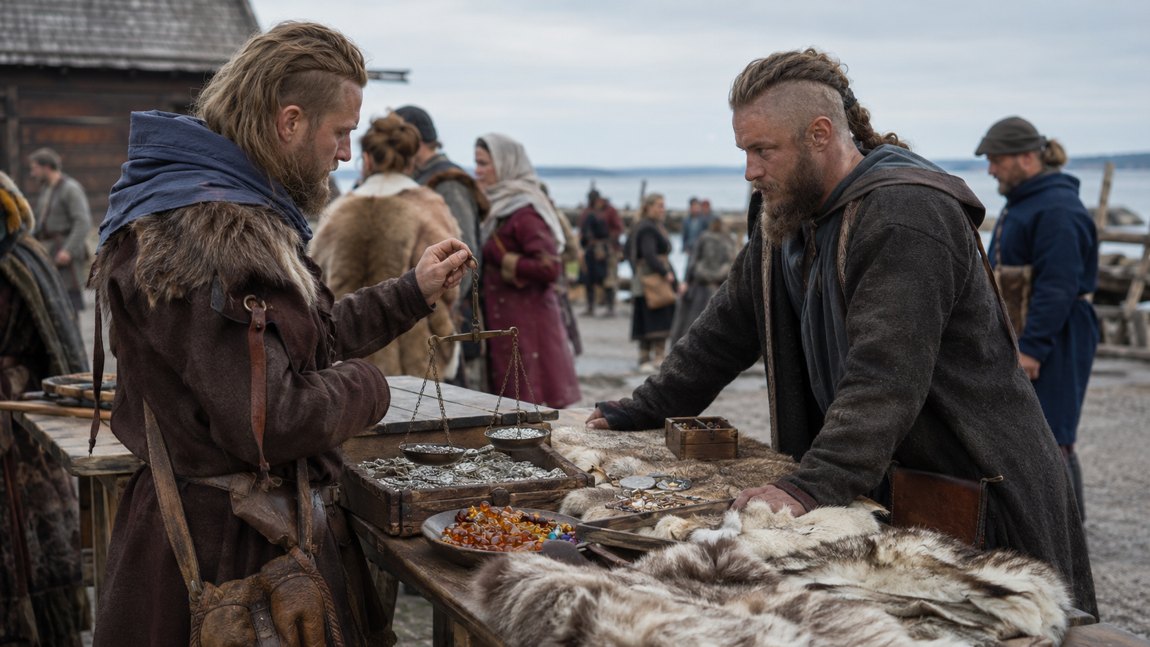
Ribe, on the North Sea coast of Jutland, is the oldest town in Denmark and one of the oldest in Scandinavia: tree-ring dates show that its marketplace was laid out in regular plots around 704–710. Bead makers, bronze casters and comb makers worked here, and hundreds of tiny silver coins of the "Wodan/monster" type lay in its soil – perhaps the first coins actually struck in the North. Here is what the excavations prove, where scholars still disagree, and how Ansgar won permission to build one of the North's first churches here.
Visit Ribe today and you see the cathedral first, then the crooked half-timbered houses and the storks over the marsh. The oldest layer of the town lies a few hundred metres away, on the north bank of the little river Ribe Å. Here, a few kilometres from the Wadden Sea, something new began around 700: a place that lived not from the plough but from exchange.
The location was well chosen. Ribe Å was navigable for the shallow-draught boats of the day, and the coast led south to the Frisians and on to the great Rhine port of Dorestad. Behind lay the farmland of Jutland, full of households that needed things they could not make themselves.
Only the excavations from the 1970s onwards revealed how deep that history runs. In places the occupation layers are more than two and a half metres thick. For archaeologists that is a gift: the market can be followed almost decade by decade, layer by layer, like the pages of a book.
How old is Ribe really? The answer comes from oak. Dendrochronology, or tree-ring dating, matches the sequence of wide and narrow growth rings in a timber against regional reference curves, and can often pin the felling date to within a few years.
For Ribe the result is remarkably sharp. Claus Feveile, the archaeologist who has worked on the site for decades, dates the laying out of the regular plot system to the years between about 704 and 710. The marketplace was partly established on a layer of naturally wind-blown sand; little seems to have stood there before. The Danish encyclopaedia Den Store Danske gives "around 705", and Ribe VikingeCenter rounds it to "around 700". So when you read "founded about 700", that is not a legend, just a rounded number on very solid ground.
"Oldest town in Scandinavia" deserves a small asterisk. What counts as a town depends on the definition, and sites such as Åhus in Scania or Groß Strömkendorf on the Bay of Wismar (probably the Reric named in Frankish sources) are also early. For Denmark, though, no other place has such a long, continuous and densely documented urban history starting so early.
What did this early market look like? Picture a long, narrow strip of land, about 65 metres wide and more than 200 metres long. A narrow street ran down the middle, and on both sides lay long, slim plots separated by small ditches and wattle fences. Feveile reckons with at least 40 to 50 of them.
That order is the truly striking part. Someone surveyed and divided the ground before the first traders arrived. It points to an authority able to allocate land and enforce rules, perhaps an early Danish king or a powerful regional lord. That person has no name: for the early eighth century the written sources are almost completely silent about Jutland.
For a long time the standard view was that Ribe was a seasonal market for its first three quarters of a century. Traders and craftspeople came in summer, pitched tents and light huts, worked, sold and left again; permanent houses only appeared around 780/790 at the latest. The excavations of 2017–18 have nudged that picture. According to Ribe VikingeCenter, solid buildings already stood on some plots around 710. The question is not fully settled, and most likely there were both: permanent residents and summer visitors.
We know what people did in Ribe from their rubbish, and their rubbish is rich. The plots produced workshop waste showing that this was not just a place of trade but of production on a serious scale.
Glass beads: In the eighth century Ribe was a centre of bead making. Craftspeople melted down coloured glass – thousands of pieces have been found – including mosaic cubes, so-called tesserae, which probably came from northern Italy, perhaps recycled from old mosaics. From this raw material they wound beads onto iron rods over a fire. We describe the craft in detail in our piece on the Viking bead maker.
Bronze casting: Clay moulds, crucibles and casting waste show that jewellery was cast here, chiefly brooches and mounts in Scandinavian animal style. That matters: these smiths were not just copying foreign goods but producing the taste of their own local customers.
Combs: Comb makers worked antler, including reindeer antler, which did not grow in Jutland but came from Norway. Composite combs of several plates riveted with iron pins were everyday objects and small works of art at once. The path from antler to finished comb is traced in our article on comb makers and bone carvers.
Add to that amber – Feveile lists almost 13,000 amber objects and raw lumps weighing more than 6.6 kilograms, from rough pieces to finished beads and gaming pieces (more on the material in Amber – the gold of the North) – plus leather and shoemaking, textile work, needles and spindle whorls.
The imports show which way Ribe was facing. More than 2,000 fragments of basalt-lava quernstones, together over 150 kilograms, come from the area south of Cologne, from the quarries of the Eifel. They travelled down the Rhine and most likely via Dorestad to the North Sea coast. Around a tenth of the pottery is imported: Tating ware jugs, Badorf and Mayen wares, relief-band amphorae from the Rhineland. From the north came soapstone vessels and objects of whalebone.
The main partners were the Frisians, who dominated the North Sea in the eighth century, and through them the Frankish realm and England. Ribe was a northern branch of a network of trading places ringing the North Sea: Dorestad, Domburg and Quentovic on the continent, Hamwic, Lundenwic and Ipswich in England. Archaeologists call such places emporia (singular: emporium), from the Latin word for a trading station.
How this world connects with the later long-distance routes to the east is told in our overview of Viking trade.
In 2017 and 2018 the Museum of Southwest Jutland and Aarhus University opened another trench in Ribe, this time with every tool of modern archaeology. The project was called Northern Emporium, led by Søren M. Sindbæk together with Claus Feveile. The team recorded every layer in three dimensions, took soil samples for micromorphology and geochemistry, and collected insect remains, plant material and animal bones. More than 100,000 finds came out of the ground.
The results are published in two volumes: Northern Emporium, Vol. 1: The making of Viking-age Ribe (2022) and Vol. 2: The networks of Viking-age Ribe (2023). They show a place far more layered than once thought: traders, sailors, weavers, tailors, comb makers, bead and metal workers, with traces of furniture and even musical instruments.
The dating is the showpiece. In one floor layer the team identified the radiocarbon spike left by a massive solar storm in the year 775 – the so-called Miyake event, named after the physicist Fusa Miyake, who first identified such spikes in 2012. That gave a whole sequence of layers, with around 140 radiocarbon dates, an anchor accurate to the year. The study, led by Bente Philippsen, appeared in Nature in 2022.
Two results made people sit up. First, goods from Norway were arriving in Ribe by ship as early as about 750. Second, around 790, give or take ten years, large quantities of glass beads from the Middle East suddenly appear in Ribe, while local bead production collapses at roughly the same time. That is exactly when the first Viking raids hit England. The seafaring network of the North was up and running decades before the raids began.
A market needs money, and in Ribe it lies in the ground by the hundred. The coins are sceattas: small, thick silver pieces usually weighing around one gram, struck in England and Frisia in the late seventh and eighth centuries. The Old English word sceatt simply means "wealth, money".
In 2008 Claus Feveile took stock. More than 300 sceattas were then known from Denmark and its surroundings – 318 in his table – and 216 of them came from Ribe or its immediate area. Of the Ribe coins whose type could be identified, 164 out of 204, or about 84 to 85 per cent, belonged to a single type: Series X, also known as the "Wodan/monster" type.
That dominance stands out. In Ribe one kind of coin had the field almost to itself. On Feveile's analysis it ruled circulation in Ribe from about 725 to 800/820 – which also means these coins stayed in use longer than many scholars used to assume.
What does such a sceatta show? On one side a face stares straight at you: big round eyes, a moustache, a fringe of bristling hair or rays. On the other side a fabulous beast twists with gaping jaws – the "monster". Numismatists later named the face "Wodan", and the label has stuck ever since.
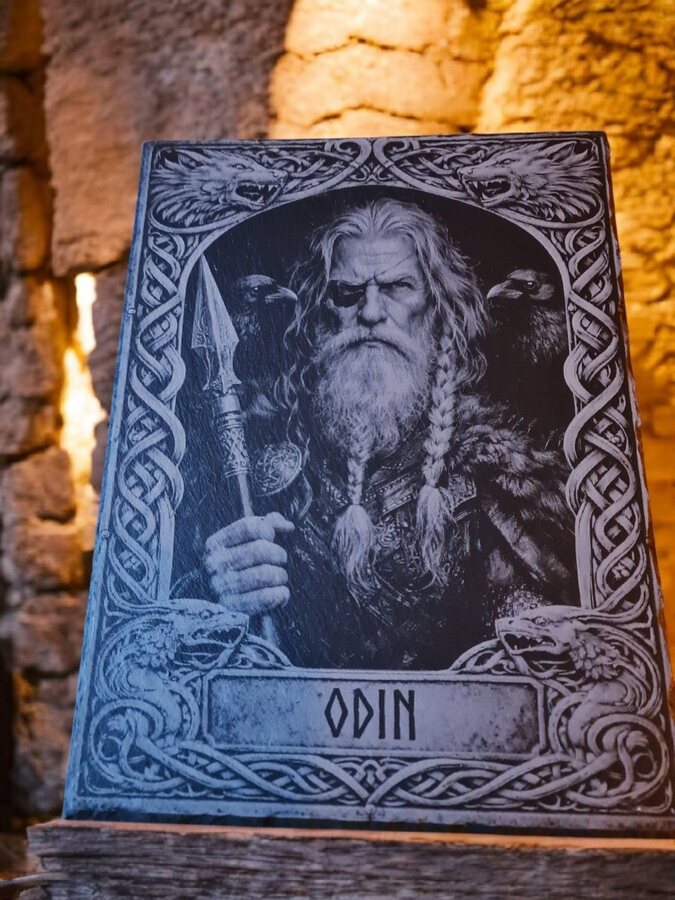
The temptation is understandable all the same. The name – Old English Wōden, Old Norse Óðinn – was very much alive around the North Sea around 700, and English royal houses traced their pedigrees back to Woden. If you want to meet this god's many faces, read our piece on Odin.
Here it gets interesting, because the question of where the Wodan/monster sceattas were actually struck has still not been settled.
The Frisian case: For a long time Series X was regarded as a Frisian coin. In its favour: Frisia was the great coining and trading power of the eighth-century North Sea, and sceattas are known to have been minted in Frisian places such as Dorestad. The Swedish numismatists Brita Malmer and Kenneth Jonsson kept to this traditional attribution.
The Ribe case: As early as 1984 the Oxford numismatist D. M. Metcalf suggested that Series X might have been minted in or near Ribe, and he developed the idea in 1993. At the time he knew only about 30 finds from Ribe. The more than 200 found since, Feveile notes, show the same pattern, only far more clearly. If the coins were made in Ribe, then probably from about 720. Feveile himself finds the Frisian scenario less convincing but explicitly leaves the question open.
The museum archaeologist Morten Søvsø went a step further and interpreted the Wodan/monster coins as a royal coinage for the three main trading places of an early Danish ruler – Ribe, Åhus and Reric. It is an attractive idea because it fits the planned plots of Ribe. Proven, in the strict sense, it is not.
Around 820 something changed. In Ribe the small, thick sceattas disappear and are replaced by thinner, broader coins, nearly twice the diameter. Numismatists call them pennies or deniers. Their imagery deliberately looks back: the obverse again shows a frontal face almost identical to the sceattas' "Wodan", while the reverse now carries a stag.
A lucky find showed how large this coinage was. In August 2018 a metal detectorist found a single coin in a wet meadow near Ribe. Archaeologists from the Museum of Southwest Jutland followed up and recovered hundreds more, scattered over an oblong area of about 50 by 15 metres. In his 2021 publication Claus Feveile gives 262 coins for this Damhus hoard: 258 with face and forward-looking stag, 4 with ship and stag. The ship type may have been a halfpenny – a genuine innovation in Danish monetary history.
The dies are even more revealing. Together with about 14 previously known coins, 57 obverse and 36 reverse dies could be distinguished. A die only survives a limited number of strikes, so that many dies mean a long, large-scale production. Whether the hoard went into the meadow as an offering or as a merchant's lost purse remains open; the museum leans towards an offering.
Further south, on the Schlei inlet, Hedeby grew into the leading trading town of the North during the ninth century. In 808, according to the Royal Frankish Annals, the Danish king Godfred had moved the merchants of Reric there. Hedeby struck coins too.
To bring order into the bewildering variety of ninth-century Nordic coins, Brita Malmer created a system of combination groups (Swedish kombinationsgrupper, abbreviated KG) in her 1966 dissertation Nordiska mynt före år 1000. The idea: designs that were repeatedly paired on obverse and reverse belong to the same issue. That produces groups that can be sorted in time and space. In the scheme Claus Feveile uses in his recent work, the picture looks roughly like this:
Malmer had dated KG 3 to 6 to roughly 825–860 and saw Hedeby as the most probable early mint. In 2025 Feveile published a major reassessment, Pennies for the King's Towns, covering 540 coins of KG 3–6. He separates Ribe and Hedeby issues clearly, extends minting across the rest of the ninth century and dates one type into the tenth. His most striking argument: Ribe and Hedeby formed two separate currency zones. Money from one town hardly circulated in the other – a managed local currency under royal control.
The best-known Hedeby designs are ships with high stems and a mast, sometimes with a sail, as well as stags, faces and heavily stylised imitations of Carolingian lettering. These coins travelled: they turn up at Birka on Lake Mälaren too, quite often pierced and worn as pendants. Feveile stresses that coins were either used for payment or turned into pendants.
From the mid-ninth century Ribe grows quieter. Activity on the old market area declines and has largely ended there by about 900 at the latest. Feveile links this to the turmoil in the Frankish realm and the Viking attacks on the Frisian partner ports in the 830s and 840s. Dorestad, the most important trading partner, faded in this period.
As coin use declined, another kind of money took over in the North: silver by weight. Dirhams, chopped-up arm rings and ingots were weighed on small folding scales – the economy we describe in Hacksilver. Next to that, the locally controlled coins of Ribe look like an early experiment with counted money, long before regular minting returned in the tenth century.
Around 800, or in the first half of the ninth century, Ribe acquired a boundary: a ditch which, according to Feveile, was only one and a half to two metres wide and no more than a metre deep. It was not a defence but a marker – here the market begins, here its rules apply. The enclosed area is given as roughly twelve hectares, and the ditch may have been short-lived.
Later a much larger moat was dug, seven to eight metres wide, with a rampart on the inner side. Until recently it could only be placed somewhere between about 850 and 1000. A 2019 study led by Sarah Croix with Søren Sindbæk combined five dating methods – artefact typology, coins, radiocarbon on plant remains and on soil organic matter, and Bayesian modelling – and reached a clear answer: the fortification was built between 889 and 974, stayed in use for at least 50 years and was filled in by the mid-eleventh century at the latest. That aligns it with the early ramparts of Hedeby and Aarhus and perhaps with a coordinated defensive programme of the kind also visible at the Danevirke.
Ribe enters the written record late, and through a missionary. Ansgar, a monk of Corbie and Corvey and later archbishop of Hamburg-Bremen, spent his life trying to bring Danes and Swedes to Christianity. His pupil and successor Rimbert wrote the Vita Anskarii, the Life of Ansgar, after the saint's death in 865.
In chapter 32 Rimbert relates that Ansgar negotiated with the young Danish king Horik II. The king allowed the church at Hedeby to be restored and, in another port of his kingdom called Ripa, gave land for a second church and permitted a priest to live there. This happened in the 850s; the often quoted "around 860" is an approximation. The passage is also the earliest written mention of Ribe.
Where exactly that church stood is uncertain. Many suspect it lay under or beside today's cathedral, which was begun around 1150 on top of earlier buildings. A bishop of Ribe is attested only from 948: Leofdag.
Between 2008 and 2012 archaeologists working around the cathedral found a large Christian cemetery: graves oriented east, no grave goods, the dead laid in wooden coffins. It was abandoned around 1050, and in total it is estimated to have held 1,500 to 2,000 burials.
One correction to our earlier version of this article: these are not "thousands of ninth-century graves". The earliest burials date to about 850, and the oldest phase comprises at least 60, probably around 75 graves. That is still remarkable: Christians were being buried here around a century before Harald Bluetooth announced on the great Jelling stone that he had made the Danes Christian. Strontium analysis suggests many of the dead grew up locally – so not just visiting foreign merchants.
If you visit Ribe, plan for two places. The museum Ribes Vikinger, opened in 1995, displays the original finds from the excavations: beads, moulds, combs and coins. Seeing a sceatta in a case makes you realise how tiny the North's first money was.
A few kilometres south lies the open-air museum Ribe VikingeCenter at Lustrupholm. Its reconstructions include part of the marketplace as it was around 710–750, the town of "Ripa" in the year 825 with houses based on excavated plans, and, since 2017, Ansgar's church – modelled on an early timber church excavated at Tostedt near Hamburg, complete with a replica of the bell found in Hedeby harbour in 1978. More destinations are listed in our guide Viking museums and sites.
Ribe dismantles a stubborn image: that the Vikings burst out of nowhere onto Lindisfarne in 793. A hundred years earlier, people on Jutland's west coast were already surveying, dividing plots, producing and trading. There were coins, workshops, and links to Italy and the Middle East. The ships that steered for England around 790 sailed routes that had long been known.
And Ribe shows how close trade, craft and belief stood to one another: a face on a coin, a timber church a century later, and in between people winding beads and sawing combs. For us in our workshop in Alsdorf it is a welcome reminder that good handwork in the North was always more than merchandise.
Is Ribe the oldest town in Denmark? Yes. Tree-ring dates put the laying out of its marketplace at about 704–710, and no other Danish town has such an early, continuous history.
Were the first Scandinavian coins minted in Ribe? Probably, but not certainly. Wodan/monster sceattas (Series X) are extremely common in Ribe and many researchers think minting there from about 720 is plausible; the older attribution to Frisia has not been disproved.
Do the Wodan coins really show Odin? That is not proven. "Wodan" is a modern collectors' name; the coins carry no inscription, and nobody knows whom the face was meant to depict.
What is a sceatta? A small, thick silver coin of roughly one gram, struck in England and Frisia in the late seventh and eighth centuries – and probably in Ribe as well.
When was the first church in Ribe built? In the 850s, when King Horik II gave the missionary Ansgar land in Ribe and allowed a priest to live there. The source is Rimbert's Life of Ansgar.
What can you see of the Vikings in Ribe today? The Ribes Vikinger museum with the original finds, and the open-air Ribe VikingeCenter with reconstructions of the marketplace, town houses and Ansgar's church.
For courage. For remembrance. For legends that live on.
Thyra Danebod – Denmark's mightiest woman · Trelleborg – Harald's ring fortresses · Odin · The Skuldelev ships · The Golden Horns of Gallehus.
All History & Finds articles →
The Viking battle was no wild scramble but a hard struggle shield to shield. A look at tactics and weapons beyond the …
Read more →Long before the Viking Age and before the Icelandic Edda there was Germanic cult – and one of the most striking stood …
Read more →Silver was the lifeblood of Viking trade – weighed, chopped up, buried. Three of the greatest hoards show how far the …
Read more →A horse, a golden disc, six little spoked wheels: the Trundholm Sun Chariot is one of the most beautiful images the …
Read more →