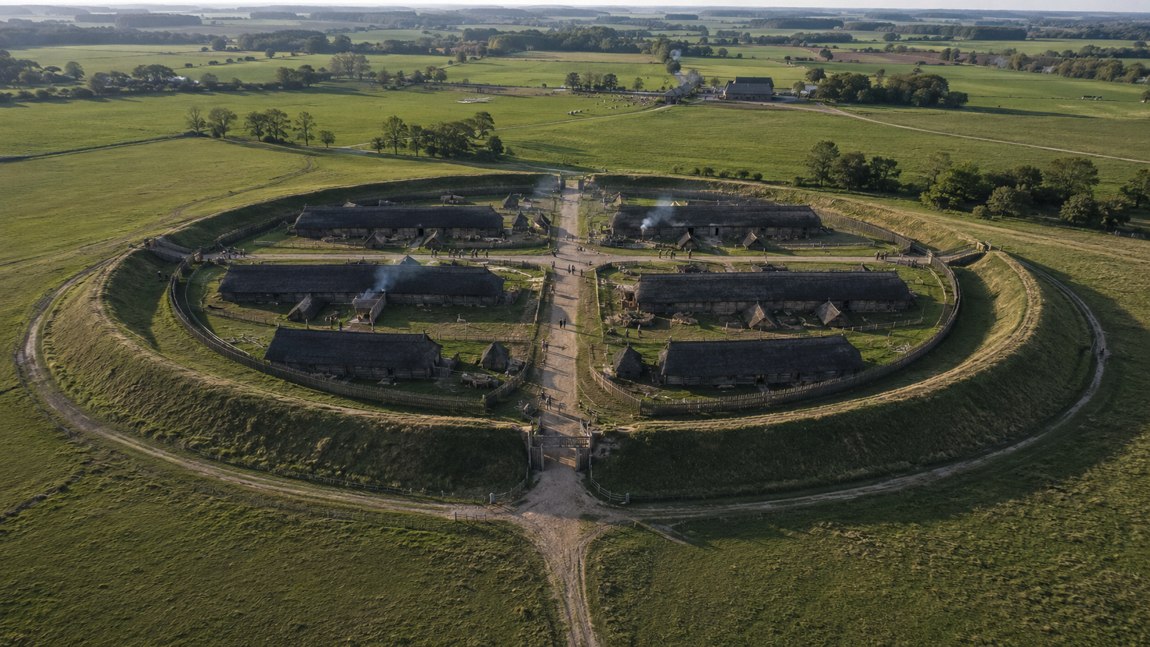
Trelleborg near Slagelse on Zealand is the best known of Denmark's five Viking Age ring fortresses – perfectly circular strongholds with four gates, two axial streets and rigidly ordered longhouses, built around 980 and very probably commissioned by King Harald Bluetooth. Its sisters are Fyrkat, Aggersborg, Nonnebakken and Borgring, with a related site in Scania. Since 2023 the five Danish forts have shared UNESCO World Heritage status. Here is what archaeology knows for certain, what remains guesswork – and why these fortresses vanished almost as quickly as they rose.
Picture the banks of the Tude Å in western Zealand in the autumn of 980. Marsh, meadows, a few farmsteads. Then the crews arrive: hundreds of men with spades, axes and ox carts. They fell oaks, cut turf, and peg out a circle with cords and stakes so precisely that archaeologists a thousand years later would stand in front of it in disbelief. A year on, a fortress stands there unlike anything the North had seen before.
As a workshop that spends every day with compasses, rulers and a laser, we have a soft spot for these sites. Somebody calculated, planned and set out these shapes – without paper, using poles, ropes and a trained eye.
Archaeologists speak of Trelleborg-type fortresses, named after the first to be excavated. The term covers circular strongholds built to the same basic pattern. Five sites in present-day Denmark certainly belong to the group:
Then there is Trelleborgen in the town of Trelleborg in Scania, southern Sweden – Danish territory in the Viking Age. It was found in 1988 when a housing estate was about to be built, and is dated to the second half of the tenth century; including the rampart it measures about 140 metres across. It is circular, with a heavy earthen bank, palisades and a ditch, but the tightly ordered house blocks and axial streets of its Danish sisters have not been identified there. A stretch of rampart with a gate has been reconstructed. A possible further ring fort at Borgeby north of Lund is discussed in the literature but not confirmed. For the older history of the region, see our piece on Uppåkra and the people of Scania.
All the confirmed Danish ring fortresses share one idea. A circular rampart of earth and turf, faced with oak timber inside and out and topped with a wooden breastwork. A ditch in front. Four gates, roughly aligned to the points of the compass. Two streets, paved or laid with timber, linking opposite gates and crossing in the centre – dividing the interior into four equal quarters. In most of the forts a ring road ran along the inner foot of the rampart.
At Trelleborg and Fyrkat each quarter held four large longhouses arranged around a square courtyard. Four groups of four: sixteen houses per fortress. At Aggersborg, the giant of the family, the scheme was multiplied: 48 longhouses, twelve per quarter, again grouped in courtyard squares. The design scales like a modular kit, and that is exactly the quality UNESCO highlights in its listing.
The numbers are impressive. At Trelleborg the rampart was about 17.5 metres wide at the base and probably around 5 metres high. The sixteen houses inside were each about 29.4 metres long, with a central hall of roughly 18 by 8 metres. At Fyrkat the houses measured about 28.5 metres, at Aggersborg a little over 32 metres. They had the gently bowed outline typical of Viking Age halls, with long walls curving outwards and narrower gable ends – often called the "ship shape". How such houses were built and lived in is explained in How the Vikings lived – the longhouse.
Trelleborg has something the others lack: an outer ward, a second, external defended zone. A curving bank and ditch enclose an area where further longhouses stood radially to the main fort, like spokes of a wheel. These houses were a little shorter, at around 26 metres. Counts differ slightly depending on interpretation; the usual figure is a little over a dozen. The cemetery lies in this outer zone too.
The best-known feature is the reconstructed longhouse built in front of the fort in the 1940s, following the excavators' plans. It has an external gallery carried on raking posts, based on sloping postholes found along the outer walls. Later research reads those traces differently: the sloping timbers most likely braced the walls directly and took the thrust of the roof, and there was probably no open gallery at all. The Trelleborg house is itself a piece of research history, a mirror of what mid-twentieth-century scholars imagined a Viking hall to be. At Fyrkat a longhouse was reconstructed in 1985 according to the newer interpretation, without a gallery.
For a long time the ring fortresses were placed around the year 1000 and linked to Sweyn Forkbeard, Harald's son and the conqueror of England. That changed with dendrochronology, or tree-ring dating. A tree adds one ring per year, its width shaped by the weather. Match the ring sequence of a timber against a long reference curve and you get the felling year – provided the outermost rings beneath the bark survive.
At Trelleborg this worked on timbers from the rampart and ditches. The oaks were felled between autumn 980 and spring 981. Since Viking Age builders usually worked their timber green, the rampart was most likely raised in 981. Fyrkat also falls around 980 and may be a year or two older. Aggersborg is thought to date to about 980, and an oak spade from the ditch at Nonnebakken in Odense has been tree-ring dated to the fort's period of use. UNESCO sums up the state of research: all five fortresses were built between about 970 and 980, within a single decade.
Borgring is the hardest case. The charred timbers from the first excavations were unsuitable for tree-ring dating, and radiocarbon pointed to the tenth century. In 2017 the team found a worked piece of oak with drilled holes and wooden pegs outside the south gate. Its rings could be dated: the tree grew until at least 950 and was felled after 966. That fits a construction date in the late tenth century, in Harald Bluetooth's reign, though no precise building year for Borgring is known yet.
For more than sixty years four Danish ring fortresses were known. The gap in eastern Zealand was obvious: Trelleborg in the west, nothing in the east of the island. Then a national digital elevation model, produced by airborne laser scanning (LiDAR), showed a barely visible circular rise at Lellinge near Køge. Aerial photographs and even trial trenches in the 1970s had missed it.
In September 2014 Aarhus University and the Museum of Southeast Denmark announced the find. Magnetometer survey (fluxgate gradiometry), which picks up disturbances in the earth's magnetic field caused by buried features, traced the circle underground. Targeted excavation confirmed a rampart about 10.5 metres wide with a timber front, and two gates. Both gates showed burnt posts and planks, with fallen charred timbers in the north gateway. No buildings have been found inside so far. The excavators, Helen Goodchild, Nanna Holm and Søren Sindbæk, published the site in Antiquity in 2017, leaving open whether Borgring was short-lived, never finished, or simply laid out differently inside.
No inscription names the builder. No runestone says "Harald had this fortress made". The attribution rests on dating: around 980 Harald was on the throne, and only a king with strong central authority could push projects of this size through in several regions at once. The case is strong enough to be the scholarly consensus – but it remains an inference, not a written record.
Harald, son of Gorm the Old and Thyra, left the great runestone at Jelling, on which he boasts that he won all of Denmark and Norway and made the Danes Christian. We look at that stone in detail in our article on the Jelling stones. The ring fortresses belong to the same building programme of an ambitious ruler. At Jelling he enclosed the monument site in a vast palisade; the Danevirke on the southern border was strengthened in his time; and around 980 a long timber bridge was built across the marshy valley at Ravning Enge near Vejle. Every one of these projects demanded timber, people and organisation on a grand scale.
A side note you may already know: the Bluetooth logo on your phone combines the runes for H and B – Harald's initials. We tell that story in Your Phone Carries a Viking King. For the king himself, start with Harald Bluetooth: Uniter of Denmark.
Scholars have argued about the purpose of the ring fortresses ever since they were found. Three lines of thought stand out, and they are not mutually exclusive.
First: barracks for the English campaigns. While the forts were dated to around 1000, it seemed natural to see them as training camps and mustering points for Sweyn Forkbeard's armies, which harried England from the 990s. The ordered houses looked like barracks, the waterside locations like embarkation points. Tree-ring dating knocked the ground from under this view: the forts were built around 980 and abandoned soon afterwards, long before the great English campaigns began. For those raids and the silver they brought home, see the England-farers and Sweyn Forkbeard.
Second: strongholds to hold the realm down. Many scholars see the forts as tools with which Harald brought his kingdom under control from within: bases against unruly petty kings and chieftains, seats of royal agents, points controlling routes. Location supports this. Aggersborg overlooks one of the narrowest points of the Limfjord, where the old army road (Hærvejen) crossed. Trelleborg sat where two streams met, with access to the Great Belt; Fyrkat lay in a river valley near Hobro, Nonnebakken on the Odense river, Borgring in the Køge Å valley. The National Museum of Denmark suggests the forts were probably meant to subdue petty kings and local chieftains.
Third: defence and a symbol of power. In 974 Emperor Otto II broke through the Danevirke; the threat from the south was real. Søren Sindbæk has proposed reading the forts as part of a defensive system in which local people could take refuge while the king led his army to wherever it was needed. Comparable systems existed at the same time in Anglo-Saxon England (the burhs) and in the Ottonian Empire. And then there is the message of the form itself. A perfect circle in the landscape tells every passer-by that a power is at work here that can measure, order and command – a statement readable from a distance.
Our take: the forts were probably all of these at once – military bases, administrative centres and propaganda cast in timber. Which role dominated likely varied from fort to fort and year to year. How warfare itself was organised in this period is the subject of Warfare of the Germanic peoples and Vikings.
Perhaps the most puzzling finding: the ring fortresses did not last. The National Museum estimates they were in use for only about 10 to 15 years; for Aggersborg, figures between 5 and 20 years are given. The ramparts were hardly repaired, the houses never rebuilt. Fyrkat burned down around the year 1000 with no trace of fighting. At Borgring, the burnt gates show that fire played a part there too.
Why the rapid decline? The most plausible answer is political. In the 980s Harald's son Sweyn rose against his father; Harald was driven out and died around 986/87 – according to Adam of Bremen, wounded, among the Slavs. Later sagas add colourful tales, such as Palnatoke of Funen as Harald's killer, which the National Museum considers highly doubtful. For the new king, his father's expensive forts may have been more burden than tool. They had to be manned and supplied, and they stood for a model of rule that Sweyn would not or could not continue.
North-west of Fyrkat lies a cemetery of about thirty burials, all aligned east–west. One stands out: a woman laid in the body of a wagon, as the wealthiest women were. She wore fine blue and red clothing woven with gold thread. Beside her lay spindle whorls and scissors – everyday things. Then it gets unusual: silver toe rings unknown elsewhere in Scandinavia; two bronze bowls, possibly from Central Asia; an iron staff with bronze fittings; a pouch of henbane seeds; white lead in a belt buckle; a box holding owl pellets and small bird and mammal bones; and a silver amulet shaped like a chair.
The National Museum interprets her as a possible völva, a seeress who practised seiðr, a form of Norse sorcery. The staff, the chair amulet (perhaps a nod to the seeress's raised seat), the psychoactive henbane and the mysterious animal remains fit the picture later sagas paint of such women. It is not certain – but few Viking Age graves match it better. We explore seiðr and the role of the staff in Seiðr – the magic of the völva, the plant itself in Henbane: the poisonous plant in a Viking woman's grave, and the figure of the seeress in The völva – the seeress of the North.
The setting is striking. A woman buried with pagan ritual gear lies beside a fortress built by a king who was just then celebrating himself as the man who made the Danes Christian. The new faith did not take over overnight – not even in the king's own orbit.
At Trelleborg, too, the dead were buried close to the fort. Around 135 graves are known, including several with more than one body. More than two thirds of the dead received no grave goods. Nineteen arrowheads were also found in the ramparts and gates – a hint that the fort came under fire at least once.
In 2011 T. Douglas Price, Karin Margarita Frei, Andres Dobat, Niels Lynnerup and Pia Bennike published a study in Antiquity with a pointed title: "Who was in Harold Bluetooth's army?" They analysed strontium isotopes in the tooth enamel of 48 individuals. Strontium enters the teeth through water and food and reflects the geology of the area where a person grew up. Their result: the young men in the cemetery were largely not local, perhaps coming from Norway or the Slavic lands south of the Baltic. All three women sampled came from elsewhere too, and people buried together often had different origins.
From this grew the widely quoted idea that Harald garrisoned his forts with foreign mercenaries – men without local ties, loyal only to the king. It is an appealing idea and fits Harald's connections to the Slavic world. Two caveats belong with it. First, the study tells us where the dead grew up, not what job they did. Second, later work showed that modern agricultural lime can distort the strontium values of present-day Danish reference samples (Thomsen and Andreasen 2019). The local baseline may therefore have been set too narrowly, and some "foreigners" might turn out to be locals after all. How international Harald's garrisons really were remains an open question – and still a fascinating one.
"Trelleborg" is an old local place-name, and nobody knows whether it goes back to the time of construction. Two explanations are offered. Old Norse þræll means "thrall, unfree servant", so "thrall fort" could be a jibe at subjugated chieftains or a nod to the workforce. The other reading derives the word from pieces of timber used in house building. Neither is proven. The Swedish town of Trelleborg, at any rate, takes its name from its own ring fort.
In September 2023 UNESCO inscribed the five Danish forts as the serial World Heritage Site "Viking-Age Ring Fortresses". The listing recognises that their scale and precision point to centralised control and demonstrate Harald's ability to mobilise military power, resources and labour. The forts are also judged an outstanding example of monumental military architecture in Scandinavia, set within the wider European world of the Viking Age.
Trelleborg near Slagelse is the best place to start. The rampart survives to full height, the house plans are marked out inside, and the National Museum runs a museum on site with finds, the 1940s reconstructed longhouse and a Viking village where crafts and daily life are shown in summer. Stand on the rampart and look across the four quarters, and the geometry makes sense faster than with any plan.
Fyrkat near Hobro sits in a lovely valley. Here too the rampart has been restored, the house sites are marked, and the 1985 longhouse shows the newer building style; a reconstructed Viking farm lies nearby. The finds from the seeress's grave are kept by the National Museum in Copenhagen.
Aggersborg on the Limfjord is above all a landscape experience: the circle is traced by the bank and post markers, and its size is overwhelming. Borgring near Køge and Nonnebakken in Odense are less dramatic but have information boards. In Scania you can visit Trelleborgen, with a reconstructed section of rampart and gate. Opening hours and seasons change, so check with the museums before you go.
What draws us to them is the clarity of the form. A circle, divided by a cross, with four gates – a sign you do not forget. When we put Viking Age motifs onto slate or wood in our workshop, we often think of that precision: every line has its place.
How many Viking ring fortresses are there in Denmark? Five confirmed: Trelleborg, Fyrkat, Aggersborg, Nonnebakken and Borgring. Trelleborgen in Scania (now Sweden) is related, and Borgeby near Lund is a possible further site.
Who built Trelleborg? Most likely King Harald Bluetooth. There is no inscription, but the tree-ring date of 980/81 falls within his reign, and only a powerful king could have planned such sites.
How old is the Trelleborg fortress? The rampart timber was felled between autumn 980 and spring 981, so the fort was built around 981 and used for only about 10 to 15 years.
What were the Viking ring fortresses used for? That is debated. They probably served to control the realm, for defence and as symbols of power. The old theory of barracks for the English campaigns has been ruled out by the dating.
Can you visit Trelleborg in Denmark? Yes. Near Slagelse the National Museum runs a site with the rampart, marked house plans, a reconstructed longhouse and a Viking village. Fyrkat, Aggersborg, Borgring and Nonnebakken are open to visitors too.
When did the ring fortresses become a World Heritage Site? In 2023, jointly listed as "Viking-Age Ring Fortresses".
For courage. For remembrance. For legends that live on.
Thyra Danebod – Denmark's mightiest woman · The Golden Horns of Gallehus · Ragnar's sons · The Skuldelev ships · The longships.
All History & Finds articles →
On a field south of Lund, where today only a small church stands, lay for almost a thousand years one of the largest …
Read more →No place stands more for the pagan cult of the North than Gamla Uppsala: the golden temple, the great sacrifice every …
Read more →In December 2020 a metal detector beeped in a field near Vindelev, only a few kilometres from Jelling. What came to …
Read more →A rare genetic trace in Iceland tells a story that sounds almost unbelievable: some Icelanders carry a maternal DNA …
Read more →