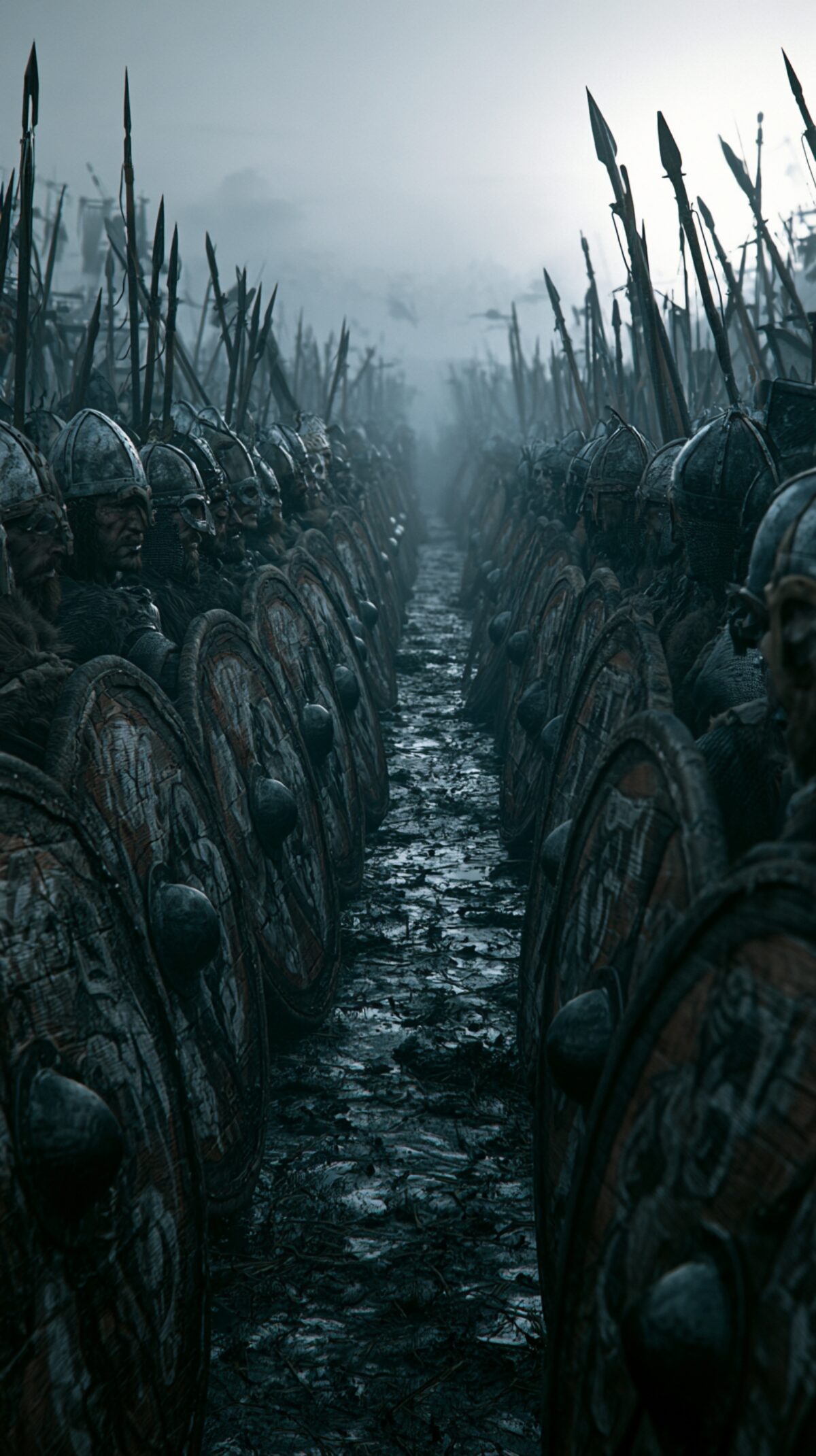
Almost a thousand years separate the spear-fighting Germanic tribes that Tacitus described around 98 AD and the feared shield wall of the Vikings. And yet a common thread runs through it all: mobility, the spear as an everyday weapon, and warfare that looked far less like horned helmets and fantasy than films would have us believe. Let us look honestly – at what is documented, and what is legend.
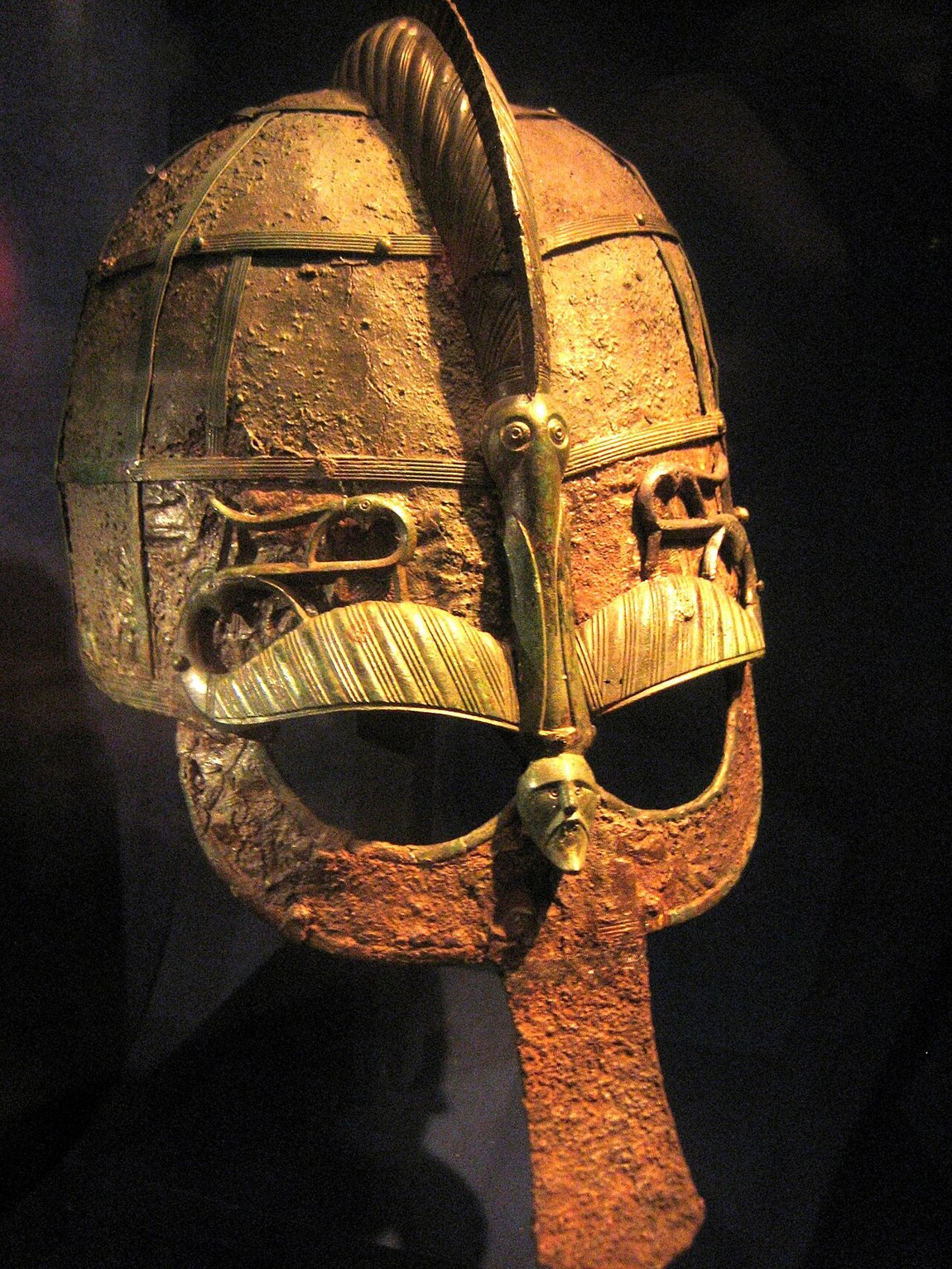
Speaking of "Germanic" and "Viking" warfare means, strictly, speaking about two very different eras. The Germani as Roman authors of the first century describe them were loose tribal confederations along the Rhine and Elbe who fought as a levy. The Vikings of roughly 793 to 1066 were seafarers from Scandinavia who reached half of Europe with fast ships. Between them lies the whole Migration Period, the rise of kingdoms and a completely changed military landscape.
Even so, the arc is worth drawing. Many basic features – the spear as a cheap, ubiquitous weapon, the shield as the core of a warrior's kit, the importance of personal loyalty, and a preference for the sudden, mobile strike over the long siege – recur in both worlds. And in both, later romanticism created an image that has little to do with the sources.
Our main witness for the early Germani is Tacitus and his work "Germania" from the year 98 AD. He describes warriors whose most important weapon was not the sword but a light lance with a narrow iron head, which they called "framea" – suited equally for close combat and for throwing. Swords and heavy equipment were rare and a sign of wealth. The ordinary warrior carried spear and shield, often barely any armour.
Tacitus depicts tribes that fielded no rigid professional army but a levy of free men, drawn up by kin and family. This created a particular fighting morale: one fought before the eyes of one's own relatives. Leaders led by example rather than command, and the bond between lord and follower was a relationship of mutual honour.
Only a few use swords or larger lances: they carry spears, or, in their own language, frameae, with a narrow and short iron head, but so sharp and so handy in use that with the same weapon they fight, as the situation demands, either at close quarters or at a distance. On foot as on horseback the same equipment is theirs.Tacitus, Germania 6
The most famous tactical figure of the Germani is the wedge, in Latin "cuneus". Roman authors describe how Germanic warriors drove into the enemy line in a pointed formation in order to tear it open at a single spot. This concentrated force at a narrow point of impact was the answer to the closed Roman battle order. Tacitus also praises the ability to withdraw in good order and attack again, without this counting as cowardice.
Later this wedge was linked in Norse texts with the term "svinfylking", the "swine array" or "boar's head" – but here caution is needed, as we shall see in the myth section. The Germanic way of fighting relied on impetuosity, knowledge of the terrain, and a willingness to fight in forests and marshes where the Roman war machine reached its limits. The Battle of the Teutoburg Forest in 9 AD is the best-known example of how deadly this adaptation could be.
The social basis of Germanic warfare was the retinue, the war band around a lord. A respected leader gathered young warriors about him, supplied them with weapons, food and plunder, and bound them by an oath of loyalty. In return they owed him allegiance unto death. Tacitus reports that it counted as lifelong disgrace to survive the fall of one's leader. Whether this was reality or an idealised image of Roman observation cannot be said with certainty.
Beside these professional followers stood the general levy, the muster of free men that assembled only when needed. This double structure – a hard core of experienced warriors plus a broad levy of farmers – recurs in altered form among the Vikings. Most of the men who took up the sword were, in daily life, farmers, craftsmen or traders.
Much changed over the centuries. Tribes became kingdoms, iron became more widely available, and shipbuilding in the north reached a level that made the entire Viking Age possible in the first place. The fast, shallow-draught longship with sail and oars was the true weapon of the Vikings. It allowed them to appear unannounced on a coast or in a river estuary, to strike, and to vanish again before an ordered defence could form.
The raid on the monastery of Lindisfarne in 793 is seen as the opening of this era. But the Vikings were not only raiders – they were traders, settlers and mercenaries. Their military strength lay less in superior technology than in mobility, surprise, and a willingness to attack unexpected targets. Anyone who wants to know more about the individual weapons will find our own articles on the sword, the axe and the shield.
Among the Vikings too the spear was by far the most common weapon. It was cheap to make, needed little iron, and was effective both in the shield wall and in single combat. Next came the axe – for many an everyday tool that became a weapon when needed, but in elite hands also wielded as a heavy, two-handed broadaxe. The bow played an important role in battles and especially in sea fights, yet it is often forgotten in the romantic picture.
The sword was the most expensive and prestigious weapon. A good, pattern-welded sword meant considerable wealth and status; it was handed down and sometimes given its own name. Mail shirts were rare and practically reserved for the elite – most warriors protected themselves with a shield, leather clothing and at most a simple helmet. The shield of thin lime wood with an iron boss was the central defensive weapon of almost every fighter.
The backbone of the Viking pitched battle was the shield wall, in Old Norse "skjaldborg". Warriors stood close together in one or several rows so that their shields overlapped and formed a closed wall. From behind this wall they thrust with spears, while the rear ranks pressed forward and filled gaps. This formation was no Viking invention – it appears among almost all foot soldiers of the age, including the Anglo-Saxons.
Battle often consisted of a long, grinding struggle between two shield walls until one side lost its order. That was precisely when it became deadly: a broken shield wall usually meant collapse and flight, and most casualties fell only in the pursuit. Anyone who wants to go deeper into this subject will find our own article on the shield wall.
The classic pitched battle was rather the exception for Vikings. Their strength lay in the sudden, mobile strike. They landed with a few ships, plundered quickly, and withdrew before a levy could bring them to battle. Only as the expeditions grew larger did larger armies arise as well, such as the "Great Heathen Army" that wintered in England from 865 and subdued whole regions.
Winter camps were an important part of this strategy. Instead of sailing home after each season, larger forces set up fortified camps and operated from them over months. Sieges of fortified towns, on the other hand, did not suit the Vikings especially well – they had little siege equipment and often failed against strong walls. Extortion was more common: rather than storming a town, they let themselves be bought off with silver, the so-called Danegeld.
Fighting also took place on the water, and in a very particular way. Because the longships had no rams or heavy artillery, sea battles were fought essentially like land battles – only on unsteady ground. The leaders lashed their ships together with ropes so that a floating platform arose. On this the fight then flowed deck against deck, with spears, arrows, and in close combat with axe and sword.
The oar ports and gunwales offered some protection like a shield wall. The aim was to storm the enemy deck and clear ship after ship. The free ships that were not lashed together, out on the wings, were important for bringing movement into the fight and for encircling the enemy. Famous sea battles such as Svold around the year 1000 followed exactly this pattern.
Warfare is never only attack. The Germani protected themselves with ramparts, palisades and the hard-to-reach forests and marshes of their homeland; the Angrivarian wall shows that earthworks were deliberately laid as a barrier across open ground. In the north something astonishing arose later: the Danish ring fortresses of Trelleborg, Fyrkat, Aggersborg and elsewhere, mathematically exact circles with four gates aligned to the compass points. They date from the time of Harald Bluetooth in the late tenth century and testify to a royal power able to organise large amounts of people and timber.
These works were not purely fortresses against foreign Vikings but also inward-facing centres of power. They show that the late Viking Age had long ceased to be only about plundering voyages and had become a matter of state organisation, border security and claims to rule. The Danevirke, the great border rampart on Denmark's southern frontier, belongs to the same world: defence was an expression of order, not merely of fear.
Tacitus praises individual Germanic tribes for their horsemanship, yet the true strength lay in the foot fight. Famous is his description of how riders and fast foot fighters worked together: the latter held on to the manes of the horses and so kept up over long distances. A heavy armoured cavalry after the Roman or later model was unknown to the early Germani. The horse was a symbol of status and a means of transport, not a battering wedge of iron and flesh.
Among the Vikings the picture scarcely shifted. Their ships carried them across the sea, but on land they often moved on foot or requisitioned horses for rides into the hinterland – so the Anglo-Saxon Chronicle reports of the Great Army. Fighting, however, was done on foot, in the shield wall. Mounted warriors striking in closed formation from horseback belong rather to the Norman army of 1066 than to the classic Viking Age. Whoever imagines the warriors coming from the sea and then riding across the land on fast ponies is closer to the truth than the image of heavy cavalry hosts.
Wars were fought not only with spear and shield but also with fear. Germani and Vikings alike knew the effect of noise, standards and reputation. Tacitus describes the "barditus", a battle chant roared against the shield that swelled and measured the courage of one's own ranks as much as it was meant to intimidate the enemy. The sound, thrown against the hollow shields, became an acoustic storm before the actual clash.
The Vikings cultivated a similar psychology. The legendary raven banner of several leaders was said to foretell victory or defeat – a standard meant to carry confidence into one's own ranks and terror into the enemy's. The reputation of the Northmen for striking suddenly and without warning was itself a weapon: monasteries and coastal towns fell into panic before the first ship ran ashore. An enemy who believed himself lost fought worse – that held true a thousand years ago as it does today.
In the end it is worth setting the picture straight. The great majority of people in the Germanic and Viking ages were not professional warriors but farmers, fishers, craftsmen and traders. The war expedition was a time-limited undertaking, often in summer, between sowing and harvest. Whoever went on a voyage did it for plunder, prestige and sometimes land – and returned, with luck, to the farm.
The warfare of these eras was pragmatic, mobile and driven by honour, not the grim endless battle of popular culture. It is precisely this honesty towards history that matters to us at Glanz & Gravur – we engrave the motifs of this world with respect for what is truly documented.
The Viking Shield · The Viking Sword · The Viking Axe · The shield wall · Berserkers.
All History & Finds articles →
No prison, no police, no king who simply handed down verdicts: the legal order of the Germanic peoples and the Vikings …
Read more →Somewhere a story must begin. For the kingdom of Denmark this beginning is a man named Gorm – Gorm the Old, the first …
Read more →