No prison, no police, no king who simply handed down verdicts: the legal order of the Germanic peoples and the Vikings rested on the assembly of free men, on clever compensation tariffs instead of endless revenge, and on the spoken word. Here is how the Thing really worked, what the sources prove – and which pretty legends still cling to it.
When we think of courts today, we think of a state with a law book, judges, police and prisons. None of that existed in the Germanic Iron Age or the Viking Age. There was no standing authority to enforce a verdict. Law was therefore not a matter for officials but for the community: anyone who felt wronged had to bring the case themselves, and enforcing a ruling depended on enough people backing it. That sounds weak, yet it was a surprisingly stable system, because losing your social backing was a very real threat.
This explains why two things stood at the centre: the assembly, where law was argued in public, and fixed compensation sums that turned a feud into a payment. Both aim at the same goal – containing conflict before it tears whole families apart. Law here was less about punishment than about restoring a broken peace.
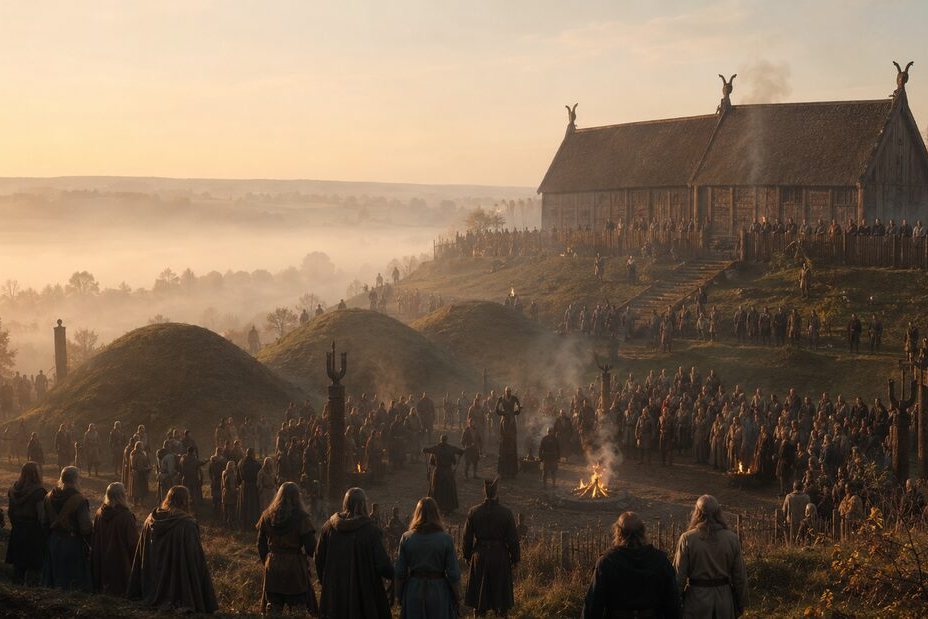
The Thing (Old Norse þing) was popular assembly, court day and market in one. People met at fixed times at a traditional place, often in the open air at a striking point in the landscape. Disputes were argued, settlements struck, marriages and inheritances arranged, laws proclaimed and public decisions taken. Anyone who did not appear or was not heard barely existed in legal terms – the Thing was the place where you could obtain justice at all.
Tacitus already describes such an assembly for the Germanic peoples of the 1st century: the free men gather armed, priests call for silence, leaders are heard, but the crowd approves or rejects by clashing their weapons or by muttering. Approval through the din of weapons is no accidental image; it shows that the armed free men were the true sovereign of the assembly.
„On lesser matters the chiefs deliberate, on greater ones all; yet in such a way that even what the multitude decides is first discussed among the chiefs. […] If a proposal displeases them, they reject it with murmurs; if it pleases, they clash their spears. To applaud with weapons is counted the most honourable form of assent."Tacitus, Germania 11–12 (translation from the public-domain Latin text)
In the Viking Age this assembly culture lived on and in many places was elaborated. In Norway large regional law districts formed, with their own assemblies such as the Gulaþing and the Frostaþing, each with its own transmitted law. In Iceland, around 930, the Alþingi arose on the plains of Þingvellir, an island-wide assembly meeting once each summer – court, legislative body and social highlight of the year all at once.
One office stands out: the law-speaker (lögsögumaðr). Elected for a few years, his task was to recite the law from memory – on the law rock (lögberg) he was to say the entire body of law aloud over the course of his term. In a society without widespread writing, this living memory was the real constitution. Only in 1117/18 were the Icelandic laws written down for the first time; until then the law-speaker carried them in his head.
Perhaps the most important legal instrument was the wergild (Norse manngjald, „man-payment"): a fixed compensation that the offender or his kin paid to the injured party or their relatives. For manslaughter, wounding, insult, even for single teeth or fingers, there were graded rates. Stretches of the early medieval law codes read like precise price lists of the body and of honour.
The purpose was very concrete: a paid compensation could avert a blood feud that would otherwise carry on for generations. The wergild was also a mirror of status – a free man was „dearer" than a bondsman, a member of a respected family „dearer" than a nobody. Law did not mean that everyone counted equally, but that for each rank a set price was fixed.
The blood feud was not a lawless outburst but a recognised, if dangerous, means. When a relative was slain, the kin had the right and the social duty to obtain satisfaction. The Icelandic sagas tell of such feuds across whole lifetimes. Yet precisely because revenge could wipe out a family, the law developed outlets: whoever killed was to admit the deed openly (secret murder counted as far worse than open manslaughter), and through the Thing the matter could be turned into a settlement with compensation.
The settlement (sætt) was often more important than the verdict, because no enforcement apparatus stood behind it. A shrewd arbitrator who brought two families to a workable balance prevented more bloodshed than any judicial ruling. Law here was an art of de-escalation.
How was truth established without modern evidence? A core means was oath-helpers – and here lurks a common misunderstanding: oath-helpers were not witnesses who said what they had seen. They swore to the credibility of a party. The heavier the accusation, the more oath-helpers you had to muster. Whoever found many respected men to swear for him won. Thus law also mirrored social standing.
Where oaths did not suffice, people knew the ordeal and the regulated single combat. In the North the holmganga (the „going to the island") was a formal duel by fixed rules by which a dispute could be decided. Over time it was increasingly restricted as a means of legal coercion and finally banned, because strong fighters abused it for extortion. The ordeals proper – by fire or water – are, incidentally, mainly Christian in character and belong more to the High Middle Ages than to the heathen early medieval period.
Because there were hardly any prisons, the gravest sanction was not confinement but exclusion. Outlawry stripped a person of legal protection: they lost the shelter of the law, could no longer be housed or fed, their property was forfeit, and killing them went unpunished. In Iceland full outlawry (skóggangr, literally „going into the wood") was distinguished from a milder, time-limited banishment.
For a society where survival depended on the community, this was a death sentence on the instalment plan. Anyone no longer welcome anywhere could barely make it through the winter. Therein lay the force of the penalty – no walls held the condemned, but the withdrawal of all social bonds.
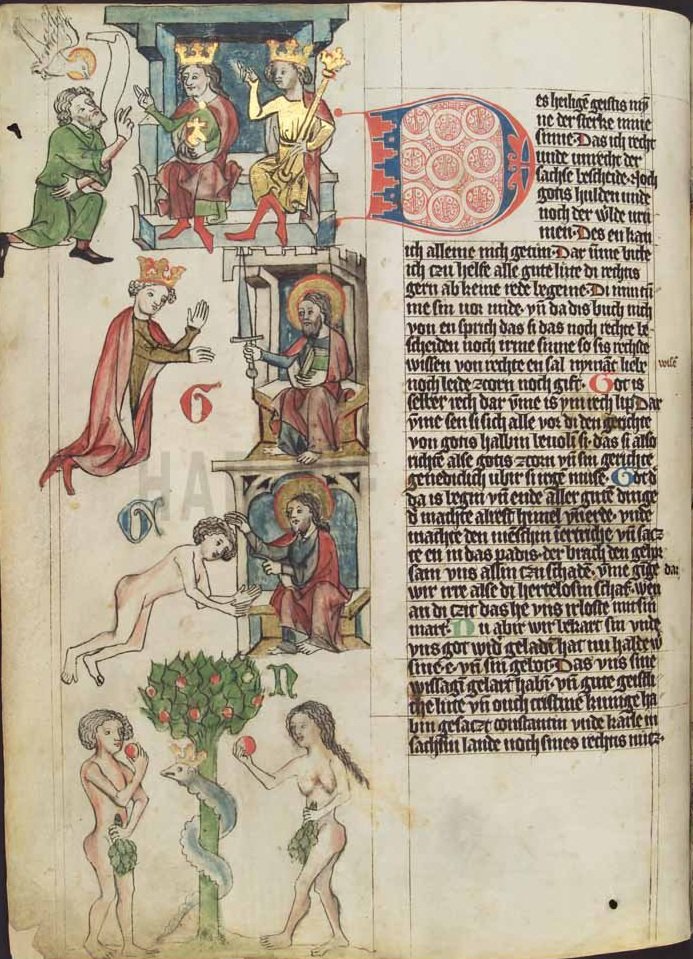
On the continent, Germanic customary law began to be written down early – but under Frankish rule and in Latin. The best-known collection is the Lex Salica of the Salian Franks, composed under Clovis around 500. Later came the Lex Saxonum, the Lex Frisionum and the Lex Thuringorum, all edited within the orbit of the Carolingian empire. They mainly regulate compensation tariffs, inheritance and procedure and are a first-rate source – as long as one keeps in mind who wrote them down, and why.
For these texts are not a pure image of ancient heathen custom. They were shaped by Christian, often clerical scribes under Frankish oversight, Roman law echoes through them, and much was ordered, smoothed or established for the first time. They show Germanic law at the moment of its writing – already in contact with empire and church.
Considerably later, and from the North itself, come the Scandinavian law books. For the Icelandic Commonwealth the Grágás (the „Grey Goose") survives, an extensive body of law that was, however, only written down in the surviving manuscripts in the 13th century. From Norway we know provincial laws such as the Gulaþingslög and the Frostaþingslög. These texts give deep insight into Thing procedure, compensation rates, inheritance law and everyday life.
Here too the time gap matters: the manuscripts are younger than the actual Viking Age and partly already shaped by royal power and church. They preserve much old customary law, but they are a snapshot of the High Middle Ages, not a direct record from the 9th century. Whoever reads them reads clever legal texts – and must factor in the filter of transmission.
As a rule women stood under the guardianship (mund) of a male relative or the husband and usually could not appear as a party before the Thing themselves. That is the sober finding. At the same time they had more legal room than the common cliché of total disenfranchisement suggests. Women could inherit, own property and dispose of the goods they brought in; the dowry and the „morning gift" secured them materially.
In the North a woman's right of divorce is also attested: under certain conditions she could separate from her husband before witnesses and take parts of the property with her. The sagas show self-assured women who set feuds in motion, demand settlements and watch over honour. They were not legally competent in the modern sense – but powerless they were just as little.
A Thing was no formless chatter but followed a well-rehearsed order. People arrived at a fixed date, often in spring or high summer, when roads and weather allowed travel. The assembly place was hallowed ground on which a special peace held: violence at the Thing weighed heavier than elsewhere, for it broke not merely a rule but the peace of the whole community. In Iceland the site was formally staked out as a court space with cords and hazel poles.
Then one stepped forward. The plaintiff laid out the matter, named witnesses and oath-helpers, the other side answered, and a body of experienced men weighed it up. Much ran through strict formulas: a word spoken wrongly, a missed procedural step could bring the whole case down. Law here was also rhetoric and knowledge of form – whoever mastered the right words in the right order held the advantage. The Thing was thus at the same time a school of public speaking.
Impressive as the assembly system is, it was no order of equals. Full legal standing belonged to the free, armed and propertied man. Above him stood leaders, chieftains and kings, whose word carried more weight and whose compensation was higher. Below him stood the unfree, the slaves (Norse þrællar), who counted as property and had practically no voice of their own before the Thing. If an unfree person was killed, the compensation went to their owner as with damage to goods.
Between these poles lay a web of gradations: freedmen who still bore ties to their former master; tenants and smallholders; respected large farmers. Each rung had its own „price" and its own measure of legal capacity. Precisely here lies the difference from the modern idea of law: it was not the human being as such who bore rights, but the human being in their station. That is not a marginal detail but the core, if one wants to understand the Thing honestly.
Well documented: Tacitus, in the Germania (ch. 11–12), describes the assembly, assent through the din of weapons and the role of the leaders. For the North, the sagas, Icelandic and Norwegian law texts (Grágás, Gulaþingslög) and the office of the law-speaker attest the Thing as a court and legislative assembly. Wergild and compensation tariffs, oath-helpers, outlawry and the holmganga are broadly documented through the law codes and the Norse laws.
Myth check: The Thing was not a modern democracy. Free, armed men counted according to rank and standing – not all people, not the unfree, and as a rule not women as a party. The oft-quoted phrase „með lögum skal land byggja" („with law shall the land be built") is high-medieval (it stands in Norse law books of the 13th century) and is not a Viking saying. The continental law codes are Frankish-Christian edits and partly back-projection, not an unfiltered image of ancient heathenism. And the National Socialist „Thing site" movement of the 1930s (roughly 1933–1936, open-air stages billed as supposedly „primordial Germanic" cult places) has nothing to do with the historical Thing – it was propaganda with invented tradition and was soon dropped even within the Nazi apparatus.
Germanic and Norse law was neither the grim rule of the fist of the clichés nor the romantic „primeval democracy" of national myths. It was a thought-through system that managed without state power: public argument instead of arbitrariness, compensation tariffs instead of endless revenge, standing and the spoken word as evidence, exclusion instead of the dungeon. It had hard edges – rank decided, the unfree had few rights – but at its core it aimed at peace rather than retaliation.
If this world fascinates you, we offer further depth: in our large overview of the Germanic tribes we place peoples, belief and culture in context, and on the blog we explore the everyday life, sagas and history of the North. The spoken word was sacred to the old peoples – no wonder that runes, names and sayings remain engraving motifs to this day, each carrying a story.
Viking Law & Thing · The Thing · The Germanic feasts · Viking Trade.
All History & Finds articles →
Somewhere a story must begin. For the kingdom of Denmark this beginning is a man named Gorm – Gorm the Old, the first …
Read more →Few stones shaped early-medieval prestige craft the way deep-red garnet did. Sliced wafer-thin and set into golden …
Read more →