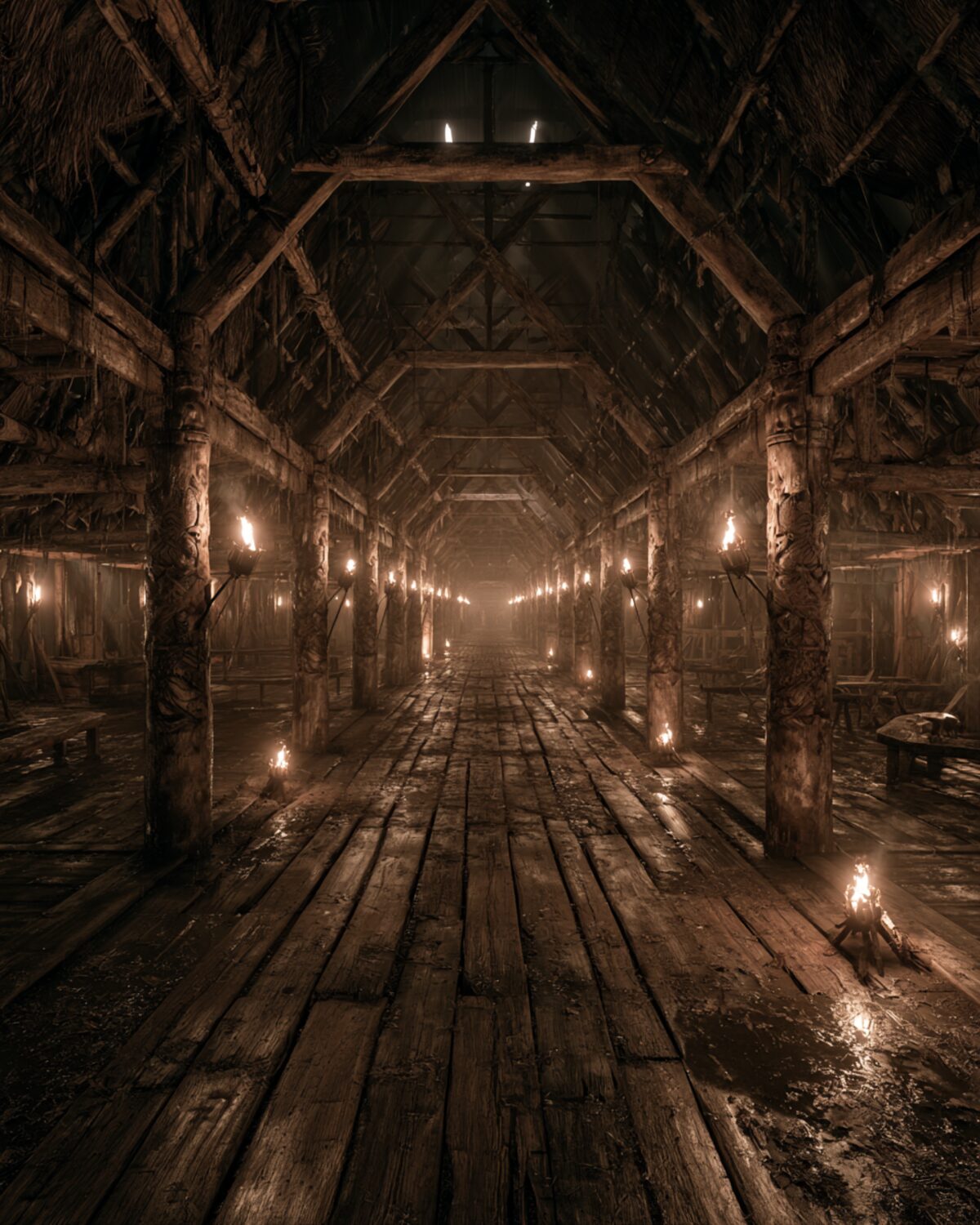
The Vikings had no central state power. Law and politics arose at the assembly of free people – the Thing.
How does a society order its life together when it has no officials, no written law books and often not even a king? The Norsemen’s answer was the Thing.
The Thing was the regular assembly of the free men of a region. Here disputes were settled, verdicts passed, contracts concluded and important decisions made. Whoever had a matter to raise put it before the community – the public itself was the authority.
Since the laws were not written down, there was the law-speaker (lögsögumaðr): a man who knew the law by heart and recited it aloud at the assembly. Law was thus something that lived in the memory of the community.
The most famous of these assemblies is the Icelandic Althing, which according to tradition first met around 930 on the plain of Þingvellir. It is regarded as one of the oldest still-existing parliaments in the world. Here we see how seriously the Vikings took the law – even without a state in the modern sense.
“Where you know wrong, call it wrong, and grant your foes no peace.”Hávamál 127, translation after Henry Adams Bellows (public domain)
The thing was the popular assembly of the Germanic and Norse world – the place where law was spoken, disputes settled and decisions made. Here the free men came together to decide on quarrels, laws and important questions of the community.
At the thing the right of the stronger did not prevail, but the spoken law. Whoever had suffered wrong could bring a case; verdicts were negotiated, often in the form of compensation payments. Thus the thing tamed the blood feud and held the community together.
In Iceland the lawspeaker (lögsögumaðr) held the whole law in memory and recited it from the "law rock" – a third of it year by year. Only in 1117/18 was the law written down. Until then the law lived solely in the memory of the people.
The most famous thing is the Icelandic Althing, founded around 930 at Thingvellir. Once a year the whole island gathered here. It is regarded as one of the oldest still-existing parliamentary traditions in the world.
All History & Finds articles →
A handle that turned out too short, a fly at the bellows and over a thousand silver amulets in the earth: Thor's hammer …
Read more →A king raises a stone for his wife and calls her on it “Denmark's adornment.” A son sets both parents an even greater …
Read more →A lake named after a god. A lord’s hall the size of a church. Weapons sunk in the water, and a gold ring heavier than …
Read more →Its name means “the god's lake.” On the shore of Tissø on the Danish island of Zealand lay, for centuries, one of the …
Read more →