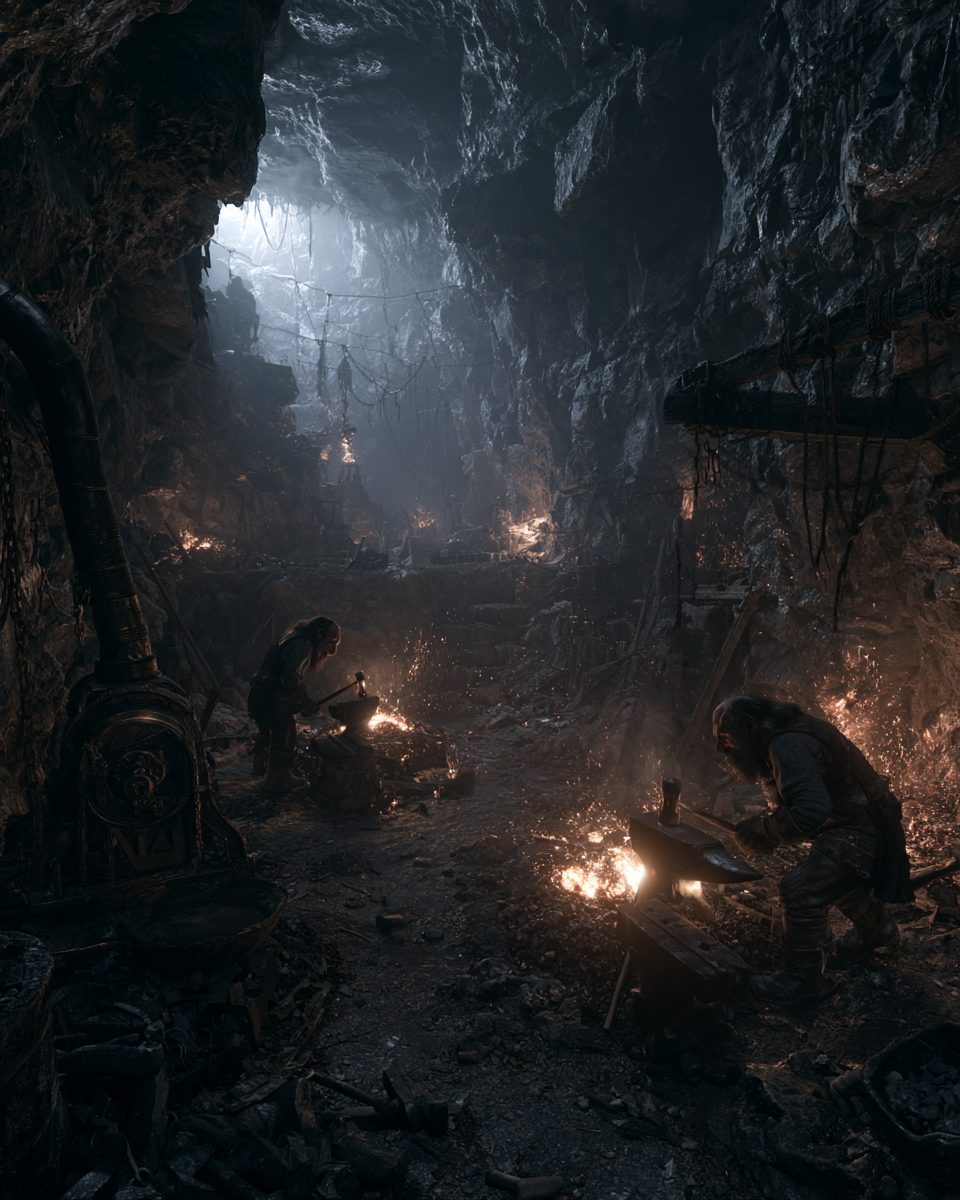
Thor's hammer stands for protection and blessing: Mjölnir is the thunder god's weapon for smashing giants, but also the tool he uses to hallow a bride, his goats and a funeral pyre. People wore it as a pendant above all in the tenth century, and archaeologists know of roughly a thousand. Here is what the Edda tells, what the finds prove, who actually wore the hammer, and why many modern pendants have little in common with the originals.
Picture a hall in the land of the giants. A wedding feast, where an unusually broad-shouldered bride has just put away eight salmon and an entire ox. Then a hammer is carried in to hallow the marriage. A few breaths later the groom lies dead on the floor. That is how one of the best-known poems of the Edda ends, and it shows the heart of what Thor's hammer means: it smashes, and it blesses. The two belong together.
Mjölnir (Old Norse Mjǫllnir) is the hammer of the thunder god Thor. In myth it is the most dangerous weapon the gods own, Asgard's only real insurance against the giants. In the lived reality of the Viking Age it was something smaller and more personal: a pendant of silver, iron or amber, worn on a cord around the neck, buried in a silver hoard or laid on a cremation urn. To keep these two worlds from blurring, this article separates carefully what comes out of the ground from what poets wrote down in the thirteenth century.
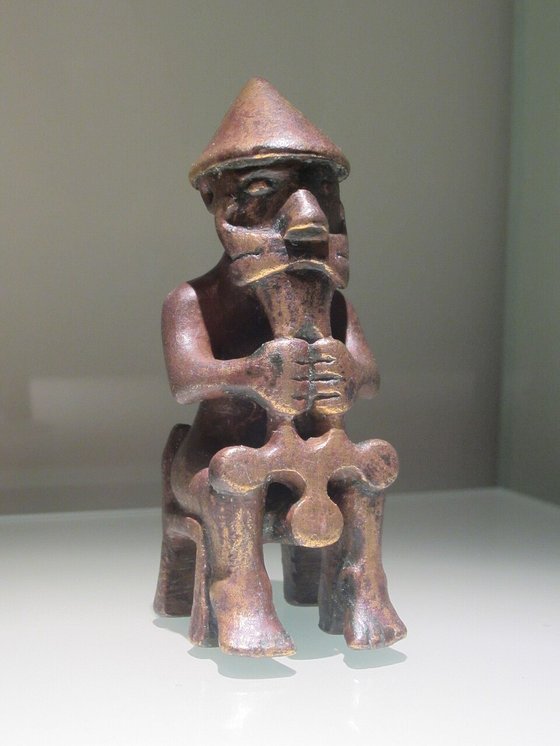
The fullest origin story is in the Prose Edda of the Icelander Snorri Sturluson, written around 1220, in the section called Skáldskaparmál ("The Language of Poetry"). It starts with a prank: Loki has cut off the hair of the goddess Sif. Thor threatens to break every bone in his body, and Loki promises to make it good. The sons of the dwarf Ivaldi forge golden hair for Sif, along with the ship Skíðblaðnir and the spear Gungnir.
That could have been the end of it, but Loki cannot help himself. He bets his head with the dwarf Brokkr that Brokkr's brother cannot produce three treasures just as good. In most editions the brother is called Eitri; in part of the manuscript tradition and in older translations, such as Brodeur's English version of 1916, he appears as Sindri. It is the same smith. You can read more about the pair in our article on Sindri and Brokkr.
The smith puts three pieces into the forge one after another, and Brokkr has to work the bellows without a moment's pause. A fly – Loki, of course – lands on his hand and stings, then on his neck, and during the third piece between his eyes. Blood runs into Brokkr's eyes, he wipes it away, and the bellows stop for an instant. Out come the golden-bristled boar Gullinbursti, the ring Draupnir and, last, the hammer. Because the bellows faltered, its handle turns out a little too short.
Odin, Thor and Freyr judge the treasures and declare the hammer the best of them all: it strikes whatever Thor aims at, never misses, returns to his hand when thrown, and can be made small enough to tuck inside his shirt. Brokkr has won the bet. Loki saves his head with a lawyer's trick – the head belongs to the dwarf, but not the neck – and Brokkr simply sews his lips shut.
Where the name Mjǫllnir comes from has not been settled. Scholars mainly discuss three routes. First, a link to words for "lightning" in Slavic languages (Russian molnija), which would make it "lightning-maker". Second, a connection with Old Norse mjǫll, "fresh snow", and Icelandic mjalli, "white" – the hammer as a brightly flashing lightning weapon. Third, a derivation from mala, "to grind", Gothic malwjan, "to crush": Mjölnir would then simply be "the crusher".
None of these is proven, and anyone selling you one of them as the definitive translation is selling more than linguistics can deliver. What is clear: a thunder god with a striking weapon is not a Nordic peculiarity. The storm god who hurls lightning with club, axe or hammer turns up in many Indo-European traditions. The Romans already equated the Germanic thunder god with their own club-bearing Hercules – more on that under Donar and Hercules Magusanus.
The poem this article opened with is Þrymskviða, "The Lay of Thrym", in older editions also called "Hamarsheimt", the fetching home of the hammer. Thor wakes up and his hammer is gone. Loki borrows Freyja's feather cloak, flies to the land of the giants and learns that the giant lord Thrym has hidden the hammer eight leagues underground and will only give it back if he gets Freyja as his wife. Freyja refuses with a fury that bursts her necklace. So Thor is put into a bridal dress and veil, and Loki goes along as the maid.
At the wedding feast Loki has to rescue the situation twice: the bride, he explains, has not eaten for eight nights out of longing, and her burning eyes come from lack of sleep. Then Thrym gives the order that seals his fate. Henry Adams Bellows' public-domain translation of 1923 renders the moment like this:
"Bring in the hammer the bride to bless;"Þrymskviða, st. 30, translated by Henry Adams Bellows (1923, public domain)
The hammer is to be laid in the bride's lap so the marriage is concluded according to custom. Thor's heart laughs when he sees his weapon; he grabs it and kills Thrym and all his kin. For our question the detail is decisive: the poem takes it for granted that a hammer hallows a bride. Whether such a wedding custom really existed in the North cannot be proven from the poem alone – it was written down in the thirteenth century, and some scholars consider it a relatively late, almost comic composition. But the scene only works if the audience knew the idea.
Hymiskviða is a different animal. Thor goes fishing with the giant Hymir, baits his hook with an ox head and hauls the Midgard Serpent up from the depths. He strikes its head with the hammer, the mountains roar – and the serpent sinks back into the sea. At the end of the poem Thor uses Mjölnir to kill the giants pursuing him. Here the hammer is pure weapon. In the flyting poem Lokasenna, Thor threatens the mocking Loki with it four times, and the duel with the stone giant Hrungnir is decided by it too. One exception tells its own story: at Geirröd's hall, Thor has to manage without Mjölnir.
In Gylfaginning, Snorri gives two scenes in which the hammer smashes nothing at all. In the first, Thor stays with a farmer, slaughters his two goats Tanngrisnir and Tanngnjóstr and invites the family to eat; the bones are to be laid on the hides. In the morning Thor raises the hammer and hallows the hides (vígði hafrstökurnar), and the goats stand up again. One of them limps, though, because the farmer's son Þjálfi split a thigh bone to get at the marrow. The penalty is well known: Þjálfi and Röskva become Thor's servants.
The second scene is the most solemn in the whole cycle. At the funeral of Baldr, Thor steps up to the pyre and hallows it with Mjölnir (vígði bálit með Mjǫllni). Then the dwarf Litr runs in front of his feet, and Thor kicks him into the fire – that is part of this god too. Shortly before, he had wanted to kill the giantess Hyrrokkin, who had launched the funeral ship, and the other gods had to hold him back.
Put together with Þrymskviða, a clear pattern emerges: the hammer is a tool of hallowing – at the threshold of marriage, at the threshold between death and new life, at the threshold of the realm of the dead. A piece of evidence that comes not from poetry but from stone fits this neatly.
A handful of Danish and Swedish runestones from the tenth and early eleventh centuries carry a short formula: Þórr vígi, "may Thor hallow". The stone from Virring in East Jutland (DR 110) reads þur uiki þisi kuml, "may Thor hallow this monument", and is tentatively dated to about 900–960. The large stone at Glavendrup on Funen (DR 209), raised by Ragnhildr for her husband Alli, ends with "may Thor hallow these runes" – we tell the story behind it in Glavendrup and Tryggevælde. Add to these the stone of Sønder Kirkeby on Falster (DR 220) and, in Sweden, the Velanda stone in Västergötland (Vg 150); on the Korpbron stone in Södermanland (Sö 140) the reading is uncertain.
Other stones show a hammer image instead of the formula: Læborg (DR 26), Hanning (DR 48) and Spentrup (DR 120) in Denmark, and Lärkegapet (Vg 113), Åby (Sö 86) and Stenkvista (Sö 111) in Sweden. The Altuna stone in Uppland and the Gosforth Cross in Cumbria depict Thor's fishing trip for the Midgard Serpent.
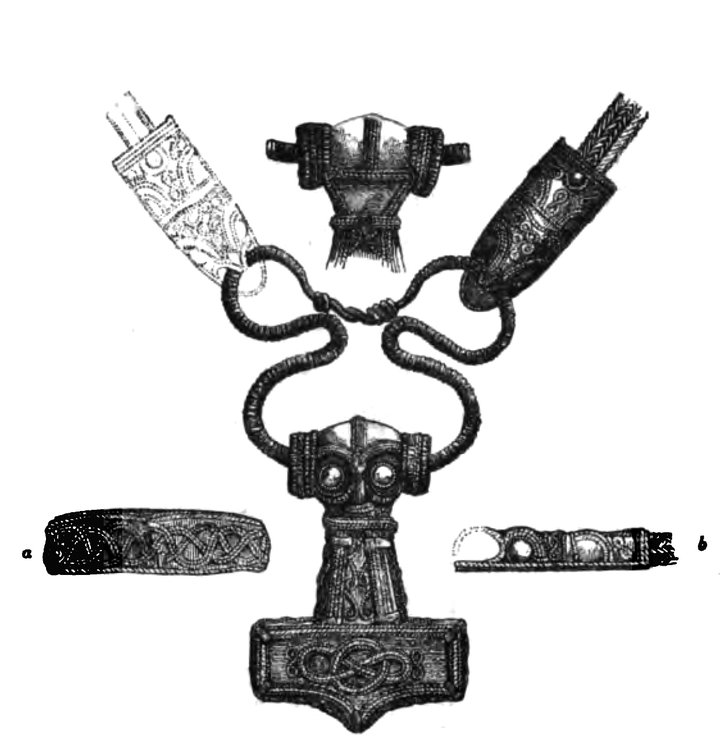
Now for the tangible side. The Danish archaeologist Else Roesdahl puts the number of known Thor's hammers at around 1,000. They have been found across Scandinavia, the British Isles, the Baltic and Russia, plus northern Germany and Poland, with a few from Iceland. The total depends heavily on what you count: a large share are tiny iron hammers hanging from so-called Thor's hammer rings. Archaeologist Bo Jensen's 2010 catalogue lists 237 individually worn hammer pendants – a good hundred from settlements, more than sixty from graves, about forty from hoards and some 35 stray finds.
Thor's hammer rings are a find group of their own: iron rings with one or more small hammers attached. They come mainly from cremation graves in the Mälaren valley, where they often lay on top of the urn, and also from the Åland Islands and from Rus territory, for example Gnezdovo. At Birka a ring with eleven little hammers was found. The earliest rings go back to the Vendel period; the bulk belongs to the Viking Age. What they were for is an open question. Because they were placed on the urn during the burial, many scholars think of a hallowing of the grave – exactly what Thor does at Baldr's pyre.
The individually worn pendants were sorted into a typology by archaeologist Jörn Staecker in 1999, and it is still in use:
Most pieces date to the tenth and early eleventh centuries. That is no accident: it is exactly when Christianity gained ground in Denmark, Norway and Sweden and more and more people wore small crosses. Many plain silver hammers come from silver hoards, where they lay among coins and hacksilver. A magnificent example is the silver pendant from Erikstorp in Östergötland with interlace and granulation; another is the silver hammer from Rømersdal on Bornholm, from the second half of the tenth century.
Where the shape came from is disputed. In 1964 the archaeologist Joachim Werner proposed linking the hammer amulets to the small "Hercules club" pendants that Germanic people wore in the Roman Iron Age. That is not an unbroken line across the centuries, but it is a serious hypothesis.
For a long time it was an assumption that the little T-shaped pendants really depict Thor's hammer. If you wanted, you could see tools, cross variants or plain jewellery in them. In 2014 a find answered the question with real elegance: at Købelev in north-western Lolland, a metal detectorist found a small tenth-century hammer bearing a runic inscription: hmar is, "hammer is" – in plain English, "this is a hammer".
It sounds almost comic, but it is priceless. Among the roughly 1,000 known Thor's hammers it is the only one with a runic inscription, and it shows that the people themselves called this object a hammer. The find was examined and interpreted at the National Museum in Copenhagen.
In the National Museum of Denmark lies an unremarkable soapstone block from Trendgården in North Jutland, dated to the second half of the tenth century. It is a casting mould, and in its hollows a craftsman could cast crosses and Thor's hammers in the same session.
You can read this stone two ways, and both are probably a little true. It shows a silversmith who supplied whatever customers wanted, Christian or pagan. And it shows a society in which both symbols were traded and worn side by side. The pendants of the Hiddensee gold treasure (tenth century, now in the Stralsund Museum) share a similar ambiguity: sixteen gold pendants that scholars describe as hammer-shaped with cross-like features. How this transition played out is covered in our article on Christianisation.
One last look at the written sources. Around 1075 the chronicler Adam of Bremen describes Thor's image in the temple at Uppsala – holding a sceptre, like Jupiter, not explicitly a hammer. And Saxo Grammaticus reports in Book 13 of his History of the Danes that the Danish prince Magnus Nilsson carried off heavy hammers attributed to Jupiter – meaning Thor – from a pagan sanctuary around 1125. Saxo was writing decades later; as an eyewitness account it does not hold up, but as a hint at large cult hammers it does.
Forums and jewellery sites repeat it again and again: Thor's hammer was really a women's symbol. The claim is too sharp, but it rests on a genuine finding.
Three caveats belong with that. First, only part of the hammers come from graves at all; most come from settlements, hoards and stray finds, where no one can be assigned a sex. Second, many grave finds are cremations, where sex is often determined from the grave goods – jewellery quickly suggests "woman", which can skew the statistics. Third, more than one grave in four with a hammer is a man's grave. Put honestly: Thor's hammer is more often attested with women, but by no means only with them.
Thor still has a fixed slot in the calendar. When Germanic speakers adopted the Roman seven-day week, they replaced dies Iovis, the day of the thunder god Jupiter, with the day of their own thunder god. That gave Old English þunresdæg, Old High German donarestag and Old Norse þórsdagr – today Thursday, Donnerstag, torsdag. The equation also shows how Thor was seen: as lord of thunder and weather, not just a brawler. We explain the whole week in Germanic weekdays.
Search for a Thor's hammer today and you will find thousands of pendants. Many are beautiful, some well researched, and a few have little to do with the Viking Age. A handful of features help you place them.
The short handle. Historical hammers have a short, often merely suggested shaft ending in a loop. The head is broad, and the arms often flare slightly or end in triangles – a shape that happens to fit Snorri's "too short handle" perfectly. Long, slim handles with leather wrapping come from comics and film.
Ornament, not symbol salad. Genuine decorated pieces carry punched patterns, interlace, filigree or granulation. Combining a valknut, Vegvísir, Yggdrasil tree or runic row on a single pendant never happened in the Viking Age. The Vegvísir, for instance, is an Icelandic magical stave from a nineteenth-century manuscript – more in our overview Which Norse symbols are authentic?.
Faces and eyes. Some southern Scandinavian pieces show large eyes or a bearded face where the shaft meets the head. That is authentic and widely copied today, often sold as the "Skåne type"; the scholarly typology does not use that term – it is a trade name.
Material. Silver and iron dominated, with amber and bronze alongside. Gold is the great exception among genuine hammers – Hiddensee is a special case.
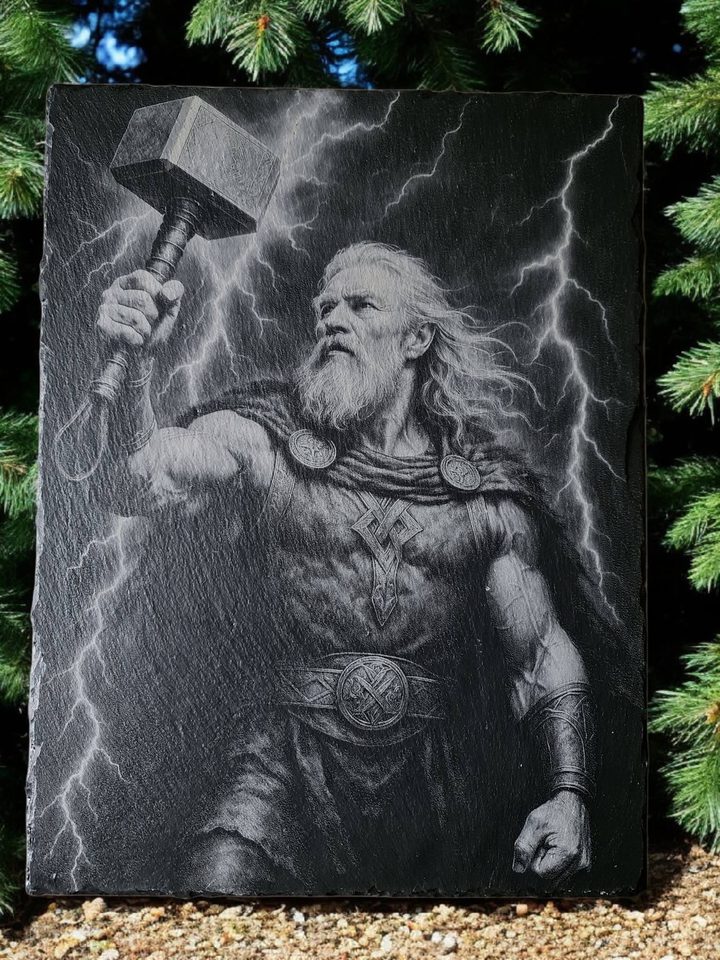
We engrave Thor's hammer often, on slate, wood and glass. A few lessons from the workshop. Take a real find as your model: Erikstorp, Rømersdal or a plain iron hammer work better as an engraving than any fantasy shape, precisely because their lines are clear. On natural slate, filled areas turn pale and the finest granulation blurs, so we translate the bead ornament into rows of dots with a little spacing. How the material behaves under the laser is explained in Laser engraving on natural slate.
If you want to add text, the attested formula beats any invented motto: Þórr vígi, "may Thor hallow" – in Younger Futhark spelling þur uiki, just as it stands on the stones. As a wedding gift, the hammer carries real history thanks to Þrymskviða; for a birth it is a modern, affectionate interpretation, and it is fine to say so. We turn your own idea into a custom engraving.
For courage. For remembrance. For legends that live on.
What does Thor's hammer symbolise? Protection and blessing. In myth Thor kills giants with Mjölnir, but he also uses it to hallow a bride, his goats and Baldr's funeral pyre. As an amulet it was probably a sign of protection and of faith.
What does Mjölnir mean? That is not settled. Proposed meanings include "lightning-maker", "the shining one" and "the crusher".
Who forged Mjölnir? According to Snorri's Prose Edda, the dwarf Eitri (Sindri in part of the tradition), with his brother Brokkr working the bellows. Because Loki interfered as a fly, the handle came out too short.
Did Vikings really wear Thor's hammer pendants? Yes. Around 1,000 hammer amulets are known, most from the tenth and early eleventh centuries. The runic hammer from Købelev even bears the inscription "hammer is".
Was Thor's hammer worn by men or women? Both. In graves it is more often found with women, but around a quarter of grave finds come from men's graves.
Is Thor's hammer a religious symbol? In the Viking Age it was closely tied to belief in Thor and was worn especially during the period of Christianisation. Today it is worn by followers of modern pagan religions as well as by people who simply value the history of the North.
A note on honesty: the Edda texts were written down only in the 13th century, in Christian Iceland. They are our main source for the myths, but not a record of the Viking Age. Where find and text agree, we say “evidence”; where only the saga speaks, we say “myth”.
All History & Finds articles →
A king raises a stone for his wife and calls her on it “Denmark's adornment.” A son sets both parents an even greater …
Read more →A lake named after a god. A lord’s hall the size of a church. Weapons sunk in the water, and a gold ring heavier than …
Read more →Its name means “the god's lake.” On the shore of Tissø on the Danish island of Zealand lay, for centuries, one of the …
Read more →Sometimes a whole world of gods sits on a thumb-sized piece of bronze. The four Torslunda dies from the island of Öland …
Read more →