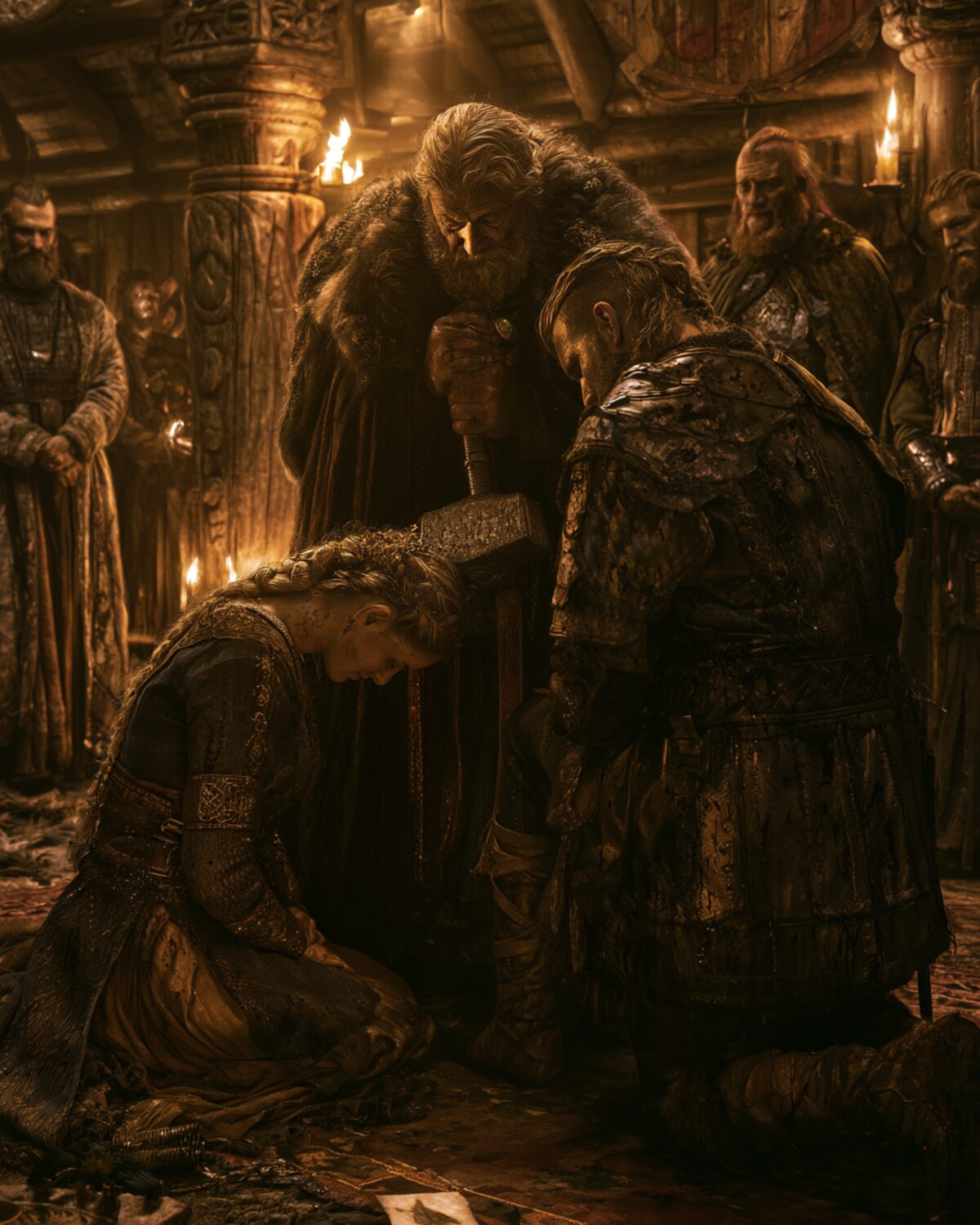
The Germanic god of thunder was called Donar on the continent – Thunaer to the Saxons, Þunor to the Anglo-Saxons and Þórr in Scandinavia, the Thor we know today. Every one of these names goes back to Proto-Germanic *Þunraz, which simply means "thunder". The Romans called him Hercules, Thursday still carries his name, and Boniface cut down his oak. Here is what the evidence actually tells us about him – and what was only added later by the Icelandic Edda.
Long before anyone in Iceland wrote down a single story about Thor, farmers along the Rhine, the Weser and the Danube heard the same rumble roll over their fields and said the same word. They did not need a poetic title for him. His name was the sound.
Donar was not the highest of the Germanic gods. He was the one ordinary people actually lived with – and that is something we can measure: in altars and amulets, place names and runes, and in how hard the missionaries worked to get rid of him. Here is the evidence, and where it stops.
Linguists reconstruct a Proto-Germanic name *Þunraz. The asterisk marks a word never written down, only worked out backwards from later languages. It means "thunder". From it come the names we actually find:
Behind all of them sits an Indo-European root meaning "to thunder", the same one found in Latin tonare and in English "thunder" itself. Many divine names are old titles whose meaning had faded long before anyone wrote them down. Not this one: god and weather shared a single word.
Which is also why crosswords that ask for a "Germanic thunder god" – or, in German puzzles, a "rumble over Midgard" – usually want four or five letters: THOR or DONAR. Both are right; they just come from different corners of Europe. For how Donar relates to the other two great continental gods, see Wodan, Donar & Ziu.
The oldest written evidence for Germanic gods comes from Romans, who translated foreign gods into their own – the interpretatio Romana, or "Roman interpretation".
Donar was not given Jupiter's name, but that of Hercules. Tacitus, writing his short Germania around AD 98, mentions him twice. In chapter 3:
"They say that Hercules, too, once visited them; and when going into battle, they sing of him first of all heroes."Tacitus, Germania 3, trans. A. J. Church and W. J. Brodribb (1876)
In chapter 9 he lists the gods to whom the Germani sacrifice: Mercury above all, on certain days even with human victims, while "Hercules and Mars they appease with more lawful offerings". Scholars see Wodan behind Mercury, Tiwaz behind Mars – and Donar behind Hercules.
Why Hercules? Apparently the Romans went by what they saw: a god with a striking weapon, fighting monsters, sung about before battle – more club-wielding hero than enthroned father of gods. In the Annals (2.12) the Cherusci gather in AD 16 in a forest sacred to Hercules beyond the Weser.
This god has an address not far from our workshop. In the land of the Batavi, in what is now the Rhine delta of the Netherlands, and along the Lower Rhine, altars name a Hercules with an epithet unknown in Rome: Hercules Magusanus.
At Empel on the Meuse, excavators uncovered a temple precinct tied to an inscription for him; the oldest known altar, from Ruimel, is dated to the mid-first century AD. In 2022 another sanctuary came to light at Herwen-Hemeling, with several altars, most of them dedicated to Hercules Magusanus. Further dedications reach Cologne, Bonn, Rome and even the Antonine Wall in Scotland, carried by Germanic auxiliaries in Roman service.
What the epithet means is disputed. Germanic *Magus-naz, "the mighty one"? A link to Noviomagus, modern Nijmegen? A Celtic root? Rudolf Simek has suggested that Magusanus was originally a byname of the thunder god. So, with every caveat: a few dozen kilometres from our workshop in Alsdorf, people raised altars two thousand years ago to a god who was very probably the Thunderer – under a Roman name.
You say his name every week. Thursday is Þunor's day, German Donnerstag is Donar's day, Dutch has donderdag and Scandinavian torsdag. The model was the Roman planetary week with its dies Iovis, Jupiter's day – French jeudi, Italian giovedì. When the Germanic peoples adopted the seven-day week, they replaced the Roman god of the thunderbolt with their own thunder god.
Notice the contradiction: in Tacitus Donar is Hercules, in the calendar Jupiter. Neither is a mistake. These equations looked for the nearest likeness, and that depended on what you were looking at – the club or the lightning. How the other weekdays got their gods is explained in our piece on the Germanic weekdays.
Church sources show the day was more than a name. The Indiculus superstitionum et paganiarum, an eighth-century list of pagan practices, includes as item 20 "the festivals they hold for Jupiter or Mercury". And around the year 1000 the Anglo-Saxon abbot Ælfric explains in his homily on the false gods that Jove is called Thor among some peoples, that the Danes loved him most – and he links him explicitly to Thursday.
Donar's most famous moment in recorded history is his fall – and we know it only because the other side wrote it down. In the 720s the Anglo-Saxon missionary Boniface was working in Hesse. At Geismar, near today's Fritzlar, there stood, according to his biographer Willibald, a tree "of wondrous size" which the pagans called by an old name, robur Iobis – the oak of Jupiter. Boniface had it felled. He had barely begun to cut, Willibald says, when a divine blast of wind seized the tree, threw it down and split it into four parts of equal length. From the timber Boniface built an oratory dedicated to Saint Peter.
The event is usually dated to 723, sometimes 724; Willibald himself gives no year. He wrote the Life of Boniface after the missionary's death in 754, probably in the 760s.
Now the critical eye. A saint's life exists to show that the old god is powerless. The gust of wind, the four equal pieces, the instantly converted crowd are stock motifs of the genre. Nobody knows what really happened.
What does hold up: there were named sacred trees, destroying them was a planned, public show of power, and the Latin text calls the god Jupiter – just like the weekday. That Donar is meant is our inference from that equation. Two generations later Charlemagne destroyed the Irminsul of the Saxons: same pattern, this time with an army. We tell the whole story in The Donar Oak of Geismar.
A manuscript in the Vatican Library (Codex Palatinus latinus 577) preserves a short baptismal vow in Old Saxon, written in the context of the Frankish mission to the Saxons around 800. The candidate renounces the devil – and then three gods by name:
"end ec forsacho allum dioboles uuercum and uuordum, Thunaer ende Uuôden ende Saxnôte ende allum them unholdum the hira genôtas sint" – and I renounce all the devil's works and words, Thunaer and Woden and Saxnot, and all the fiends who are their companions.Old Saxon baptismal vow, c. 800 (our own rendering)
Nobody drafts an abjuration against gods no one believes in. That makes this little text one of the most reliable guides to which gods mattered among the Saxons around 800. And Thunaer comes first.
The third name is a puzzle. Saxnot appears elsewhere only as Seaxnēat in the royal genealogy of Essex; he is usually taken as a tribal god of the Saxons. The vow belongs to the world of Charlemagne's Saxon wars: the old faith did not fade away by itself, it was pushed out with laws, armies and sentences like this one. More in our piece on the Christianisation of the Germanic peoples.
Every text so far was written by outsiders. One find carries Donar's name in the Germanic peoples' own script.
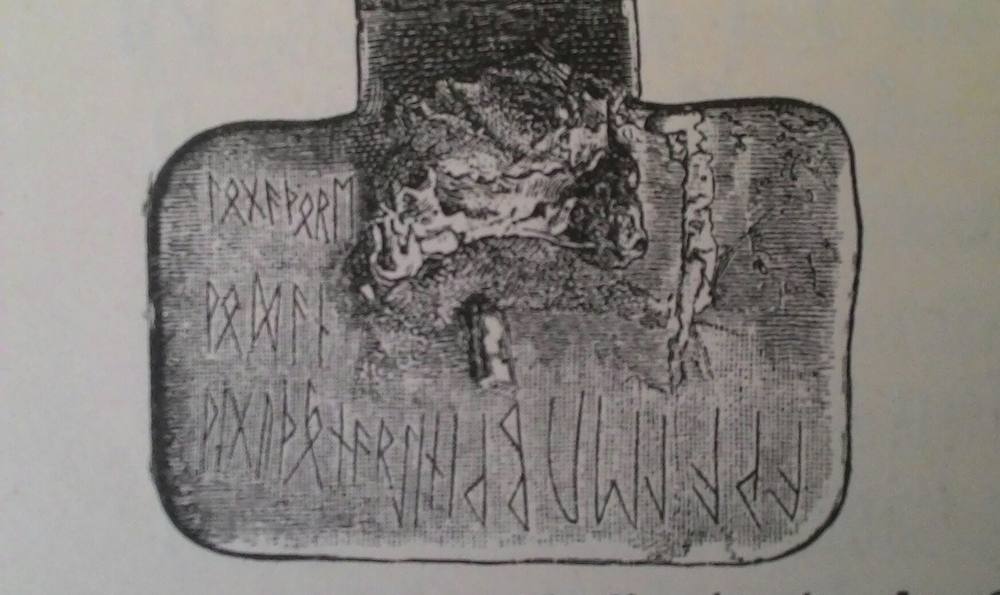
In 1843 a bow brooch – a dress fastener of the kind women wore in pairs – came out of an Alamannic cemetery at Nordendorf north of Augsburg; its partner from the same grave followed a year later. "Nordendorf I" is dated from the mid-sixth to the early seventh century and carries two inscriptions on its back in the Elder Futhark, the older Germanic rune row: awa leubwini – probably the names Awa and Leubwini – and, upside down relative to it, logaþore / wodan / wigiþonar.
Wigiþonar is read either as "hallowing Donar", from a verb meaning "to consecrate", or as "battle Donar". For logaþore, Loki, Lóðurr and a word for "sorcerer, deceiver" have all been proposed. Is someone invoking Wodan and Donar for protection? Or does the line say, as Klaus Düwel suggested, "Wodan and Donar are sorcerers" – an early Christian charm against the old gods? The Alamanni were being converted at exactly this time. The debate is open.
Either way: here is the thunder god's name in sixth-century southern Germany, scratched by someone from that world – centuries before anything of the Edda was written down in Iceland.
In the second and third centuries, people across the Roman Empire wore small club-shaped pendants, mostly of gold, modelled on the knotty club of Hercules; one from Cologne-Nippes even carries the words DEO HER[culi]. Later, roughly in the fifth to seventh centuries, similar club pendants appear in the Germanic world – now usually of antler, bone or wood. In a well-known 1964 study the archaeologist Joachim Werner traced the path from the Roman "Hercules club" to the Germanic "Donar amulet": the Germanic peoples, he argued, took over a Roman Hercules sign and applied it to their own thunder god.
That is not certain – the Germanic pendants carry no inscriptions. But the sequence is striking: a club in late antiquity, a hammer in the Viking Age, both small, both worn at the neck, both the weapon of a god who strikes and protects.
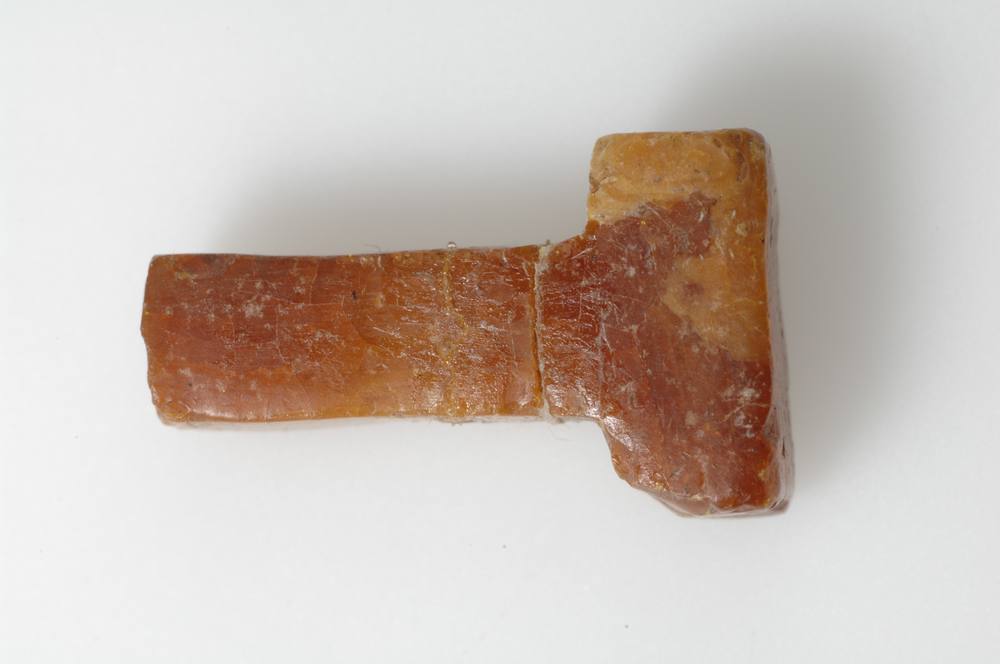
In the north the club becomes a hammer. According to the Danish national encyclopaedia, some thousand Thor's hammer amulets are known from the Viking Age, from Scandinavia, the British Isles, the Baltic and Russia – often from women's graves, and from silver hoards. No other divine symbol comes close. More on forms and types in Thor's hammer Mjölnir.
Two finds stand out. At Trendgården in North Jutland a soapstone mould was found in which a cross and a hammer could be cast side by side, dated to the second half of the tenth century: one craftsman serving both sets of customers. And in 2014 a small bronze hammer with traces of silvering and gilding turned up at Købelev on Lolland, telling us in runes what it is: hmar is, "(this) is a hammer". It is so far the only Thor's hammer with a runic inscription.
Then there are inscriptions that address the god directly. Danish and Swedish runestones carry the formula Þórr vígi, "may Thor hallow": the Glavendrup stone on Funen ("may Thor hallow these runes"), Virring ("may Thor hallow this monument"), Sønder Kirkeby and Velanda. A copper amulet from Kvinneby on Öland asks Thor to protect its wearer with his hammer. More on such formulas in Rune hallowing.
The hammer plays the same role in poetry. In the Þrymskviða, a poem of the Poetic Edda, the giant Þrymr has the supposed bride – Thor in disguise – hallowed with the hammer:
Bring in the hammer to hallow the bride, / lay Mjöllnir in the maiden's lap, / wed us together by the hand of Vár.Þrymskviða 30, our own rendering
So the hammer does not only strike; it makes things valid – marriage, grave, stone. And Adam of Bremen, describing the temple at Old Uppsala around 1075, writes that Thor stood in the middle between Wodan and Fricco, ruling thunder and lightning, wind, rain, fair weather and crops, and that people sacrificed to him when plague or famine threatened. Not for victory. For harvest and health.
For centuries, farmers ploughing their fields turned up polished Neolithic stone axes. People explained them as what lightning leaves in the ground: thunderstones, German Donnerkeile. They were laid under thresholds, built into walls or kept in the roof timbers to protect the house from lightning and fire. Such axes turn up in medieval and early modern buildings in Scandinavia, northern Germany and the British Isles often enough to count as a real custom, and folklore collections record the belief into the nineteenth century.
Belemnites – the bullet-shaped fossils of ancient squid-like animals – shared the same fate. In German they are still called Donnerkeile, "thunderbolts", or Teufelsfinger, "devil's fingers", and they too were treated as storm relics with protective power.
Whether seventeenth- or nineteenth-century farmers still had Donar in mind is doubtful. What survived was the idea that thunder throws missiles – and that you can turn them against it. Not every thunderstone is a "pagan survival".
Place names are precious: nobody coined them to prove a point, and they outlast changes of religion. In Scandinavia Thor is the god with the most place names of all: Torslunda ("Thor's grove"), Torsåker ("Thor's field") and many more, plus Tórshavn in the Faroes. In England there are Thundersley in Essex and Thursley in Surrey, both from Old English Þunres lēah, "Thunor's clearing or grove". These names cling to fields, groves and hills – not to battlefields.
On the continent the trail thins out. The best-known candidate is the Donnersberg in the Palatinate, usually linked with Donar. But Celtic derivations have been proposed too, and a mountain can simply be named after thunder without any god in mind. More in our piece on gods in place names.
Almost – but not quite. The name is the same, as is the role of protector and hallower, the striking weapon and the equation with Jupiter in the weekday.
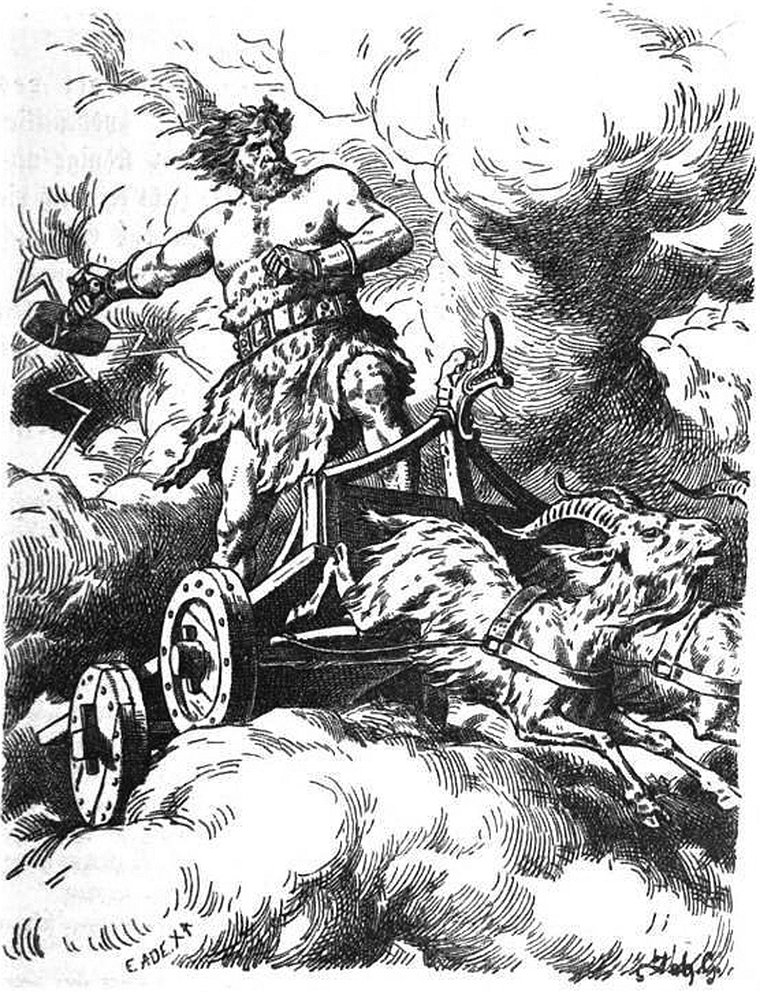
But every story you know about Thor – Mjölnir forged by dwarfs, the goat-drawn chariot in Gehrts' illustration above, fishing for the Midgard Serpent, dressing up as a bride – comes from Icelandic manuscripts of the thirteenth century. Between the Nordendorf brooch and those manuscripts lie some seven hundred years and well over a thousand kilometres. Projecting Thor's adventures onto Donar is an inference, not evidence.
What we have is real: stones, brooches, baptismal formulas, weekdays, place names. They show a god who lived not in heroic poetry but in everyday life. Odin was the god of princes and poets, moody and unpredictable. Donar was the one you called on when the storm hung over the harvest. Whoever wore one of those thousand hammers had chosen the protector.
What was the Germanic god of thunder called? Donar among the continental Germanic peoples, Thunaer among the Saxons, Þunor among the Anglo-Saxons and Þórr – Thor – in the north. All go back to Proto-Germanic *Þunraz, "thunder".
Is Donar the same as Thor? The same god under different names – but the familiar Thor myths come from thirteenth-century Icelandic sources. No story about Donar himself survives.
Why is Thursday called Thursday? It is Thunor's (Thor's) day, modelled on Latin dies Iovis, Jupiter's day, with the Germanic thunder god taking Jupiter's place.
What was the Donar oak? A sacred oak at Geismar in Hesse that Boniface felled around 723. Willibald calls it robur Iobis, the oak of Jupiter; that Donar is meant follows from the Roman equation.
What symbol belonged to Donar? In the north the hammer, attested by around a thousand amulets. On the continent there are earlier club pendants interpreted as Donar amulets – a well-argued but unprovable thesis.
For courage. For remembrance. For legends that live on.
Wodan, Donar & Ziu · Taranis · Tiwaz · Thor · Germanic Religion.
All Gods & Goddesses articles →
Every great deity of the North has a dwelling. That of Frigg, the highest of the goddesses, is called Fensalir – „the …
Read more →Where there is strife, one is needed who settles it. The North gave that idea a face: Forseti, the god of law. Whoever …
Read more →Freyja is far more than the „Norse goddess of love" she is often reduced to. She is a war-mistress, a master of magic …
Read more →Freyr is the god the Vikings offered to for good weather, rich harvest and peace – the „foremost of the Æsir", as …
Read more →