According to Frankish sources the Irminsul was a sacred object of the Saxons, probably an upright tree trunk or a wooden pillar. The name can be read as "great pillar" or "pillar of Irmin" – irmin is an old Germanic word for "mighty, all-encompassing", which also appears in the tribal name of the Herminones. It was destroyed in 772, right at the start of Charlemagne's Saxon wars.
The Royal Frankish Annals and Einhard report briefly: Charlemagne took the Eresburg (near Marsberg in the Sauerland), felled the Irminsul, and seized a treasure of gold and silver kept there. A later chronicler, Rudolf of Fulda, interprets the pillar as a "world pillar that supports, as it were, everything" – an image of the tree or pillar linking heaven and earth.
"universalis columna quasi sustinens omnia" – "an all-encompassing pillar that supports, as it were, everything"Rudolf of Fulda, Translatio S. Alexandri (public domain, own translation)
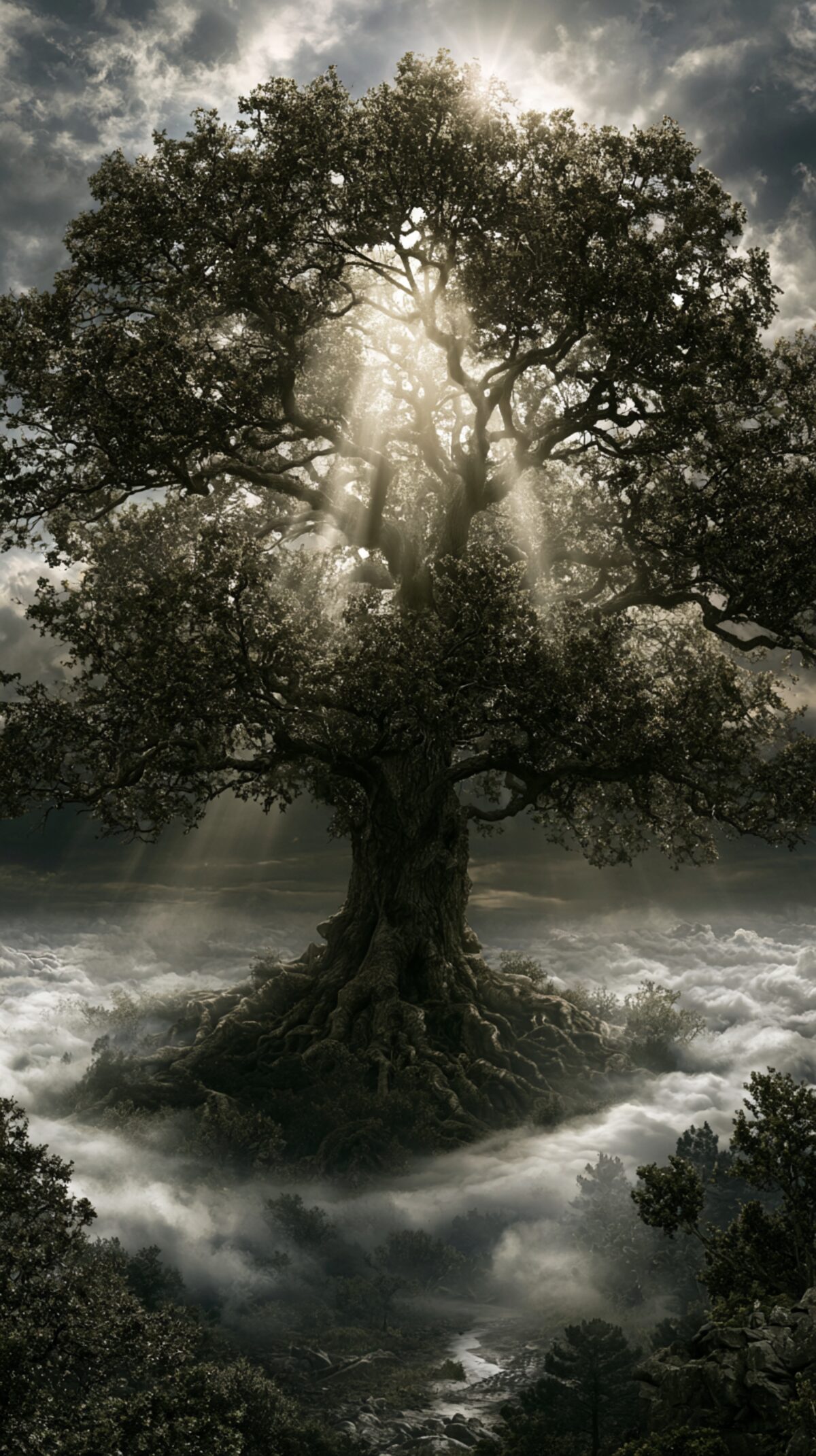
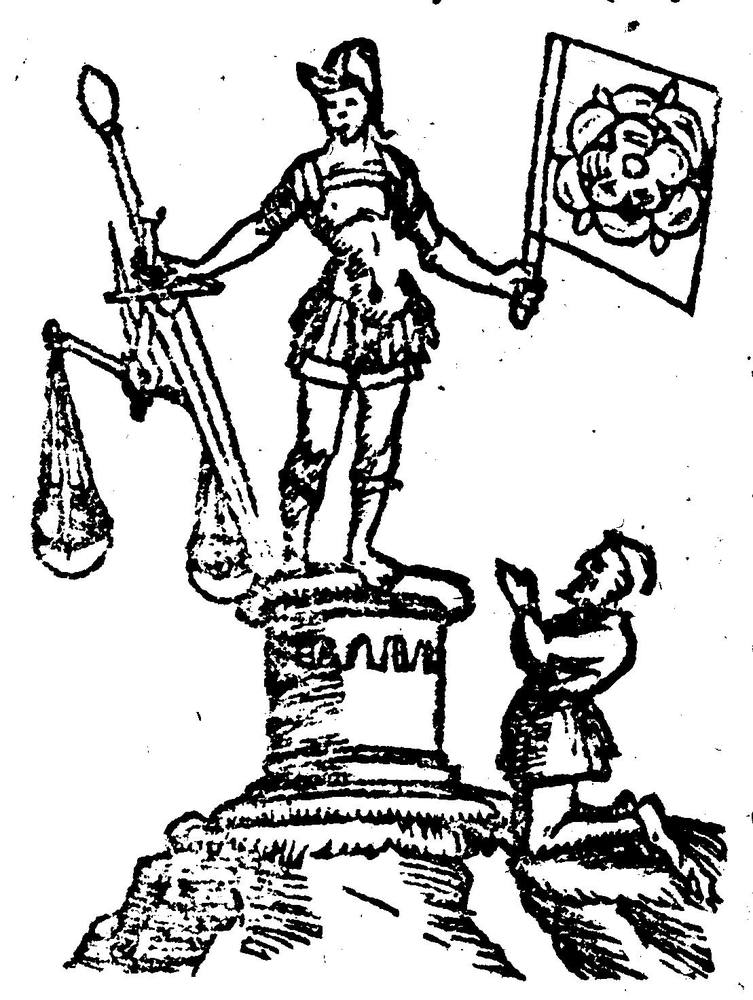
The idea of a world pillar or world tree holding the cosmos together appears later in the North too: Yggdrasil, the world ash of the Edda. Both belong to the same Germanic imagery of the cosmos as a tree or axis. But one must not simply equate them: we know the Irminsul only from hostile Frankish sources, and Yggdrasil only from Icelandic texts 400 years younger and shaped by Christianity. The resemblance is real; the equation "Irminsul = Yggdrasil" remains interpretation.
The destruction of the Irminsul was no accident but a statement. Whoever wished to subject a people struck at its sanctuary. Charlemagne's Saxon wars dragged on for over 30 years (772–804), with mass baptisms, deportations, and the infamous bloody assize of Verden (782, disputed in its interpretation). The Irminsul stands at the beginning of this long, violent transition from the old belief to Christianity in northern Germany – the very "development" that ended Germanic belief.
The Irminsul was an important sanctuary of the Saxons – a mighty pillar or tree that was regarded as the support of the sky and the centre of the world. It is one of the most important testimonies to continental Germanic belief.
In 772 Charlemagne marched against the Saxons and had the Irminsul at the Eresburg destroyed. The chronicler Rudolf of Fulda describes it as "universalis columna quasi sustinens omnia" – an all-embracing pillar that as it were carries everything.
The idea of a world-carrying pillar strongly recalls the Norse world tree Yggdrasil. Both belong to a common Germanic image-world of the cosmos, carried by a central axis.
The Irminsul has become a symbol of pre-Christian Germanic religion. We do not know its exact form – precisely that makes it a screen for interpretations of all kinds.
The Irminsul remains a shadow: mighty enough that it had to be felled, yet so poorly recorded that we know it only in outline. That is precisely what makes it an honest symbol – for the old belief and for what was lost with it.
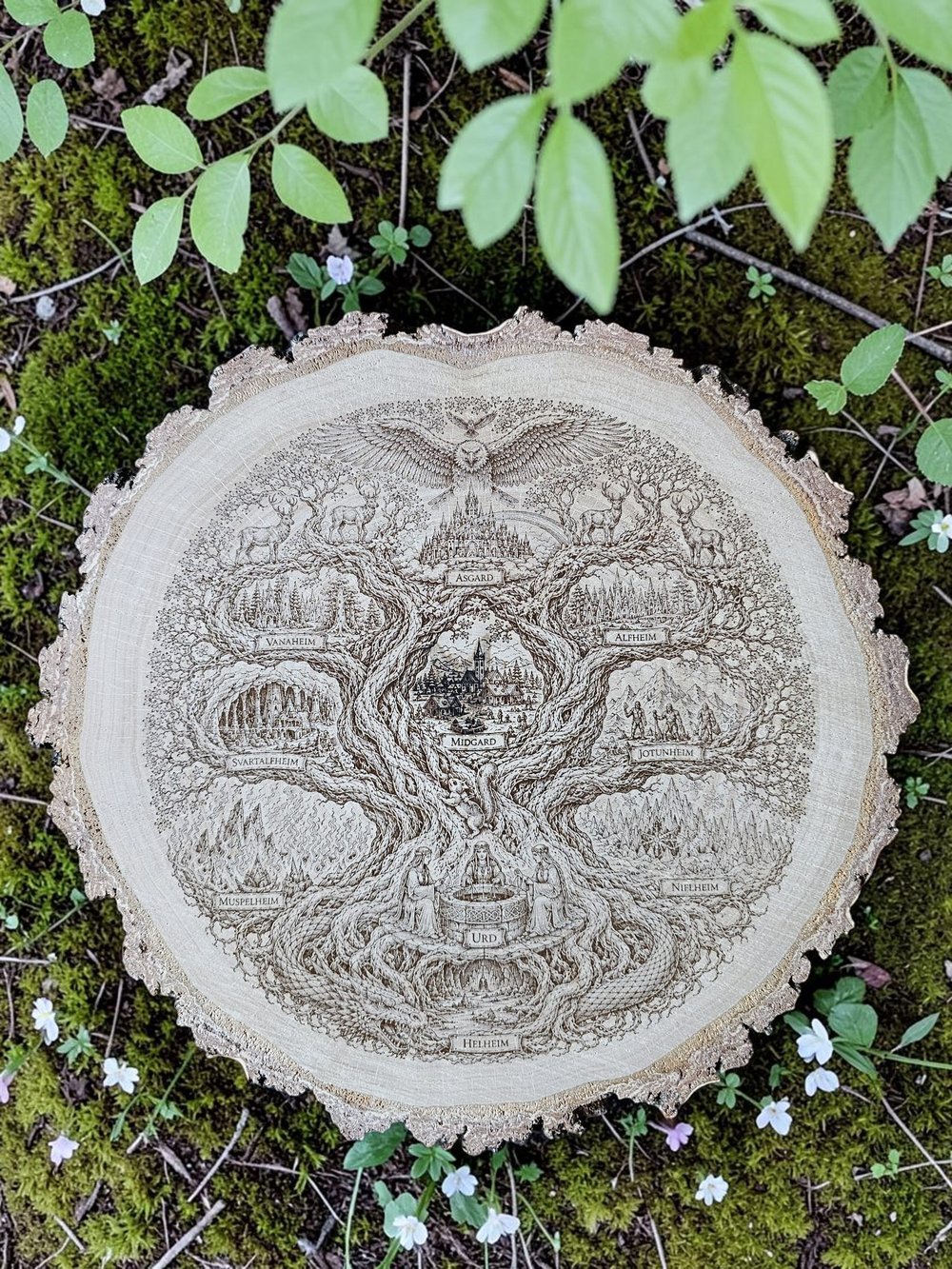
Everything we know for certain about the Irminsul we owe to its enemies. No Saxon voice ever spoke of it — no priest, no eyewitness from the people who worshipped there. What survives was written by Frankish, Christian hands, by men for whom the sanctuary was an idolatry to be swept away. That perspective has to be read along with the words: it explains why the reports are at once so brief and so triumphant.
The most important notice appears in the Annales regni Francorum, the Royal Frankish Annals, under the year 772. There we read that Charlemagne marched into Saxony for the first time, took the fortress of Eresburg, pushed on as far as the Ermensul, destroyed that sanctuary, and carried off the gold and silver he found there. The whole event is compressed into a few words: conquest, destruction, plunder. The explicit mention of precious metal is telling — it suggests the cult site was not a plain stump in the woods but a richly furnished place of more than local importance, or the Frankish war chest would have found nothing worth taking.
The only description of what the Irminsul actually was comes some ninety years later, from a monk: Rudolf of Fulda, in his Translatio sancti Alexandri (863–865). Recounting the way of life of the heathen Saxons, he turns to the pillar. His sentence remains the key passage for every interpretation of the Irminsul.
They worshipped a tree trunk of no small size, raised up under the open sky; in their native tongue they called it Irminsul, which in Latin means „the universal column", as if it were the one that sustains all things.Rudolf von Fulda / Reichsannalen 772
Caution is due here. Rudolf wrote decades after the destruction, from monastic books and hearsay, and he himself had never seen the Irminsul. His „universalis columna, quasi sustinens omnia" is a learned Latin reading, not a photograph. But it is the only one we have — and it describes neither a statue nor a temple building, but an upright, venerated wooden post standing under the open sky.
Piece the fragments together and a sober picture emerges: the Irminsul was a wooden post or mighty column, raised at a holy place, a central Saxon sanctuary of more than regional rank. No stone building, no god's figure in the modern sense — wood, and the upright element itself was the sacred thing. That is precisely why nothing of it survives: wood perishes, and what the Franks did not burn, time carried off.
The name is revealing. The first element Irmin goes back to Proto-Germanic *ermana- and means „great, mighty, all-encompassing". Rudolf of Fulda rendered it quite aptly with his „universalis". The second element, Old Saxon sûl, is simply „column". So Irminsul means something like „the great, all-encompassing column" — a name that points less to a particular god than to a cosmic function.
Yet the trail runs further. An element Irmin appears repeatedly in Germanic tradition, and Tacitus, in his Germania, already names the Herminones as one of the three great tribal groups tracing themselves back to an ancestor, Mannus. Whether a distinct god „Irmin" stands behind this, or whether Irmin- was merely an intensifying epithet (comparable to Anglo-Saxon eormen-, „vast"), remains an open question in scholarship. Only one thing is certain: the name carries within it the idea of greatness and totality.
From here it is only a step in thought to the idea of the world tree or world pillar — that axis which joins heaven, earth and the underworld and bears up the order of the cosmos. This is exactly how Rudolf read it: as the column „that sustains all things". One is tempted to think at once of Yggdrasil, the world ash of Norse mythology. But restraint is called for. Both belong to the same imagery of the supporting tree at the centre of the world, yet they are not the same: Yggdrasil we know from Old Norse poetry written down in Iceland centuries later, the Irminsul from a Saxon cult of the 8th century. Related ideas — no proof of a shared, fixed „system". Anyone who wants to go deeper into the world-tree idea will find it in our detailed Yggdrasil article.
The Royal Frankish Annals link the destruction of the Irminsul to the Eresburg. This hill-fort most probably lay on the spur of present-day Obermarsberg on the river Diemel in northern Hesse/Westphalia — a strategically commanding site the Franks took in 772. The sanctuary lay „near" the fortress; no source names an exact spot. Every modern location is reconstruction, not tradition.
The blow of 772 was not a one-off campaign but the opening of one of the longest and hardest wars of the Carolingian age. The Saxon Wars dragged on, with interruptions, from 772 to 804 — more than thirty years. Charlemagne fought not only for land but for the subjugation of a people and its faith. The destruction of the Irminsul was deliberate policy: they struck the people at its religious heart, not merely at its ramparts. That the Saxons apparently rebuilt the cult site in the following years, and that the Franks intervened again, shows how stubborn the resistance was — and how central this place must have been to Saxon identity.
Into this context belong the notorious severities: forced mass baptisms, deportations, the harsh Saxon law — and, weighing heaviest in the tradition, the bloody assize of Verden in 782. The Christianisation of the Saxons was no gentle wooing but, over long stretches, a subjugation by the sword. Anyone interested in the larger frame will find the story of Charlemagne and the Saxons treated separately by us.
After 772 the Irminsul vanishes from history — and resurfaces more than a thousand years later, this time as a symbol. In the 19th and above all the early 20th century, the „Irminsul" became a longing-sign for a Germanic-heathen movement that sought, in the lost Saxon sanctuary, an image of pre-Christian roots. The „Irminsul symbol" sold today in esoteric and decor shops — usually a column shaft with two arms curving down or outward, like a stylised tree capital — comes precisely from this modern revival. It is a 20th-century invention, not a transmitted form.
The decisive error goes back to Wilhelm Teudt. In his 1929 book Germanische Heiligtümer he interpreted a particular detail in the great Descent-from-the-Cross relief at the Externsteine near Horn-Bad Meinberg as a „bent-over Irminsul": a curved, chair-like object beneath the figure, on which Nicodemus stands. For Teudt this was proof that the Christians had here demonstratively bent down the heathen sanctuary. From this reading came the widespread shape of today's Irminsul symbol.
Art-historically it does not hold up. The Externsteine relief is a high-medieval Christian work (around 1160); the curved object is simply a collapsed seat or a palm-frond motif of the kind the visual language of the time knew — it has nothing to do with a Saxon cult column of 772, neither in time nor in place (the Externsteine lie far from the Eresburg). Teudt's thesis was wishful thinking, not evidence. It has long been refuted, yet it persists stubbornly in popular literature. Anyone wishing to read up on the Externsteine and their real as well as invented history will find it in our separate Externsteine article.
That the matter is delicate has a serious background: Wilhelm Teudt later stood close to the SS-affiliated „Ahnenerbe", and the Irminsul was appropriated in völkisch and National Socialist circles as a Germanic identity marker. This belongs to the honest history of the symbol and should here be neither concealed nor inflated. The historical Irminsul of the Saxons has nothing in common with this 20th-century political charging — it was a cult post, not a party badge.
Myth check: The curved object in the Descent-from-the-Cross relief at the Externsteine is not a „bent-over Irminsul". This reading comes only from Wilhelm Teudt (1929) and is refuted on art-historical grounds: the relief is a Christian work of the 12th century, hundreds of years after the destruction of the real Irminsul, and lies far from the Eresburg. The „Irminsul symbol" sold today, with its curving arms, is likewise a modern design — not a transmitted shape of the Saxon column.
In the end a striking contradiction remains. The Irminsul is well attested historically — not by a find, but by the event of its destruction. That Charlemagne marched there specifically, tore it down, and carried off its gold and silver is powerful testimony: one does not destroy a meaningless thing with a military campaign. The Irminsul was real, it was important, it was the religious centre of a whole people.
And yet we do not know what it looked like. No image, no description of its form, no measurements beyond Rudolf's vague „of no small size" have outlasted the centuries. Was it a smooth trunk? A carved pillar? A tree with its crown intact? We simply do not know. Every „reconstruction" — including the Irminsul symbol so popular today — is a modern interpretation, an honest attempt to give a picture where the tradition falls silent. That is no flaw, so long as one says so plainly: the idea of the Irminsul is old and genuine, its drawn form is young.
Perhaps that is exactly what makes it fascinating. Today the Irminsul stands as a sign for something lost, something we can only circle — an all-encompassing column that sustains all things, of which no one can any longer tell us how it rose into the sky. Whoever engraves or wears it carries not a reconstructed relic but an idea: that of the tree as the axis of the world. And that idea is as great as its name promises.
The Externsteine – an invented cult site? · The Donar oak & Boniface · Yggdrasil – the world tree · The Cherusci & Arminius · The Germanic feasts.
All Festivals & Belief articles →
There are cosier Christmas figures than a house-sized cat that prowls through the winter night to check who did not …
Read more →Before a Viking ship glided toward home, the crew took the carved dragon-heads down from the prow. Not out of modesty …
Read more →Between the years lies a time that ticks differently: the Rauhnächte, the Twelve Nights around the winter solstice. The …
Read more →