To some an ancient Germanic sun-sanctuary, to others a Christian place of pilgrimage – the Externsteine in the Teutoburg Forest are above all a giant screen for projection. A sober look at the evidence resolves the quarrel surprisingly clearly.
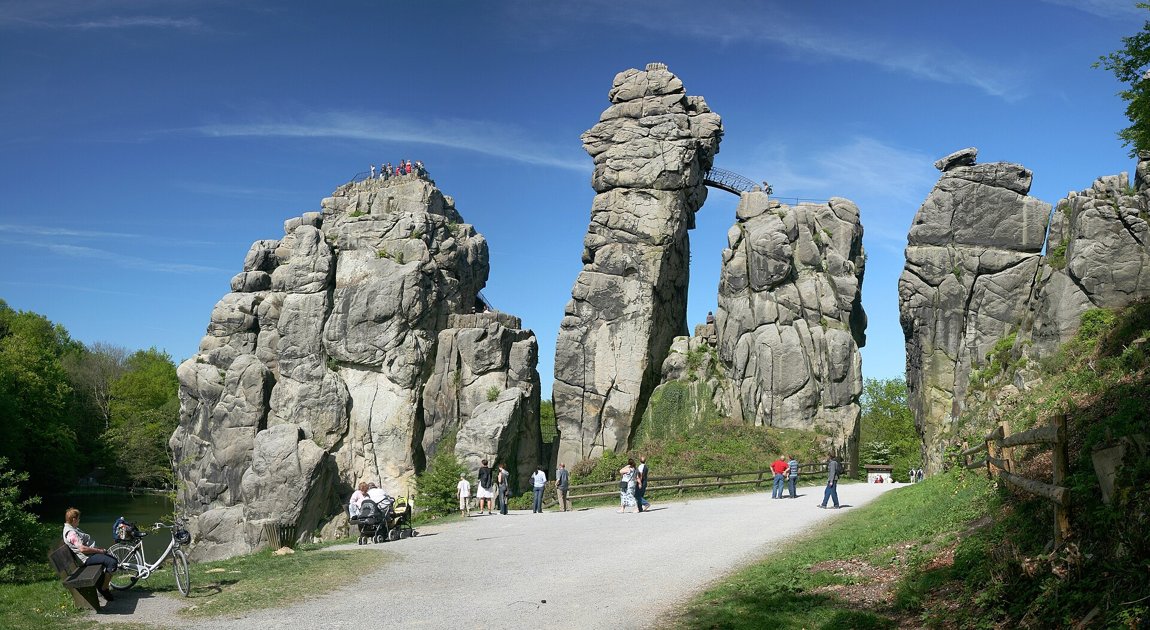
The Externsteine near Horn-Bad Meinberg in Lippe are a natural row of tall sandstone rocks – shaped by nature, not raised by human hands. That Christians were active here in the Middle Ages is well attested. Everything beyond that is a story of interpretation, wishful thinking and hard ideology.
The rocks were demonstrably used in the High Middle Ages: there is a grotto (chapel) cut into the stone, stairs, a summit chamber and the famous relief. A continuous „pagan cult site“ with a temple or sacrifices, by contrast, is not attested archaeologically – tempting as the image may be.
The great rock relief shows the Deposition of Christ – it is a Christian work, made around 1170, and one of the largest of its kind north of the Alps. Beneath the figure of Nicodemus, who lowers Christ from the cross, he stands on a strangely bent object. It is precisely this detail that set off the whole myth-making.
In the 1920s the völkisch amateur researcher Wilhelm Teudt read this bent object as the toppled Irminsul – the Saxon sanctuary said to have been destroyed by Charlemagne. From this he built the thesis that the Externsteine had been the site of the Irminsul. Scholars, however, regard the bent object rather as a footstool or a toppled tree (palm) within the Christian image. Teudt’s reading is a back-projection, not a finding.
Under National Socialism this became policy: Himmler’s Ahnenerbe investigated the stones, there were solstice celebrations and propaganda of a „Germanic sanctuary“. The upright, s-shaped „Irminsul“ seen today on stickers and in esoteric circles goes straight back to Teudt’s model – a 20th-century symbol, not a handed-down Germanic sign.
The medieval Christian use is certain. Whether the rocks played a role in pre-Christian times is possible but unproven; an astronomical alignment of the summit chamber is discussed but disputed. In short: the Externsteine are a fascinating real place – just not the Germanic temple the 20th century wished to make of them.
Before anyone speaks of gods, solstices or priests, it is worth looking soberly at the rock itself – and it is impressive enough. The Externsteine are a group of towering sandstone pillars in the Teutoburg Forest, near Horn-Bad Meinberg in the district of Lippe. The stone is so-called Osning sandstone, formed around 120 million years ago from coastal sand deposited in the early Cretaceous period. Originally these layers lay horizontally, as sedimentary rock should. What makes them so spectacular today is a geological quirk: during the mountain-building that also folded up the Alps, the strata along the northern edge of the Teutoburg Forest were tilted to an almost vertical position. Once flat-lying beds became upright teeth of rock.
The softer surroundings weathered away over millions of years, while the resistant sandstone remained standing – as a row of narrow towers, some over thirty metres high. It is no wonder such a place fires the imagination. It looks as if placed there by a giant's hand. But that is exactly where the first honest observation lies: the striking shape is a purely natural work of deposition, folding and erosion. No human built these rocks, no cult shaped them. What people later added – stairs, chambers, a relief – can be clearly distinguished from this if you look closely.
The most significant man-made part of the Externsteine is unmistakably Christian. On the eastern face of the first rock is a large stone relief showing the Descent from the Cross: Joseph of Arimathea and Nicodemus take the body of Jesus down from the cross, sun and moon bow above, and at the top God is enthroned with the banner of victory. It is one of the largest Romanesque images north of the Alps and is dated fairly securely by art historians to around 1160 to 1170 – that is, to the High Middle Ages, in the middle of a long-since Christian landscape. It was probably connected with the nearby monastery of Abdinghof in Paderborn, which maintained a place of devotion and pilgrimage here meant to evoke the Holy Land.
Beneath the feet of Nicodemus one peculiar detail stands out: a bent, almost buckled object on which the figure appears to stand. For medieval visual language this is not mysterious but familiar – it is most likely a stylised figure bowing under the weight of the sacred event, or a curved seat, a common motif that subordinates the old to the new. Yet it was precisely this bent object that would enjoy an astonishing second career in the 20th century – not as what it is, but as what someone wanted to see in it.
In 1929 the former pastor Wilhelm Teudt published his book "Germanische Heiligtümer" (Germanic Sanctuaries). In it he simply reinterpreted the Externsteine as a central cult site of the Germanic peoples: a sun observatory, a sanctuary, a place of priestly astronomy. The bent object beneath Nicodemus he declared to be the "toppled Irminsul" – the holy pillar of the Saxons, depicted at the moment of its Christian overthrow. The round opening in the upper rock chamber became for him a deliberate sun sight, aligned to sunrise at the summer solstice. Teudt conjured an entire Germanic priestly realm before the reader's eyes.
The fundamental problem with this narrative is that it has neither a source nor a find on its side. Teudt was not an archaeologist but an enthusiastic amateur with a fixed conviction, for which he made the stones fit. His interpretations are conclusions drawn from a wish, not from the evidence. The "toppled Irminsul" is an interpretation of a Christian pictorial motif of the 12th century – you first have to believe the thesis in order to see it in the stone.
Myth check: The Externsteine are not a documented Germanic cult site, and the bent object in the relief is not a "toppled Irminsul". This interpretation comes entirely from Wilhelm Teudt (1929) and is a free invention with no archaeological or written basis. The only securely dated old human intervention at the Externsteine is the Christian Descent-from-the-Cross relief from the High Middle Ages (around 1160/1170). A Germanic sun observatory cannot be proven by finds or by sources.
Teudt's book appeared at a time when such ideas found grateful takers. The völkisch movement was searching for a pagan-Germanic origin to set against Christianity – and the Externsteine offered the perfect backdrop. The interpretation became a project: in 1933 an Externsteine Foundation was set up to research the site and stage it as a Germanic national sanctuary. Soon afterwards it came under the influence of the SS; the "Ahnenerbe", Heinrich Himmler's pseudo-scientific research organisation, took over authority over the interpretation of the site from the mid-1930s. Excavations were carried out – expressly in order to confirm Teudt's thesis.
The result is perhaps the bitterest twist in the whole story: the excavations meant to prove the Germanic cult did not find it. Instead of pre-Christian sanctuaries, medieval and early modern traces came to light. The scholars who worked honestly simply could not deliver the desired prehistory. The site remained what it was – a natural rock with a Christian pilgrimage relief. We tell this part of the story deliberately in a matter-of-fact way and without any glamour: the Externsteine are an example of how an invented past was made politically useful, and precisely for that reason the actual state of the evidence deserves a clear, calm look.
The real research – before, during and above all after the Nazi era – paints a thoroughly different picture from Teudt's. There are no securely dated pre-Christian cult traces at the Externsteine: no Germanic votive offerings, no sacrificial sites, no evidence of priests or ritual use in pagan times. The famous upper rock chamber with the round opening, often called the "sun-hole chamber" or "height chamber", was according to current knowledge cut into the rock in the medieval or early modern period – in connection with Christian use as a place of devotion, not as a Germanic observatory.
The famous solstice alignment, too, does not survive sober examination as proof. Yes, the opening of the upper chamber points roughly in the direction of sunrise at the summer solstice – but a rough compass bearing is not yet an observatory. Windows and niches almost always point somewhere; only a find, a written record or a systematic result would prove that this alignment was deliberate and Germanic. That is exactly what is missing. What remains is a charming coincidence within a Christian-shaped complex, not proof of an astronomical priesthood of prehistory.
If the evidence is so clear – why do so many people still believe in the Germanic sanctuary today? Because a good myth is stronger than a correct footnote. The Externsteine are atmospherically overwhelming, and the wish to feel something ancient and sacred at such a special place is deeply human. Add to this a flourishing esoteric tourism: books, guided tours and websites have repeated Teudt's interpretations for decades, often without naming their origin. Every year at the summer solstice hundreds gather at the rock to celebrate – which is perfectly fine in itself, as long as one knows that one is holding a modern festival at an old natural monument, and not continuing an unbroken Germanic tradition.
Our approach to this is honest, not a killjoy's: you may find the Externsteine magnificent, you may marvel there, meditate, greet the solstice. You just should not confuse the history with the longing. The rock needs no invented Irminsul to be remarkable – its real story, from the Cretaceous period through the medieval relief to its instrumentalisation in the 20th century, is exciting enough. Anyone who has us engrave a symbol from the Norse-Germanic world into stone or wood gets the same thing from us: the honest classification of what is documented and what is beautiful interpretation.
So there is no misunderstanding: the Irminsul itself is not an invention. It is historically attested. Frankish sources report that Charlemagne destroyed a Saxon sanctuary called Irminsul in the year 772 during the Saxon Wars – a large wooden pillar or column that was evidently of high religious importance to the Saxons. We know little for certain about its exact form, its location and its meaning, but its existence and its destruction are well attested. We have gathered more on this in our own article on the Irminsul.
The decisive point is where Teudt glued the two things together: there is no provable connection whatsoever between the historical Irminsul of the Saxons and the Externsteine. Where the Irminsul stood is not secured; the Externsteine are named in no old source as its location. The link exists solely in a 20th-century interpretation that reread a Christian relief as an image of Germanic downfall. Two separate things, then: a real but poorly documented pagan pillar – and a real but misread rock formation with a Christian image. Keeping them honestly apart makes neither of them smaller. It only makes the history true.
Kolovrat or Black Sun? · Donar’s Oak.
Wilhelm Teudt, Germanische Heiligtümer (1929, historical, as evidence for the history of interpretation). Scholarship/overview: Uta Halle, „Die Externsteine sind bis auf weiteres germanisch!“ (2002); wissenschaft.de & taz on the „Externsteine myth“. On the Irminsul: Frankish royal annals (772).
When thick flakes fall, people in many regions still say: „Frau Holle is shaking her beds." A harmless children’s …
Read more →Friday – the finest working day carries a goddess’s name. But whose? Some swear by Freya, others by Frigg. The answer …
Read more →Most people know the Brothers Grimm as the two kindly gentlemen behind Little Red Riding Hood and Cinderella. But that …
Read more →She enters Odin's hall, is pierced with spears and cast three times into the fire – and rises three times again …
Read more →