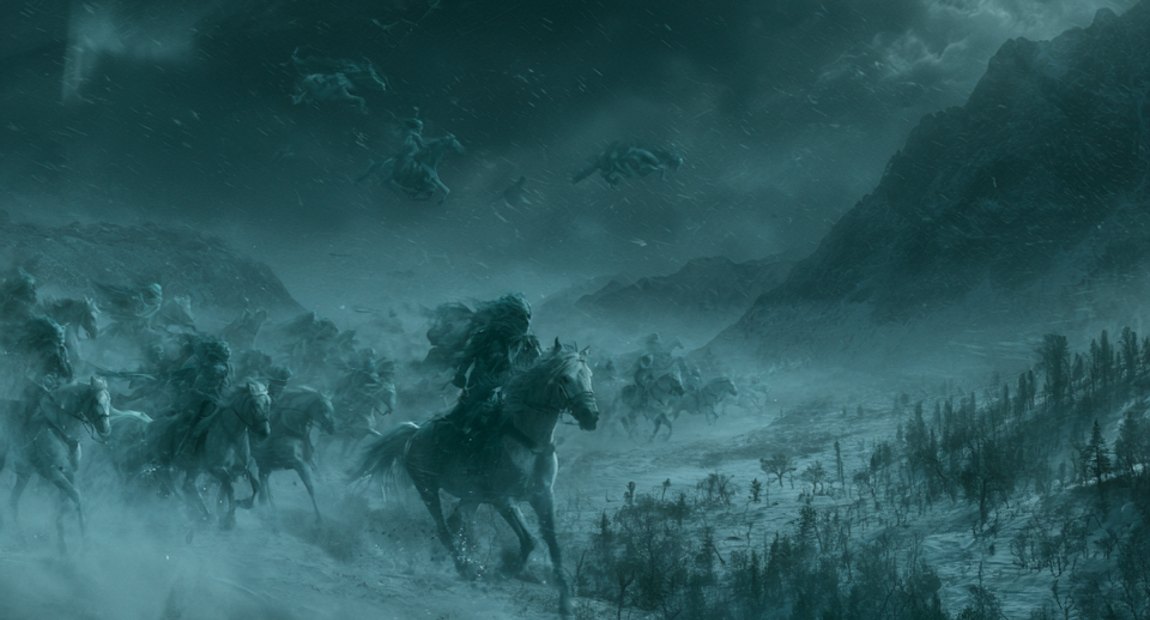
When thick flakes fall, people in many regions still say: „Frau Holle is shaking her beds." A harmless children’s saying – and at the same time the last, faint echo of an ancient goddess. Behind the Grimm fairy tale lies far more than a diligent and a lazy maid.
Frau Holle is one of the most intriguing figures of German folk belief: half fairy-tale character, half forgotten mistress of winter, spinning wheel and the realm of the dead – and inseparably bound to a bush at the garden fence and to two brothers who rescued the old knowledge from oblivion.
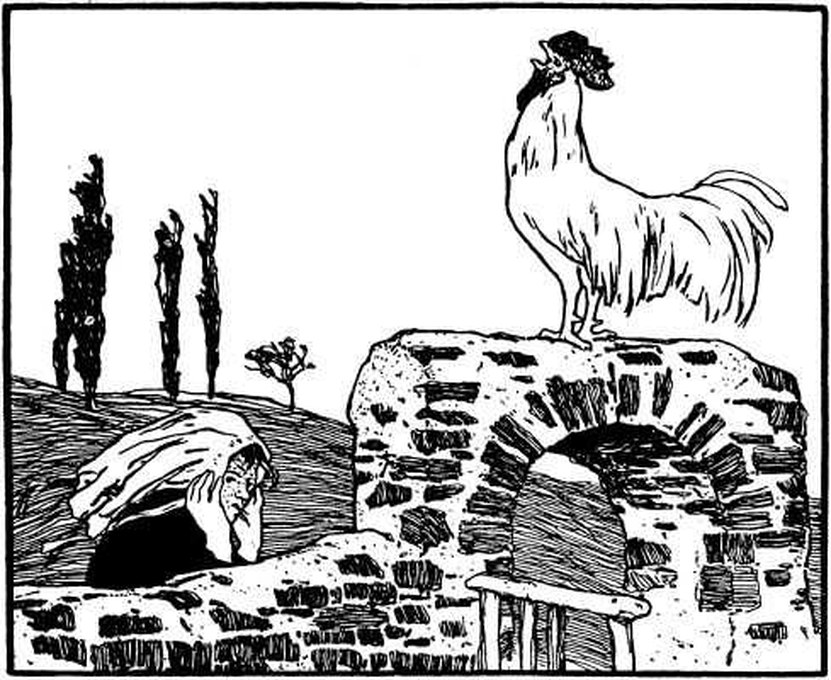
In the Brothers Grimm’s Children’s and Household Tales (no. 24, from 1812) a hard-working girl falls into a well and reaches the otherworld of Frau Holle. There she shakes out the featherbeds „so that the feathers fly" – and on earth it snows. Diligence is rewarded with gold, laziness punished with pitch. Jacob Grimm already noted the core: when Frau Holle plumps up her bed, it snows in the world. Winter itself obeys her.
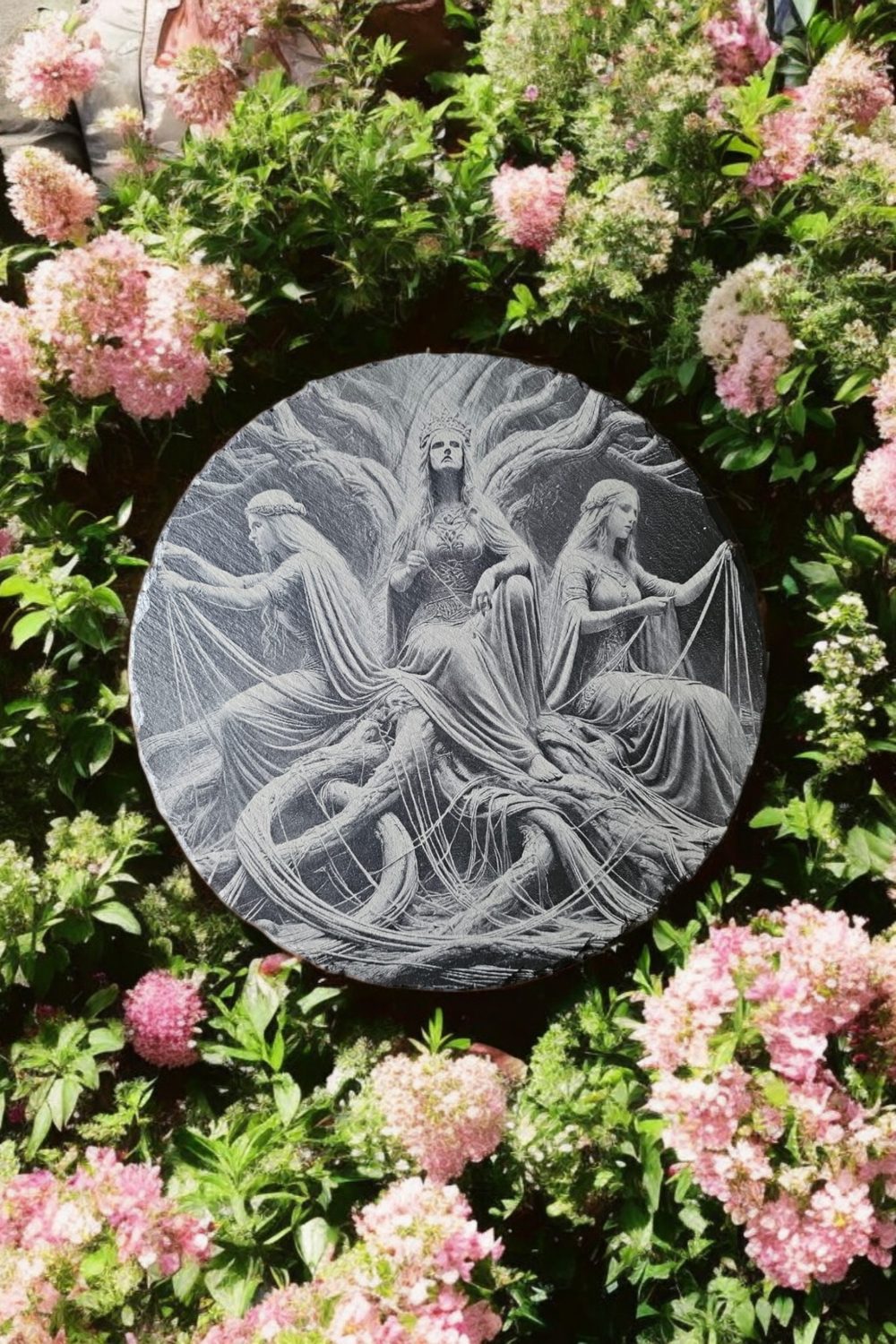
In his Deutsche Mythologie (Teutonic Mythology, 1835) Jacob Grimm read Frau Holle as the survival of a pre-Christian goddess: Holda, „the gracious, the kindly" (from Old High German huld – benevolent). She is mistress of the house and of women’s work, above all spinning and flax; she watches over children – born and unborn – and over the dead; and on winter nights she rides at the head of the Wild Hunt. In this double nature – motherly to the diligent, stern to the lazy – she strongly resembles the spinning Frigg and the love-and-death goddess Freyja.
And here is the surprise: the oldest written record of Holda comes not from her worshippers but from her enemies. Around 906 the Canon Episcopi (Regino of Prüm) condemned women who believed they rode through the air at night with the goddess Diana. About a century later Burchard of Worms, in his Decretum (c. 1010), added the name Holda at exactly this point. Belief in a supernatural woman riding through the night with a retinue was thus alive in the Rhineland and Hesse around the year 1000 – and branded by the Church as heathen superstition. Holda is therefore attested centuries before the Grimms.
Regionally the same figure carries different names. In central Germany she is Frau Holle, in the southern Alpine region Perchta (Berchta), in the north Frau Gode or Wode – a name pointing straight to Wodan. All are tied to the twelve Rauhnächte („rough nights") between the years: a time when the spindle rests, the house is smoked with incense, and one had better keep order – for Holle and Perchta check who has been industrious. To this day the fearsome Perchten still run through Alpine villages at Epiphany.
Hardly any tree is so closely woven with her as the elder (German Holunder, „Holler"). Folk belief linked the elder bush directly to Frau Holle: a protective woman was said to dwell in it – in Denmark and England the Hyldemoer, the „Elder Mother". Anyone wishing to fell an elder first had to ask its permission and doff their hat – or misfortune would follow. An elder beside the door protected farm and family. Whether the tree’s name really derives linguistically from Holda is disputed; but folk belief made the elder her sacred shrub beyond doubt. Whoever brews elderflower cordial today is picking from an old god-tree.
That we still know all this we owe above all to Jacob and Wilhelm Grimm. The two did not merely collect fairy tales – in his Deutsche Mythologie Jacob Grimm tried to reconstruct the buried divine world of the heathen Germanic peoples from tales, customs, place-names and „superstition". His core idea: in folk tales and rural custom, fragments of the old faith had outlasted the Christian centuries – disguised, shrunken, but alive. For him Frau Holle was the prime example of a goddess who survived as a nursery figure.
In honesty it must be said: Grimm was a child of Romanticism and drew some connections more boldly than the sources allow – not every fairy-tale figure is a disguised deity. Today’s scholarship is more cautious. Yet as collectors and interpreters the Grimms rescued countless motifs that would otherwise have vanished without a trace. Without them we would know of Holda little more than a single line in Burchard of Worms.
The old goddess lives on where you least expect her: in grandparents’ snow-saying, in the elder by the fence, in elderflower cordial, in the newly popular Rauhnächte and in the Alpine Perchten runs. The mistress of life, winter and death became a friendly fairy-tale granny – but her core endured. That is exactly what is so fascinating about the Germanic heritage: it never quite disappeared. It simply hid well.
Frigg & Friday · Freya · Odin / Wodan · Old Germanic festivals · Nerthus.
Brothers Grimm, Children’s and Household Tales (no. 24, public domain); Jacob Grimm, Deutsche Mythologie (1835, public domain); Canon Episcopi (Regino of Prüm); Burchard of Worms, Decretum; Rudolf Simek, Dictionary of Northern Mythology; folklore of the elder (Hyldemoer). Image: Otto Ubbelohde, public domain (Wikimedia Commons).
Friday – the finest working day carries a goddess’s name. But whose? Some swear by Freya, others by Frigg. The answer …
Read more →Most people know the Brothers Grimm as the two kindly gentlemen behind Little Red Riding Hood and Cinderella. But that …
Read more →She enters Odin's hall, is pierced with spears and cast three times into the fire – and rises three times again …
Read more →The god Freyr stood for fertility, harvest and peace. Two very different sources show what his cult could look like in …
Read more →