Odin (Old Norse Óðinn, German Wodan) is the All-father of Norse mythology – god of wisdom, poetry, runes, war and the dead. Odin is no comfortable sky-father. He is wanderer, war god, poet, sorcerer and lord of the dead – a god who pays almost any price for knowledge, and who lets even his own favourites fall to the spear to get it. No god of the North is more contradictory.
Odin (Old Norse Óðinn, on the continent Woden/Wotan) is the all-father of the Æsir – but anyone who takes him for a gentle sky god is badly mistaken. His very name comes from óðr: „frenzy, fury, ecstasy, poetry". Adam of Bremen put it bluntly around 1075: „Wodan id est furor" – „Woden, that is: the fury". God of wisdom and poetry, but equally of war, magic and death.
No god of the north is as many-layered, as fascinating and as uncanny as Odin. He is the All-Father (Alföðr), head of the Æsir – and yet no kindly sky-father. Odin is the god of ecstasy and wisdom, of poetry and death, of runes and fury. He grants victory and takes it back; he drives kings into battle to harvest the bravest of the fallen for his own hall. To understand the north, you must understand this divided god: cunning to the point of treachery, noble to the point of cruelty, a wanderer between the worlds who pays a price for every piece of knowledge – and demands one from others too.
Almost all our images of Odin come from the Poetic Edda and the Prose Edda of Snorri Sturluson – written down only in the 13th century, a good two hundred years after Iceland's conversion. But his cult is far older: the Romans knew him as Mercury, runestones and gold bracteates name him, and place names from Scandinavia to the Rhine still carry him today. This article covers it all: origin, myths, cult, afterlife – cleanly separating what is documented from what remains interpretation.

Odin bears more names than any other Germanic god – tradition knows well over 170 bynames (heiti). The Eddic poem Grímnismál alone strings together dozens. Each name is a mask, an aspect of his being: Alföðr ("All-Father"), Yggr ("the Terrible"), Bölverkr ("evil-doer"), Grímnir ("the Masked One"), Hangaguð ("god of the hanged"), Valföðr ("father of the slain"), Sigföðr ("father of victory"), Gangleri ("the wander-weary"). This wealth of names is no accident: Odin is the god of transformation and disguise, who comes to foreign halls under false names, tests, deceives and vanishes. The name itself – Old Norse Óðinn, Proto-Germanic *Wōðanaz – goes back to the root *wōð-: "fury, frenzy, ecstasy, poetic possession". Odin is literally the "lord of ecstasy".
Odin comes from the primordial age. His father was Borr, his mother the giantess Bestla, daughter of the giant Bölthorn – so the chief of the Æsir carries giant blood on his mother's side. With his brothers Vili and Vé he forms the first divine triad. His wife is Frigg, lady of Fensalir, the only one allowed to sit beside him on the high seat Hlidskjalf. His sons are the greatest of the pantheon: the thunder god Thor (by the earth goddess Jörð), the shining Baldr, along with Vidar, Vali, Höd and the skald Bragi. Even the troublemaker Loki is bound to Odin by an oath of blood-brotherhood. So the All-Father stands at the centre of a vast web – god, forefather and progenitor at once, to whom even royal lines later traced themselves.
Odin is not only ruler but creator. In the beginning, say the Völuspá and Snorri, Odin and his brothers slew the primordial giant Ymir and shaped the world from his body: the earth from his flesh, the sea from his blood, the mountains from his bones, the sky from his skull. On the shore the three brothers found two tree-trunks and made from them the first human pair, Ask and Embla. Odin gave them the most precious gift: the önd, breath and living spirit. So Odin is not only father of the gods but, quite literally, the life-giver of humankind – every breath an echo of his gift.
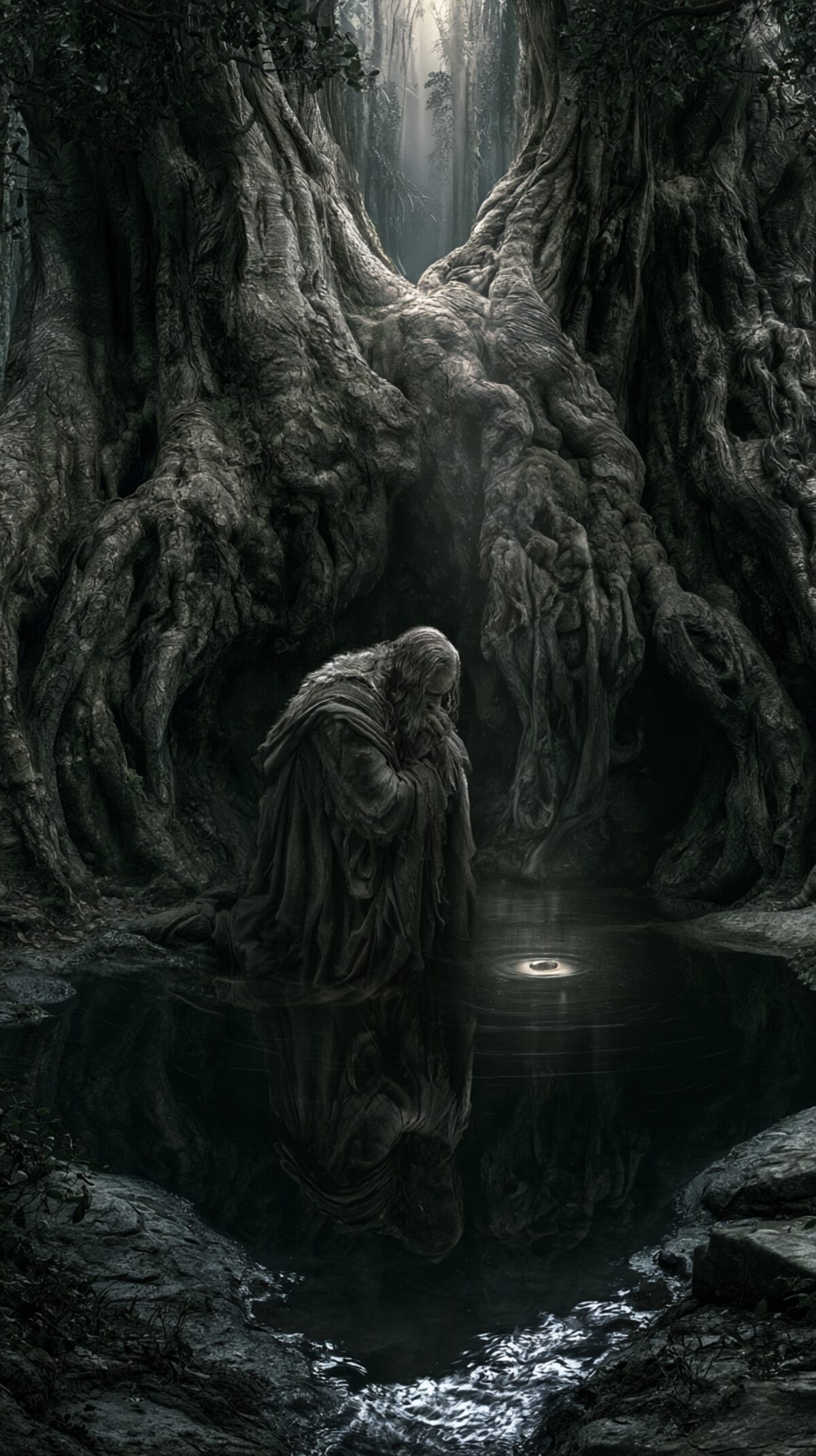
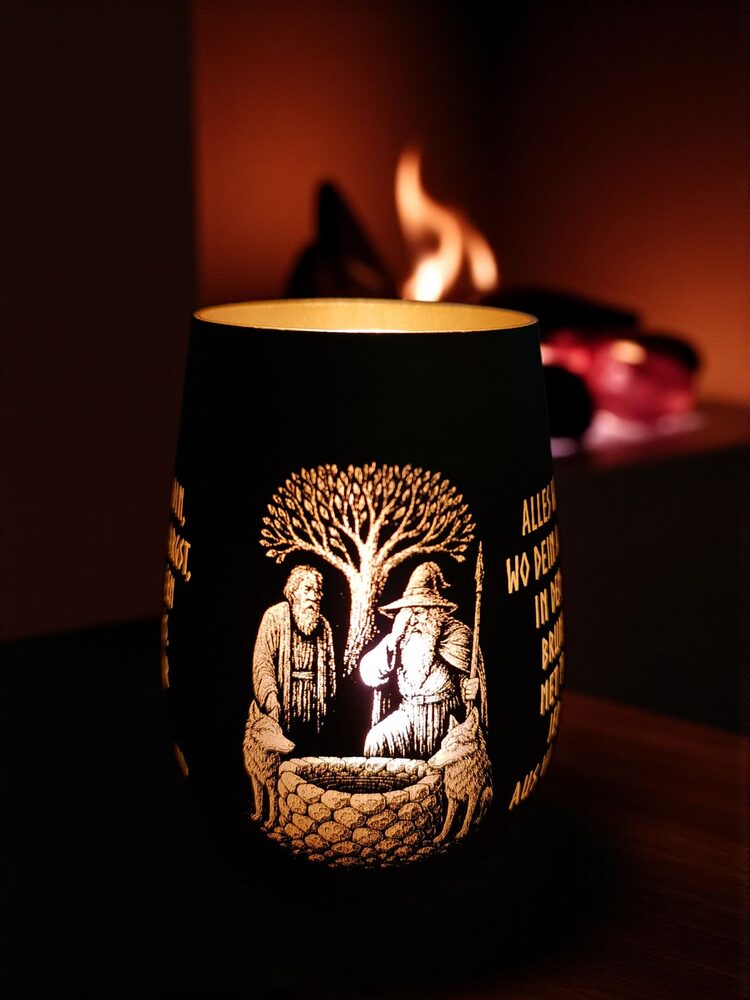
Odin's greatest hunger is for knowledge – and he pays cruel prices for it. Beneath one of the roots of Yggdrasil lies the well of wise Mímir, in which wisdom itself is hidden. To be allowed to drink from it, Odin gave his eye as a pledge – forever. The Völuspá knows: "I know where Odin's eye is hidden, in the far-famed well of Mímir." Ever since, the All-Father is one-eyed, a god who has literally sacrificed part of himself for insight. When the Vanir later beheaded Mímir, Odin preserved his head with herbs and spells so that it could go on giving him counsel – wisdom beyond death.
Darker still is Odin's second great sacrifice. To win the secrets of the runes, he hanged himself for nine nights on the wind-battered world-tree, wounded by his own spear – "given, myself to myself". Without bread, without horn, he peered into the depths until, screaming, he took up the runes and fell back down. This scene from the Hávamál (stanzas 138–139) is one of the most haunting moments in all Germanic poetry: the highest god sacrificing himself to draw knowledge from the abyss. For Odin the runes are no mere script but power – signs with which one can heal, bind, wake and kill. More on this in our piece on the Rúnatal.
Odin is also the god of poetry – and he stole it. The mead of poetry, brewed from the blood of the wise Kvasir, lay deep in the mountain Hnitbjörg, guarded by the giantess Gunnlöd. Under the name Bölverk, Odin hired himself out, bored into the rock as a snake, spent three nights with Gunnlöd and drained the three vessels Óðrœrir, Boðn and Són in three draughts. As an eagle he escaped back to Asgard and spat the mead into vessels – ever since, poetry is a gift of Odin to those he chooses. Whoever makes a good poem drinks, in this image, from the remnant of the mead the All-Father once stole.
Odin is the mightiest sorcerer in the world. He masters seiðr, that magic of prophecy and fate-steering he learned from the Vanir goddess Freyja. He can change his shape, leave his body behind asleep and travel the worlds as an animal, make the dead speak and calm the winds. Snorri reports all these arts in the Ynglinga saga – but notes that seiðr was so charged with "ergi" (unmanliness) that it was left to the priestesses. Here Odin's boundary-crossing shows itself: the supreme warrior god is at once master of a magic held to be female. He is the god who crosses every line – between life and death, man and woman, truth and deception.
A unique retinue gathers around Odin. On his shoulders sit the ravens Huginn and Muninn ("Thought" and "Memory"), who fly over the world each day and whisper everything into his ear at evening. At his feet lie the wolves Geri and Freki, to whom he gives all his food while he himself lives on wine alone. He rides the eight-legged steed Sleipnir, swiftest of all horses, a child of Loki – it carries him over land, sea and down into the realm of the dead. His spear Gungnir never misses its mark; his golden ring Draupnir drips eight new rings every ninth night. From his high seat Hlidskjalf he surveys all nine worlds at once.

As Valföðr, father of the slain, Odin rules over Valhalla, the hall of the slaughtered heroes. His valkyries ride over the battlefields and choose the bravest dead; one half comes to Odin, the other to Freyja in Fólkvangr. In Valhalla the Einherjar fight to the death each day and wake to feasting at evening. But this paradise has a grim purpose: Odin gathers his army of the dead not out of kindness but for the last battle. He needs the best for Ragnarök – and so he kindles wars, breaks oaths and lets even favourites fall when their death serves him. The god who grants victory is the same who withdraws it at the decisive moment.
Odin's worship had a dark side. He was the god of the hanged and the stabbed: prisoners of war and victims were dedicated to him by casting a spear over them or hanging them from trees – "I give you to Odin". The chronicler Adam of Bremen describes (as a hostile outside view) the grove of Uppsala, where men and animals hung in the trees. So the cult mirrors the myth: as Odin sacrificed himself on the tree, so he received sacrifice on the gallows. Small wonder that he was also the god of the berserkers, those warriors who fought in holy fury ("wōð"). Odin is no god for the faint-hearted – he is the god of the extreme, of intoxication and of death.
Long before the Vikings called him Óðinn, the continental Germani worshipped him as Wodan or Wôden. The Romans equated him with Mercury (interpretatio Romana) – god of travellers, traders and guide of souls. The second Merseburg Charm (Old High German, 9th/10th c.) shows Wodan as a healer who chants over Balder's sprained horse's leg. Among the Lombards "Godan" decides victory (Paulus Diaconus). And to this day Wednesday bears his name in English: "Wodan's day" (after the Roman dies Mercurii). More in our article Wodan, Donar and Ziu.
In folk belief Odin lived on longest – as leader of the Wild Hunt. In the storms of the dark season, especially the Yule nights around the winter solstice, a ghostly host rides through the air, led by a one-eyed, hat-clad rider on a grey horse. From Scandinavia to the German uplands this legend is known; scholarship sees in it an afterlife of the old god of the dead. That of all figures the leader of storm and death survived into modern times, while the milder gods faded, says much about Odin's grip on the human imagination.
In the end even the All-Father cannot escape his fate. In the last battle, Ragnarök, Odin rides with his Einherjar against the powers of chaos – and is devoured by the wolf Fenrir. All his knowledge, all his cunning, all the gathered host of the dead can only delay the doom, not avert it. His son Vidar avenges him by tearing the wolf's jaws apart. In this tragedy lies the deepest truth of the Odin myth: a god who knows everything – even his own death – and yet acts, fights and gathers. Not because he can win, but because he must. After the doom, though, says the Völuspá, a new world rises from the sea, and the surviving gods find again in the grass the golden game-pieces of the old.
Odin never wholly vanished. He stands in every calendar – as Wodan's day in English "Wednesday", as Mercury's day in Romance "mercredi". He rides through the legends of the Wild Hunt, through Wagner's operas and Tolkien's Gandalf (the grey wanderer with hat and staff is a direct descendant of Rosen's Odin). He has become an emblem of the search for knowledge, of the price of insight, of the courage to look into the unknown. That is exactly what makes him, to this day, one of the most beloved motifs of Norse art – the one-eyed wanderer with spear, ravens and wolf, the grey lord of ecstasy. For us as a Norse workshop, Odin embodies what real Germanic history stands for: not shallow fantasy kitsch, but a god full of depth, contradiction and dignity. Whoever has his name, his spear or his ravens engraved in slate or crystal glass carries not mere decoration but two thousand years of cult, poetry and boundary-crossing – from the Mercury of the Romans through the Migration-era bracteates to the grey wanderer who still rides through the storms of the Yule nights.
Odin also stands at the beginning of the very first war. The Völuspá tells how he hurled his spear Gungnir over the host of the Vanir – the ritual opening of the great conflict between Æsir and Vanir. After long, undecided struggle, the two divine families exchanged hostages: Njörd, Freyr and Freyja came to the Æsir, and with them seiðr, the magic Odin later took for himself. This myth explains why two families of gods stand side by side in the north – and why, of all gods, the war god Odin could become master of a Vanic magic. The spear thrown over the enemy became a real rite too: warriors dedicated a whole army to Odin by casting a spear over it.
When dreams foretold the death of his son Baldr, Odin did what no other god dared: he saddled Sleipnir and rode down to Niflheim, to the gates of Hel's realm. There, says the Eddic poem Baldrs draumar, he woke with death-magic a long-dead völva from her grave and forced her to reveal the future to him: that Baldr would die, who would kill him and who would avenge him. The scene shows Odin in his most uncanny role – as a necromancer who crosses the border between living and dead to wrest knowledge no living being may hold. Even the unavoidable, he insists on having known beforehand.
Odin's weapon is not only the spear but the question. In the Vafthrúðnismál he enters, disguised, a deadly contest of knowledge against the wisest of all giants. Both answer every question about the origin and end of the world – until Odin asks the one no one can answer: "What did Odin whisper in the ear of his dead son before he was laid on the pyre?" By this the giant knows his opponent – and has lost, for only Odin himself knows the answer. He sets the same unanswerable riddle to King Heidrek. It is Odin's signature: the god of wisdom wins in the end not by strength but by a secret he alone possesses.
How dangerous Odin's tests are shows in the frame of the Grímnismál. Odin and Frigg, from the high seat Hlidskjalf, wager over two foster-sons. By a ruse Frigg makes King Geirröd take a stranger – Odin under the name Grímnir – for a sorcerer. Geirröd has him bound and roasted for eight nights between two fires, without drink. Only when Geirröd's young son hands him a horn does Grímnir begin to speak: in great stanzas he reveals the structure of the world, the halls of the gods, the streams and trees – and at the end names his true names. The horrified Geirröd leaps up, falls on his own sword and dies. The lesson is bitter: whoever mistreats Odin has sealed his end the moment the god lets his mask fall.
Odin is the patron of warriors – but a fickle one. Into the hall of the Völsungs he thrust, as a one-eyed old man, a sword into the tree-trunk that only the worthiest could draw: Sigmund won it. Yet years later, in Sigmund's last battle, Odin met him with raised spear – the king's sword shattered, and Sigmund fell. Odin gives and Odin takes: he grants victory while it serves him, and withdraws it when he wants to fetch the hero to his hall. In the same way he let the aged King Harald Wartooth fall at the battle of Bråvalla. Royal lines from Scandinavia to England traced themselves proudly to Odin – the All-Father was the forefather of the mighty, but never their reliable ally.
One of Odin's names is Jólnir – "the one belonging to Yule". The midwinter feast of Yule, the longest night of the year, belonged in special measure to the god of the dead and of ecstasy; here his cult touches the Wild Hunt, which roars through the storms precisely in the twelve Yule nights. From this bundle of Jólnir, the wild host and the grey, gift-bringing wanderer, later centuries spun much – down to the popular but unproven equation of Odin with Father Christmas. Only this is certain: the darkest time of the year was always his time. Whoever hears the storm howl around the house in the Yule nights hears an echo of the old All-Father.
Hardly any god is so bound up with his animals as Odin. The ravens Huginn and Muninn are more than messengers – they are Odin's externalised mind. "For Huginn (Thought) I fear that he may not return, yet more I dread for Muninn (Memory)", the Grímnismál has him say: a god who fears losing his memory – deeply human. The wolves Geri and Freki ("the greedy" and "the ravenous") embody the other side: war, the battlefield, the carrion-eater. And Sleipnir, the eight-legged steed, born of Loki in mare's shape, carries him faster than any wind over sea, fire and the border of death. Raven, wolf and steed – thought, greed and speed: his retinue mirrors Odin's whole nature.
Odin's mightiest treasures come from the craft of the dwarves. The spear Gungnir, forged by the sons of Ivaldi, is so perfectly balanced that it strikes every target and makes an oath unbreakable when sworn upon it. The arm-ring Draupnir ("the dripper"), a work of the dwarves Brokkr and Sindri, drips eight rings of equal weight every ninth night – a never-failing spring of wealth, symbol of royal generosity. Odin laid it on Baldr's pyre; from there Baldr sent it back out of Hel's realm. These treasures are not mere equipment but signs: the spear stands for unerring power, the ring for inexhaustible giving – the two pillars on which the rule of a Norse king rested.
In the flyting poem Hárbarðsljóð, father and son face each other – and could hardly be more different. Odin, disguised as the ferryman Hárbarð, mocks the homeward-bound Thor from the far bank: while he himself, he boasts, lay with noble women and drove princes to war, Thor merely slew trolls and giant-women. "Odin gets the nobles who fall in battle – Thor gets the kin of thralls." Behind the mockery lies a real social truth: Odin was the god of leaders, skalds and kings, of the cunning elite; Thor the god of the free farmer and warrior, reliable, straightforward, beloved of the common folk. Two gods, two images of humankind – and Odin leaves no doubt which he counts as his own.
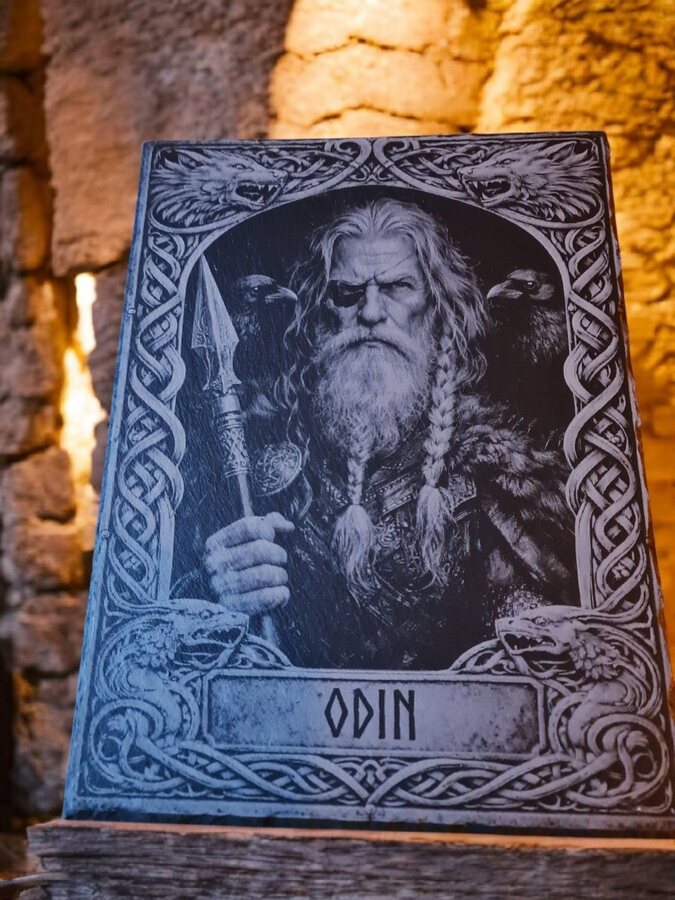
Odin likes best to appear not in glory but as a grey stranger: an old man in a wide cloak, hat pulled low over his face to hide the missing eye, a staff or spear in hand. So he comes to the halls of men – as a guest who poses riddles, gives counsel, distributes gifts and imposes tests. Now he is called Grímnir, now Gestumblindi, now Gangleri. Whoever honours him gains; whoever offends him is lost. Even the later saga tradition has him appear and vanish again as a one-eyed wanderer at the court of King Olaf Tryggvason. From exactly this image – the mysterious old man who comes from nowhere and knows everything – a whole strand of world literature has grown, down to Gandalf. The wanderer is Odin's truest form: the god who never stays.
Unlike the late sagas, Odin's cult is also materially tangible. The gold bracteates of the Migration Period (5th/6th c.) again and again show a head with bird and horse – by today's reading Odin as healer and lord of animals. The spectacular hoard of Vindelev (discovered in Denmark in 2020) bears a runic inscription that names Odin outright – the oldest secure attestation of his name so far, some 150 years earlier than previously known. Small silver amulets and the valknut on picture stones and in the Oseberg ship burial link him with death and sacrifice. And the Ardre picture stone already shows, in the 8th century, the rider on the eight-legged horse. Odin, then, is no mere literary product of Snorri, but a god immortalised for centuries in gold, silver and stone.
"I know that I hung on the windy tree nine full nights, wounded by the spear and given to Odin, myself to myself."Hávamál 138, after the public-domain translation
Odin’s Eye at Mímir’s Well · Odin & the runes · Valhalla · The Valkyries · The Einherjar · The Norse pantheon.
Völuspá, Hávamál (Rúnatal 138–145), Grímnismál, Lokasenna (Poetic Edda), English public domain: Henry Adams Bellows (1923). Snorri Sturluson, Gylfaginning, Skáldskaparmál, Ynglinga saga. Tacitus, Germania 9; Adam of Bremen, Gesta Hammaburgensis IV 26. Scholarship: Rudolf Simek, Dictionary of Northern Mythology; John Lindow, Norse Mythology (2001).
All Gods & Goddesses articles →
There is a love story in Norse mythology made almost entirely of longing. Its hero is a god of whom we know little more …
Read more →Her hair was of pure gold – and this hair set off one of the most consequential stories in all of mythology. Sif, wife …
Read more →She does nothing grand – no heroic deed, no spell – and yet she is one of the most moving figures in all of mythology …
Read more →She came to Asgard to take revenge – and stayed as a goddess. Skadi is the mistress of the mountains, of winter, of the …
Read more →Odin (Old Norse Óðinn, Old High German Wodan) is the All-father of Norse mythology: god of wisdom, poetry, runes, war and the dead. He rules in Asgard and receives fallen warriors in Valhalla.
The name goes back to Proto-Germanic *Wōdanaz and is related to Old Norse óðr, 'frenzy, ecstasy, poetic inspiration' – Odin is 'the furious one', lord of ecstasy.
According to the Edda, Odin gave one eye as a pledge at Mímir's well in order to drink from it and gain wisdom (Völuspá 28, Gylfaginning 15).
His ravens are Huginn ('thought') and Muninn ('memory'), his wolves Geri and Freki, his eight-legged horse Sleipnir and his spear Gungnir.
At Ragnarök Odin is swallowed by the wolf Fenrir; his son Víðarr avenges him (Völuspá 53–56, Gylfaginning 51).
