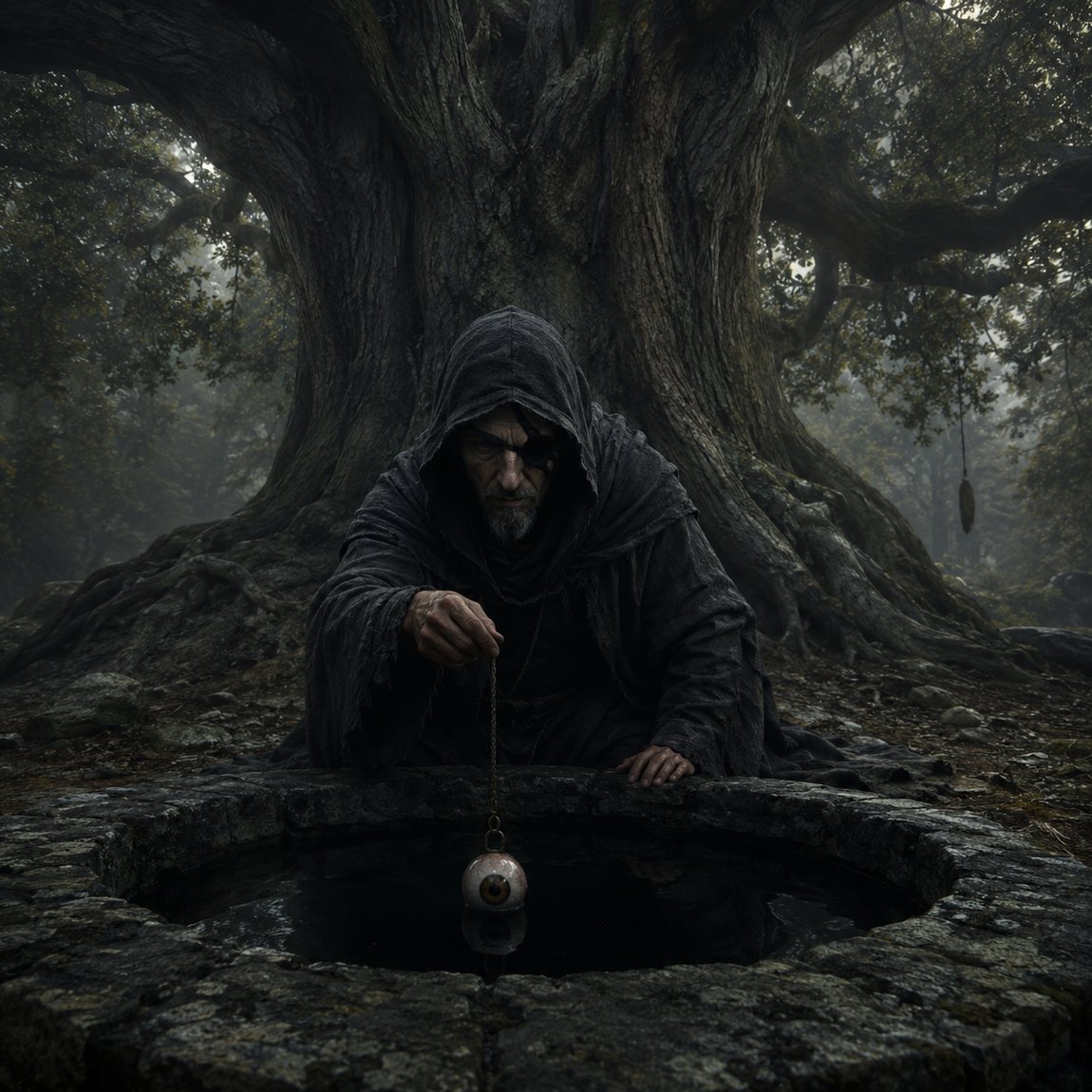
Odin is one-eyed because, according to the sources, he gave one of his eyes as a pledge to Mímir in exchange for a single drink from Mímir's well of wisdom. The Völuspá alludes to it in one cryptic stanza, and Snorri Sturluson tells it in a few lines of his Gylfaginning in the 13th century. That is all the texts say – nothing about which eye, when, or how. Here we take the evidence apart: stanza, prose, interpretation and archaeology, from Mímir's morning mead to Odin's eye-names and the helmet dies with one eye struck out.
He has a spear that never misses, a high seat that overlooks every world, two ravens and a hall full of dead heroes. And still something is missing. Not power – knowledge. So the god goes to the place where knowledge lies, and he pays with the only currency the keeper will accept: a piece of himself. Ever since, the All-Father has looked at the world through one eye, while the other rests at the bottom of a well beneath the world-tree.
That is the story everyone knows. What surprises most people is how little of it actually survives. The whole tale rests on a few lines of an Eddic poem and half a paragraph of prose. Everything else – Odin at the rim of the well, tearing out his eye with his own hand, Mímir asking whether he is ready to pay – is retelling, most of it from the 19th and 20th centuries. That is exactly why it pays to pick up the sources one at a time. We describe the well itself and its place beneath Yggdrasil in our article on the three wells, and the keeper in our article on Mímir. This piece is about the sacrifice itself: the eye.
The oldest source is the Völuspá, the "Prophecy of the Seeress", the most famous poem of the Poetic Edda. It survives mainly in the Codex Regius (c. 1270) and in Hauksbók (early 14th century); many scholars date its composition to around the year 1000, though that remains debated. A seeress, a völva, speaks to Odin – and halfway through her account of the world she suddenly turns on him personally.
The scene opens with a chilly image. She sits alone outside when "the old one" comes, the lord of the Æsir, and looks into her eyes. "What do you ask of me? Why do you test me?" she says – and then she hits him where it hurts. In Henry Adams Bellows' translation of 1923:
"I know where Othin's eye is hidden,
Deep in the wide-famed well of Mimir;
Mead from the pledge of Othin each morn
Does Mimir drink: would you know yet more?"Völuspá 29, translated by Henry Adams Bellows (1923, public domain)
"Would you know yet more?" is the seeress's refrain throughout the poem. Here it sounds almost like a threat: I know more than you would like.
Two things stand out. First, the seeress tells no story. She assumes that Odin – and the audience – already know what happened. A myth one only needs to allude to was evidently familiar. Second, the word for the eye in the well is veð, "pledge". Not a gift, not a cult sacrifice in the strict sense, but collateral, the kind of thing you deposit when you borrow. Odin did not throw his eye away. It lies there as security.
Immediately before the eye stanza (Neckel/Kuhn 27), the seeress mentions a second thing hidden beneath the holy tree: Heimdall's hljóð. Over it pours a stream "from Valfather's pledge". The same formula, the same veð Valfǫðrs.
What hljóð means here is one of the neater puzzles in Eddic studies. Snorri, and Bellows after him, take it as Heimdall's horn, the Gjallarhorn with which he will summon the gods at Ragnarök. But the word normally means "hearing" or "listening". In that case what lies under the tree is not a horn but Heimdall's hearing – also left as a pledge. That would give us a striking pair: the watchman of the gods, who according to Snorri can hear grass grow, has deposited his ear, and the All-Father his eye. Two sense organs traded for supernatural perception. The reading is not proven, but it is seriously discussed, and it shows how dense and unresolved the images of the Völuspá are.
We get a little more – though still very little – from Snorri Sturluson, the Icelandic scholar and chieftain who wrote his Edda around 1220 (more in our article on Snorri Sturluson). In the question-and-answer dialogue of Gylfaginning, chapter 15, he describes the three roots of the ash Yggdrasil. One reaches to the frost giants, where Ginnungagap once was, and beneath it lies Mímir's well, "in which wisdom and understanding are hidden".
Then come the key sentences, in our own rendering: Mímir is full of knowledge because he drinks from the well with the horn Gjallarhorn. The All-Father came there and asked for a single drink from the well, but did not get it until he had laid his eye as a pledge. Snorri then quotes the Völuspá stanza as his authority.
Snorri's version answers some questions and raises others. He turns the allusion into a small scene with a request and a condition. He ties the well firmly to the Gjallarhorn as Mímir's drinking vessel. But he does not say what Odin gained from the drink, whether he knew more afterwards – and he does not say which eye. If you read online that it was "the left one", or that Odin gouged it out himself, you are reading modern embellishment. Pain, ordeal and dialogue are all missing too. The deal feels almost businesslike, which suits the calculating Odin of the Hávamál.
The Völuspá says that every morning Mímir drinks mead af Valfather's pledge – "from" or "out of" it. The preposition allows both. Taken literally, the eye serves as the vessel Mímir drinks from, a gruesome picture that some commentators, Bellows among them, accepted. Taken figuratively, Mímir "lives off" the pledge, drawing his profit from it the way a creditor does from collateral.
Snorri resolves the tension his own way: in his account Mímir drinks with the Gjallarhorn. Whether he preserved an older tradition or merged two stanzas (Heimdall's hljóð and Odin's eye) into one tidy picture cannot be decided. Snorri was a systematiser, and in other places he demonstrably smoothed out contradictions.
Why mead, of all drinks? In the North, mead belongs to the hall, the feast, the oath – and to poetry. The mead of poetry brewed from Kvasir's blood, which Odin wins from Gunnlöð by seduction and trickery, is the classic case: whoever drinks it becomes a poet or a scholar. In these myths wisdom is not studied; it is swallowed. Knowledge is a liquid you take into your body. Mímir's morning draught fits that pattern perfectly.
The Mímir at the well is not the only Mímir in the sources. In Ynglinga saga (ch. 4), Snorri tells how the Æsir sent Mímir as a hostage after their war with the Vanir; the Vanir cut off his head, and Odin treated it with herbs so it would not rot and sang charms over it, so that it spoke to him (see Æsir and Vanir). The Völuspá also knows "Mím's head", with which Odin speaks before the end of the world, and in Sigrdrífumál the head speaks the first true words.
How keeper and head fit together is an open question. A living Mímir who drinks each morning and a severed head that Odin consults do not sit comfortably in one narrative. Perhaps these are two strands of tradition; perhaps the head was imagined in the well. We go into this in detail in our article on Mímir. For the eye, one point is enough: both times Odin goes to Mímir when he needs knowledge. Once he pays with his eye, once he preserves the source by magic.
Talk about Odin's eye and you inevitably arrive at the god's second great self-sacrifice. In the Rúnatal, the rune section of the Hávamál, Odin says (stanza 138 in Neckel/Kuhn, 139 in Bellows):
"I ween that I hung on the windy tree,
Hung there for nights full nine;
With the spear I was wounded, and offered I was
To Othin, myself to myself,
On the tree that none may ever know
What root beneath it runs."Hávamál 139 (Bellows numbering), translated by Henry Adams Bellows (1923, public domain)
Then he takes up the runes, screaming, and falls back down. The parallels with the well are obvious. Both times the knowledge comes from beneath or upon the world-tree. Both times Odin gives something of his own body – an eye, his life for a time. And both times he is giver and receiver at once: "myself to myself".
Whether the two episodes originally belonged together, we do not know. No text links them explicitly, and although the tree in the Hávamál is naturally taken to be Yggdrasil, the stanza does not name it. Scholars often treat both as expressions of the same idea: Odin's wisdom is not a birthright but something he has bought. That sets him apart from gods in other traditions who simply are all-knowing. Odin becomes wise, and he pays for it. For the god as a whole, see our portrait Odin – wisdom at any price.
A god with one eye in a well has always attracted interpreters. The main lines, each with an honest label:
Sun and moon. 19th-century nature mythology liked to read gods as phenomena of the sky. Odin became a sky god, his visible eye the sun, and the eye in the well the sun's reflection in water or the sun sinking into the sea at evening; others saw the moon in it. It is a poetic picture, and it shaped generations of illustrators. The sources offer no support for it. The Edda has its own figures for sun and moon, Sól and Máni, and nowhere is Odin's eye identified with either. Today this reading is regarded as a product of its time.
A sacrifice for wisdom. The most obvious reading is the one the text itself suggests: knowledge has a price. Many people add a second layer, outer sight exchanged for inner sight – whoever turns one eye inward, or towards the other world, sees more there. That is a modern reading, though an understandable one. It cannot be proven; the sources interpret nothing.
Initiation and ecstasy. Other scholars set the eye-pledge and the hanging on the tree beside initiation patterns known from northern Eurasia: suffering, mutilation, symbolic death, return with knowledge. Odin's links to ecstasy and to seiðr support this view. The comparison is stimulating but contested, because "shamanism" is easily stretched too far.
The one-eyed sovereign. In "Mitra-Varuna" (1940) the French scholar of religion Georges Dumézil set the one-eyed Odin beside the one-handed Týr, who puts his hand in the wolf Fenrir's jaws as a pledge (see Gleipnir). For Dumézil these were two sides of Indo-European sovereignty – magical-knowing and legal-binding – and he found a matching pair in Rome: the one-eyed Horatius Cocles and the one-handed Mucius Scaevola. Notably, in both Norse cases the word "pledge" appears. Dumézil's overall system is viewed critically today, but the observation about the two maimed gods remains striking.
Odin has well over a hundred names in Old Norse poetry, and a few of them refer to his eyes. The most important appear in Grímnismál, the poem in which Odin introduces himself. In stanza 47 he calls himself, among other things, Bileygr and Báleygr. Bileygr is usually explained as "the one with weak (or wavering) sight", Báleygr as "the flame-eyed", from bál, "fire, pyre". Báleygr also occurs in skaldic verse, for instance in the Hákonardrápa of Hallfreðr vandræðaskáld (10th century) – a hint that the name was not invented in the 13th century.
Other names in the name-lists (the þulur) and in Snorri include Blindi ("the blind one") and Tvíblindi ("twice-blind"). Whether they point to one-eyedness or to disguise and deception is open. Helblindi is also an Odin name, but it is likewise the name of one of Loki's brothers, and its meaning is unclear.
And Hár, "the High One"? It is Odin's best-known name – Snorri's dialogue in Gylfaginning is led by a figure called High. Occasionally it has been suggested that Hár(r) might be linked to Gothic haihs, "one-eyed". That is a minority idea and linguistically insecure; the usual explanation remains "high". As evidence for one-eyedness, the name does not work.
The sagas are clearer. In Völsunga saga (ch. 3) an unknown old man enters the hall – tall, with a low-brimmed hat, one-eyed – and thrusts a sword into the tree-trunk Barnstokkr that only Sigmund can pull out. His name is never spoken; every listener knew who he was. In Snorri's saga of Óláfr Tryggvason a one-eyed, eloquent old man in a wide hat visits King Óláfr and talks late into the night; the Christian king later realises it was Odin. The Danish historian Saxo Grammaticus (c. 1200) also has Odin appear as a one-eyed old man. The name Síðhöttr, "deep hood" or "low hat" (Grímnismál 48), fits the picture: the hat hides the empty socket.
For the Viking Age itself – before anything was written down – Odin's one eye is only indirectly visible in texts: through names like Báleygr and through the Völuspá's allusion. No skaldic verse that explicitly tells of the pledged eye survives.
Can the one-eyed god be found in the ground? Several objects come up again and again. Let us take them one by one.
The Torslunda dies (Öland). In 1870 four bronze dies were found in the parish of Torslunda, used to stamp thin foil plates for helmets. They date to the Vendel period (6th–7th century) and are now in the Swedish History Museum in Stockholm. One shows a dancing man in a horned helmet holding spears, next to a wolf-warrior. Laser scanning, published by Birgit Arrhenius and Henry Freij (1992), showed that the dancer's right eye is missing – it seems to have been struck out on the model from which the die was made. Since then many have read the figure as Odin, and the wolf-man as an úlfheðinn. More in our article on the Torslunda plates.
Sutton Hoo and Valsgärde. In 2014 Neil Price and Paul Mortimer published an observation on the helmet from the Sutton Hoo ship burial (England, early 7th century): the garnets in one eyebrow are backed with gold foil and sparkle; those in the other are not. According to them, the dull one is the left. In the firelight of a hall the wearer would have looked one-eyed – a ruler performing as Odin. They describe something similar on a helmet from Valsgärde grave 7 in Sweden. The idea is elegant and widely cited. It is still an interpretation, not proof of intent.
Uppåkra and Lindby. The great central place of Uppåkra in Scania has produced small "horned man" figures on which, according to Mortimer, one eye is struck out or damaged. The small bronze figure from Lindby (Scania, Swedish History Museum) is often called Odin because one eye is only a slit while the other is a raised oval. The figure is heavily worn, and whether the difference was intended cannot be proven.
Lejre and Ledberg – two control samples. The silver figure from Lejre (found 2009, c. 900) is interpreted as Odin on his high seat with two birds. That identification rests on the throne and the birds, not on a missing eye. The Ledberg runestone (Östergötland, Ög 181, 11th century) shows a figure whose foot is in the mouth of a beast, often read as Odin being swallowed by Fenrir. No single eye is depicted there. Both objects sometimes turn up in lists of "one-eyed Odin images" – wrongly.
The gold bracteates of the Migration Period, on which many researchers see Odin, do not help either: their heads are almost always shown in profile, so a second eye is not visible anyway. And the oldest secure mention of Odin's name on an object, in the Vindelev hoard, says nothing about his eyes.
The finds are fascinating but methodologically tricky. First, there is a risk of circular reasoning: a figure is declared to be Odin because an eye is missing, and then used as proof that Odin was imagined one-eyed early on. Second, corrosion, wear and casting flaws attack the finest details first – on small metalwork, eyes are often the first thing to disappear. Third, no Vendel or Viking Age object carries an inscription that names a one-eyed figure as Odin.
On the other hand, some features are hard to explain as accident: the deliberately struck-out eye on the Torslunda model and the unequally backed garnets at Sutton Hoo are craft decisions. A fair summary: there are good reasons to think a god's one-eyedness could be meant visually as early as the 6th and 7th centuries. That this god was called Odin, and that the well story was already told in this form, is likely but not proven.
Modern reception has given the motif plenty of new twists. Richard Wagner gave his Wotan in "The Ring of the Nibelung" a reason of his own: in "Das Rheingold" Wotan reminds Fricka that he staked an eye to win her as his wife. That has nothing to do with the Edda. In the 20th and 21st centuries the eyepatch became Odin's trademark, in comics and films down to Marvel's Odin (see our Marvel fact check) and Neil Gaiman's "American Gods". The sources know nothing of eyepatches, by the way. At most, a low-pulled hat hides the socket.
Perhaps it is the very sparseness of the sources that makes the motif so strong. One stanza, one sentence of prose, a few struck-out eyes on bronze – and everyone grasps it at once: give up something precious to gain something unseen. When we engrave Odin motifs in slate or glass, we stay with that simple picture: the old man in the hat, the single eye, the well beneath the tree. If you want to read the stanzas yourself, you will find the Völuspá and the bilingual Hávamál in our library.
Why does Odin have one eye? According to the Völuspá and Snorri's Gylfaginning, Odin gave one eye as a pledge to Mímir in return for a drink from his well of wisdom. The sources give no further details.
Which eye did Odin sacrifice, left or right? No source says. On the Torslunda die the dancing figure lacks his right eye; on the Sutton Hoo helmet, according to Price and Mortimer, the left side looks "blind".
Where is the story of Odin's eye told? In the Völuspá (stanza 28 or 28/29, depending on the edition) and in Snorri Sturluson's Gylfaginning, chapter 15. Both were written down in the 13th century.
What is Mímir's well? A well beneath the root of Yggdrasil that reaches towards the frost giants. According to Snorri, wisdom and understanding are hidden in it, and Mímir drinks from it with the Gjallarhorn.
Is Odin's eye connected with his hanging on the world-tree? No text links the two directly. But both express the same idea: Odin gains knowledge through a sacrifice of his own body, "myself to myself" (Hávamál 138).
What does Báleygr mean? "Flame-eyed", one of Odin's names in Grímnismál (st. 47) and in skaldic verse. Next to it stands Bileygr, "weak-sighted".
For courage. For remembrance. For legends that live on.
Odin (Wotan) · Yggdrasil · Odin & the runes · The Norns at the well of Urd · The Norse pantheon.
Can a poem save a life? In the North, yes. The skald Óttarr svarti („the Black") had drawn the wrath of King Óláfr the …
Read more →Norse religion has no distant, all-powerful deity on a throne. It has a family – quarrelsome, cunning, loving, mortal …
Read more →Few names sound as thoroughly Viking as Ragnar Lodbrok. Television has made him the face of the entire North – the …
Read more →Norse mythology is the only great tradition in which the gods themselves are doomed – and in which they know it …
Read more →