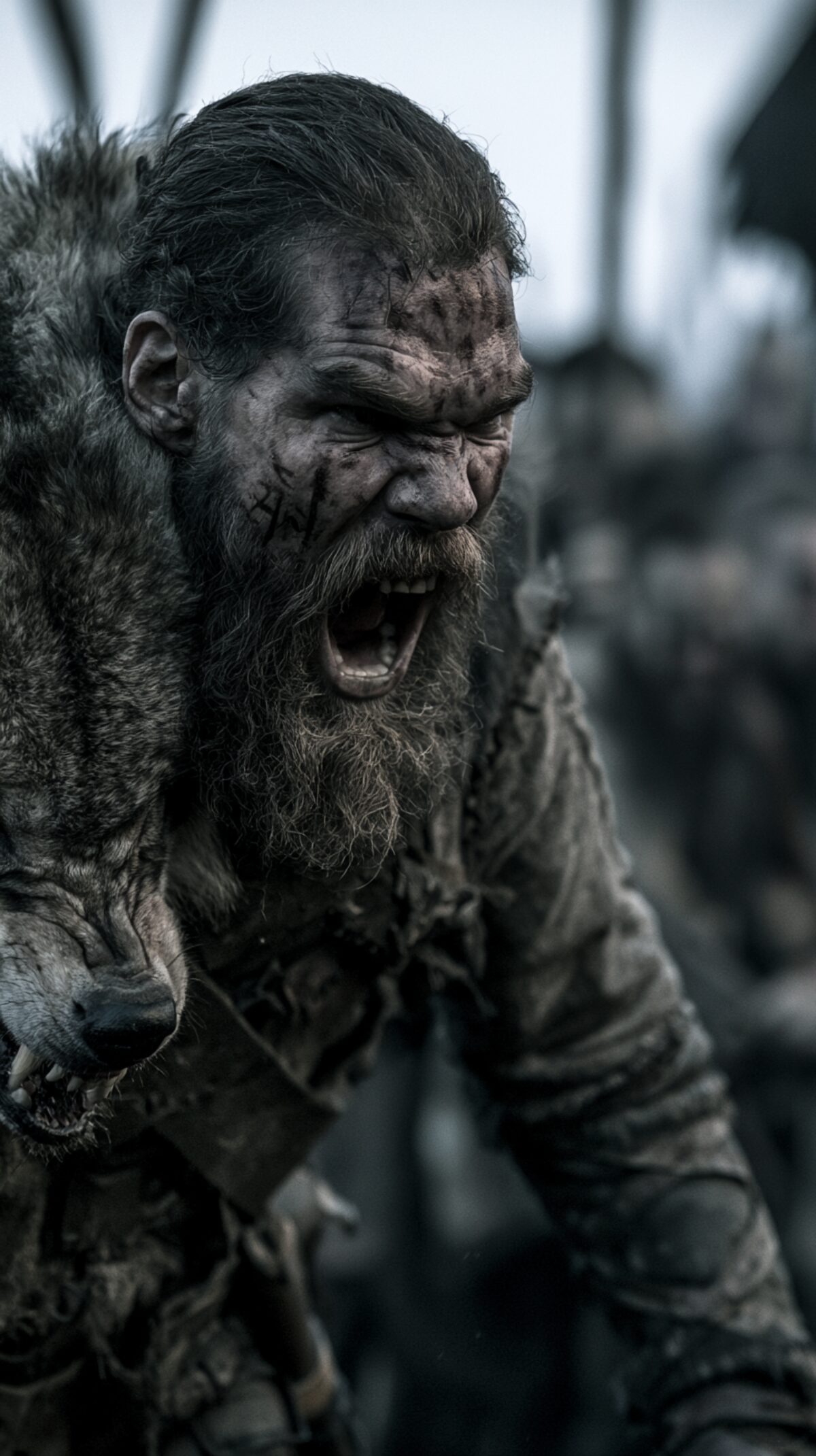
They howled like wolves, wore the pelts of predators and were reckoned the most dangerous fighters of the North: the ulfheðnar, the „wolf-coats". Few warrior figures of the Viking Age are so famous – and few so hard to pin down. Here we separate cleanly what the sources actually say from what later centuries added.
The Old Norse term úlfheðinn (plural ulfheðnar) denotes a warrior clad in a wolf-skin – literally a „wolf-coat" or „wolf-hide man". In the sources these men almost always appear in the same breath as the berserkir, the „bear-shirts", and like them as a small, feared elite: frenzied fighters who went into battle in a kind of trance or fury, supposedly impervious to pain and weapons. Their name bound them to the wolf – the animal that in the North was at once hunter, outlaw and beast of the world's end.
So much for the short version you will find in every popular account. The real interest of the subject begins precisely where that version stops. For the number of genuinely early testimonies is small, they contradict one another, and much of what circulates today as „knowledge" about the ulfheðnar comes from the pens of medieval writers working centuries after the end of heathendom – or from the scholarly imagination of the last two hundred years. So let us look at what is actually preserved.
The word is transparently built: úlfr is the wolf, heðinn a coat or garment of animal hide. An úlfheðinn is thus „one in a wolf-skin". Running exactly parallel is berserkr: the most common reading takes ber- („bear") plus serkr („shirt, tunic") – the „bear-shirt wearer". A second, older reading takes ber- as „bare, without", yielding the „fighter without a shirt", that is, without armour. Both explanations survive to this day; the question is not firmly settled.
The key observation both words share is this: they name the warrior by an animal skin. The fighter is linguistically equated with the predator. Whether this means a real garment, a ritual costume or merely a poetic image of ferocity is one of the great open questions – and we shall not resolve it, only leave it honestly open.
By far the oldest testimony for the ulfheðnar stands in the Haraldskvæði, also called Hrafnsmál („Raven Song") – a skaldic praise-poem attributed to the Norwegian court poet Þorbjörn Hornklofi and traditionally dated around 900. The poem is a dialogue between a valkyrie and a raven about King Harald Fairhair and his great sea-battle at Hafrsfjord. In one stanza it lists Harald's warriors – and here, for the first time in surviving verse, the word appears:
Hlaðnir váru þeir hǫlða / ok hvítra skjalda, / vigra vestrœnna / ok valskra sverða; / grenjuðu berserkir, / guðr vas þeim á sinnum, / emjuðu ulfheðnar / ok ísǫrn dúðu.
Laden were they [the ships] with men and white shields, with western spears and Frankish swords; the berserkir bellowed, the battle had become their companion, the wolf-coats howled and shook their iron. – Þorbjörn Hornklofi, Haraldskvæði (Hrafnsmál) st. 8, c. 900; own translation, Glanz & Gravur.
This terse verse tells us more than one might at first think. First: berserkir and ulfheðnar stand side by side here as two names for the same kind of fighter in the king's retinue – the one bellowing, the other howling. Second: they carry western, that is Frankish, spears and swords. These are not wild loners in fur cloaks but well-equipped professional warriors of a royal force (see our guide to weapons). And third: the verse comes from the Viking Age itself, not from a later retelling. It is our firmest ground – and it says almost nothing about fur-magic, trance or an Odin cult. It says: they were there, they were loud, they were the king's spearhead.
The question keeps recurring whether berserkir and ulfheðnar were the same thing or two different ones. The honest answer is that the sources draw no clean dividing line. In the Haraldskvæði both groups appear in parallel; in later sagas berserkr often becomes the umbrella term under which the ulfheðnar are subsumed. One may picture it thus: „berserker" is the broader category of the frenzied elite fighter, „ulfheðnar" a more specific variant defined by the wolf rather than the bear.
What both share is the notion of the battle-fury – the berserksgangr, the „going berserk". The sagas describe it as a state of ecstatic rage in which the man is superhumanly strong, no longer feels himself, and afterwards collapses in total exhaustion. Whether this describes a real psychological combat reaction, a ritual performance, or a literary pattern the storytellers reached for again and again is disputed. All that is certain is that it was a fixed image, known and passed on.
The most famous description of the wild warriors comes from a much later source: the Ynglinga saga, which Snorri Sturluson wrote around 1225 as the opening of his kings' history Heimskringla. In chapter 6 Snorri describes how Odin's men went into battle: without mail, „mad as dogs or wolves" (galnir sem hundar eða vargar), biting their shields, strong „as bears or bulls" (sterkir sem birnir eða griðungar), slaying men while neither fire nor iron could harm them. This state, says Snorri, was called berserksgangr.
This is the image that still shapes every notion of berserkers and wolf-warriors: the shield-biting, weapon-proof frenzy in the service of the war-god. But one must look closely at the authority with which it speaks. Snorri wrote roughly 250 years after the Christianisation of Iceland. He was a Christian scholar who ordered, systematised and interpreted the old lore about the gods – not an eyewitness to heathen battles. His Ynglinga saga sets out to explain where the kings of Norway came from, and to that end euhemeristically turns the gods into early kings and sorcerers. Odin's shield-biting warriors are part of that interpretive project. They are a marvellous image – but they are Snorri's image, not necessarily a snapshot from the ninth century.
What is attested: the ulfheðnar are securely attested by a contemporary source only once: in Þorbjörn Hornklofi's Haraldskvæði around 900, alongside the berserkir as the warrior elite of Harald Fairhair. Everything else is younger: Snorri's Ynglinga saga (c. 1225) supplies the classic fury-description, the Icelandic sagas (13th/14th century) narrative episodes, and the Vendel-period picture-plates from Torslunda, Vendel and Valsgärde (6th/7th century) images of animal-clad warriors. Over three centuries separate the oldest verse from the fullest prose – a gap the reader must keep in mind.
Behind the fur-name lies a broader Old Norse idea: that of the human who can take on the shape or the strength of an animal. The verb hamask means both „to fly into a rage" and „to change shape"; of a man who is not einhamr – not „single-hided", not fixed in one form – the sagas say he can be more than an ordinary man. In Egils saga, Egil's grandfather is called Kveldúlfr, „Evening-Wolf", because towards nightfall he grew withdrawn and wolf-like. Such tales connect the wolf-warrior with a world in which the boundary between human and animal was thought permeable.
Whether the ulfheðnar truly „felt" themselves to be wolves, whether the pelt was a ritual, a costume or merely a badge of honour, no source tells us. The wolf in the North wore a double face in any case: it was Odin's companion (Geri and Freki), but also the beast vargr – a word that meant both „wolf" and „outlaw, criminal". Whoever adorned himself with the wolf played on both: on nearness to the war-god and on the terror of the outcast. More on this double role in our overview The Wolf in the North.
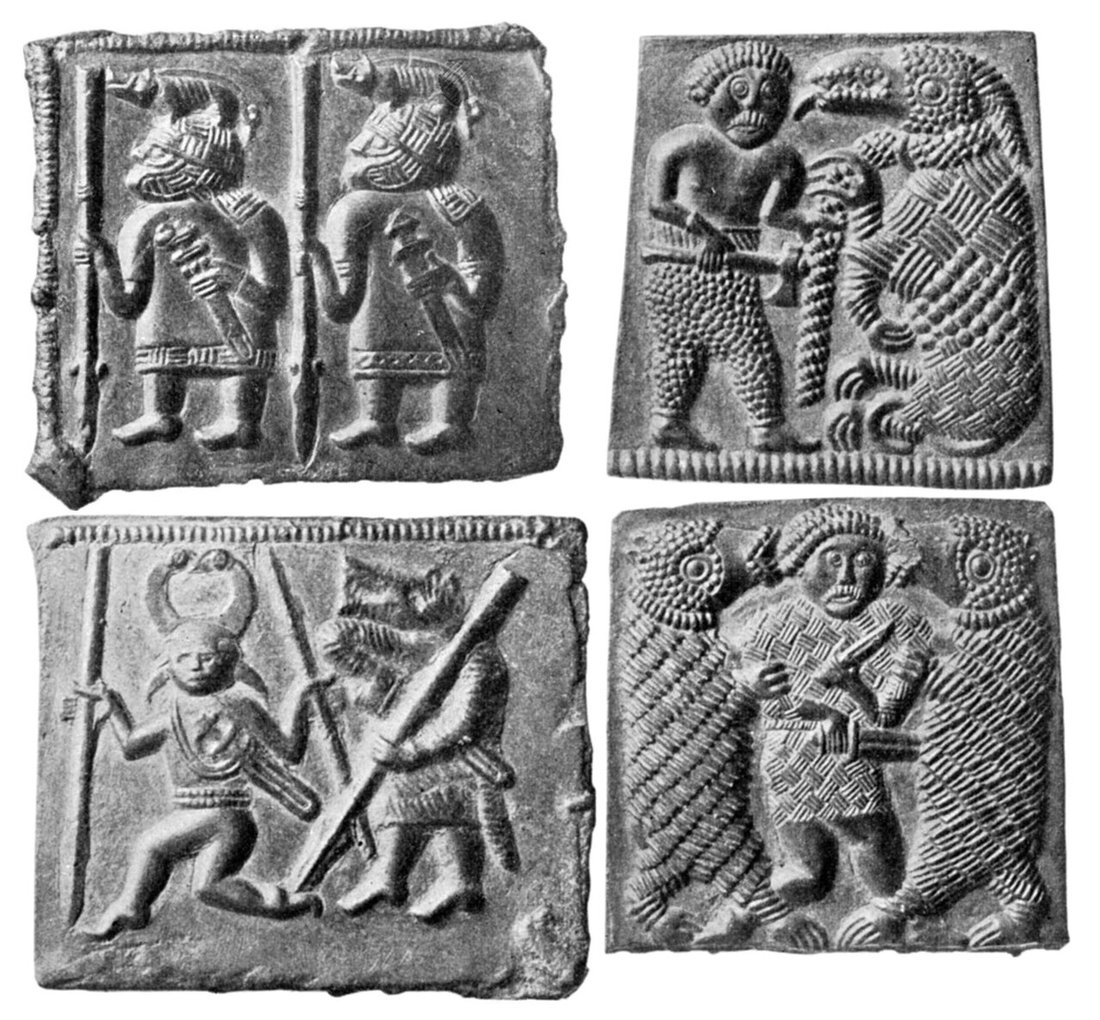
The most famous pictorial witnesses actually predate the Viking Age. On the island of Öland, the Torslunda plates were found in 1870: four cast bronze matrices of the Vendel period (6th/7th century) used to stamp thin foil images for helmets. One matrix shows two figures: a warrior in a horned helmet holding two spears and seeming to dance, and beside him a figure in an animal skin – often read as a wolf-warrior. Similar motifs are known from helmet-plates at Vendel and Valsgärde in Uppland: the „spear-dancer" beside the animal-clad fighter.
These images are fascinating because they attest a whole iconography of the animal warrior and the weapon-dance – centuries before Snorri wrote his lines. They show that the idea of the fur-clad fighter was old and widespread. But they carry no caption. Exactly what they depict, and whether they connect to the ulfheðnar of the poetry, is interpretation – and that interpretation has recently been thrown into motion, as the myth-check below shows.
In Icelandic prose of the 13th and 14th centuries berserkir and ulfheðnar appear regularly – but usually as opponents the hero must defeat. In the Vatnsdæla saga ulfheðnar appear in a Norwegian context; in the Grettis saga the hero Grettir faces a berserker and sees through his fury as something that can be overcome. The tone is striking: where the old poetry celebrates the wolf-warriors as the king's elite, the later sagas often treat the berserker as a brutal troublemaker, a robber and ravisher whom a decent man puts down.
This shift is no accident. It reflects the Christian era in which the sagas were written down. The heathen frenzy-fighter now served as a dark foil: his ferocity was no longer honour but disorder. For us this means the saga episodes tell us much about the high-medieval view of the old warriorhood – and less about how a ninth-century ulfheðinn really lived and fought.
A whole branch of scholarship sees in the ulfheðnar the Norse offshoot of an ancient pattern: the „männerbund" of young, unmarried warriors who temporarily detached themselves from ordered society, lived in the wilderness and ritually identified with the wolf. Scholars such as Kris Kershaw and Kim McCone have linked this idea to the reconstructed Indo-European koryos – a warband of young men thought to be discernible across many Indo-European cultures, from the Greek and Italic world to the Indian and Iranian traditions.
This is an elegant and influential thesis – but it is a thesis. It rests on comparisons across vast gulfs of time and space and on linguistic reconstructions that by their nature cannot be proven by finds. It should therefore be read as what it is: a learned interpretive model that ties much together and explains much, yet does not hold with the same certainty as a single surviving verse. We name it here because one should know it – not because it is the last word.
The fly-agaric myth. The most popular explanation of the berserker fury – that the warriors worked themselves into a rage with the fly-agaric mushroom (Amanita muscaria) – is unproven speculation. It originated with the Swedish theologian Samuel Ödmann (1784), who drew on reports of Siberian shamanism, and was popularised in 1956 by Howard Fabing. There is not a shred of evidence for it: the mushroom's active compounds (muscimol, ibotenic acid) are chiefly sedative and dreamlike, not disinhibiting and aggressive, and no fly-agaric has ever been found in a warrior grave. Alternatives put forward are henbane, bog-myrtle, or simply battle-adrenaline and ritual – none of these explanations is proven either. The Torslunda reading. The common interpretation „Torslunda wolf-warrior = Odin cult" is likewise now contested. Neil Price and Paul Mortimer (2014) saw in the one-eyed Torslunda figure a hint of Odin role-playing; Iris Schulz and Jörgen B. Jepsen (2023) argue instead that the plates may show Christian soldier-saints (the dog-headed Christopher, Saint George), and that the figure's „single eye" is a manufacturing defect of the hammer-stamp, not an Odin marker. This is a live debate, not a closed case. And the film image. The bellowing, half-naked wild man in a horned helmet is Hollywood and the 19th century – the sources show well-equipped royal warriors. Snorri wrote 250 years after conversion, and the sagas are literature, not reportage.
Let us gather what stands on firm ground. First: the term ulfheðnar is genuine and old – it already appears around 900 in a praise-poem for Harald Fairhair. Second: there these wolf-warriors belonged to the elite of a royal army and appeared alongside the berserkir. Third: the idea of the animal-clad warrior and the weapon-dance is pictorially attested as early as the Vendel period. Fourth: the detailed descriptions of fury, shield-biting and weapon-proofness come from Christian times and bear their stamp.
And what we do not know is, in all honesty, more than that: we do not know whether the ulfheðnar actually wore wolf-skins in battle or whether that is a poetic image. We do not know whether their fury was a ritual, an intoxication, a psychological reaction or a literary motif. We do not know how closely they were really bound to Odin. It is precisely this uncertainty that makes the ulfheðnar so compelling – and it is a good reason to meet them with respect for the sources rather than with the nearest image from the cinema. The wolf-warrior of the North was real enough to howl in the oldest poetry. Everything else we should separate, with a steady hand, from the legend.
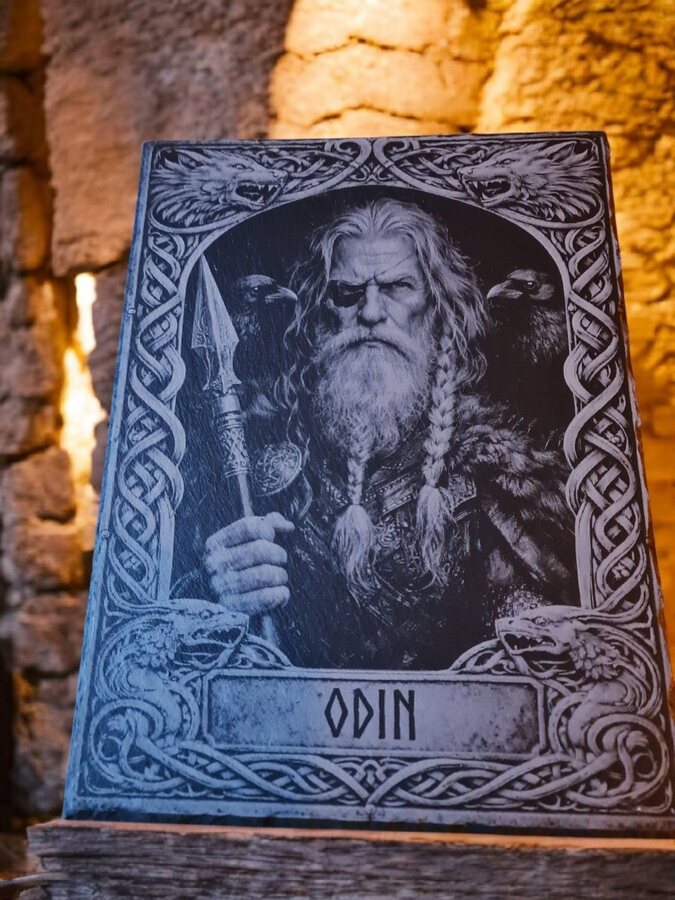
Berserkers · The Torslunda Dies · Odin · The Wolf in the North · Weapon Lore.
The funniest and at the same time most profound Thor story is a string of defeats – that are none at all. On his …
Read more →A poet who fears for his reward, and a lord who lets himself be celebrated: the Vellekla („gold-lack“) by the skald …
Read more →Valhalla is no resting-place for weary souls. It is a barracks of the fallen: a vast hall where the bravest dead fight …
Read more →They are far more than the winged warrior-maidens of the opera: the valkyries decide who falls in battle – and who is …
Read more →