Say "Viking" and most people picture a sword – yet the majority of warriors in the Viking Age never owned one. Spear and axe were the everyday weapons; the sword was the costly badge of the elite. This overview walks through the whole arsenal of the Norse fighter, places each weapon in its archaeological and written context, and draws a clean line between what is proven and what the sagas and the cinema simply tell us.
In the Viking Age a person's armament was not purely military but deeply social. Weapons cost money, and what someone could muster revealed their standing. A free man typically carried a spear, a shield and a knife or seax; the better-off added an axe; and the truly wealthy owned a sword. A complete elite set of sword, spear, axe, shield, mail and helmet was so rare that it almost never appears together in the grave record.
Burial finds across Norway, Sweden, Denmark and the colonies bear this out plainly: spearheads and axes turn up in great numbers, swords far less often, mail shirts and helmets almost never. That does not mean everyone else fought unprotected – it means that high-grade iron and steel were precious, and most of it was reused or handed down rather than buried.
It is also important that "the Viking" was no professional soldier. Most men who went raiding were farmers, fishermen and craftsmen who set out in summer to trade or plunder and returned in autumn for the harvest. They had to provide their own gear. Only late in the Viking Age did standing retinues, paid by king or jarl, arise, whose warriors were more uniformly and heavily armed. To understand the weapon landscape of the North one must therefore always hold two pictures in mind: the average free fighter with spear and shield – and the narrow upper class that displayed its wealth in the sword, the broad axe and the armour.
The spear was the most widespread weapon of the Viking Age – cheap to make, because only the iron head had to be forged while the long shaft was of ash or other wood. It served both as a thrusting weapon and as a throwing missile. Archaeologically, spearheads are by far the most frequent weapon find; the typologies distinguish many forms, from slender throwing heads to broad, winged thrusting spears whose sockets were sometimes richly inlaid with silver.
The spear also stood at the heart of war as a religious act. Odin's weapon was the spear Gungnir, and tradition tells us that before a battle a spear was thrown over the enemy host to dedicate it to Odin. That the Germanic bond between free man and spear reaches far back is already shown by the Roman historian Tacitus in his "Germania".
"They also carry iron spears – framea in their own tongue – with a narrow and short head, yet so sharp and handy in use that with the same weapon they fight, as the situation demands, at close quarters or at a distance."Tacitus, Germania 6 (own translation)
Although Tacitus writes some eight centuries before the Viking Age, he describes the same basic idea: the one versatile pole-weapon of the ordinary warrior. Shaft lengths varied greatly – short throwing spears about the height of a man stood alongside long thrusting spears with which one could strike from the second rank of the shield wall over the heads of those in front. Some heads bear small wings or lugs below the blade; they kept the weapon from driving in too deep and could be used to parry and hook. Thus the spear was at once the cheapest and the tactically most flexible weapon of the North. Readers who want the religious dimension will find more in our piece on Germanic warfare.
After the spear, the axe was the second most common weapon – and at the same time an indispensable tool on every farm. The range runs from the simple hatchet to the heavy war-axe. The light bearded axe, with its downward-drawn "beard" of the edge, was versatile and could even be used to hook. The large, thin-bladed broad axe of the late Viking Age, by contrast, was a pure war-weapon: wielded in both hands, it could split shields and drive through mail.
The axe was the common man's weapon because it was present on every farm anyway and tied up little costly iron. Only the edge was of hardened steel, the rest of the head of softer iron – which made the weapon tough and cheap at once. Some showpieces, such as the famous Mammen axe from a Danish grave of the 10th century, were richly decorated with fine silver inlay and served as status symbols; its ornament even gave its name to a whole art style, the Mammen style. The long, slender haft of the broad axe gave the two-handed blow enormous force, but cost the fighter the cover of his shield – one reason the heavy axe belonged rather to the equipment of disciplined retinue warriors. More on forms, typology and finds in our own article on the Viking axe.
The sword was the most expensive and prestigious weapon of the Viking Age. A good sword tied up an enormous amount of iron and the highest craftsmanship; it was handed down over generations, was given a name, and marked rank and wealth. Typical Viking swords were double-edged cutting weapons with a broad, fullered blade and distinctive pommels, whose forms archaeology has arranged into detailed typologies.
Many of the best blades were not forged in the North but in the Frankish realm, even though Charlemagne explicitly forbade exporting weapons to the Northmen. Famous are the blades inlaid with "+VLFBERH+T" of high-grade, carbon-rich steel – a kind of brand so coveted that it was also counterfeited. The older idea that every blade was elaborately "damascened" must be qualified: pattern-welding (the artful welding of different iron grades into a visible pattern) was common in the early Viking Age but gave way increasingly to more homogeneous steel blades.
The hilt was as much a statement as the blade. Pommels and guards were inlaid with silver, copper and brass wire, laid in plait patterns or covered with animal-style ornament. Such a sword was heirloom, legal title and gift in one: kings rewarded loyal followers with costly blades, and in the tradition named swords change hands with the standing of their bearers. The sword was carried on a baldric over the shoulder or at the belt, in a wood-lined, leather-covered scabbard that protected the blade from rust. More in our articles on the Viking sword and the Ulfberht sword.
Between knife and sword stood the seax – a single-edged short sword or long fighting knife that is said to have given the "Saxons" their name across the entire Germanic world. The seax was markedly cheaper than a double-edged sword and therefore more widespread; it ranged from short, knife-like forms to long, sword-like blades. As a robust, straight cutting and thrusting weapon for the tight press of close combat, it rounded out the arsenal of the free warrior who could not afford a full sword.
The bow was far more than a hunting tool. In sea battles and open field battles the fight was often opened with arrow fire before it came to hand-to-hand combat. On the water especially, where ships were lashed together into floating fighting platforms, arrow fire often decided the first phase. Long wooden bows were used, above all of yew, together with iron arrowheads in great variety of form – slender, hardened points to punch through armour alongside broad cutting heads for unprotected targets. Archers enjoyed real standing in the tradition: a good shot could help decide a battle, and the sagas name individual bowmen. That the bow is underrepresented in today's image of the "Viking" owes more to the modern iconography of axe and sword than to its actual importance.
The round shield was the universal protective weapon. It usually consisted of thin, glued boards – often of lime wood or other light timber – with a central iron shield boss protecting the hand, and a rim frequently covered in leather or rawhide. Contrary to the heavy Hollywood cliché, the Viking shield was light and mobile; the famous finds from the Gokstad ship show thin boards and simple construction.
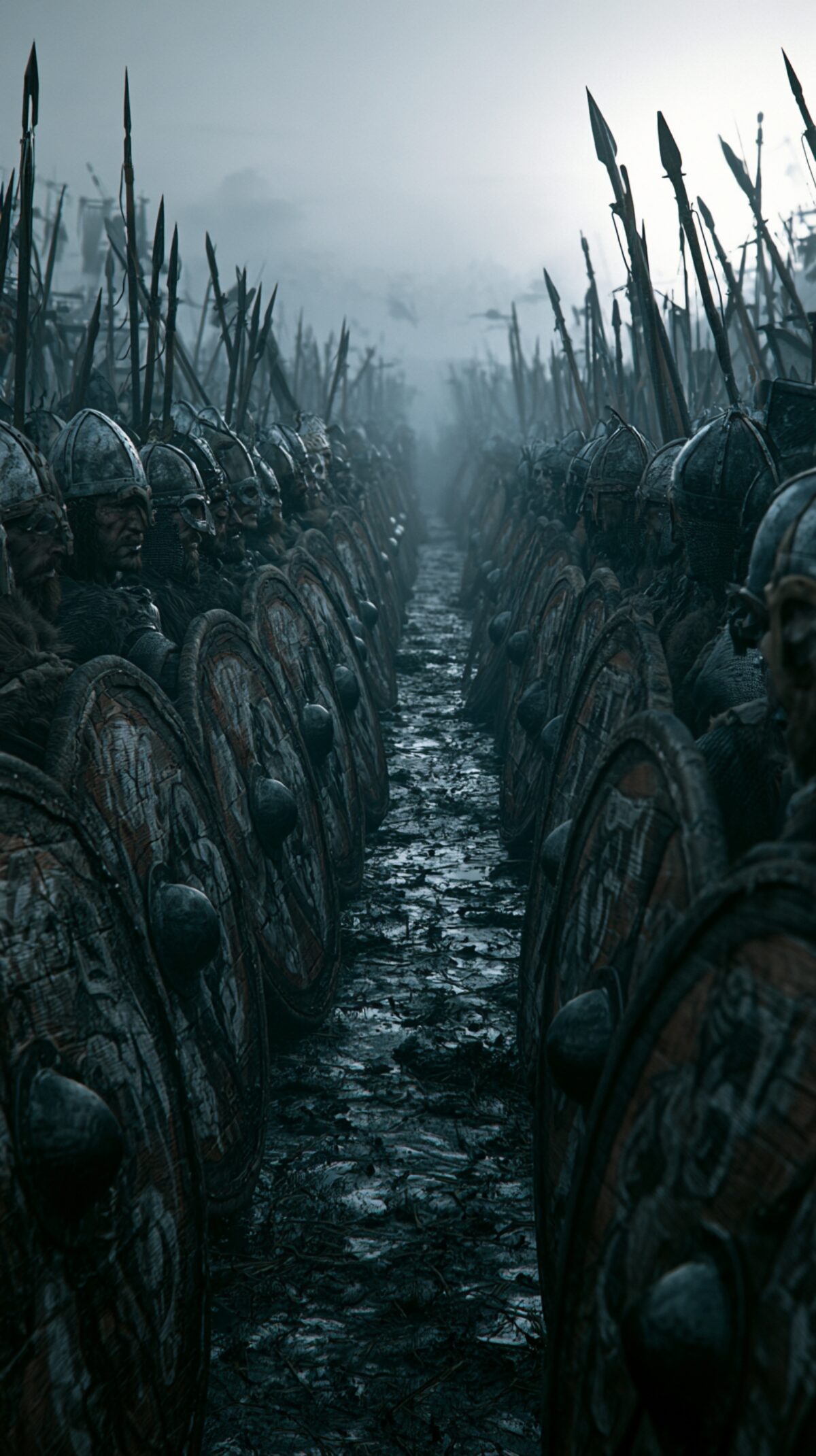
The shield was not merely cover but a weapon in its own right: one punched with the boss, hooked away enemy weapons, and in close order pressed shield against shield. This formation, the shield wall, was the backbone of Norse field battle. Shields were frequently painted – red, black, yellow and white fields are attested – which helped tell friend from foe in the press. A shield was consumable: the thin boards splintered in combat, and a warrior had to reckon on going through more than one in the course of a battle. We treat construction and finds in detail in our article on the Viking shield and the tactics in the text on the shield wall.
Armour was a luxury. A mail shirt, the brynja, consisted of tens of thousands of individually made and riveted iron rings – an effort that made it the equipment of the elite. Complete mail shirts are extremely rare archaeologically; the best-known piece comes from the grave at Gjermundbu in Norway. Anyone without a brynja wore at most a padded textile layer, or relied entirely on the shield.
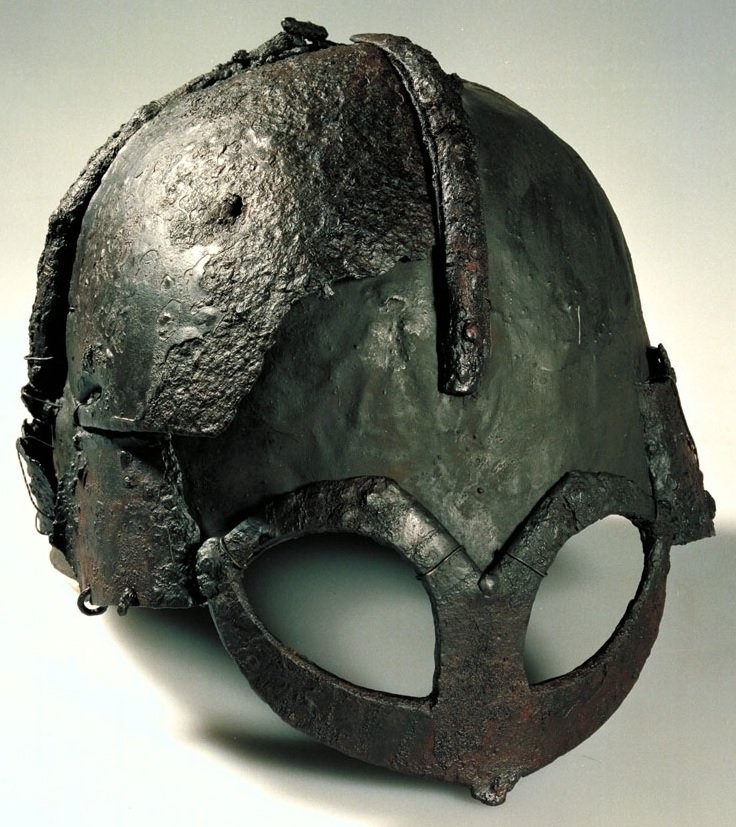
With the helmet the evidence is thinner still. The only largely preserved helmet of the actual Viking Age is the Gjermundbu helmet – a plain rounded iron cap with a spectacle- or mask-like eye guard. It has no horns. More on it, and on the famous misinterpretation, in our article on the Gjermundbu helmet.
Behind every blade, every spearhead and every shield boss stood the work of the smiths. Iron was won in bloomery furnaces from ore or bog iron and laboriously cleaned of slag. Good weapons were created by deliberately combining softer and harder iron grades – a tough core, a hard edge. Pattern-welding demanded the utmost control over temperature and folding. To forge a sword was weeks of work and affordable only for the few, which further explains the status value of the weapon. More on furnaces, techniques and tools in our article on the smithing craft of the Vikings.
In Norse society bearing arms was not merely permitted but expected. Free men carried weapons to the thing, the assembly, and assent was at times expressed by the clash of arms. Anyone without weapons was usually unfree – slaves were denied the carrying of arms. In the later law codes of the North the duty to keep certain weapons ready is even tied to the organisation of defence: for the naval levy, the leiðangr, every able-bodied man had to provide a basic kit, often spear, shield and a set number of arrows. The weapon was thus less a tool of war than a token of personal freedom and legal standing. Whoever lost it – through outlawry or unfreedom – lost their place in the community at the same time. In this light it becomes clear why a well-made weapon in the North was crafted, decorated and passed on with such care: it was the most visible sign of who and what a person was.
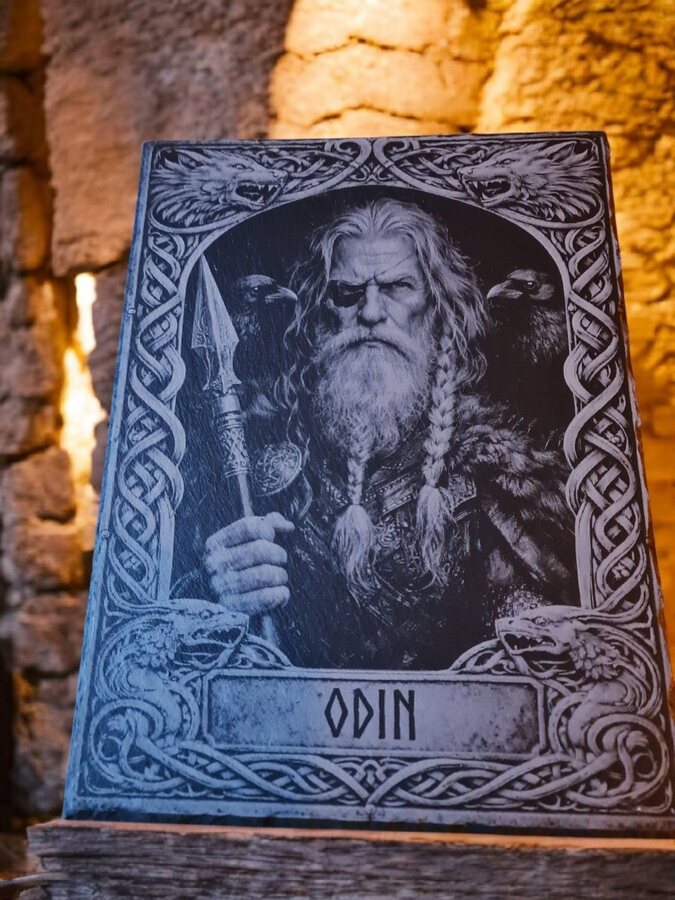
In the North weapons were more than gear – they carried meaning. Some were deliberately rendered useless before being laid in a grave or a bog: bent swords and broken spears from votive finds show that the weapon was "given" to the dead or the deity and withdrawn from worldly use. In the heroic sagas the greatest bear named blades whose origins reach back to dwarves or ancient kings. These tales are no historical weapon catalogue, but they reveal the rank a good blade held in people's minds: it was a bearer of honour, fate and family history. In mythology too the gods are defined by their weapons – Odin's spear Gungnir, Thor's hammer Mjölnir, Freyr's sword that fights of its own accord. Anyone who engraved or named a weapon placed themselves squarely in this tradition.
Well attested: Spear and axe were the most common weapons and can be documented in great numbers from graves; swords are rarer and appear above all in wealthier burials. The Gjermundbu find provides the only largely preserved Viking helmet and a rare mail shirt. Frankish blades, including the Ulfberht group, are materially proven; the Carolingian ban on weapon export is recorded in writing. Tacitus attests the framea as the basic Germanic weapon.
Myth check: Not every Viking swung a sword – most fought with the cheaper spear or axe, and the sword was the status weapon of the elite. Horned helmets demonstrably never existed; they come from the art and opera of the 19th century. The term "Dane axe" for the large broad axe is a later outside label, not a contemporary word. And the famous named wonder-swords of the sagas – Skofnung, Tyrfing and others – are saga literature: named swords existed, but magical blades with a will of their own belong to the realm of the tale.
If you want to know how a warrior society was armed, you have to start by counting. For Norway, by far the richest find country of the Viking Age, the number of known swords runs to something on the order of three thousand – an impressive figure until you set it against the rest: spearheads and axes clearly outnumber them, and both turn up in graves that hold no sword at all. Of the famous blades inlaid with +VLFBERH+T, around 170 are known across Europe, some 45 of them from Norway. That is the hard core behind the claim that the sword was the exception.
With protective gear the evidence thins further. A near-complete Viking-Age mail shirt is known essentially only from Gjermundbu; estimates for such a garment run to twenty or thirty thousand individually made rings. For helmets the count comes to four or five pieces from the entire Norse world – besides Gjermundbu, the fragments from Tjele and Lokrume, a piece from Kyiv, and the disputed Yarm find, whose date is debated between the Vendel Period and the Viking Age. Only one of them is genuinely reconstructable.
These numbers have to be read correctly. A grave does not show what somebody fought with; it shows what the mourners wanted, and were able, to give away. Armour was expensive, repairable and heritable – it stayed with the living. And with Christianisation the custom of furnished burial ends, so the late Viking Age is missing from the record. Grave statistics are not a muster roll. More on the individual categories in our articles on the spear, the axe, the sword, mail and helmets.
There is a second source alongside the spade, and it says something quite different: not what a man had, but what he was required to have. The older Gulathing law of western Norway binds every free man to the folkvápn, the people's weapons – spear and shield, plus an axe or a sword. The Frostathing law sets out the same basic kit for the unmarried man. And for the fleet, the leiðangr, a remarkable clause is added: every rowing bench, usually manned by two, is to provide a bow and twenty-four arrows.
That is a strikingly concrete figure, and it shifts the picture. The bow appears there neither as hunting gear nor as a specialist's weapon but as the planned equipment of a warship, apportioned bench by bench: a ship with thirty benches carried several hundred arrows before the first spear flew. Norse naval warfare has to be thought through with the bow in it.
Two caveats belong here. These legal texts were only written down in the 11th and 12th centuries, that is, after the Viking Age; they may preserve older practice, but they do not prove it. And a regulation is not an inventory – that a law names the minimum kit means above all that it could not be taken for granted. The listing “spear, shield, and an axe or a sword” is telling all the same, because it treats the sword as an alternative, interchangeable with an axe rather than the centrepiece. For the thin purse there remained the seax, the long knife, which appears on no levy list and yet hung from almost every belt.
The popular image inverts the order of things: helmet and body armour first, shield second. The evidence says the opposite. The shield is the principal protection of the North, and it is so for everyone – from the levied farmer to the jarl. The 64 shields from the Gokstad ship are astonishingly thin at six to ten millimetres, carry no metal rim fittings and are built from plain boards butted together. Rolf Warming has reopened the question of the rim and argued for a rawhide facing; the largely preserved shield from Trelleborg brought fresh material to the debate in 2008.
A shield like that is not a bulwark but a tool: light enough to be actively worked, turned and set against the enemy's weapon, and cheap enough to break in the course of a fight – which is what makes it the weapon of the many. Mail sits at the other end of the scale, no standard issue but a mark of lordship, its manufacture measured in weeks. The padded textile layer beneath it, which shows up in every reconstruction, is inferred for the Viking Age, not excavated.
Leather armour has no find evidence at all. There is no Viking-Age leather corselet, no cuirass of hardened hide – the notion comes from the costume departments of film and games, where it fills the visual gap between farmer's tunic and mail shirt. And the horned helmet is an invention of the 19th century. More in our articles on the Viking shield, the Gjermundbu helmet and the horned-helmet myth.
What a weapon cost cannot be stated directly for the North – no price lists survive. A look across the border helps nonetheless, and it comes from our own neighbourhood: the Lex Ribuaria, the law of the Rhenish Franks from the 7th century, took shape in the region of Cologne and lists weapons as redemption values. The brunia, the mail shirt, stands there at twelve solidi – as much as a horse. A helmet costs six. A sword with scabbard is set at seven, the sword alone at three. Shield and lance together: two.
You only have to read that list once to see the society behind it. A fully armoured horseman cost many times what a levied man could raise, while shield plus lance sat at the bottom of the scale – affordable, replaceable, ordinary. Most revealing is the gap between the sword with and without its scabbard: four solidi remain, by arithmetic, for an object of wood, leather and wool – twice the price of shield and lance combined. Anyone who has wondered why the scabbard is treated so seriously in the sources has the answer here.
Two qualifications. These figures are Frankish, not Norse, and they lie some two centuries before the Viking Age. They are also legal values for settling fines, not market prices. As an order of magnitude they still serve, because the same region later supplied the most coveted blades in the North – on how they were made, see our articles on smithing and the Ulfberht sword.
The field battle of the North is a matter of close ranks. Men form up shield beside shield, secure the flanks and try to make the enemy line waver at one point. It usually opened at a distance: arrows, thrown spears, stones. The spear cast over the enemy host belongs to this phase and carried a ritual meaning alongside the military one. Only then came the collision, and it was short – a matter of minutes, not hours. The sagas describe pauses, exchanges of words, a falling back and a fresh advance.
At sea the same principle worked, only afloat. Ships were lashed together bow to bow into a fixed fighting platform, while individual vessels stayed free to strike at the flank, and whoever cleared a neighbouring gunwale worked forward as if along a street. That is why bows and throwing weapons mattered so much at sea – the target could not step aside.
On the details, caution is due. The much-quoted wedge formation svinfylking, with its precisely counted ranks, goes back in that elaborated form to Paul Du Chaillu and the late 19th century, not to a Norse source. Much the same applies to the idea of frenzied individuals bursting a shield wall single-handed: the tradition about the berserkers is literary in shape and cannot be translated into tactics. What we can say with confidence is set out in our pieces on the shield wall and on Germanic warfare.
Beside the battle stands the regulated duel. The holmgang – literally the going to the islet – was a legal institution: a way of deciding claims, insults and inheritance disputes when witnesses and oath-helpers no longer helped. The fullest description of the rules is in Kormaks saga: a hide spread out as the fighting ground, marked boundaries, three shields per fighter, a fixed order of blows, and a ransom by which the loser could buy himself off.
That very orderliness became the problem. A skilled fighter could run the holmgang as legalised robbery: raise a claim, force the other party to the duel and pocket land or property. Tradition accordingly places a ban in Iceland in the year 1006 and in Norway in 1014, in the Icelandic case in connection with the duel between Gunnlaugr Ormstunga and Hrafn Onundarson.
Those dates come from 13th-century sagas and are therefore tradition, not charters. The rule details, too, describe how the High Middle Ages imagined the single combat of their forebears. The core still holds: in the North, fighting was not a departure from the law but a part of it. Honour was a legal category, and the weapon was the instrument by which it was negotiated.
The most informative weapon finds of northern Europe do not come from the Viking Age at all. In the sacrificial bogs of Jutland and Schleswig lies the complete equipment of defeated armies, sunk in thanks or in banishment after the victory. At Illerup Ådal some 15,000 objects were recovered; the deposition took place shortly after AD 205. The count runs to at least 430 lances and 439 spears, plus over 200 swords and roughly 300 shields – and, which is what makes wooden finds so precious, 748 lance shafts and 661 spear shafts.
That ratio is the real treasure. Here no burial custom skews the figures, no selection by mourners, no regard for heirlooms: this is the equipment of a body of men as it took the field. Roughly two pole weapons fall to about one sword, and the shields correspond closely to the number of men. Ejsbøl North, with equipment for some two hundred fighters, and the Nydam bog with its rowing ship of around 310 to 320 belong in the same series.
The large caveat: five to six centuries lie between these deposits and the Viking Age, and the numbers cannot simply be extended forward to the year 900. What they show is something more fundamental – that the pole weapon was the principal arm of Germanic forces long before anyone sailed a longship to England, and that even then the sword marked a minority. The imagery of those centuries is matched by the Torslunda dies; readers looking for the comparison with the west will find it among the Celtic warriors, and the sites themselves we treat in our article on the bog army offerings.
Weapons tell us what was possible. Skeletons tell us what happened. Osteoarchaeology draws a strict line between healed injuries, which somebody survived, and perimortem traces from around the time of death. Common are blows to the head and to the left side of the body – the side facing a right-handed opponent – along with injuries to unprotected lower legs and forearms. That pattern fits shield combat exactly: protected torso, exposed edges.
Two cases deserve to be placed correctly. The mass grave at Repton in England long looked contradictory, because the bones yielded differing radiocarbon ages. In 2018 a reassessment showed that the high proportion of fish in the diet had skewed the results; once this marine reservoir effect was corrected for, the burials fall consistently into the late 9th century, with a double grave in the range 873 to 886 – the time of the Great Army.
The second case is a misunderstanding that stubbornly persists: Sandby borg on Öland, where the slain were left lying between the houses, does not belong to the Viking Age. The ringfort dates to the Migration Period, and the event is placed around 480 – some three hundred years too early. And a skeleton without a cut mark proves nothing: soft-tissue wounds leave no trace on bone. We are seeing a sample, not a balance sheet.
Of all aspects of weapon lore this is the most surprising – at least for anyone who associates runes on a blade with sorcery. The evidence says otherwise: where Norse and Germanic weapons were written on, what stands there are names. Names of people, names of workshops and, remarkably, names of weapons.
The oldest known example from Norway is the spearhead from Øvre Stabu, dated to the second half of the 2nd century. Its Elder Futhark inscription consists of a single word: raunijaR, “the tester” or “the trier”. Scholarship largely reads this not as an owner's name but as the name of the weapon itself – the spear tests the opponent. So at the very beginning of Germanic literacy we have not a magic word but a naming.
The second great find leads to England. The seax of Beagnoth, found in the Thames in 1857 and now in the British Museum, is a 10th-century showpiece, its blade inlaid with copper, brass and silver wire. It carries the only completely preserved sequence of the twenty-eight-character Anglo-Saxon futhorc – and beside it, likewise in runes, the personal name Beagnoth, presumably the smith or first owner. The piece is Anglo-Saxon, not Norse; and even here, where a whole alphabet stands on a weapon, there is no incantation among it.
With the Frankish blades it becomes plainer still. The famous +VLFBERH+T is not written in runes but in Latin letters – a workshop name so coveted that it was imitated and its spelling garbled. Even the few swords with genuine runes are awkward: on the Sæbø sword, made known by George Stephens in 1867, the blade was damaged during a cleaning with acid, and the reading has been disputed ever since.
For us in the workshop the lesson is simple and rather pleasing. The historically attested way of inscribing an object is the plainest one: the name of whoever owns it, or of whoever made it – in Old Norse in a form such as “X owns me”, X á mik. Anyone who wants to place an engraving in the old tradition needs no invented formula. A name is enough, just as it was enough a thousand years ago. More on the objects involved in our articles on the Ulfberht sword, the seax and the scabbard.
To go deeper into individual categories, here is the whole set in one place. Offensive weapons: spear, axe, sword, seax, bow and arrow. Protection and equipment: shield, mail, helmets, scabbard. Individual finds and workshops: Gjermundbu helmet, Ulfberht sword, Torslunda, bog army offerings, smithing. Combat, context and reception: shield wall, Germanic warfare, Celtic warriors, berserkers and the horned-helmet myth.
The Viking Sword · The Viking Axe · The Viking Shield · The shield wall · The Ulfberht sword · Warfare.
All History & Finds articles →
A name that outlasted three decades of war: Widukind was the most famous leader of Saxon resistance against …
Read more →