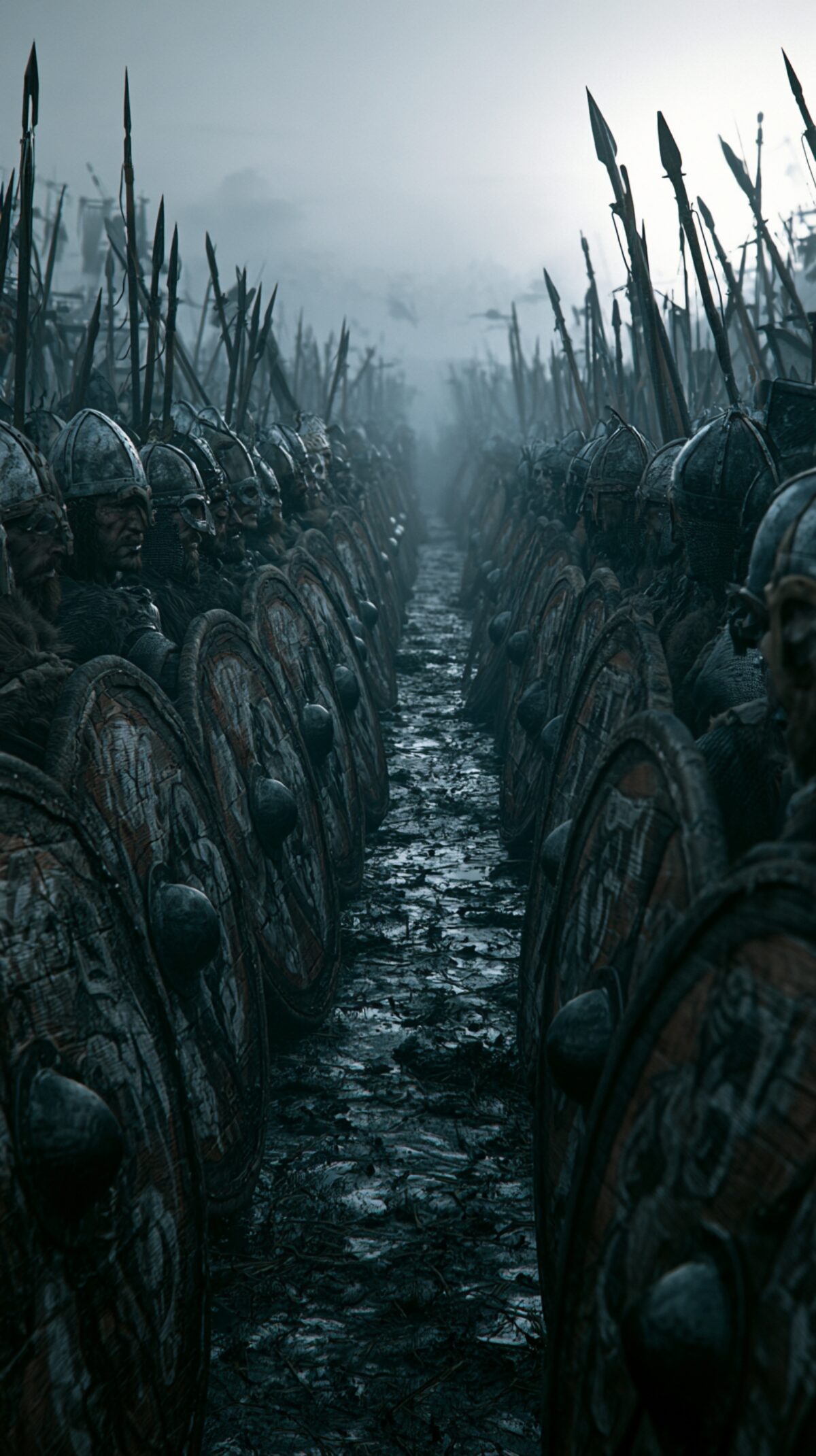
When a Norseman steps out of the fog on screen, he carries a sword. When an archaeologist opens a weapon grave, he usually finds something else: a rusted piece of iron with a socket that once sat on an ash shaft. The spear is the worst-marketed and best-attested weapon of the Viking Age – and anyone who wants to know how these people actually fought has to start there.
There is a stubborn error in our mental picture of the North: we see swords. On book covers, in series, in museum shops. The sword is elegant, expensive, nameable – it has personality. The spear has none of that. It is a long stick with a point, which is precisely why it was made in enormous numbers and underestimated in even greater ones.
The finds tell a different story from the cinema. In the weapon graves of the Viking Age and in the bog deposits of the Roman Iron Age, the dominant object is not the blade but the point. To understand this weapon you have to take it seriously as what it was: the backbone of every Germanic and Norse battle order, from the opening cast to the last thrust in the press. For an overview of the other weapon classes, see our weapons guide.
The most honest approach to a prehistoric weapon is counting. In Norwegian Viking Age weapon graves, spearhead and axe belong to the standard set, while the sword is the exception. More than three thousand Viking Age swords are known from Norway alone – an absurdly high figure by European standards, largely because weapon burial lasted longer and was practised more richly there. Even so, the rule holds: a person given only one weapon in the grave usually received a point or an axe, not a blade.
This is not a whim of the undertakers but economic history. A spearhead consumes a fraction of the iron a sword devours, and a fraction of the smithing time. Anyone thinking about manufacture should look at our piece on smithing, which shows why a blade cost weeks and a point cost hours.
One qualification belongs with this: Norwegian material dominates the statistics because weapon burial lasted longest there. In Denmark, Viking Age weapon burial is far rarer overall; in Sweden it is differently composed – the chamber graves of Birka draw their own picture. That is exactly why the claim “many spears, few swords” does not rest on graves alone but additionally on the Iron Age weapon deposits, where no group of mourners selected what went into the ground.
One caveat belongs here immediately. Graves do not show what people owned in life but what the survivors chose to give them. Burial customs shift by region, century and family. Add a banal preservation problem: wooden shafts vanish completely in ordinary soil, iron rusts, and a ploughed-out grave surrenders the small point more readily than the long sword. To say “the spear was the most common weapon” is strictly to say “the spear is the most common weapon in our material”. That is strong evidence, not a census return.
Two independent observations support the picture: the legal texts, which demanded a spear from every free man, and the great Iron Age weapon deposits, where whole equipment sets lie together in the ground without the selection a grave always imposes.
The Old Norse word for spear is spjót; the older, poetic term is geirr, cognate with Old High German gêr and Old English gâr, from Proto-Germanic *gaizaz. It survives in personal names such as Geirmundr and, through German, in the mitre joint.
Alongside these stand terms that popular literature likes to promote into weapon types even though the sources do not separate them cleanly: höggspjót, literally “hewing spear”, a broad-bladed polearm you could also strike with; krókspjót, “hooked spear”, a head with barbs or wings; kesja and atgeirr, both words for a heavy polearm, routinely rendered as “halberd” in translation, which is certainly wrong. Linguistically atgeirr is more like “battle spear” than a distinct category. Anyone building a tidy type table out of these words is building it out of fog: the sagas use the terms loosely, sometimes interchangeably, and they were written down centuries after the Viking Age.
The oldest outside view of Germanic armament comes from Tacitus. In Germania, chapter 6, he describes a warrior society in which iron is scarce and the spear is everywhere. The passage is valuable because it links two things: the rarity of the sword and the dual role of the spear at close and long range. He notes that even the horseman is content with shield and framea, while the foot soldiers throw missiles, each man several, and hurl them a great distance.
Where the word framea comes from is still unresolved. Tacitus explicitly calls it a native word, but every proposed Germanic derivation remains speculative. The best-known suggestion links it to a Proto-Germanic *þramja, related to Old Norse þremjar (“edges”) and Old Saxon thrumi (“spear point”). Only one thing is certain: framea is not the same word as geirr.
The Norse spearhead is a socketed head. The iron tapers into a conical hollow cone that is pushed over the sharpened end of the shaft and secured with one or two rivets driven through socket and wood. This is cleverer than it looks: the socket spreads thrusting force over several centimetres of timber instead of channelling it into a split, and it protects the shaft end against blows from the side.
The blade itself ranges from narrow lanceolate forms under twenty centimetres to broad leaf-shaped monsters over fifty centimetres long – the latter are the candidates for what the sagas call höggspjót. Some types carry lugs or wings at the base of the socket, preventing the weapon from driving in too deep and sticking. And, to many people's surprise, sheaths for spearheads existed: leather covers protecting the edge on the march. A spear was tool enough not to be carried bare all the time.
The socket itself is not carved from solid stock. The smith drives a plate around a mandrel until the edges meet; some sockets are forge-welded along that seam, others stay open and show a clean slit down their whole length. Both work, and both can be seen on originals – a neat demonstration that there was no single correct method, only workshop habits. Incidentally, this is the most interesting surface on the entire weapon for decoration: the base of the socket is round, smooth and clearly visible, and that is precisely where the later decorators laid in their silver.
For shafts only waterlogged ground helps. Where bog and wetland settlements have preserved wood, ash dominates: in surveys of early medieval shaft finds it accounts for roughly three quarters of the material, with hazel a clear second. That matches the language – Old Norse askr means “ash” and serves in poetry as a word for the spear itself. Ash is elastic and tough-fibred; it does not snap brittle but splinters along the grain, forgiving the cross-blows that oak will not forgive.
On length the honesty gets uncomfortable. Complete shafts are rare, and the usual figures of two to three metres derive partly from pictorial sources and reconstructions, not from a measured series of originals. A throwing spear was shorter and lighter than a thrusting spear – plausible, and supported by the deposits – but the tradition has not left us a tape measure for each type.
You cannot reliably read a head's use off the head. A narrow heavy point suits punching through shield and mail, a light one suits throwing – but the weight and balance of the whole weapon decide, and those hang on the missing shaft. Statements like “type X is a throwing spear” are therefore often interpretation, not finding.
What can be said: Tacitus explicitly describes a weapon for both, near and far. And the sagas tell of spears thrown, caught and thrown back – a literary topos, but one that only works if the audience knows the throwing spear. The likeliest answer is the unglamorous one: if you could, you carried more than one spear.
This is supported by graves in which two heads of different sizes lie side by side. As an isolated case that is chance; as a pattern it is an argument – and in the deposit at Illerup Ådal the pattern turns into a number.
The strongest argument for the spear comes not from a grave but from a bog. At Illerup Ådal near Skanderborg in Denmark, the equipment of defeated armies was sacrificed over centuries. The main deposit is dated dendrochronologically, via the shield boards, to shortly after AD 205. Some 15,000 objects have been recovered, now in Moesgård Museum – and only around forty per cent of the sacrificial area has been investigated so far.
The weapon counts of the main deposit are the real hammer blow: at least 430 lances and 439 spears against a good 200 swords. Jørgen Ilkjær did not title his publication Die Lanzen und Speere by accident – separating the two categories was the result of the analysis, not its premise. More on this class of find in our article on bog and army sacrifices.
The near-equal number of lances and spears is the single most interesting result in the whole debate. It suggests that a warrior normally took the field with two polearms: a heavier one for thrusting in close combat and a lighter one for throwing. For the excavated portion of the deposit, research reckons with a force of roughly 450 to 500 men; for the entire defeated army at least a thousand are assumed.
Put in proportion, that is about four polearms to one sword – in a context where nobody was economising, because what was sacrificed was what lay on the field. Anyone extending the ratio of AD 205 into the Viking Age is reaching across six centuries and should say so; but the basic order of “many spears, few swords” stays stable across the whole span.
Illerup yields a second observation that is rarely told. The equipment sets can be graded by expense: a very small group with gilded and silver fittings, a larger one with bronze fittings, and beneath them the mass that makes do with polearm and shield. One may read a rank order into this – commanders, middle level, ordinary fighters – and research does. It remains an interpretation, but one unusually well carried by the material. The spear does not sit at the bottom of that hierarchy; it runs straight through all three groups.
Some spears speak. An iron head from the farm of Øvre Stabu in Østre Toten, Innlandet, carries the word raunijaR in Elder Futhark – “the tester” or “trier”. The head is 28 centimetres long, belongs to the so-called Vennolum type and is dated to the second half of the 2nd century, with proposals reaching to AD 210–240. Together with the comb from Vimose, it counts among the oldest securely legible runic inscriptions anywhere.
What is remarkable is what does not stand there: no charm, no invocation of a god, but a weapon name. The spear is called “tester” because it tests the opponent. That is craft pride and gallows humour in a single word – and a hint that runes on weapons first of all denote names, not spells.
The lance shaft from Kragehul on Funen is a different case, found in 1877 in a bog with five weapon deposits between roughly AD 200 and 475. The Elder Futhark inscription begins legibly – a man calls himself erilaʀ and gives a name – then runs into a sequence containing, among other things, gagaga, partly written as bind runes. That is no Germanic word.
The obvious reading as a battle cry or charm formula is widespread, but runology regards this inscription as one of the most difficult of all; every translation in circulation is a reconstruction. What can be stated: something stands on a spear shaft that is not an everyday sentence. Precisely what, we do not know.
Anyone sorting spearheads scientifically still works with Jan Petersen. His standard work De norske vikingesverd of 1919 is famous for its sword typology but also contains the first usable ordering of spearheads, with letter types from A to M. Petersen dated them via associated finds in Norwegian pagan graves – a method that works but risks dating grave and type by each other.
In 1984 Bergljot Solberg in Bergen reworked the Norwegian heads of the Merovingian and Viking periods, this time with multivariate statistics rather than pure eye judgement; the work is occasionally cited as 1985. Both systems grew out of Norwegian material. They can be applied to Danish, Swedish or British finds, but not transferred without friction – a point that reconstructions and museum labels tend to skip.
What the types additionally reveal is trade. Some of the winged heads appearing in Scandinavia follow Frankish models; within the empire, weapons were at times on the prohibited export list – the Thionville capitulary of 805 names arms and mail shirts explicitly. Whether such bans were ever enforced is another question. The heads in the ground suggest not.
And then there are the spears that flatly contradict the cliché of the farmer's tool. Around 900 a new fashion appears: the socket is decorated with inlaid silver, sometimes copper and brass, first on Petersen types I and K. In the 11th century heads emerge whose socket base is ornamented in Ringerike style – Signe Horn Fuglesang assembled a group of 24 such pieces of types K, K/M and M.
These weapons were expensive. A man who paid for a silver-inlaid socket could also afford a sword and probably owned one. The decorated spear is not a fallback but a statement of status, and it dismantles the comfortable equation of “sword equals elite, spear equals poor” from the inside. The same ornamental language recurs on sword pommels, stirrups and strap mounts; it is one workshop culture, the same one that produced the famous blades.
Tactically the spear is the logical weapon of a formation. It reaches past the shield rim of the man in front, it lets the second rank intervene without opening the line, and it keeps the enemy at a distance where axe and sword only work at arm's length. If you want to hold a closed front, you hand out spears, not blades.
The equipment of the ordinary warrior fits: spear and round shield, plus a knife and, with luck, an axe. How that order worked in detail – and how much of it is reconstruction – is covered in our piece on the shield wall. In short: the sources describe a dense front; the details of rank spacing come largely from modern interpretation.
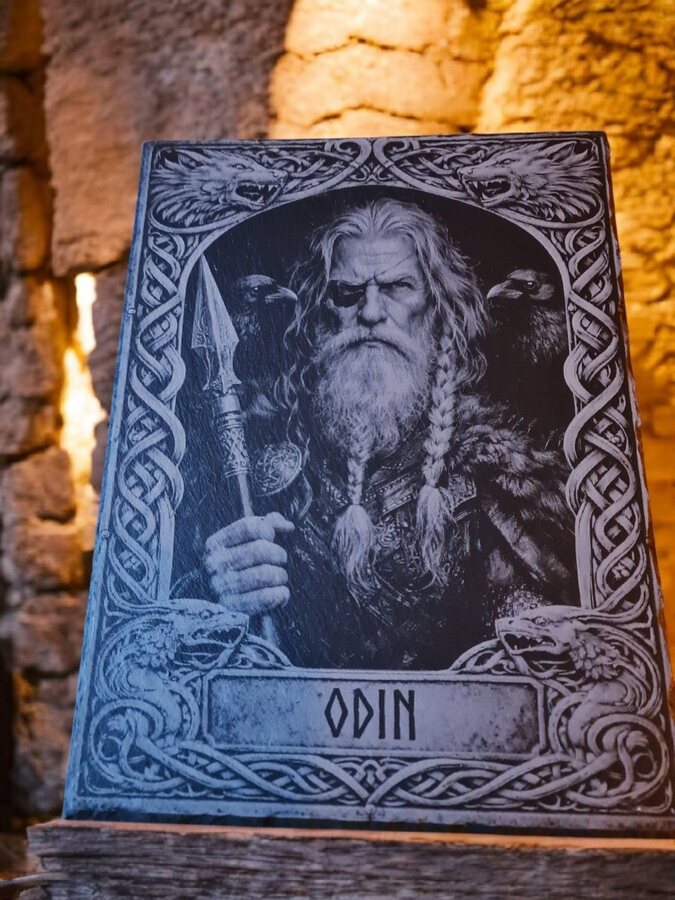
Pictorial sources support the picture, but need care. On Gotlandic picture stones, riders and foot warriors carry spears; on the Torslunda helmet dies a figure appears with two spears, frequently read as Odin – a reading, not a caption. And the Bayeux Tapestry, whose forest of spears everyone knows, was made after the Viking Age and shows Norman conditions. Images tell you what people wanted to show, which is not the same as what they did.
Several narrative sources report that a battle opened with a spear cast over the enemy host. Practically this is plausible: a hail of throwing spears before contact is one of the few ranged effects a foot force has without archer superiority. Tacitus describes exactly that for the infantry – every man throws, and they throw far.
The point where tactics and cult run together is the cast over the enemy army. A spear that hits nobody is militarily worthless. As a gesture it is unambiguous: whatever stands beyond the line of the spear belongs to the god.
The mythical reference point is Odin's spear Gungnir and the first war in the world. The Völuspá puts it this way in Henry Adams Bellows' translation of 1923:
On the host his spear did Othin hurl, Then in the world did war first come; The wall that girdled the gods was broken, And the field by the warlike Wanes was trodden.Völuspá 24, translated by Henry Adams Bellows, 1923 (public domain)
Precision pays here. The Old Norse text names no object at this point: Fleygði Óðinn ok í fólk um skaut means “Odin hurled and shot into the host”. It does not say “the spear”. Bellows supplies “his spear” because the context invites it – a well-founded supplement, but a supplement. That Odin is a spear god is beyond question on other grounds; but anyone citing this one verse as a verbal proof of the spear cast is citing a translator's decision along with it. More on Odin's weapons and attributes in our Odin article.
Two other passages are clearer. In the Hávamál, Odin describes his self-sacrifice on the tree with the words geiri undaðr ok gefinn Óðni, sjalfr sjalfum mér – “wounded by a spear and given to Odin, myself to myself”. Here the spear is the instrument of dedication, not the weapon of battle. And in the Ynglinga saga Snorri relates that Odin had himself marked with a spear point before his death and claimed for himself all who fell in battle. Both texts are late, both transmitted by Christians – but they show the same pattern of thought: whoever the spear strikes, the god has taken.
The clearest narrative passage stands in Eyrbyggja saga: Steinþórr casts a spear at fornum sið, “according to ancient custom”, over the band of Snorri goði to secure luck for himself. The saga treats this not as sorcery but as inherited practice – and in the same breath delivers the sharpest punchline in the whole history of the spear: the cast strikes Már Hallvarðsson, Steinþórr's own kinsman, and puts him out of the fight.
A second, often-quoted case is Styrbjarnar þáttr Svíakappa in Flateyjarbók. There King Eiríkr speaks the formula Óðinn á yðr alla – “Odin owns you all” – and casts over Styrbjörn's army. This matters because it is misreported almost everywhere: what he throws is not a spear in the text but a reed, which becomes a spear in flight. Both texts were written down in the 13th or 14th century, two to three hundred years after the events they describe. They securely attest that Christian Icelanders knew the custom as heathen. That it was performed this way in the Viking Age is likely, but not covered by a contemporary witness.
From myth back to administration. The Norwegian provincial laws, above all the Gulathing law, regulate the folkvápn, the people's weapons: every able-bodied man had to provide spear and shield, plus an axe or a sword; every rowing bench required a bow and twenty-four arrows. In the later recensions wealthier men had to bring more, up to helmet and mail shirt.
Two things follow. First, the spear was not optional but compulsory kit – the law allowed a choice between axe and sword, but none about the spear. Second, these texts are high medieval in their written form. They describe a levy system younger than the Viking Age, even if it rests on older ideas. They may be taken as evidence that the spear counted as the basic weapon of the free man – not as evidence that these exact paragraphs applied in the 9th century.
Spear and lance heads are more frequent than swords in the weapon deposits and weapon graves of the Germanic Iron Age and the Viking Age. The main deposit at Illerup Ådal, dated dendrochronologically to shortly after AD 205, contains at least 430 lances and 439 spears against a good 200 swords. Construction is consistently the socketed head with a transverse rivet; surviving shafts are roughly three quarters ash. The head from Øvre Stabu carries raunijaR (“tester”), one of the oldest legible runic inscriptions, dated to the second half of the 2nd century. Silver-inlaid sockets are attested from about 900; for the Ringerike style, Signe Horn Fuglesang assembled 24 decorated heads of types K, K/M and M. The typologies of Jan Petersen (1919) and Bergljot Solberg (1984) rest on Norwegian material. The Gulathing law lists spear and shield as compulsory equipment for the free man.
The image of the Norseman with a sword is an invention of the 19th century and of film; the mass fought with spear and shield. But the counter-formula falls short too: the spear was not the “weapon of the poor”. Silver-inlaid heads ornamented in Ringerike style are expensive elite weapons, and the law demanded a spear from everyone, the wealthy included. On terminology, caution is required: kesja, atgeirr and höggspjót are used loosely and partly interchangeably in the sagas – the crisp weapon-type tables built from them are modern. Translating atgeirr as “halberd” is simply wrong. In the Völuspá the famous line contains no word for “spear”; the object is supplied by translators. In Styrbjarnar þáttr what is thrown is a reed, not a spear. And shaft lengths of two to three metres derive largely from reconstruction, not from a series of fully preserved originals.
In the end the spear is a better witness than the sword, precisely because it is unspectacular. It shows a society in which iron was precious and wood was cheap, in which battles were won by formation rather than individual heroics, and in which a farmer became a warrior within the hour because the law required it of him and because the weapon stood in the house.
It also shows how tightly craft, law and belief were interwoven. The same weapon that appears as compulsory kit in a legal text bears a personal name at Øvre Stabu, an uncomprehended formula at Kragehul, silver in the socket by the 11th century – and in myth the cast that opens the first war in the world. A long stick with a point, certainly. But one on which the whole age hangs.
Weapon Lore · The Viking Sword · The Viking Axe · The Viking Shield · The shield wall · Warfare.