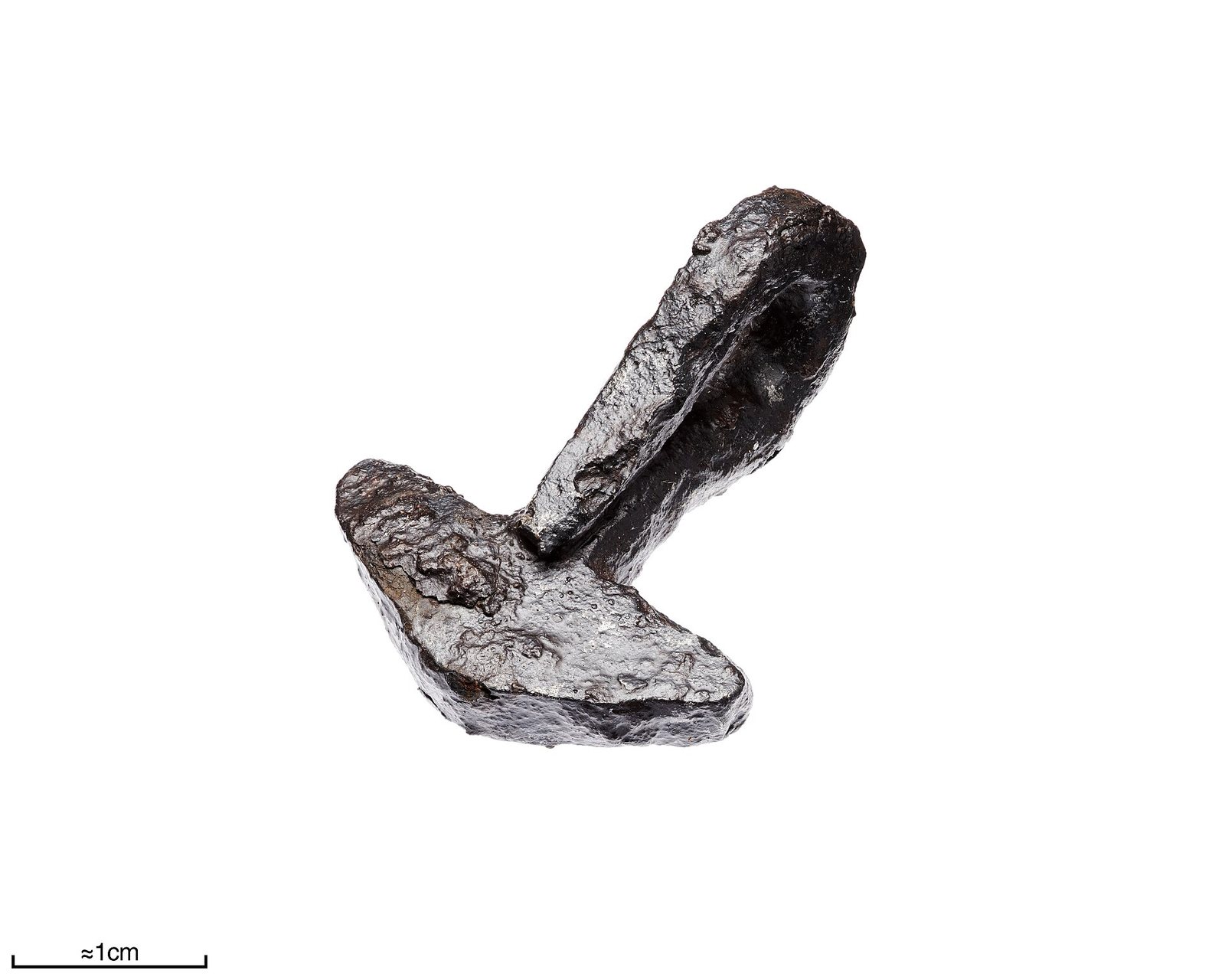
Genuine Viking symbols include Thor’s hammer, the Valknut, the raven, the dragon ship and the Norse animal styles – all backed by Viking Age finds. Many other “Norse symbols” are not: the Vegvísir and the Ægishjálmur come from early modern Icelandic books of magic, the troll cross and the Web of Wyrd from the 1990s. This guide explains each sign on its own – what it means, how old it really is and how strong the evidence is – with a link to our in-depth article on every symbol and practical tips for engraving at the end.
Type “Viking symbols” into any search engine and you get the same grid of images every time: Thor’s hammer, the Valknut, the Vegvísir compass, the troll cross, a tree inside a circle. They look like a set. They are not. The oldest of them were cast in bronze and silver in the tenth century. The youngest was designed by a Swedish smith in the late 1990s. One of the most popular first appears in an Icelandic manuscript written in 1860 – roughly eight centuries after the last Viking raid.
None of that makes a symbol worthless. But if you are going to wear one, have it engraved in slate or inked into your skin, you probably want to know where it really comes from. That is what this guide is for. We take the best-known Norse and Viking symbols one by one, explain what they mean, show how solid the evidence is – and link you to our in-depth article on each, if you want to dig further.
Here is the short version first. “Date” means the earliest secure evidence; “status” is our honest verdict.
| Symbol | Date | Evidence | Status |
|---|---|---|---|
| Thor’s hammer (Mjölnir) | mainly 10th c. | c. 1,000 pendants, rune stones, Edda | genuine Viking Age |
| Valknut | 8th–10th c. | Gotland picture stones, Oseberg find | sign genuine, name modern |
| Yggdrasil | texts 13th c. | Edda, skaldic verse; no secure image | genuine myth, modern design |
| Runes | from 2nd c. | thousands of inscriptions | genuine (Elder Futhark pre-Viking) |
| Raven / Huginn & Muninn | 6th–11th c. | helmet plates, coins, Lejre figure, Edda | genuine Viking Age |
| Spear / Gungnir | 6th–13th c. | images, Edda, sagas | genuine, name from texts |
| Dragon head / ship | 9th–11th c. | Oseberg, picture stones, skaldic verse | genuine Viking Age |
| Animal styles | 9th–12th c. | hundreds of objects, Urnes portal | genuine Viking Age |
| Triquetra | 7th–11th c. | Insular art, rune stones, coins | genuine, not only Norse |
| Vegvísir | 1860 | Huld manuscript, Iceland | early modern Icelandic |
| Ægishjálmur | word: Edda; sign: later | Icelandic grimoires | sign post-Viking |
| Svefnþorn | word: 13th c. | sagas; sign form late | old word, young sign |
| Troll cross | late 1990s | jewellery design, Sweden | modern |
| Web of Wyrd | 1990s | book cover, 1993 | modern |
A quick word on method, because everything below depends on it. For the Viking Age – roughly 793 to 1066 – we have three kinds of evidence, and they do not carry equal weight.
Finds are the hardest currency: a pendant from a grave, a carved stone, a decorated plank. They prove that a sign was actually made and used at the time. What it meant, they do not tell us. Objects do not talk.
Texts tell us meanings, but they come late. The Eddas and the sagas were written down in thirteenth-century Iceland, by Christians, more than two hundred years after the old religion had faded. Older poems survive inside them, but never unfiltered. The exceptions are rune stones and skaldic verse, some of which date from the Viking Age itself.
Modern interpretations – from esotericism, modern Heathenry, fantasy fiction and the jewellery trade – are not forbidden. They are simply something else. A symbol can carry real, lived meaning even if it is thirty years old. Nobody should claim the Vikings wore it, that is all.
If you want the bigger debate, read our piece Which Norse symbols are genuine – and which are invented?. Here we go sign by sign.
If there is one sign you can call a Viking symbol without the slightest hesitation, it is Thor’s hammer. Around 1,000 hammer pendants are known, in iron, bronze, lead and silver, a few in gold or amber. They come from graves, hoards and stray finds, concentrated in present-day Denmark and southern Sweden but reaching Norway, England, the Baltic and Russia. One detail surprises most people: according to material published around the National Museum of Denmark, most of them come from women’s graves. The hammer was no warrior’s badge.
The fashion for hammer pendants peaks in the tenth century – exactly when Christianity was gaining ground in Scandinavia. The most famous object illustrating that moment is a soapstone casting mould from Trendgården in northern Jutland. It has room for one hammer and two crosses. The smith served both markets from the same stone. Many scholars therefore read the hammer partly as a pagan answer to the cross pendant; it is a good reading, but still a reading.
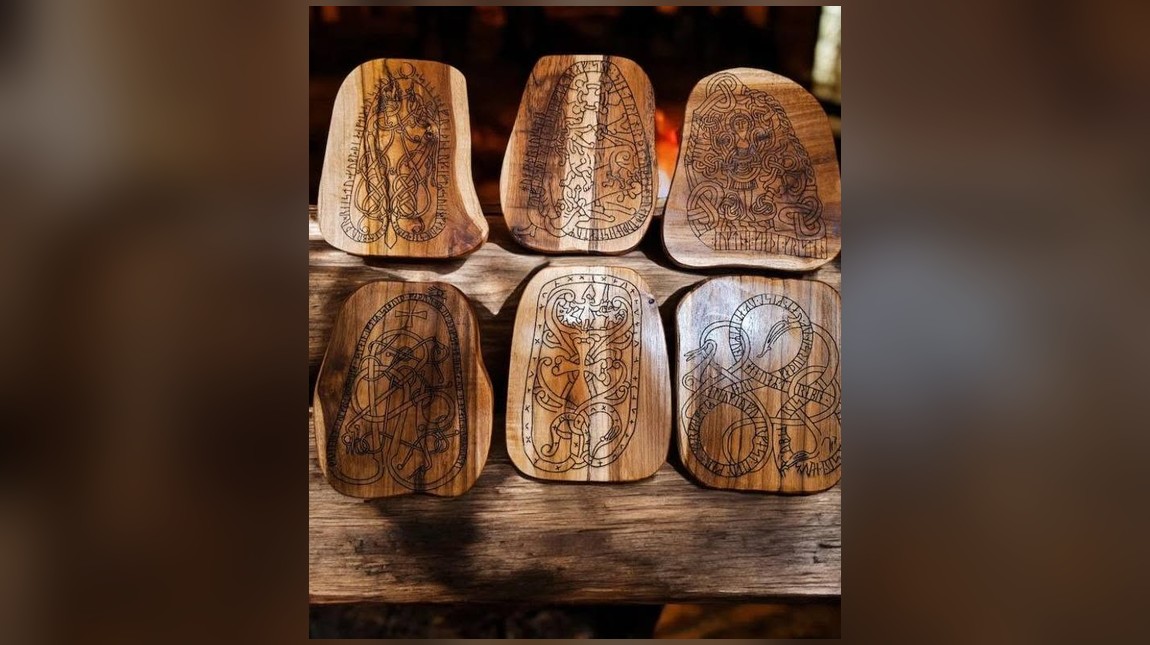
What the hammer meant can be pieced together quite well. In the eddic poem Þrymskviða, Mjölnir is laid in the lap of the supposed bride to hallow her. Rune stones such as Glavendrup in Denmark carry the formula “may Thor hallow these runes”, and on some stones, for example in Södermanland, a hammer is carved into the surface. Protection, blessing, consecration: that is the field of meaning the sources support. More on the god himself in our article on Thor.
Three interlocked triangles – the Valknut is one of the signs that genuinely appears in Viking Age and earlier imagery. On the Stora Hammars I picture stone and the Tängelgårda stone on Gotland it sits in scenes associated with death, sacrifice and Odin: warriors, a hanged man, birds, a rider. In the Oseberg ship burial (Norway, buried in 834) it is carved on a bedpost, and it has also been identified on textile fragments from the same grave. In England it turns up on a gold finger ring from the River Nene. We cover the Gotland stones in detail in our article on the picture stones of Gotland.
The problem is the name. “Valknut” – roughly “knot of the slain” – is a modern Norwegian coinage. What people in the Viking Age called the sign is unknown. A favourite comparison is Snorri’s description of the giant Hrungnir, whose heart was made of stone and three-cornered, like a carved sign called hrungnishjarta. Whether that is our Valknut is an attractive guess, nothing more.
Historian of religion Rudolf Simek considers a link to funerary ritual possible because of where the sign is found; Hilda Ellis Davidson connected it to Odin’s power to bind and loosen. Both are plausible. Neither is proven. Wear a Valknut and you wear a genuinely old sign with an open meaning and a modern name.
Strictly speaking, Yggdrasil is not a symbol at all but the world tree of Norse myth. The Völuspá calls it an ash, wet with white dew; the Grímnismál tells of three roots, an eagle in the crown, stags nibbling the branches and the dragon Níðhöggr gnawing below. In the thirteenth century Snorri shaped this into an orderly cosmos.
There is also a near-contemporary report worth knowing. Writing in the 1070s, Adam of Bremen mentions a huge evergreen tree beside the sanctuary at Uppsala. Whether it was meant as an earthly image of the world tree is debated. What we do not have is any Viking Age picture that certainly shows Yggdrasil. The popular design – a round tree with mirrored roots, often in knotwork – is a modern creation, inspired largely by Celtic “tree of life” designs.
For engraving, Yggdrasil is still a wonderful motif, especially for families, weddings and front doors. Just keep in mind: the myth is old, the picture is new. We look at the popular “nine worlds” in our Yggdrasil article.
Runes are the oldest writing of the North, and the topic where most things get mixed up. The Elder Futhark of 24 letters is attested from the second century AD, long before the Vikings. The Vikings themselves wrote with the Younger Futhark of only 16 letters, which took shape in the eighth century. So when a “Viking pendant” carries Algiz or Othala from the Elder Futhark, it is, strictly speaking, a few centuries early.
It is equally well established that runes were more than everyday writing. Formula words such as alu appear on amulets and gold bracteates of the Migration Period, and the hallowing formula “may Thor hallow these runes” shows that the script itself was thought to carry power. Today’s lists of meanings (“Algiz = protection”) go back to the medieval rune poems and modern reconstruction, though. Even the names of the elder runes are reconstructed rather than recorded.
Which runes suit protection, strength and courage, and how certain those meanings are, we have untangled in Runes for protection, strength and courage. If you want the basics first, start with Runes – an honest introduction.
Few animals are tied to Odin as closely as the raven. In the Grímnismál, Huginn and Muninn – “thought” and “memory” – fly over the world every day, and Odin worries that one of them will not come back. That is the Edda, so thirteenth century. But the raven is also well attested in archaeology, which makes it one of the strongest motifs you can choose.
Helmet plates of the Vendel period (sixth to eighth centuries) already show riders with spears accompanied by two birds. The tiny silver figure from Lejre in Denmark (about 900, found in 2009) shows a seated figure on a throne with a bird on each armrest. The excavator read it as Odin on Hliðskjálf; because the figure wears women’s dress, others suggest Freyja or Frigg. An honest open question. Beyond dispute are the silver pennies of the Viking king Anlaf Guthfrithson of York (939–941), which show a raven with spread wings.
Then there is the raven banner. The Anglo-Saxon Chronicle records for the year 878 the capture of a banner called “Raven”. Later English tradition embroiders the story – a banner woven by the daughters of Ragnar, on which the raven spread its wings before a victory. That embroidery is legend; the banner itself is a near-contemporary note.
We know the name of Odin’s spear, Gungnir, from the Eddas and from Snorri, who says it was forged by dwarves, the sons of Ívaldi. In the Völuspá Odin hurls his spear over the enemy host, and that throw starts the first war in the world. Saga literature knows the motif as a ritual: a spear cast over the enemy dedicates them to Odin. And in the Hávamál Odin hangs nine nights on the tree, “wounded with a spear”, to win the runes.
Archaeologically the spear is not as clear-cut an attribute of Odin as the hammer is of Thor, but the imagery fits: spear-bearers on Vendel-period helmet plates, riders with spears on Gotland picture stones. One thing to keep in mind: a spear on a Viking object is not a “Gungnir symbol” with a fixed meaning; first and foremost it is a weapon. As an engraving motif it still works well – for determination, for Odin’s resolve, for an oath taken all the way to the point.
The ship may be the Viking symbol par excellence, and rightly so. The great finds – Oseberg, Gokstad – show what Norse shipbuilding could do. The stem of the Oseberg ship ends in a spiralling serpent head, and the same grave held carved animal-head posts that rank among the finest woodwork of the age. More in our article on dragon ships.
No complete dragon head from a Viking warship has survived, though. The famous carved animal head dredged from the River Scheldt in Belgium, now in the British Museum, has been radiocarbon-dated to around the fourth to sixth centuries – well before the Vikings. We still know that Viking ships carried animal heads: from skaldic verse, from the word dreki (dragon) for large warships, from ships on picture stones and the Bayeux Tapestry. The Icelandic Landnámabók even preserves an old rule that heads were to be taken down before landfall so as not to frighten the land spirits.
If you really want to know how the Vikings decorated things, look past the single signs and at their ornament. The Norse animal styles are the best-attested “symbol” of the period – hundreds of brooches, mounts, wood carvings and rune stones carry them. Scholars distinguish six styles, named after find sites, with fluid transitions:
Exact dates vary by decades depending on the author; the sequence does not. Our article on Viking art styles walks you through them with examples, and we present the last great masterpiece in our piece on the Urnes portal. In our workshop, the animal styles are the most honest thing you can engrave: put an Urnes beast on slate and you carry a piece of real Viking art.
The triquetra, the three-cornered knot of interlaced arcs, tops many lists of Viking symbols. It is genuine – but its home is larger. In the Insular art of Britain and Ireland the interlace motif is common from the seventh century, in manuscripts such as the Book of Kells and on Anglo-Saxon coins of the eighth century. In Scandinavia it appears on rune stones, for example at Funbo in Uppland, and on a Norwegian penny of Harald Hardrada (1047–1066). The coinage of the Scandinavian kings of York also includes a triquetra type.
And the meaning? The familiar Christian reading as a sign of the Trinity is largely a product of the nineteenth century and the Celtic Revival; experts doubted it as early as around 1900. What people in the eighth or tenth century associated with it is unknown.
This is the delicate part, because these two signs are so often sold as “ancient Viking runes”. The Vegvísir, the “wayfinder”, is first attested in the Huld manuscript compiled by Geir Vigfússon in Akureyri in 1860. Its caption promises that whoever carries the sign will not lose their way in storms or bad weather, even when the way is unknown. No earlier source is known. Around 800 years separate the Viking Age from that record.
The Ægishjálmur, the “helm of awe”, is more complicated – and more interesting. The word is old: in the eddic Fáfnismál the dragon Fáfnir boasts that he wore the helm of terror to frighten everyone, and in the Völsunga saga Sigurd takes it from the hoard. But no drawn sign appears there; the helm is an object or a magical effect. The radiating signs that carry this name are known only from Icelandic books of magic from the early modern period.
These magical staves – Icelandic galdrastafir – are a fascinating chapter of their own: Christian, learned magic full of angels, Solomon and remnants of runes. They deserve respect as part of Iceland’s cultural history. Viking symbols they are not.
The svefnþorn, the “sleep thorn”, is a case much like the Ægishjálmur. In the Völsunga saga Odin pricks the valkyrie Brynhild with a sleep thorn and sends her into deep sleep, and other sagas know the motif too. That is genuine medieval tradition of the thirteenth and fourteenth centuries – but as a thing, not a sign. The glyphs circulating today as the “svefnþorn symbol” come from much later sources. We know of no Viking Age find showing that sign.
Sun motifs are often filed under “Norse symbols” as well. They are attested – but chiefly from the Bronze Age, some two thousand years before the Vikings, as the famous Trundholm sun chariot shows. There is no distinctive sun sign of the Viking Age in the finds, so we do not list sun motifs here as Viking symbols.
The troll cross, an iron ring crossed at the bottom, is marketed as “ancient Scandinavian protection against trolls”. In fact it was made as jewellery by the smith Kari Erlands from western Dalarna in Sweden in the late 1990s. She said she based it on a sign from her grandparents’ farm; that has never been verified, and there is reason to think the original was a house mark. Belief in trolls and in iron as protection, on the other hand, really is old in Scandinavian folklore.
The Web of Wyrd, a grid of nine lines said to “hide” every rune of the Elder Futhark, is younger still. The phrase goes back to Brian Bates’s novel The Way of Wyrd (1983); as far as we know, the sign itself first appears in 1993 on the cover of a rune-magic book by Jan Fries. The idea behind it, though, is old: Norns who spin and weave fate, and valkyries at the loom in the Darraðarljóð.
A sign from 1998 can mean as much to you as one from 998. What matters is that you choose it with open eyes – and that no seller tells you it is a thousand years old.
In our family workshop in Alsdorf, near Aachen, requests for Norse motifs land on the bench every day – on slate, wood and glass. Our experience: the best pieces happen when symbol and story match. A few rules of thumb from the workshop:
If you want historically attested Viking art, go for Thor’s hammer, the raven, the ship, the Valknut or an animal-style ornament. With hammers, a design based on a real find beats the fantasy version with a cross-guard and Celtic knots every time.
If you want a message, runes are ideal – but please in the right futhark and spelled correctly. For Viking Age accuracy the Younger Futhark is the choice; for well-known meanings such as Algiz, the Elder.
If you want a seafarer’s or protective feel, the Vegvísir is a strong motif, as long as you know it is an Icelandic magical stave. Many customers have exactly that added to the piece – it makes it richer, not poorer.
A detailed list of motifs with design tips is in Authentic Viking motifs for engraving and tattoos. And if you have your own design in mind, take a look at our custom engraving page.
Which Viking symbols are actually authentic? Well attested by Viking Age finds are Thor’s hammer, the Valknut, the raven, ship and dragon head, Younger Futhark runes, the animal styles and the triquetra. The Vegvísir, the Ægishjálmur as a sign, the troll cross and the Web of Wyrd are much later.
What does the Valknut mean? Nobody knows for certain. Because of where it appears – on picture stones and in the Oseberg grave – scholars link it to Odin, death and sacrifice; the name “Valknut” is modern.
Is the Vegvísir a Viking symbol? No. It is first recorded in an Icelandic manuscript of 1860 and belongs to the early modern Icelandic magical tradition.
What is the strongest Norse protection symbol? Historically the best attested is Thor’s hammer, worn as an amulet and linked on rune stones with hallowing formulas. Modern protective signs such as the troll cross or the Ægishjálmur have a different, younger history.
Which runes did the Vikings use? The Younger Futhark with 16 letters. The better-known Elder Futhark with 24 letters had long gone out of use by the Viking Age.
Is the triquetra Celtic or Norse? Both – and more. It appears in Insular, Anglo-Saxon and Scandinavian art; no single origin or fixed meaning can be pinned down.
For courage. For remembrance. For legends that live on.
Norse symbols: genuine or invented? · Thor’s hammer · Valknut · Vegvísir & Ægishjálmr · All symbol articles.
All History & Finds articles →
Without their ships the Vikings would never have become Vikings. The longship was the high technology of its time …
Read more →