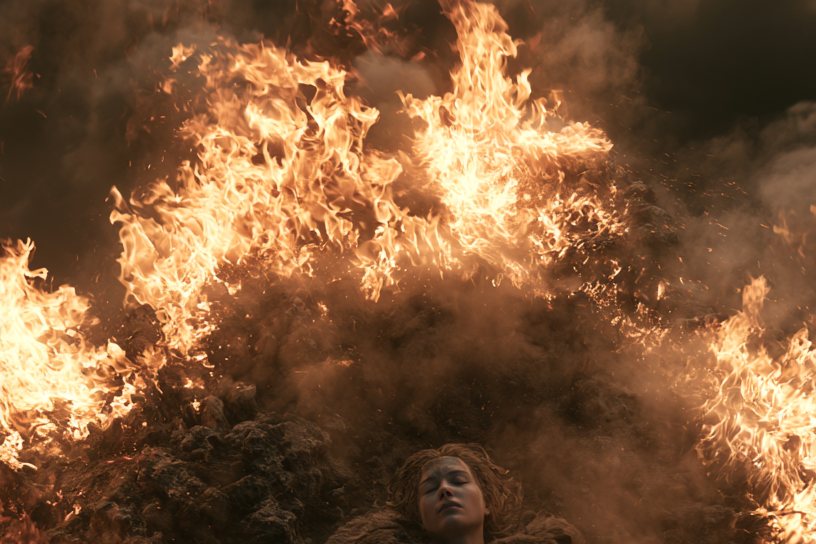
A single thorn – and even a valkyrie sleeps for years: the svefnþorn, the „sleep thorn," is one of the eeriest motifs of Norse literature. But beware: the graphic „Svefnthorn symbol" you see on tattoos today is younger than the sagas.
A sleep thorn plunges its victim into a deep, often years-long sleep from which they wake only when the thorn is removed. In the sources it is sometimes a literal thorn, sometimes a magical act – but always a tool of power over sleep and waking.
The most famous sleep-thorn story stands at the very beginning of the great Völsung saga. Its heroine is a valkyrie – called Sigrdrífa („victory-driver") in the Sigrdrífumál, identified with Brynhild in the Völsunga saga. Valkyries were Odin’s messengers on the battlefield: they chose who fell and who lived and led the slain to Valhalla. But Sigrdrífa made a choice of her own.
Two kings faced each other, old Hjálmgunnar and young Agnar. Odin had promised victory to Hjálmgunnar – but Sigrdrífa thought his cause unjust and let Agnar win instead. For a valkyrie that was treason against the Lord of the Slain. Odin pricked her with a sleep-thorn and passed a twofold sentence: never again would she ride victorious in battle, and she must be wedded to a mortal man. Sigrdrífa swore a counter-oath in reply – she would marry no man who knew how to be afraid.
“Odin pricked her with the sleep-thorn as punishment and said she should never again win in battle, but be given in marriage. She, however, vowed to take no man who could feel fear.”— after the prose intro to Sigrdrífumál / Völsunga saga (public domain)
So that her sleep would not be an easy prize, Odin ringed the sleeper with a blazing wall of fire (Old Norse vafrlogi, „flickering flame"). On the mountain Hindarfjall she lay in full armour, surrounded by shields and fire – for years, beyond the reach of anyone who flinched. The punishment thus became a test: only the fearless would find her.
That hero was Sigurd, the dragon-slayer. He rode through the flames, found the sleeping figure and at first took her for a fallen warrior – the armour had all but grown into her flesh. He cut the mail open with his sword, and the valkyrie woke. Her first words greet the powers of day: she hails the sun, the day and the sons of day, and gives thanks for waking. Then she teaches Sigurd rune-lore and wisdom for living – the finest verses of the Sigrdrífumál.
What begins as deliverance ends in ruin – and the sleep-thorn is the quiet trigger of the whole tragedy. Sigurd and Brynhild pledge their troth, but later Sigurd comes to the court of the Gjúkungs. Their sorceress mother Grímhild gives him a potion of forgetting; Sigurd forgets Brynhild and marries Gudrun. Worse: disguised in the shape of his brother-in-law Gunnar, he rides through the wall of fire a second time and wins Brynhild for another man. When the deceit comes out, Brynhild breaks over her broken oath. Out of pride and grief she drives Gunnar to have Sigurd killed – and then follows him into death on the pyre. The sleep-thorn was the first domino in a chain that ends in the downfall of an entire dynasty.
If this reminds you of Sleeping Beauty, you are not wrong: the sleeping woman behind a barrier (a hedge of thorns in the Brothers Grimm, a ring of fire here), woken by the fearless hero – scholars see in the Brynhild legend one of the oldest literary relatives of the fairy tale. Only the Norse original is anything but a happy ending.
The second great sleep-thorn scene has a very different, almost grimly comic flavour. In Göngu-Hrólfs saga („The Saga of Hrólf the Walker") the giant, good-natured hero Hrólfr serves at a king’s court. His false companion Vilhjálmr is an envious schemer. Once, while Hrólfr sleeps deeply, Vilhjálmr thrusts a svefnþorn into his head so that he cannot wake – and uses the chance to claim Hrólfr’s deeds and glory for himself and to blacken his name before the king.
The helpless Hrólfr lies as if dead. Only when his faithful horse comes up and rolls the motionless body about with its hooves does the thorn work loose and fall out – and Hrólfr wakes, just in time to expose the betrayal. Here the sleep-thorn is no divine punishment but a treacherous weapon: a way to remove a stronger opponent silently. And, as so often in the sagas, it is the loyalty of an animal that saves the hero.
The svefnþorn is no one-off. The motif recurs in Hrólfs saga kraka and other legendary sagas: a thorn or spell that forces a person into deep, helpless sleep. Sometimes punishment, sometimes trap, sometimes simply a tool of cunning magicians. What they share is this: sleep here is no harmless state but a border between life and death, crossed back only by an intervention from outside.
Here it gets sobering for symbol fans: in the medieval sources the sleep thorn has no fixed, drawn form. Sometimes it is a real thorn laid under the sleeper’s head or in their clothing, sometimes a pure act of magic, sometimes a prick. Not one of the old tales describes a graphic sign – a „logo" of sleep. The thorn works through the deed, not through an image.
The graphic sign circulating today on tattoos, posters and TV as the „Svefnthorn" – usually four staff-like lines with barbed ends – is a galdrastafur, an Icelandic magical stave. Its earliest tangible source is the Huld manuscript, compiled by the Icelander Geir Vigfússon in Akureyri in 1860 from older material (now in the National Library of Iceland, shelf-mark ÍB 383 4to). It gathers 30 such staves – including the best-known forms of the Vegvísir and the Ægishjálmur.
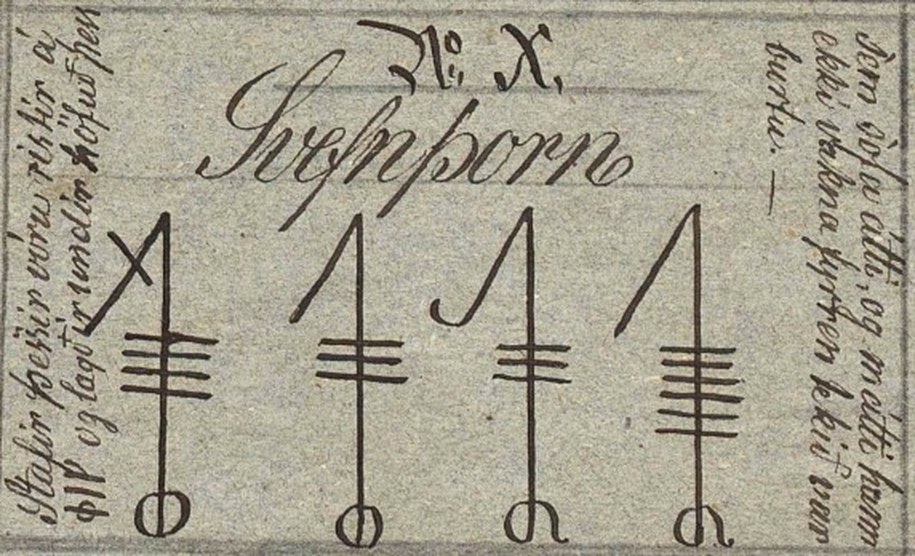
Of the sleep thorn it says, roughly: carve the sign on oak and lay it under the head of the one who is to sleep – then he will not wake until the stave is taken away again. It is a fine, clear instruction – but it comes from a 19th-century Icelandic spell-book bundling older, mostly post-Reformation traditions. With the runes and imagery of the Viking Age this line-drawing has nothing to do.
Sigurd & the Valkyrie · Valkyries · Valhalla · Odin · Real & invented symbols · Rune lexicon.
Sigrdrífumál, Fáfnismál (Poetic Edda), English public domain: Henry Adams Bellows (1923); Völsunga saga, Göngu-Hrólfs saga, Hrólfs saga kraka (Fornaldarsögur Norðurlanda). On the stave symbol: Huld manuscript (Geir Vigfússon, 1860, ÍB 383 4to, Landsbókasafn Íslands); scholarship on Icelandic galdrastafir. Rudolf Simek, Dictionary of Northern Mythology. Image: Wikimedia Commons (public domain).
They appear on T-shirts, tattoos, jewellery and in every second Viking TV series: the Vegvísir, the supposed „Viking …
Read more →Few images from the Viking Age are as disturbing as the „blood eagle": a ritual killing in which the victim's ribs were …
Read more →To some an ancient Germanic sun-sanctuary, to others a Christian place of pilgrimage – the Externsteine in the …
Read more →When thick flakes fall, people in many regions still say: „Frau Holle is shaking her beds." A harmless children’s …
Read more →