The sun wheel is one of humanity's oldest signs – around the world, since the Stone Age. Precisely for that reason, care is needed: two wheel-shaped symbols are marketed as “ancient and Germanic or Slavic” and are in truth neither. We get to the bottom of it – honestly and with evidence.
A word up front. We care about the genuine heritage of our ancestors – and precisely for that reason we separate things cleanly. The Nazi swastika and the far-right-appropriated signs – the Black Sun as a scene identifier, the modern Kolovrat as a political brand – we do not engrave. The ancient sun wheel in its genuine historical context, on the other hand – wheel crosses, runes, the sun symbols of the Bronze Age – belongs to human history and may be named and shown. This is not about bans, but about honest distinction.
The Black Sun – an SS creation
In origin, the “Black Sun” is not a Germanic sign but a floor ornament in the north tower of Wewelsburg castle. From 1935, Heinrich Himmler had the castle turned into an SS cult site; in the so-called Obergruppenführer hall a dark, wheel-shaped, twelve-spoked ornament was set into the marble floor. The work was carried out using concentration-camp forced labour.
Evidence – the geometry. The figure consists of twelve right-angled spokes and can be read as three superimposed, rotated swastikas or twelve Sig runes (3×4). It is a one-off design for Himmler with no attested ancient prototype. What the ornament was called during the Nazi era is not recorded – the SS demonstrably did not call it the “Black Sun”.
The name is a post-war myth. “Black Sun” arose only after 1945, in the right-esoteric circle around the former SS man Wilhelm Landig, spread in his “Thule” novels from 1971, and was expressly linked to the Wewelsburg floor only in 1991. The “ancient Germanic” or “Aryan” reading is therefore pure invention – an SS art object plus modern esotericism.
Today the Black Sun is an international identifying mark of the far-right and right-esoteric scene – often as a substitute for the swastika, which is illegal in Germany. The Anti-Defamation League lists it as a hate symbol; the Christchurch attacker (2019) displayed it openly on his manifesto and gear.
Legal status (Germany), carefully framed. Unlike the swastika, the Black Sun is not blanket-banned under § 86a of the Criminal Code; whether its use is punishable depends on context (for example as the mark of a banned organisation). Socially it is clearly ostracised as a far-right sign. This is not legal advice – when in doubt: hands off.
The Swastika: an ancient world symbol – before the abuse
To place the Black Sun, you have to understand the turning cross itself. It is one of the oldest and most widespread signs of humanity – invented independently in many cultures, long before the Nazis seized it in 1920 and poisoned it for the West for good.
Evidence – across the ages. A meander-like spiral pattern already adorns Ice-Age mammoth-ivory finds from Mezine (Ukraine, about 12,000 years old – whether a true swastika or a meander is disputed). It appears in the Neolithic Vinča culture, on Indus seals from Harappa and Mohenjo-Daro (c. 2500 BC), in the Greek meander or “Greek key” border and on Roman mosaics. The Sanskrit word svastika means roughly “conducive to well-being”; in Hinduism, Buddhism and Jainism it is a symbol of good fortune to this day.
The meander band (“Greek Key”) of Greek antiquity – the ornamental cousin of the turning cross: an endless, interlocking band as an emblem of eternity and the sun's course. An ancient, unpolitical motif.
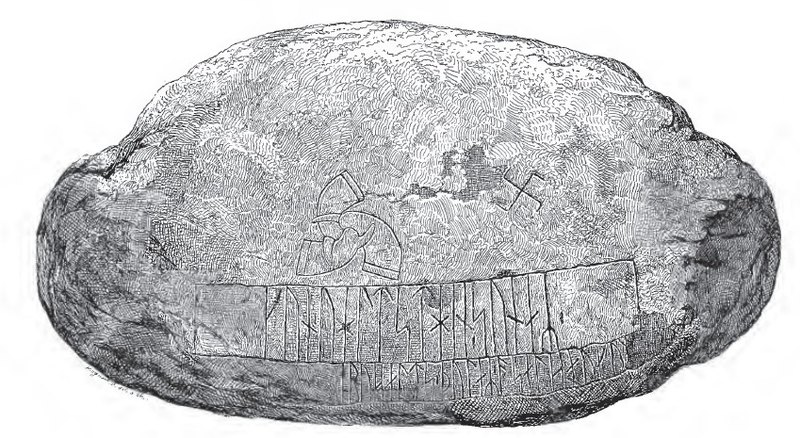
In the North and the Baltic too. In Latvian folk tradition the turning cross is called ugunskrusts (fire cross) or pērkonkrusts (thunder cross) and is woven deep into costume. And on genuine Germanic finds it appears as the “fylfot” – for instance on the Danish Snoldelev stone (9th c.) beside the three drinking horns, or on Anglo-Saxon cremation urns and brooches (often linked to the thunder god). In short: an ancient sun and good-luck sign – but not the twelve-spoked “Black Sun”, which never existed like that in antiquity.
The Danish Snoldelev stone (DR 248, 9th c.): beside runes and the triskele of three drinking horns it bears a fylfot (swastika) – a genuine, non-political sun and good-luck sign of the Viking Age. Drawing: George Stephens (1813–1895), public domain (Wikimedia Commons).
The Swastika and Thor
The swastika was linked especially closely to the thunder-god Thor. The scholar Hilda Ellis Davidson suggested the sign symbolised his hammer Mjölnir and the lightning; the term Þórshamar („Thor’s hammer") was later even transferred to the sun-wheel or swastika. A caution on dating: runologists such as MacLeod & Mees stress that this equation „Thor’s hammer = swastika" is in part only attestable in early-modern times – but the basic closeness to the thunder-god is old and well attested (fylfots on grave urns, brooches and rune-stones, often connected with Thor).
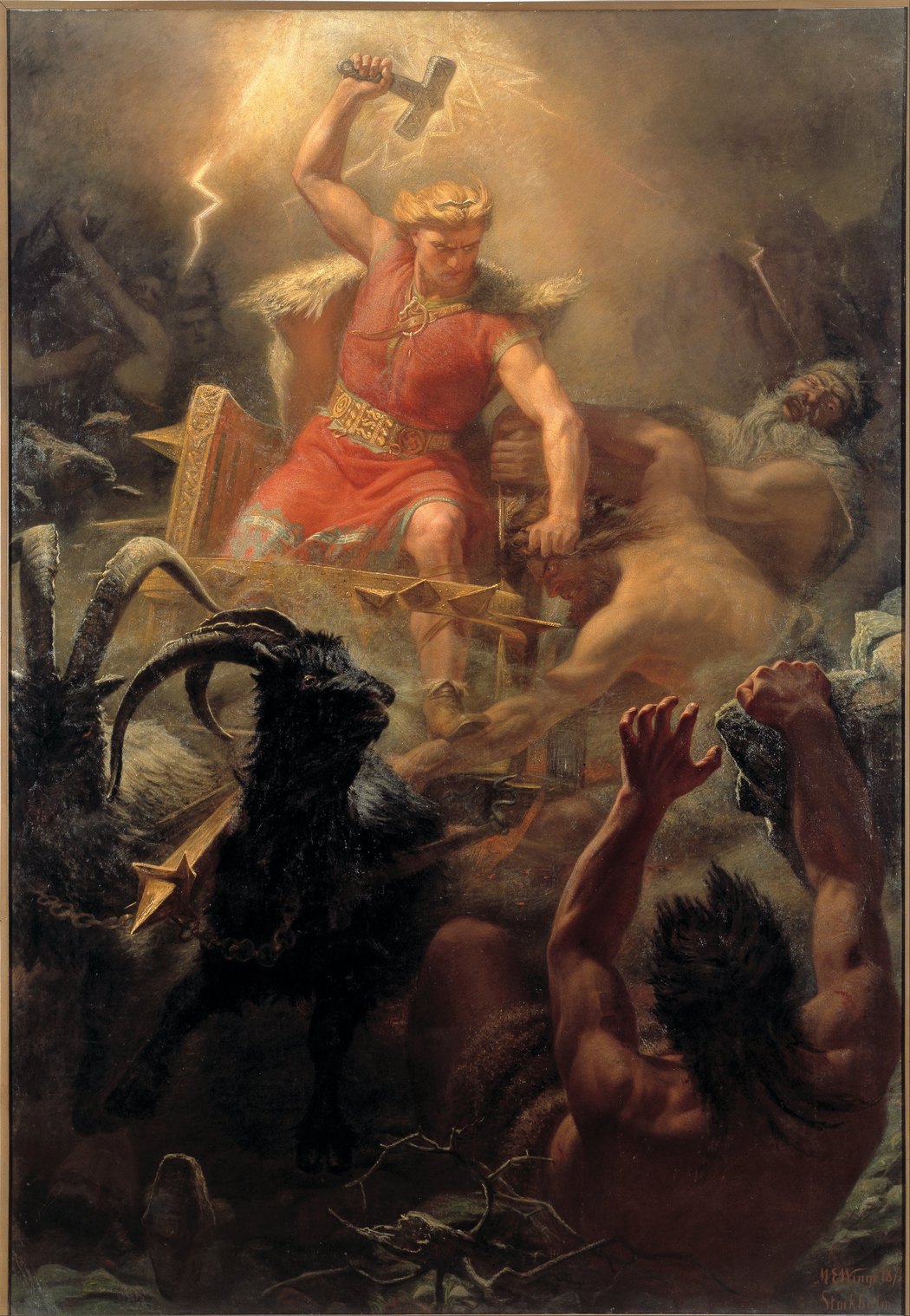
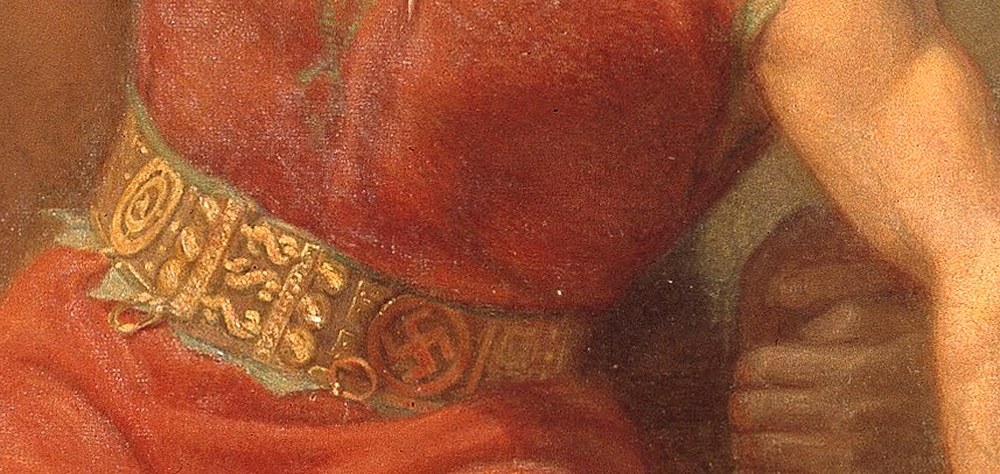
Mårten Eskil Winge, „Thor’s Fight with the Giants" (1872), Nationalmuseum Stockholm. Look closely at Thor’s belt – swastikas are worked into it. In 1872 this was a sign of the sun and good fortune; only later did extremists co-opt it. Painting: public domain (Wikimedia Commons).Detail of Thor’s belt of power Megingjörd: the swastika is clearly visible as a sun and thunder-god sign.
Finland: a blue swastika with no Nazi connection at all
How much older and more innocent the sign is than its darkest use is shown by a striking example: the Finnish Air Force carried a blue swastika as its national marking from 1918 – two years before the Nazi party and fifteen years before 1933.
Evidence. The sign was the personal good-luck symbol of the Swedish count Eric von Rosen, who in 1918 donated an aircraft bearing his blue swastika to the Finnish side. At the time it had no Nazi meaning whatsoever. Only in 2017–2020 did Finland remove the sign from its emblems – for diplomatic reasons towards allies, not because it had ever stood for National Socialism in Finland. A clean proof that a swastika is not the same as the Nazi swastika – the context makes the difference.
On the fylfot (swastika) in these images. The fylfot shown here – on the Snoldelev stone (9th c.) and on Thor’s belt in Winge’s 1872 painting – is a historical sun and good-luck sign, not a Nazi symbol. We show it solely for the purposes of science, research and teaching, and we expressly and unmistakably distance ourselves from any far-right, glorifying or trivialising use. This is exactly what § 86a of the German Criminal Code permits through its „social adequacy" clause (§ 86 (4)): art, science, research, teaching and civic education are allowed, provided the disapproving, educational purpose – as here – is clear. We do not show or engrave the Nazi swastika, the Black Sun or the modern political Kolovrat. This is not legal advice.
The Kolovrat – an old motif, a young cult
The Kolovrat (from kolo = wheel/circle + vrat = to turn; literally “the turning one”, historically also simply the spinning wheel) is a wheel-shaped sign, usually with eight bent or right-angled arms. In today’s Slavic native faith (Rodnovery) it stands for the eternal cycle of life, for light, power and the protection of the god Svarog. The key is to separate the motif (old) from its present-day meaning (young).
Evidence – the motif really is old. The multi-armed sun wheel is clearly a variant of the turning cross with more than four arms, and it appears sporadically across roughly three millennia of European material culture. The oldest known depictions come from ancient Greece, from Geometric pottery (900–700 BC) – terracottas from Thebes and amphorae with eight-armed, left-turning signs. Finds also come from regions once settled by the early Slavs – for the Czech lands, for instance, two ceramic finds from Zabrušany and the hillfort of Bílina, plus examples from Poland, Russia and Ukraine, and signs of this kind on medieval churches in Russia. Since much was worked in wood, which rarely survives, the record is thinner than one might expect.
But not “the” main Slavic symbol. In every epoch from which we know such wheels, the ordinary four-armed swastika was far more common; the doubling into the multi-armed “Kolovrat” can be read as an intensification of the same force, but stayed rare. So one cannot speak of a central ancient-Slavic sign – comparable to a fixed “Germanic sun wheel”: it was one of many symbols, always used for a purpose (for good weather, rich harvest, healthy cattle), recalling the eternal cycle of life and death. The Kolovrat became a main symbol only in the closing decades of the 20th century, in the reconstruction of Slavic paganism – a modern imagined emblem, not a handed-down one.
Political co-option – why we do not engrave it. Alongside the pagan use, the Kolovrat is heavily used by far-right and ultra-nationalist groups in Eastern Europe as a substitute swastika – from the Russian neo-Nazi band “Kolovrat” to “Russian National Unity” to paramilitary units; the Russian pagan Alexej “Dobroslav” Dobrovolsky even openly stressed its closeness to the Nazi swastika. At the same time: not everyone who wears the Kolovrat is a neo-Nazi – many non-political Rodnovery followers use it as a plain sun sign. But because the milieus overlap and the extremist use is so widespread, the symbol is heavily tainted today – which is why we do not engrave the modern political Kolovrat.
What genuine sun symbols look like
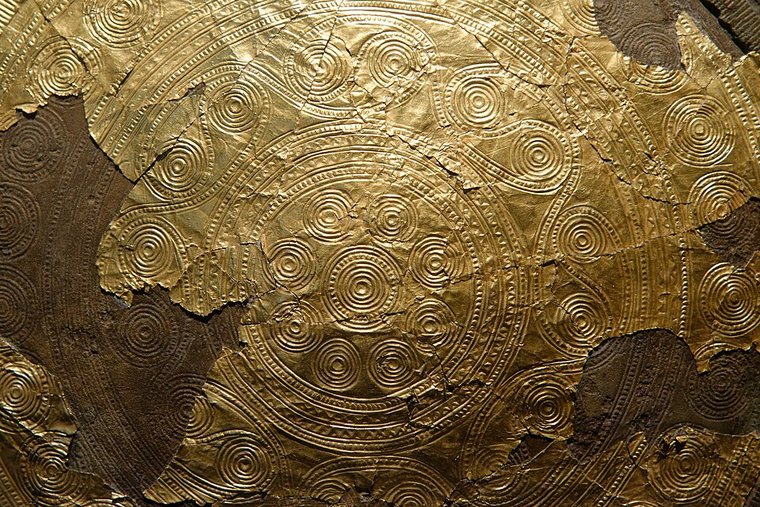
Sun wheels really do exist – and they are ancient and unpolitical. The Trundholm sun chariot (Denmark, c. 1400 BC, now in the National Museum of Denmark) shows a gilded sun disc on a wagon: a genuine testimony of Bronze-Age sun worship. The plain sun cross, too, is among the oldest symbols in Europe.
A genuine sun symbol: the Trundholm sun chariot (Nordic Bronze Age, c. 1400 BC), National Museum of Denmark. Image: public domain, via Wikimedia Commons.
The core point. The problem is not the ancient sun-wheel motif itself, but the modern political charging of certain forms. And to be clear: neither the twelve-spoked Black Sun nor the Kolovrat appears on genuine Viking or Germanic finds. Anyone selling them as “Norse” is telling a legend.
And the Runes? Sig and Othala
It is similar with individual runes. The Sig/Sowilo rune (as the SS double-bolt), the Othala/Odal rune and the Tyr rune were appropriated in the 20th century.
Important and often misunderstood. These runes are ancient and, in themselves, not banned. Their names are harmless: Sowilo means “sun”, Othala “inherited property / homeland”, Tyr is a god. Their use becomes punishable only in the context of their appropriation – as a mark of the Nazi regime or of an organisation banned today. Moreover, the Nazi reading (“Sig” = “victory”) does not come from the genuine tradition but from the invented “Armanen runes” of Guido von List around 1900. Anyone who knows the history knows the difference – and can tell a real sun rune from a political misuse.
This clarity is exactly what matters to us. We work with genuine Norse and Germanic imagery – runes, wheel crosses, sun chariots, historically attested motifs – because it belongs to the history of our ancestors. And we say honestly what is old, what was invented in modern times and what is politically tainted. More of it in our post on real and invented Viking symbols.
Where does the „Black Sun“ actually come from?
The so-called „Black Sun“ is a floor mosaic on the upper level of the north tower of Wewelsburg castle near Paderborn. It was laid in the 1930s and 1940s under the SS, who – at Heinrich Himmler’s instigation – sought to turn the castle into an ideological centre. The dark-green inlaid ornament with its twelve spokes was therefore created only in the 20th century, in the middle of the Nazi era.
This point matters: there is not a single archaeological find that documents such a symbol from Germanic or Viking-age times. It appears on no rune stone, no picture stone, no brooch, no coin, and in no written source. Even the name „Black Sun“ is a later term coined after the war – the SS did not call the mosaic that. The term only became popular in far-right and esoteric circles from the 1990s onwards.
Why it is not a Germanic symbol
At first glance the figure recalls sun-wheel and disc motifs that do genuinely occur in European prehistory. But the specific twelve-spoked form of Wewelsburg – three interlocked swastikas merged into a wheel – is a deliberate creation of the 20th century. It is not a tradition; it is a construction.
Linking this sign to an alleged „Aryan“ mythology is pure Nazi ideology. It served to give an inhuman worldview a seemingly ancient, sacred veneer. Anyone who today presents the „Black Sun“ as an „old Viking symbol“ – whether deliberately or out of ignorance – spreads a historical fabrication that far-right circles circulate quite intentionally, in order to replace banned or discredited symbols and make them socially acceptable.
Our stance
At Glanz & Gravur we work with real Norse and Germanic history and mythology – accurately, and with respect for the sources. That is exactly why this distinction matters to us: we reject symbols with a far-right context. We do not engrave the „Black Sun“, and we do not sell it. Full stop.
Anyone interested in genuinely attested Norse signs will find a whole world of real symbols with documented history with us: Thor’s hammer (Mjölnir) as a sign of protection and blessing, the Valknut associated with Odin and the fallen, or the runes of the Elder and Younger Futhark. These signs have a verifiable past – and you don’t need an invented history to find them beautiful and meaningful.
Frequently asked questions
Is the „Black Sun“ a Viking symbol?
No. It is a floor mosaic from the Nazi era and has nothing to do with the Vikings or the pre-Christian Germanic peoples. There is no historical find that documents such a symbol before the 20th century.
Is the „Black Sun“ banned in Germany?
We can’t and won’t give a legally binding answer here – this is not legal advice. What is clear: the symbol is regarded as an identifying sign of far-right circles and is monitored accordingly by German security authorities. Depending on context, combination and intent, its use can be legally relevant. When in doubt: leave it alone.
What real Norse sun symbols are there?
Genuinely old examples include the Bronze Age sun wheels and the Trundholm sun chariot, as well as ornamental discs and gold bracteates with sun motifs. These finds are truly documented – entirely without the ideological baggage of the 20th century. Anyone looking for a sun motif with an honest history will find it here.
Sources & Evidence
Kreismuseum Wewelsburg – history of the north-tower ornament; the term “Black Sun” as a post-war coinage (Landig circle, from 1971 literary, Wewelsburg link from 1991); N. Goodrick-Clarke, Black Sun (2002).
Anti-Defamation League (ADL), Hate Symbols Database, “Sonnenrad/Black Sun”; German Federal Office for the Protection of the Constitution, brochure on far-right symbols (2022).
US Holocaust Memorial Museum, “History of the Swastika”; Britannica – the swastika as an ancient, worldwide good-luck symbol; Mezine (Ukraine), Vinča signs, Indus seals (Harappa/Mohenjo-Daro).
Snoldelev stone (DR 248, 9th c.) – fylfot beside the drinking-horn triskele; Anglo-Saxon fylfot finds. Latvian ugunskrusts/pērkonkrusts.
Finnish Air Force (Ilmavoimat) – blue swastika from 1918, origin Eric von Rosen, removal 2017–2020 (Wikipedia “Finnish Air Force”, “Eric von Rosen”).
Kolovrat – motif & find record: Z. Váňa, Mythology and Gods of the Slavic Peoples (1992) & The World of the Ancient Slavs (1996); A. Buko, The Archaeology of Early Medieval Poland (2008); P. J. Šafařík, Slawische Alterthümer (1843/44); D. Kushnir, Slavic Light Symbols (2014); M. Handwerg, Die slawischen Götter in Pommern und Rügen (2010); P. Grimal (ed.), Mythen der Völker (1967). Greek Geometric pottery (900–700 BC); ceramic finds Zabrušany & Bílina. Modern meaning & political use: Rodnovery scholarship (e.g. K. Aitamurto); Reporting Radicalism; Projekt Forlǫg (Vlasatý).
National Museum of Denmark – the Trundholm sun chariot. § 86a and § 86(4) of the German Criminal Code (gesetze-im-internet.de); Federal Court of Justice, 15 March 2007 (3 StR 486/06).
Note: this article serves education and demarcation. It is not legal advice; the criminal liability of individual depictions depends on context.