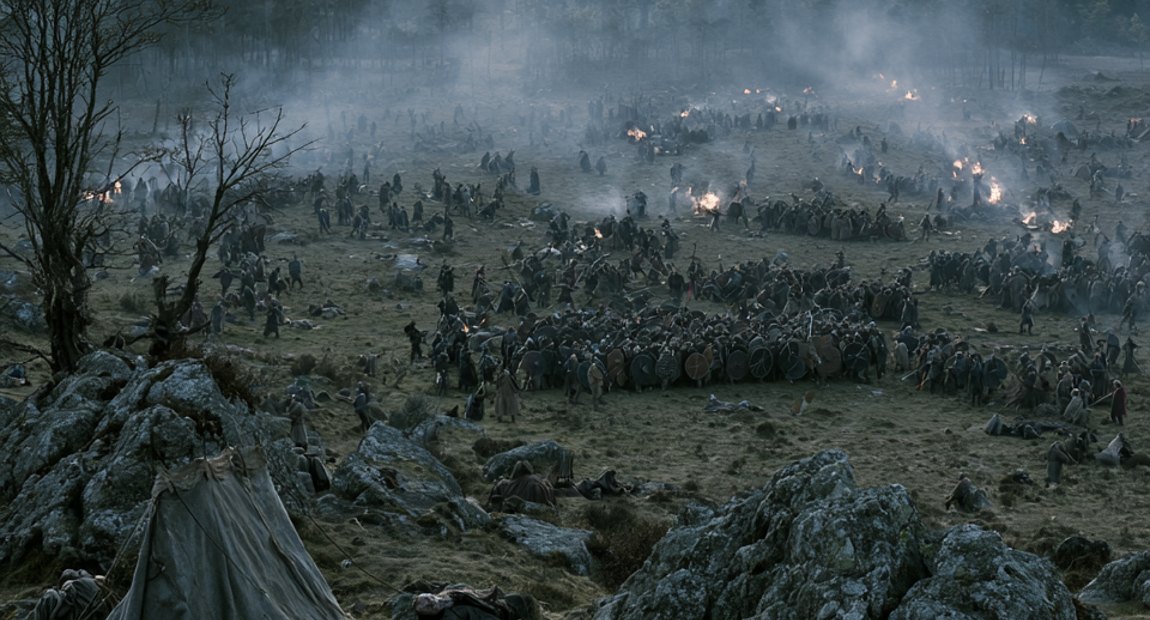
Few images of the Viking Age disturb like the “blood eagle”: the victim’s ribs supposedly severed from the spine and the lungs pulled out through the back like two wings. The closer you read the sources, the thinner the whole thing gets. The earliest evidence is an ambiguous skaldic verse of the eleventh century, the ritual description appears in sagas of the thirteenth and fourteenth, and since 1984 scholars have argued over whether a real execution lies behind it or a poetic image taken literally. A sober source check, without sensationalism.
The best-known version runs like this: to avenge their father’s death, the sons of Ragnar Lothbrok capture the Northumbrian king Ælla. Their brother Ivar has the “blood eagle” (Old Norse blóðörn) cut into him. The ribs are severed at the spine and bent outward, the lungs drawn through the open back until they lie apart like an eagle’s wings. In some tellings salt is rubbed into the wound. The procedure appears in only a few texts, and it always falls on defeated enemies of high rank.
The image is vivid, bloody and unforgettable. That is exactly the problem: a scene remembered so well is seldom checked for how old its source is and what it really says. We take the evidence in chronological order, from the event through the first verses to the sagas.
King Ælla ruled Northumbria from about 862 or 863 and died on 21 March 867 at York. His ancestry is unknown; one source calls him the brother of Osberht. Most accounts portray him as a tyrant and an illegitimate king, and Symeon of Durham accuses him of seizing church land. That is the enemies’ side. The Great Heathen Army, which landed in England in 865, took York in November 866. In the attempt to retake the city, according to the Anglo-Saxon accounts, Ælla and Osberht fell.
The Anglo-Saxon Chronicle records that both kings died in battle. There is no mention of an execution. The Danes then installed a puppet king named Ecgberht.
“… and both the kings were slain on the spot.”Anglo-Saxon Chronicle, entry for 867, after a public-domain English translation (rendering our own)
That is the only contemporary report. It comes from the camp of the Vikings’ opponents, who elsewhere do not keep quiet about Danish violence. Silence proves nothing, but a ritual on this scale might well have been noticed. Norse sources tell a different story: Ælla threw Ragnar Lothbrok into a snake pit, and Ragnar’s sons killed him for it. Ragnar himself is regarded by most scholars as a figure of legend; his sons, by contrast, are historical.
To place the blood eagle, the sources must be separated by age and genre. There are three layers.
The later the layer, the more precise the description. For a real event that would be odd: memory fades over time, it does not sharpen. For a literary elaboration it is the rule.
The oldest evidence comes from the Knútsdrápa of the skald Sigvatr Þórðarson. Sigvatr lived from about 995 to 1045, served Olaf Haraldsson, Cnut the Great and other kings, and with some 160 surviving verses is better attested than any other poet of his time. He was a Christian and, scholars note, mostly avoided pagan mythology. The Knútsdrápa was composed between 1020 and 1038, a good 150 years after 867. The exact date of the verse is unknown. A source problem adds to it: like almost all skaldic verse, this one is known only from manuscripts made centuries later.
“And Ívarr, who dwelt at York, had the eagle carved on Ælla’s back.”Sigvatr Þórðarson, Knútsdrápa (11th c.), prose translation after a public-domain edition
Not a word here of severed ribs or lungs. Literally, the line says only that an eagle is at work on the back of the slain man, or that the eagle is cut into the dead man. The verb rista means “to cut, to carve.” Take it literally and you read a ritual. Know the imagery of the skalds and you read something else.
Skaldic poetry works with kennings, coded circumlocutions. “Blood” became the “dew of wounds”, the sword a “serpent’s tongue”, the warrior a “feeder of the eagle” because on the battlefield he nourishes the carrion birds. In this system an eagle on a dead man’s back is a perfectly familiar image: the man fell, and the birds came. Tear such a line out of its imagery and read it as an action, and “the eagle hacks him” becomes “an eagle is carved into him.” At this seam, many scholars suspect, the ritual was born.
The Old Norse scholar Roberta Frank worked this out in 1984 in her essay “Viking Atrocity and Skaldic Verse: The Rite of the Blood-Eagle”, published in the English Historical Review. Her thesis: the saga writers misread ambiguous verses about leaving enemies lying face down, with the eagle feeding on the back, and recast them as a ritual. She links the elaborated details – ribs, lungs, salt – to Christian martyrdom accounts such as the tortures of Saint Sebastian. That is no proof, but it is a connection that explains why the image developed so drastically.
The elaborated version appears in saga prose. Best known is the Orkneyinga saga, whose lost original dates to the late twelfth century and whose surviving form comes from the early thirteenth, probably by an unknown Icelander. It tells of Torf-Einarr, an earl of Orkney, who had Hálfdan Háleggr (“Long-leg”), a son of Harald Fairhair, killed. Hálfdan had killed Einarr’s father Rögnvald and driven Einarr out of Orkney. Later Einarr caught him on North Ronaldsay. In the saga, Hálfdan is given the blood eagle as an offering to Odin: Einarr “gave him to Odin for his victory.” In Snorri’s Heimskringla, Einarr carries out the deed himself.
What the older verses say about the same event is telling. Five stanzas are attributed to Einarr and survive in the Landnámabók. Older skaldic verses describe Hálfdan dying under a volley of spears. Scholars suspect the saga writers added the blood eagle later, perhaps prompted by the eagle that appears in the verses as a carrion bird. Here is a case in which the step from stanza to saga can be watched directly.
Ívarr and Ælla appear in the Ragnarssona þáttr, the “Tale of Ragnar’s Sons”, a prose work of the thirteenth or fourteenth century. There Ivar avenges his father by having Ælla executed. Saxo Grammaticus, in his Gesta Danorum of around 1200, describes an eagle carved on a captive’s back, followed by rubbing salt into the wounds. The heroic tales around Sigurd contain, in the Reginsmál, an oblique allusion to the death of Lyngvi Hundingsson, and the Nornagests þáttr of the early fourteenth century describes the deed more fully. What they share: the elaboration is late, and the victims are kings or kings’ sons.
The source base for Ragnar and his sons is difficult anyway. The main sources are the Saga of Ragnar Lothbrok, the Tale of Ragnar’s Sons, Saxo’s Gesta Danorum and the death-song Krákumál. Scholars regard the stories about Ragnar as largely fictional, while Ivar, Halfdan, Björn, Ubba and Sigurd are considered historical. A Viking leader named Reginherus, who besieged Paris in 845, has been proposed as a model for Ragnar; the identification is disputed. More on these figures in our article on Ragnar’s sons.
The religious reading – the blood eagle as a human sacrifice to Odin – stands only in the late sagas. The Orkneyinga saga names Odin explicitly. At first glance the link looks coherent: Odin is the god of the slain, his ravens Huginn and Muninn fly over battlefields, and the eagle belongs to the carrion-bird repertoire beside the raven (see The Raven in the North). But that is interpretation, not the transmission of a contemporary cult.
The historian Alfred Smyth argued in the 1970s that the blood eagle was real, a human sacrifice to Odin. Ronald Hutton in 1991, by contrast, called it “almost certainly a Christian myth” arising from a misreading of older verse. Bjarni Einarsson and Frank carried the quarrel on in articles in Saga-Book in 1988 and 1990. The dispute is instructive because both sides know the same few sources and still reach opposite conclusions.
A myth check stays honest only if it names the other side too. Murphy, Fuller, Willan and Gates published a study in Speculum in 2022 that tested the procedure from a medical-anatomical point of view. It takes no position on whether the ritual ever happened. The authors found it neither inconsistent with physiology nor with the tools of the Viking Age, and that in the most extreme versions the victim would probably have died within seconds.
The limit of that statement matters: that something is anatomically possible does not prove it happened. Feasibility is not historical evidence. The study neither refutes Frank nor supports Smyth; it only keeps the possibility open. The debate therefore remains undecided.
Real men stand behind the revenge story. Ivar the Boneless died around 873 (the Annals of Ulster and the Fragmentary Annals of Ireland give 873, Æthelweard’s chronicle 870). He is often identified with Ímar, a Viking king of Dublin between 870 and 873 and ancestor of the Uí Ímair. As a leader of the Great Army he took York in 867; in 869 he returned with Ubba to East Anglia, where King Edmund fell. His nickname is unexplained. Some sagas speak of a bone disease, others of impotence, the Ragnar tale of a curse. One theory holds that a scribe misread the Latin exosus, “the hated”, as ex os, “without bone.” A burial mound found at Repton in 1686 has been suggested as his possible resting place.
The Anglo-Saxon sources name Halfdan, Ivar and Ubba as leaders of the army. That they were brothers and sons of Ragnar appears only in later sources; the Chronicle mentions just three sons taking part in the campaign. The army pushed into Mercia in 867 (Nottingham), conquered East Anglia in 869 and settled in Northumbria and the Danelaw. Alfred the Great paid the Vikings off in 871 and defeated them at Edington in 878. More on the brothers at Ivar the Boneless and Halfdan Ragnarsson.
To see how the same era looked on the lower Rhine, read our article on Vikings in Aachen. No blood eagle appears there, and the Frankish reports mention no such ritual either. That too is a finding: the period knew violence in plenty, and the sources describe it without this image.
To see why an eagle on a dead man’s back was nothing mysterious to poets and listeners, look at another poem. In the Haraldskvæði, also called Hrafnsmál (“Raven Song”), a valkyrie and a raven converse about the king and his warriors, who won the battle of Hafrsfjord around 880. The poem, attributed to the skald Þorbjǫrn hornklofi, survives only in fragments quoted in kings’ sagas of the thirteenth century. The raven in it is no ornament but witness and beneficiary of the battle. More on this poem in our article on berserkers.
This stock – raven, wolf, eagle – belonged to the language of battle description. Whoever praised a victory said he had sated the birds. “To give the eagle the back” could mean: to kill the enemy and leave him lying. That a metaphor of this kind was read a century later as an instruction for torture presupposes that the imagery was no longer familiar. That is exactly what Frank assumes.
One trap should be avoided: the opposing position can also appeal to texts. Some scholars point out that the motif turns up in several texts that appear independent – Torf-Einarr, Ælla, Lyngvi – and that a cluster does not necessarily indicate a mere misunderstanding. The objection is not to be dismissed. It depends, however, on the texts really being independent, and for works from the same Icelandic milieu of the thirteenth century that is hard to show.
Laid side by side, the texts make the growth almost visible. In the verse of the Knútsdrápa there is an eagle carved on the back, nothing more. Around 1200 Saxo adds the rubbing in of salt. The younger sagas bring ribs, lungs and the wing shape, plus names, places and a religious frame. Every layer adds something the previous one does not know. With a real practice you would expect early testimony to name details that later ones forget. Here it runs the other way.
That proves nothing about truth, but it is a pattern literary scholars know from many traditions: a terse formula becomes a motif, then a scene, finally a story with a logic of its own. As an observation it is more sober and more solid than any claim that the ritual existed or never did.
The Norse sources tie the blood eagle to a motif of revenge. In the saga Ragnar Lothbrok falls into the hands of King Ælla, who has him thrown into a snake pit. The death-song Krákumál puts verses into his mouth at the point of death that charge his sons with vengeance. From this starting point the story develops: the killer of the father must die a death that matches the crime and impresses the audience. Snake pit and blood eagle belong together in this logic; both are literarily effective, and both lack a counter-testimony.
This is no accusation against the saga writers. They wrote stories, not court records. A thirteenth-century narrator was free to heighten a scene as the victim’s rank and the guilt of the deed demanded. Read the saga as a protocol and you ask too much of the genre. For the question of what a king like Ælla actually suffered in 867, it yields nothing that can be checked.
Places can be assigned to the Great Army: the Viking burials at Repton and Heath Wood are linked with it, and the mound found at Repton in 1686 has been proposed as a possible resting place of Ivar. Those are traces of presence, not of violence against individual captives. We know of no find that scholarship cites as evidence for a blood eagle. That does not exclude the ritual, but it means the dispute hangs on texts alone and cannot so far be decided by finds.
For the texts, what we state in our myth checks again and again applies: the fewer the counter-testimonies, the more carefully one must formulate. The blood eagle is therefore a teaching case. It shows how a single verse can become a fixed notion over centuries.
The chronology shows there was no consensus over decades, only a shifting majority. Anyone claiming that “science” has refuted or confirmed the blood eagle oversimplifies. What is accurate: the critical reading is widespread today, but not uncontested.
Three things feed the myth. First, the skalds, who left a dark, ambiguous line. Second, the saga writers of the high Middle Ages, who shaped a striking scene from it: revenge, regicide, an enemy who dies particularly horribly. And third, popular culture. The television series Vikings anchored the blood eagle in the public mind in a lavish scene and turned Ælla into a fictionalised figure. Ælla has a long literary afterlife: he appears in Chaucer’s Man of Law’s Tale, in the 1958 film The Vikings, in Bernard Cornwell’s Last Kingdom novels and in the series Vikings, where he is fictionalised and placed about 70 years too early. Each version takes from the blood eagle what it needs dramatically. How the series uses historical traces and where it simply invents is covered in our fact check of the series “Vikings”.
None of this makes the subject less interesting. It shows how Norse tradition actually works: as a web of poetry, late writing-down and modern interpretation. The same holds for the shield wall and the berserker: the picture in the head is often older and louder than the evidence.
Anyone checking a source can ask three questions, and the blood eagle is a good place to practise them. First: how far is the source from the event? Between 867 and the Orkneyinga saga lie a good three centuries, and to the Ragnarssona þáttr more still. Second: what genre is it? Skaldic verses are imagery, sagas are storytelling, chronicles are memory with intent. Third: is there an independent witness? For the blood eagle there is none, neither a find nor a second eyewitness.
It does not follow that “this never happened.” It follows only that we cannot document it. The honest formula is that such a deed lies within the realm of the possible, that it rests on no reliable source, and that the sagas paint a picture whose origin more likely lies in the imagery of the skalds.
At Glanz & Gravur we engrave motifs from the Viking world in natural slate, wood and glass, to your template. The eagle, raven and wolf as animals of the battlefield are an attested stock of skaldic imagery; a ritual that scholarship cannot secure we do not depict as fact. If you want to preserve a motif of your own or a line from the Edda, our custom engraving is the place.
What is the blood eagle? An alleged Viking execution ritual in which the victim’s ribs were supposedly severed from the spine and the lungs laid outward. The sources for it are late and in part ambiguous.
When is it first mentioned? The oldest evidence is a verse in the Knútsdrápa of Sigvatr Þórðarson, composed between 1020 and 1038, a good 150 years after Ælla’s death in 867.
Was King Ælla really killed this way? The Anglo-Saxon Chronicle says Ælla and Osberht fell in battle at York. The blood-eagle ritual appears only in Norse sources of the thirteenth and fourteenth centuries.
What does Roberta Frank say? In her 1984 essay she argues that the blood eagle is a misunderstanding of ambiguous skaldic verses that originally spoke only of the carrion eagle on the fallen.
Is the blood eagle anatomically possible? A study in Speculum (2022) found it neither inconsistent with physiology nor with the tools of the time. That does not prove it was ever carried out.
Was the blood eagle offered to Odin? The Orkneyinga saga claims so in the thirteenth century. A contemporary witness for such a cult is lacking.
For courage. For remembrance. For legends that live on.
Ragnar Lodbrok · Ragnar's sons · The Great Heathen Army · Berserkers · The shield wall.
To some an ancient Germanic sun-sanctuary, to others a Christian place of pilgrimage – the Externsteine in the …
Read more →When thick flakes fall, people in many regions still say: „Frau Holle is shaking her beds." A harmless children’s …
Read more →Friday – the finest working day carries a goddess’s name. But whose? Some swear by Freya, others by Frigg. The answer …
Read more →Most people know the Brothers Grimm as the two kindly gentlemen behind Little Red Riding Hood and Cinderella. But that …
Read more →