England had known raids since Lindisfarne in 793. Raiders came by ship, took what they could carry and were gone before a levy could be raised. In the autumn of 865 something different landed in East Anglia: an army that demanded horses, wintered in the country and did not leave for thirteen years. By the end, three of the four Anglo-Saxon kingdoms had fallen and warriors had become farmers. What we really know about this army comes from a single chronicle – and, for some years now, from the ground.
The Anglo-Saxon Chronicle is terse. Under the year now usually reckoned as 865 it notes that a great heathen army came to East Anglia, took winter quarters there, and that the East Angles made peace and gave it horses. The Old English words are micel hæþen here, and they gave the army its modern name.
The name should not be overrated. The chroniclers did not use it as a title; in the entries that follow the host is mostly just se here, the army. Who these people were, where exactly they came from, what they called themselves – the Chronicle does not say. It describes what the army did, seen from the side of those it struck.
Three things set 865 apart. The army stayed over winter. It moved overland on horseback and used the great rivers as roads rather than striking only at the coast. And it went for kingdoms, not monasteries. Within a few years Northumbria, East Anglia and Mercia had fallen; only Wessex held.
Why such an army came at that moment is stated in no source. Historians offer plausible reasons: the English kingdoms were at odds with one another, Northumbria was in the middle of a succession dispute, and across the Channel the Frankish realm was beginning in the 860s to defend its rivers against Viking fleets. These are interpretations, not evidence – but they fit together.
The route can be traced year by year, because the Chronicle almost always notes where the army wintered. From East Anglia it moved north in 866 and took York in late autumn. In March 867 the two rival kings of Northumbria, Osberht and Ælla, tried to retake the city; both were killed.
In 868 the army was at Nottingham, in the heart of Mercia. King Burgred called on Wessex, the brothers Æthelred and Alfred came, there was a siege – and in the end a peace. In 869 the army returned to East Anglia and King Edmund was killed. That he was tied to a tree, shot with arrows and that a wolf guarded his head is told only by Abbo of Fleury's saint's life a century later. The Chronicle simply says he fell.
In 870 the army turned on Wessex. From Reading it fought the battle of Ashdown in early 871, where the Chronicle names two of its kings, Bagsecg and Halfdan; Bagsecg was killed. In April King Æthelred of Wessex died and his brother Alfred became king. That same year a second host arrived from overseas, which the Chronicle calls the great summer army.
The winter camps of the following years are the places being excavated today: London in 871–2, Torksey on the Trent in 872–3, Repton in 873–4. At Repton King Burgred of Mercia fled to Rome and the army installed Ceolwulf in his place, a king by its grace.
The Chronicle gives names but no hierarchy. For 871 it names the kings Bagsecg and Halfdan and several jarls; for 875 Guthrum, Oscetel and Anwend. Under 878 it mentions a brother "of Ivar and Halfdan" who was killed in Devon with twenty-three ships. So Ivar is present in the Chronicle itself, and that he and Halfdan were brothers is not a saga invention.
What the Chronicle does not give is a father. Around 1075 Adam of Bremen names an Inguar filius Lodparchi, Ivar son of Lodbrok. The full story arrives only with the Icelandic narratives of the thirteenth century: the sons of Ragnar sailed to England to avenge their father, whom King Ælla had thrown into a snake pit. It is a great story. It is also two to three centuries younger than the army, and no ninth-century source knows it. More on that under Ragnar Lodbrok.
For a long time the Great Army was purely a matter of texts. Metal detectorists changed that. Over some twenty years around seventy of them searched the fields north of Torksey in Lincolnshire, reported their finds and had them plotted. Dawn Hadley and Julian Richards analysed the material and published it in 2016.
The camp of the winter of 872–3 covered some 55 hectares on rising ground by the Trent. The count stands at 1,572 early medieval finds, among them 124 Arabic silver coins, dirhams – the largest concentration from any site in the British Isles – sixty pieces of hacksilver, well over three hundred weights and 289 lead gaming pieces, besides forty Anglo-Saxon silver pennies and more than 170 Northumbrian copper coins.
The picture is not a camp in the narrow sense. Silver was weighed, traded, melted and gambled away. There was craftwork, and very probably there were women and children. The army was a moving settlement with a market.
This has been argued since the 1960s. Peter Sawyer thought such armies small, hundreds rather than thousands; Nicholas Brooks disagreed. The Chronicle gives no figures for this army.
Torksey has not settled the debate, but it has shifted it. A camp of that size sits badly with a few hundred men. Hadley and Richards reckon cautiously: if a fleet numbered fifty to a hundred ships and each carried thirty to fifty warriors, an army of 1,500 to 5,000 is not implausible. A reasoned range is all there is.
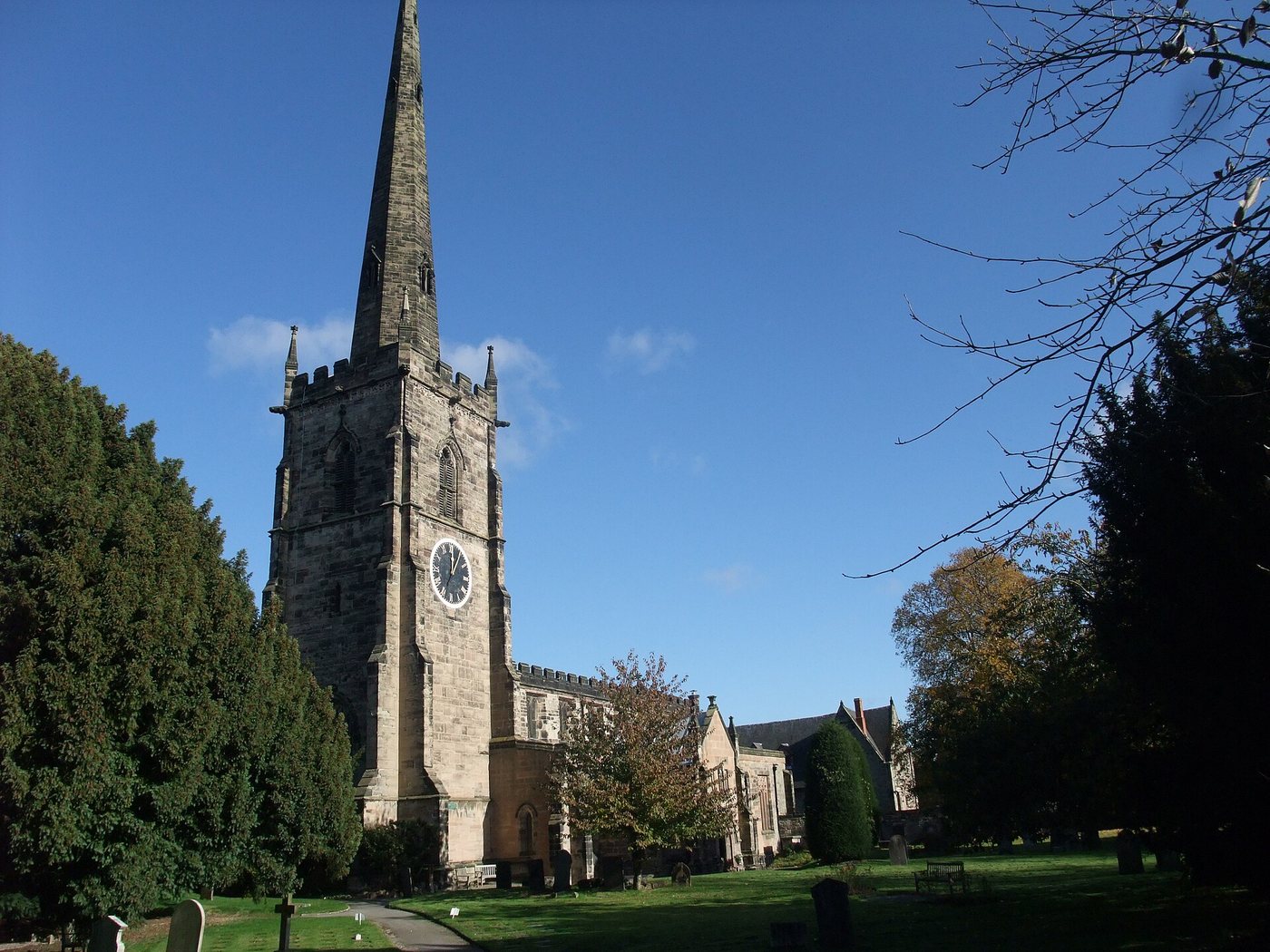
In the winter of 873–4 the army lay at Repton on the Trent, one of the great places of Mercia, with the church of Saint Wystan and a crypt in which Mercian kings were buried. Martin Biddle and Birthe Kjølbye-Biddle excavated there between 1974 and 1988. They read a D-shaped ditch that incorporated the church as the army's defence, with the church serving as a gatehouse.
Beside the church lay grave 511: a man with a sword of Petersen type M and a silver Thor's hammer pendant. Isotope analysis shows he grew up in a region consistent with southern Scandinavia.
Better known is another find. Under a mound in the vicarage garden lay the bones of at least 264 people, mostly men between 18 and 45. Radiocarbon dates from the 1990s scattered oddly, some pointing to the seventh or eighth century. In 2018 Catrine Jarman and colleagues showed why: the marine reservoir effect. People who eat a lot of fish take up old carbon from the sea, and in the laboratory their bones look older than they are. Once corrected, all the dates fit a single event in the late ninth century, consistent with 872–874.
A few kilometres away, at Heath Wood, lies the only known Scandinavian cremation cemetery in Britain, with 59 mounds. A strontium study of 2023 on human and animal remains produced a mixed picture: one adult and one child had grown up locally, but another adult came from the Baltic Shield region – Norway or central and northern Sweden – and with him a horse and a dog. The army brought its animals across the North Sea.
After Repton the army split. Halfdan went north, and under 876 the Chronicle has what may be the most important sentence of the whole story: Halfdan shared out the land of the Northumbrians, and they were ploughing and providing for themselves. Warriors had become landholders.
Guthrum took the other part south. In 878 he surprised Alfred in midwinter at Chippenham; Alfred withdrew into the marshes of Athelney, raised a levy and defeated Guthrum in May at Edington. Guthrum was baptised, took the name Æthelstan and around 880 settled with his people in East Anglia. The lands where parts of the army settled later became the Danelaw – a chapter we tell in an article of its own.
Contemporary evidence is the chronology of the Anglo-Saxon Chronicle, compiled under Alfred around 890 – from a West Saxon point of view, which one has to keep in mind – together with Asser's life of Alfred of 893 and Æthelweard's chronicle of the late tenth century.
Archaeological evidence is the camps at Torksey and Repton, the cemetery at Heath Wood and the Scandinavian origin of some of the dead, their horses and their dogs.
Later tradition is Edmund's martyrdom with arrows and wolf, the father Lodbrok in Adam of Bremen, and the revenge for Ragnar with its snake pit in the sagas of the thirteenth century.
Modern interpretation covers the reasons for the timing, the size of the army and, not least, the image television has painted of it.
What remains is big enough without the saga: an army that came to stay and changed the map of England for good. For courage. For memory. For legends that live on.
Ivar the Boneless · Ragnar's sons · Alfred the Great · Ragnar Lodbrok · The Danelaw · The England Voyagers · Erik Bloodaxe · The Vikings in Ireland, Scotland & the Isles.
All History & Finds articles →
The name says it all: Gudme means „home of the gods". On the Danish island of Funen lay one of the richest cult and …
Read more →They are so small and so thin that you can barely hold one without creasing it: the guldgubber, “gold men,” tiny …
Read more →In 1891 peat-cutters in a bog near Gundestrup in Jutland struck something metallic: a dismantled cauldron of pure …
Read more →
