Drive through Lincolnshire today and the road signs read Grimsby, Scunthorpe, Kirkby, Ingoldmells. That is neither chance nor fashion. It is the imprint of a land-taking that began more than eleven hundred years ago, when an army decided to stop moving on. Warriors became farmers, winter camps became villages, plunder became property. We call the area where they lived the Danelaw. The word, though, is a good century younger than the thing – and the thing was never as uniform as the maps in school textbooks suggest.
The story begins with three terse entries in the Anglo-Saxon Chronicle. Under 876 it says that Halfdan shared out the land of the Northumbrians, "and they were ploughing and providing for themselves". Under 877 part of the army went into Mercia, shared out some of it and left the rest to King Ceolwulf. And under 880 Guthrum's army went into East Anglia, "settled that land and shared it out".
These men came from the Great Heathen Army, which had landed in 865 and marched through England for thirteen years. Now they settled down. So there was not one Danelaw but several areas of settlement with their own lords: the kingdom around York, the district around the towns of the east Midlands, and Guthrum's realm in East Anglia. What linked them was the origin of the new elite, not a common government.
Guthrum had been defeated by Alfred at Edington in 878 and had accepted baptism. At some point between 878 and Guthrum's death in 890 the two made a treaty that survives in Old English in a manuscript at Corpus Christi College, Cambridge. Many place it after 886, when Alfred occupied London. It opens with the border:
Ærest ymb ure landgemæra: up on Temese, ond þonne up on Ligan, ond andlang Ligan oð hire æwylm, þonne on gerihte to Bedanforda, ðonne up on Usan oð Wætlingastræt.
"First concerning our boundaries: up the Thames, and then up the Lea, and along the Lea to its source, then straight to Bedford, then up the Ouse to Watling Street."Treaty of Alfred and Guthrum, ch. 1; English rendering our own
That is the border with East Anglia, not with the whole later Danelaw. The treaty then turns to practicalities: a slain Englishman and a slain Dane of equal rank are worth the same, eight half-marks of refined gold. Anyone wishing to trade horses, cattle or slaves across the border must give hostages. A peace treaty, then, written for living side by side.
"Danelaw" means "law of the Danes". As a phrase, Dena lage appears only after the year 1000, in the legal texts that Archbishop Wulfstan of York drafted for Kings Æthelred and Cnut. There it stands beside Engla lage and Myrcna lage, the law of the English and of the Mercians. It meant a legal area, not a state, and its border was probably never precisely drawn.
What that law looked like is shown by a code of King Æthelred issued at Wantage around 997. It applies explicitly to the Five Boroughs and is full of Norse loanwords. Its court districts are called wapentakes, from Old Norse vápnatak, the clash of weapons with which an assembly signalled assent. And it requires that in each wapentake the twelve leading thegns swear not to accuse any innocent man nor conceal any guilty one. Wapentakes survived into modern times in Yorkshire, Lincolnshire, Nottinghamshire, Derbyshire and Leicestershire. More on Norse legal custom in our article on the Thing.
At the heart of the Danelaw lay five fortified places: Derby, Leicester, Lincoln, Nottingham and Stamford. Even the name Derby is Norse, a -by place that replaced an older English name.
The reconquest began under Alfred's children. In 917 Æthelflæd, Lady of the Mercians, took Derby. In the same year her brother Edward the Elder stormed the fortress at Tempsford, where the last Danish king of East Anglia fell, and took Colchester. In 918 Leicester submitted to Æthelflæd, and Stamford and Nottingham fell to Edward. After Æthelflæd's death in June 918 Edward took Mercia into his own hands. Under 920 the Chronicle reports that at Bakewell the Scots, the Northumbrians and all who lived in Northumbria submitted to him, "English and Danes and Norsemen and others". Whether that was true submission or an alliance between equals is debated.
Around 940 Olaf Guthfrithsson, king of Dublin and York, took the Five Boroughs back. In 942 King Edmund reconquered them, and the Chronicle celebrates the event with a short poem. It contains the sentence that explains the Danelaw of the tenth century:
Dæne wæran æror under Norðmannum nyde gebegde on hæþenra hæfteclommum lange þrage …
"The Danes had before been forcibly bowed under the Norsemen, in the fetters of the heathens, for a long time …"Anglo-Saxon Chronicle s.a. 942, "The Capture of the Five Boroughs"; English rendering our own
Here the Danes of the Five Boroughs are no longer the enemy but the liberated. The heathens are the Norsemen from Dublin. Two generations after the settlement, the descendants of the Great Army counted as Christians and subjects of the English king. In 954 Erik Bloodaxe, the last Scandinavian king of York, lost his throne.
The most lasting trace is the place-names. -by means farm or village, -thorpe usually a smaller, dependent settlement. Grimsby, Whitby, Selby, Scunthorpe, Kirkby: they crowd together in Yorkshire, Lincolnshire and the east Midlands and grow rare further south. Around two thirds of the -by names contain a Norse personal name. Then there are hybrids such as Grimston, a Norse name joined to English -tūn.
How many people stood behind these names is the old dispute. Peter Sawyer thought the settlers few; Kenneth Cameron and others read a large immigration into the density of names. A place-name does not count heads. It shows who owned the land and whose language was spoken there.
The language has left traces to this day. The English pronouns they, them and their come from Norse, as do words like law, sky and window. The Danelaw changed not only the map but the grammar.
When William the Conqueror had Domesday Book record in 1086 who held which land, one group stood out: the sokemen. They were personally free and could sell their land, but owed a lord suit of court and certain services. In the counties of the Danelaw, above all Lincolnshire and East Anglia, they made up a large part of the rural population – by common estimates between a third and a half.
Frank Stenton saw in them the descendants of the rank and file of the Great Army, settled as free farmers. That is an attractive interpretation, but an interpretation. Two hundred years separate 880 from 1086, and free peasants existed elsewhere too. The sokemen show that society in eastern England was built differently. Why remains open.
The coins are more solid. Soon after 880 Guthrum struck pennies in East Anglia on Alfred's model – under his baptismal name Æthelstan. From the 890s pennies honouring Saint Edmund circulated in East Anglia – the king the Great Army had killed in 869. The descendants of his killers paid in his name.
At York, kings with the Norse names Cnut and Siefredus had silver struck around 900 that was no worse than the money of the south. Later came pennies in the name of Saint Peter, some bearing a sword. Erik Bloodaxe also put a sword on his coins.
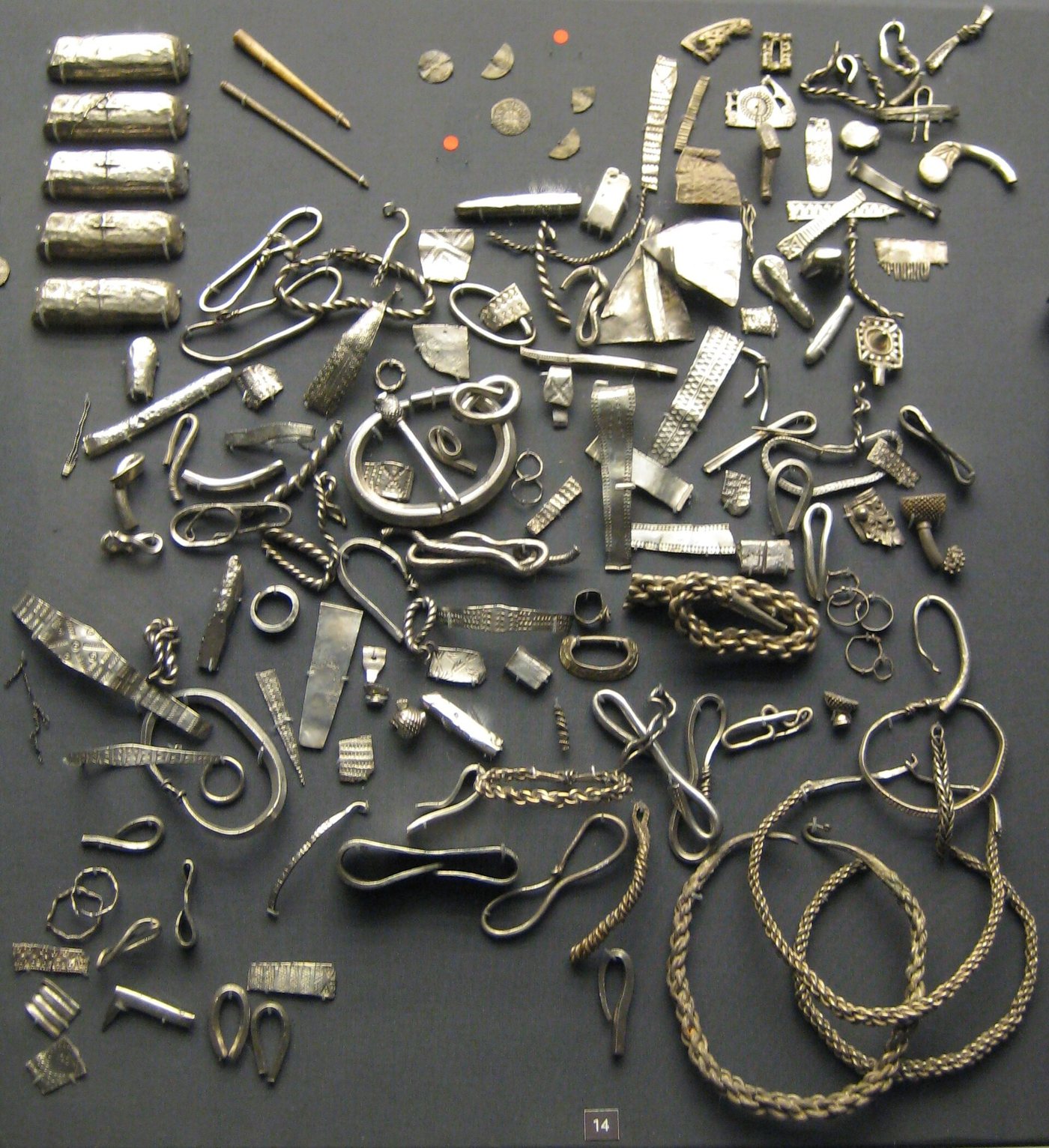
How much silver was in circulation is shown by the Cuerdale hoard. On 15 May 1840 workmen on the bank of the Ribble near Preston in Lancashire came upon a lead chest holding some 40 kilograms of silver: about 7,500 coins and around a thousand ingots, ornaments and pieces of hacksilver, more than 8,600 objects in all. The latest coins date its burial to around 905. Among them were issues from York and East Anglia, some 1,800 St Edmund pennies, coins of Alfred, Frankish and Arabic pieces. The hoard is often linked to the Vikings expelled from Dublin in 902. That cannot be proved. Either way it is a window into the world of the Danelaw Danes.
For a long time the rule was: the settlers were men who married local women. Archaeology has corrected that. Over the last few decades metal detectorists have found more than 500 Scandinavian brooches and pendants from women's dress, dated roughly 870 to 950. Jane Kershaw has analysed them: they cluster in rural Norfolk and Lincolnshire. That points to women of Scandinavian origin or upbringing in considerable numbers.
And the genes? In 2015 the "People of the British Isles" project published a fine-grained genetic map of Britain in Nature. Stephen Leslie and his colleagues found a Norwegian share of about a quarter in Orkney, but for the Danelaw "no clear genetic evidence" of the Danish occupation. This is often shortened to "the Vikings left no trace". That is not what it says. The authors themselves stress that Danish and Anglo-Saxon input can hardly be told apart, because both came from neighbouring regions. In 2016 Jane Kershaw and Ellen Røyrvik argued that part of the supposedly Anglo-Saxon signal could be Danish as well. The last word has not been spoken.
Contemporary evidence is the settlements of 876, 877 and 880 in the Anglo-Saxon Chronicle, the treaty of Alfred and Guthrum, the reconquest of 917–918, the Five Boroughs in the poem under 942, and Æthelred's Wantage code of around 997.
Archaeological evidence is the coinage of East Anglia and York, the Cuerdale hoard and the Scandinavian-style women's brooches.
Later evidence is the term Dena lage after 1000 and the sokemen of Domesday Book in 1086.
Modern interpretation covers the number of settlers, the sokemen as descendants of warriors and the reading of the genetics.
The Danelaw was not a Danish land wrested from England, nor a Victorian fairy tale. It was a region where incomers and locals ploughed the same fields for a few generations until they could hardly be told apart. For courage. For memory. For legends that live on.
The Great Heathen Army · Alfred the Great · Erik Bloodaxe · Cnut the Great · The England Voyagers · The Ostmen · The Vikings in Ireland, Scotland & the Isles.

