Before the Vikings, Ireland had no towns. It had monasteries, royal seats and ringforts, but no place where thousands lived packed together off trade. The first were built by people who had come to plunder. A ship camp on the Liffey became Dublin, other camps became Waterford and Limerick. Three hundred years later the English called the descendants of those founders "Ostmen". By then they spoke Irish, went to church and struck their own coins. They were no longer Vikings. But they were not quite Irish either.
Under the year 841 the Annals of Ulster record a longphort at Duiblinn. The word means a fortified base where ships could be hauled ashore and kept over winter. From there, the annals say, Leinster and the Uí Néill were plundered far inland. The same entry names a second such camp, Linn Duachaill on the coast of what is now County Louth. The raids that had struck the coastal monasteries since 795 now had fixed bases.
Duiblinn means "black pool": a basin where the small River Poddle met the Liffey, a natural harbour. Close by lay Áth Cliath, the "ford of hurdles", still the Irish name of the city. Where exactly the first camp stood is unresolved. At Kilmainham and Islandbridge, some three kilometres west, numerous graves with swords, spears and shield bosses have come to light since the nineteenth century; the cemetery is regarded as the largest of the Viking Age outside Scandinavia. Further warrior graves at Ship Street and South Great George's Street lie closer to the later town.
It was not a foregone conclusion. In 902 the kings of Leinster and Brega drove the foreigners out of Dublin. Only in 917 did a fleet return under Sihtric Cáech, of the line of Ímar, and from then on Dublin stayed under Scandinavian rule. The founding generation around Olaf the White has an article of its own; the wider picture is in our overview of the Vikings in Ireland, Scotland and the Isles.
The return after 902 did not start in Dublin but in the south. Under 914 the Annals of Ulster report a great new fleet of heathens on Loch Dá Chaech, the estuary at Waterford. It was led first by a jarl called Ottir, then by Ragnall, a grandson of Ímar. In Old Norse Waterford is Veðrafjǫrðr, usually read as "wether fjord". The spot was not new: a Viking camp in the area is attested as early as the 850s. In 2003 archaeologists building the Waterford bypass found such a camp of the ninth and tenth centuries at Woodstown, with a richly furnished warrior grave. The road was moved and the site left in the ground.
At Limerick, Old Norse Hlymrekr, Vikings appear in the annals as early as 845. Permanent settlement began in 922, when a leader named Tomrair mac Ailchi brought a fleet up the Shannon. Limerick immediately became Dublin's rival; the two Viking towns fought each other until 937. Independence ended from the Irish side: in 967 Mathgamain, Brian Boru's elder brother, defeated the foreigners of Limerick at Sulcoit and burned the town. Ten years later Brian killed Limerick's last Viking king, Ivar. The town survived and became the seat of kings from Brian's family.
Besides the big three there were Wexford and Cork. None of these towns was ever a Viking state in the sense of a realm of its own. They were ports with a hinterland, living off trade and tribute – and they quickly learned to bargain with Irish kings rather than merely fight them.
What Dublin was in the tenth and eleventh centuries we know today not from chronicles but from the mud of the Liffey bank. Between 1962 and 1981 the National Museum of Ireland excavated in the old town: first under Breandán Ó Ríordáin at High Street, Winetavern Street and Christchurch Place, then under Patrick Wallace at Wood Quay and Fishamble Street. The wet, airless ground had preserved wood, leather, textiles and plant remains that would have rotted anywhere else.
The result: more than two hundred houses, mostly post-and-wattle, with fences, paths and waterfront revetments. The town was divided into rectangular plots whose boundaries barely moved over generations. The commonest house had a three-part interior with a central hearth and benches along the long walls. There were quarters for antler comb-makers, for non-ferrous metalworkers, for woodcarvers. Lead weights follow a Dublin ounce of about 26.6 grams. Add amber, silk, walrus ivory, English brooches, runes on bone and antler.
The dig had a sequel every older Dubliner remembers. The city wanted to build offices on the site. In September 1978 some 20,000 people marched through Dublin under the banner "Save Wood Quay"; in 1979 protesters occupied the site for three weeks, and the High Court for a time declared it a national monument. The offices were built anyway. The Civic Offices have stood on the Viking town since 1986. The finds are in the National Museum.
Scholars now usually call these townspeople Hiberno-Norse or Hiberno-Scandinavian. That is a modern convenience, not a name they used. The Irish annals speak of the Gaill, the foreigners, and more precisely of the "foreigners of Áth Cliath". The English "Ostmen" goes back to Old Norse austmenn, men from the east – that is, from Scandinavia.
How mixed these towns already were in the tenth century shows in a single life. Olaf Cuarán, king of Dublin and at times of York, bore a Norse name with an Irish nickname, married into Irish royal families and was a Christian. In 980 he lost the battle of Tara to the high king Máel Sechnaill and withdrew to the monastery of Iona, where he died. His grandchildren bore Irish and Norse names side by side. The language of the street was probably long since bilingual, that of the church Latin. The annals had already known an earlier mixed group in the ninth century: the Gall-Goídil. Vikings in the proper sense – men on a voyage, out for loot – these townsmen were not. They were traders, craftsmen, sailors and mercenaries who hired out their fleets to Irish kings.
Around 997 something happened in Dublin that Ireland had never seen: a king had coins struck. Sihtric Silkbeard, son of Olaf Cuarán, copied the English penny of King Æthelred II, the so-called Crux type, and put his own name on it.
+SIHTRC REX DYFLIN
"Sihtric, king of Dublin"Legend of the first Dublin pennies, c. 997, in varying spellings; our rendering
The coins weighed about one to one and a half grams and followed English models for decades. Some moneyers' names are copied from English pieces, and the spelling of Dublin wanders wildly. The Hiberno-Norse coinage ran on, ever lighter and cruder, into the twelfth century. For Dublin it meant above all one thing: the town thought in silver, not in cattle like the countryside around it. More on paying by weight under hacksilver.
The same Sihtric went on pilgrimage to Rome in 1028. Around that time Dublin gained a bishopric and its first Christ Church. The heart of a town that had once been a raiders' camp was now a cathedral.
In Irish schoolbooks of the nineteenth and early twentieth centuries the matter was simple: on Good Friday, 23 April 1014, Brian Boru defeated the Vikings at Clontarf and freed Ireland. Brian fell, but the foreigners were broken.
The evidence is less convenient. On one side stood Brian with Munster and his allies. On the other stood Máel Mórda, king of Leinster, rebelling against Brian's overlordship, together with Dublin and auxiliaries from the islands, among them Earl Sigurd of Orkney. It was in large part an Irish war for supremacy, with Norsemen on both sides. According to the Irish annals Sihtric himself did not fight but stayed in the town.
And the Vikings were not driven out. Sihtric ruled Dublin for more than twenty years after 1014, went on striking coins and endowed his church. The picture of a war of liberation comes chiefly from the Cogad Gáedel re Gallaib, "The War of the Irish with the Foreigners", a narrative of the early twelfth century written to glorify Brian's descendants. More on the battle itself in our article on Clontarf 1014.
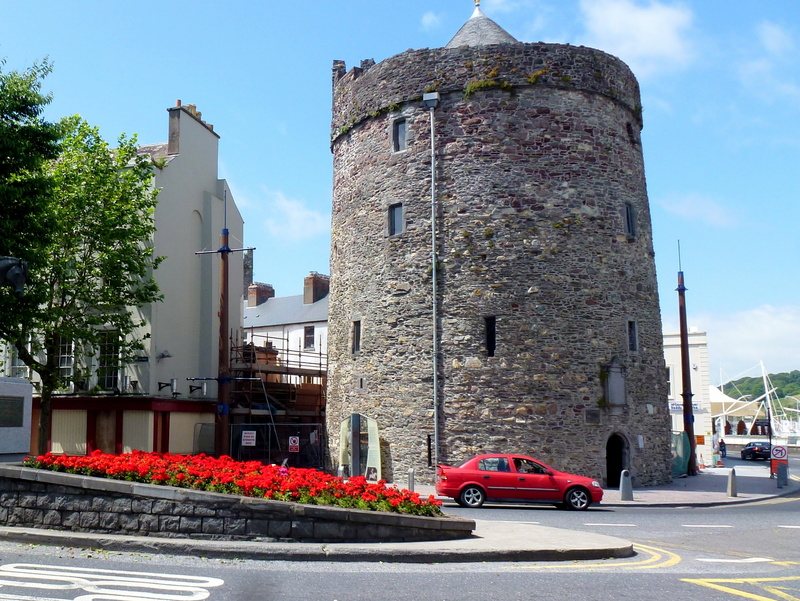
The end of the Ostman towns came neither from Scandinavia nor from the Irish hinterland, but from Wales. The exiled king Diarmait Mac Murchada of Leinster called in Anglo-Norman knights; the first landed in 1169. In August 1170 Richard de Clare, known as Strongbow, stormed Waterford. According to the Anglo-Norman accounts, the town's leaders held out in a tower they call turris Reginaldi, Ragnall's tower. Today's Reginald's Tower on the same spot still bears the name, but is later. Soon afterwards, in Waterford, Strongbow married Diarmait's daughter Aoife.
On 21 September 1170 Dublin fell. The last Hiberno-Norse king, Ascall mac Ragnaill, escaped by ship to the northern isles. In 1171 he returned with a fleet from the isles and from Norway and attacked the east gate. The attack failed; Ascall was captured and beheaded. In October 1171 King Henry II landed near Waterford. Dublin became an English royal town, which the king granted to men of Bristol to settle.
Only now does the history of the word begin. In English charters and court records of the twelfth to fourteenth centuries the descendants of the town founders are called Ostmanni, Ostmen. They counted as a group of their own, neither English nor Irish, and that had real consequences. An Ostman could claim English law. An Irishman, as a rule, could not.
In Dublin the Ostmen moved – by choice or under pressure – to the north bank of the Liffey. The settlement was called Ostmaneby or Ostmantown. It survives as the district of Oxmantown, a name hardly anyone now connects with Scandinavians.
What the status was worth shows in a case from 1311. A certain Robert le Waleys stood trial for killing a man called Eóin Mac Gilla Muire. He admitted the deed but denied it was a crime: the dead man, he said, was Irish. The other side argued that the Mac Gilla Muire family belonged to the Ostmen of Waterford, to whom Henry II had granted English law and Edward I had confirmed it. How the case ended is not recorded. But it shows that around 1300 "Ostman" was a legal category worth fighting over in court. Over the thirteenth and fourteenth centuries the Ostmen merged into the English town population, and the word dropped out of the records.
Contemporary evidence covers the camps of 841, the expulsion of 902, the fleets of 914 and 922, the wars between the towns and the battle of 1014 – from the Irish annals, written from the point of view of monasteries and Irish kings. For 1169 to 1171 Gerald of Wales writes from the side of the conquerors.
Archaeological evidence is the graves of Kilmainham and Islandbridge, the town under Wood Quay with its houses, plots and workshops, the camp at Woodstown and Sihtric's coins.
Later tradition is the image of Clontarf as a battle of liberation, which goes back mainly to the twelfth-century Cogad Gáedel re Gallaib and to the Icelandic Njáls saga.
Modern interpretation covers terms like "Hiberno-Norse" and the question of how Irish the Ostmen already were by 1100. That their towns stayed when their kings went is no interpretation. Dublin, Waterford and Limerick are still there. For courage. For memory. For legends that live on.
Olaf the White · The Vikings in Ireland, Scotland & the Isles · The Gall-Goídil · The Earls of Orkney · The Danelaw · Erik Bloodaxe.

