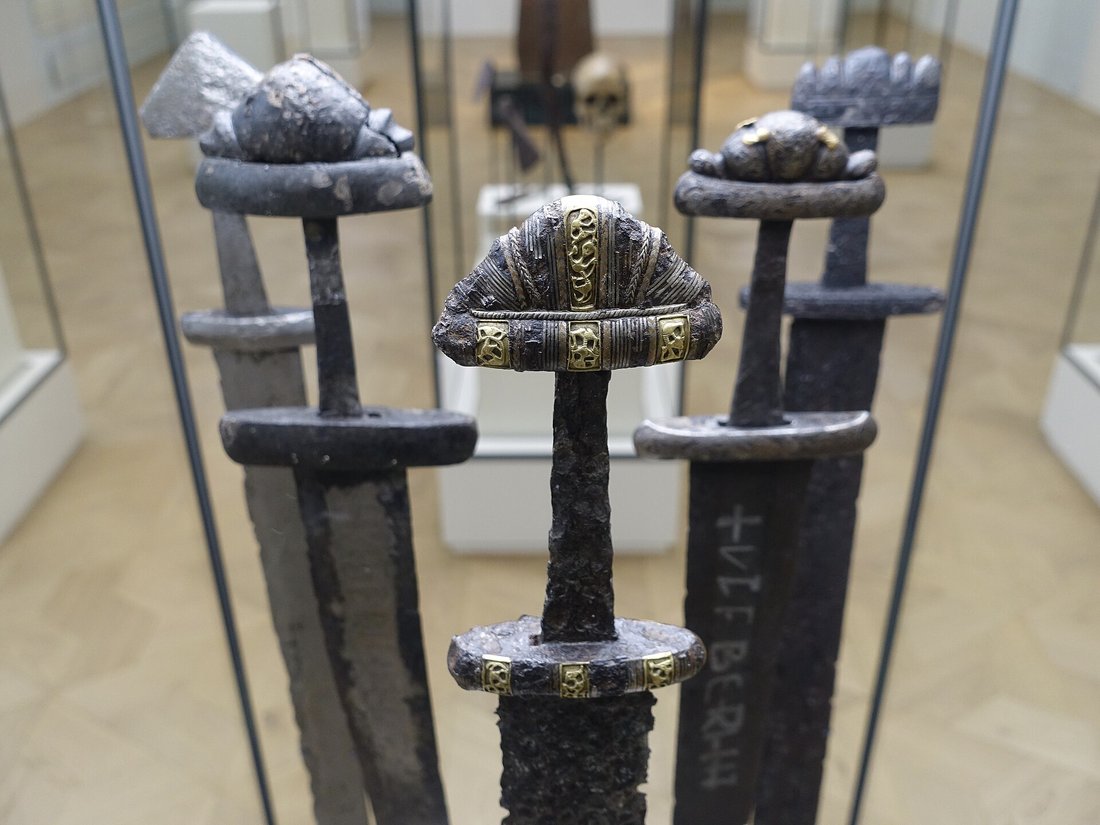
When a find comes out of the ground, the archaeologist faces one plain question: how old is it, and where does it belong? For Viking swords a Norwegian answered that question more than a century ago – not through the blade, but through the hilt. Here is how the Petersen typology works, what it achieves, and where its limits lie.
A typology is really just a sorted drawer: you lay hundreds of individual objects side by side, look for recurring features, and group them into clearly distinguishable classes. It sounds dry, but it is the sharpest tool archaeology has for finds that carry no date of their own. A sword bears no birth certificate. If it lies in a grave that can be dated by other means, you gain a foothold – and when a hundred swords of the same build keep turning up with the same associated finds, a time-span emerges. A typology therefore does more than order things; it dates them. It is sequence and clock at once.
One honest distinction matters from the start: the typology tells you how a piece is built and which group it belongs to. It does not automatically tell you who owned it, where it was forged, or what its bearer lived through. That boundary between evidenced ordering and later interpretation runs through this whole article – and it is precisely why the Petersen typology still stands.
The man behind the system is Jan Petersen, a Norwegian archaeologist and later long-serving head of the museum in Stavanger. In 1919 he published his standard work, “De norske vikingesverd” – “The Norwegian Viking Swords.” For it he had worked through more than a thousand swords, overwhelmingly from Norwegian grave finds, because Norway is a stroke of luck for the subject: nowhere else do so many swords lie in datable burials.
From that flood of material he distilled a chronological-typological sequence. Petersen labelled his main types with letters – a good two dozen, usually cited in the literature as 26 main types from A to Z (Petersen himself counted up to Æ in his Norwegian alphabet, with several special types on top). Anyone handling a Viking sword today will almost inevitably hear sentences like “a clear type H” or “that could be a late type S.” All these shorthands go back to 1919. For the sword as weapon and status symbol, see our piece on the Viking sword.
Petersen's decisive insight was the choice of feature. He classified not by the blade but by the hilt – more precisely by pommel and cross-guards, upper and lower. There is a solid reason for this: Viking-age blades resemble one another closely. They are double-edged, hollow-ground, often with a broad fuller, many of them imported and in circulation almost unchanged for decades. A blade on its own reveals little about its age. Some were reforged, re-hilted, handed down.
The hilt, by contrast, was fashion. Pommel shape, the number of pommel lobes, the cross-section of the guards (four-sided, with rounded or pointed ends), whether the pommel was one piece or two, whether it was decorated – all of that shifted visibly over the course of the Viking Age. The hilt is thus the diagnostic feature: the part that shows when and in what setting a sword was assembled. This is also the root of a common misunderstanding, which we will come back to.
The earliest types – Petersen's A and B – still stand close to the weapons of the Merovingian period and are partly single-edged; they lead out of the era before the great voyages into the 9th century. From there the sequence runs through the whole alphabet to the late forms of the 10th and early 11th century. Each letter stands for a recognisable hilt shape: sometimes a plain triangular pommel, sometimes a flat crescent, sometimes a richly divided pommel with several lobes.
One should not picture the alphabet as a dead-straight timeline. Types overlap, run alongside one another, persist stubbornly or vanish quickly. Petersen ordered by kinship and probability, not by rigid dates. Alongside the main types he also recorded special types – hilts that fit no standard scheme. These outliers are often the most exciting for us, because it is on them that the craftsmanship shows most clearly.
If any Viking sword has an “average” hilt, it wears a type H. Type H is by far the most common hilt type of the entire Viking Age – hundreds of examples from Norway alone, in circulation from the late 8th to the late 10th century. By various counts, type H (together with the closely related type I) accounts for a very large share of all Norwegian finds.
Yet the H hilt is anything but plain: pommel and guard were often of iron, inlaid with fine wire of silver, copper or brass in dense, mostly geometric bands. The mass type was thus perfectly representative – just made in series rather than as a one-off. That of all forms the commonest is so often decorated says a great deal about the standing of the sword in this society.
At the other end of the scale stand the display pieces. Type D stands out through especially richly divided hilts decorated in animal style, often with silver and copper overlay. Type S carries a multi-lobed pommel and dense silver inlay; it belongs to the 10th century and is one of the clear examples of how much effort could flow into a hilt. Type O, finally, shows two variants: pommel and guards cast in bronze and decorated with knotwork, or made of iron with applied silver plaques engraved with interlace or animal motifs – and it is on a sword of this very type that a famous Ulfberht blade sits.
These decorated types are proof that a sword hilt was a picture surface. Anyone who studies the ornament of these hilts reads the same design languages that appear on brooches, stones and wood carving of the age – from the early gripping beasts to the late, interlacing bands.
The archaeologists read the hilt – the poets of the age read the blade. In the Old English “Beowulf” the sword that Unferth lends the hero bears its own name and a loving description of its patterned edge:
That hilted sword was named Hrunting; it was foremost among the old treasures; its edge was iron, marked with venom-twig patterns, hardened in battle-blood.Beowulf, ll. 1457–1460; translation: Glanz & Gravur
“Marked with venom-twig patterns” – the Old English atertanum fah is usually read as a description of the patterned, pattern-welded blade surface. The poet, in other words, celebrates precisely the blade that is of little use to the archaeologist for dating. The two views complement each other: the saga names the name and the gleam, the typology names the build and the date.
Petersen's system is thorough, but finely grained for everyday use. In 1927 the British archaeologist Mortimer Wheeler put forward a simplified version, tailored to the British material: just seven types, in Roman numerals I to VII. Wheeler combined hilt and blade features and gathered several Petersen types into one group. For a quick overview this is handy – you sort coarsely rather than finely.
But the two systems should not be muddled. A “type H” by Petersen and a “type VII” by Wheeler are statements in two different languages; they cannot be translated one-to-one into each other. Anyone reading both shorthands must know whose count is meant.
The British arms scholar Ewart Oakeshott built on Wheeler. He added two transitional types (VIII and IX) that mark the leap from the Viking Age into the High Middle Ages, and then developed a system entirely of his own for the swords of medieval Europe – types X to XXII, roughly from the 11th to the 16th century. Oakeshott thus takes over where Petersen and Wheeler leave off. The three systems interlock in time: Petersen and Wheeler for the Viking Age, Oakeshott for what follows. Anyone who wants the whole chain of European sword forms will find the overview in our study of weapons.
Petersen did not classify only swords. In the same work he also set out a typology of axes – around a dozen forms, lettered A to M. Two broad groups can be distinguished: the bearded axe (Old Norse skeggøx), with its edge drawn downward, which Petersen grouped in variants B to E, and the great broad war axes.
The star among the latter is type M – the famous “Dane axe.” Its head is broadly flared, wedge-shaped and astonishingly thin: the blade usually only about two to five millimetres, with projecting lugs for hafting. Type M appeared around the middle of the 10th century and became so popular that it spread from England into the Rus and stayed in use into the 13th century. Anyone wanting to dig deeper into the forms and use of the battle axes should read our piece on the Viking axe; Petersen's ordering eye also helped with the spear.
For us in the workshop the typology is more than a dating aid – it is a catalogue of ornament. What makes a sword hilt a “type” is, in the end, often the decoration: inlaid silver wire, geometric bands, animal-style motifs in interlace. That is exactly the language an engraver reads. A pommel in Borre style with its gripping beast, a hilt in Mammen or Ringerike style with its sweeping tendrils – these are not merely dating markers but self-contained, internally consistent worlds of pattern.
Anyone who wants to engrave a historically coherent motif is therefore well advised to keep the ornament cleanly separated by period and style, rather than mixing epochs. For the hilt type reveals not only a century but the fitting repertoire of forms. A late interlace band does not belong on an early pommel – here the typology is, almost as an aside, a style guide.
One point the typology practically forces on us: blade and hilt were frequently two separate matters. Many of the best blades were not forged in the North but arrived as trade goods from the Frankish realm, often from the Rhineland – think of the famous Ulfberht blades. The hilt was then fitted locally, from a regional repertoire. A sword could thus carry a Frankish blade and a Norwegian hilt.
This has an inconvenient consequence: the hilt type dates the assembly of the sword and places it culturally – about the origin of the blade it says almost nothing. The long tradition of the forged iron blade reaches back far in any case; its roots lie already in the La Tène period, long before the Vikings. Hilt and blade tell two different stories – the typology reliably tells only one of them.
What is secure: Jan Petersen published “De norske vikingesverd” in 1919, ordering a good two dozen main types (usually cited as 26, A to Z) plus special types, based on over a thousand mostly Norwegian swords. The basis is the hilt, not the blade. Type H is by far the most common hilt type. Mortimer Wheeler simplified the system in 1927 to seven types (I–VII); Ewart Oakeshott continued it with transitional types and created his own series (X–XXII) for the High Middle Ages. Petersen also classified the axes (types A–M); the broad “Dane axe” is his type M with its thin edge, appearing around the middle of the 10th century.
Powerful as the tool is, it has clear limits, and they belong to an honest account. First, it dates imprecisely: where hilt components are mixed (say an older guard with a younger pommel), a precise year can hardly be given. Second, many types ran for decades, some for a century – an attribution yields a span, not a date. Third, there are regional overlaps and local by-ways that fit no neatly into the alphabet.
And fourth, the most important caveat: the type describes the hilt, not the blade, and least of all the origin of the weapon as a whole. To identify a “type H sword” is to have classified the hilt – about the steel of the blade, its smith or its journey through the world, nothing has yet been said.
Myth-check: The Petersen typology classifies hilts, not blades – to say “a type H sword” is to have said almost nothing about the blade itself. Wheeler's seven types are a simplification of Petersen and cannot be equated one-to-one with his letters; the systems are not interchangeable. And the type letters are pure ordering shorthands: they have nothing to do with runes, “power symbols” or name magic. A hilt type is a build, not a spell.
In the end the Petersen typology is a thinking tool that stays sober, and precisely for that reason has lasted so long. It turns a heap of rusted iron into a readable history: from the early, still Merovingian-looking hilts through the ubiquitous type H to the silver-inlaid showpieces of the 10th century. It orders, it dates roughly, and – through the ornament of the hilts – it opens a window into the craftsmanship of a whole age.
The next time you see a Viking sword and someone mutters “a fine type S,” you now know what is meant: not the blade, not the warrior, not the legend – but the hilt, on which a Norwegian museum man learned, more than a hundred years ago, to read time.
The Viking Sword · The Viking Axe · Weapon Lore · La Tène Swords · The Ulfberht sword.