Some weapons give their name to an entire age. The long iron sword of the Celts is one of them: after the find-spot of La Tène on Lake Neuchâtel, the later Iron Age of Central Europe is simply called the La Tène period. But what really lies behind these blades? A look between find-pit, forge fire and ancient propaganda.
When archaeologists speak of the La Tène period, they mean roughly four hundred years of Celtic history, from the 5th to the 1st century BC. And when arms scholars speak of the La Tène sword, they mean the characteristic weapon of that world: a long, double-edged iron blade, worn on an iron chain, sheathed in a scabbard that was itself a work of art. These swords were more than tools of war. They were marks of status, proofs of craft and, as we shall see, at the end of their lives often offerings to the gods.
La Tène is really just an unremarkable stretch of shore at the northern end of Lake Neuchâtel in Switzerland, where the little river Thielle leaves the lake. When the water level was lowered in the 19th century, an extraordinary treasure emerged. In the excavations of 1880 to 1885 and again from 1907 to 1917, thousands of objects were recovered: over 2500 swords and scabbards, along with spearheads, tools, brooches, chariot fittings and human bones. So dense were these iron witnesses to a warrior culture that scholarship made the site the eponym of the entire late Iron Age.
What La Tène actually was remains disputed to this day. Military camp, weapons arsenal, trading place or sanctuary – each of these readings has had its supporters. The great catalogue by J. M. de Navarro, "The Finds from the Site of La Tène" (1972), made the site the yardstick of every sword and scabbard typology. He arranged the scabbards by form and decoration and thereby created a framework that guides research to this day.
The La Tène sword was not a fixed form but a weapon in flux. In the early phase (La Tène A and B, roughly 450 to 250 BC) the blades were comparatively short and tapered to a point. They served for thrust and cut alike, an all-rounder for close combat. Such swords were carried by the warriors who also rolled into battle on the war-cart – more on that in our piece on the Celtic war-chariots.
Over the course of the 3rd century the picture changed. Blades grew longer, often over eighty centimetres, and the point rounded off. The thrusting weapon had become a pure slashing sword, made for the wide, sweeping blow – whether in the press of a foot battle or from horseback. This development coincided with the great Celtic migrations that carried warriors as far as Italy, Greece and Asia Minor. In the late phase (La Tène C and D) swords of ninety centimetres and more were no rarity. Anyone who wants to know how these men fought and lived will find more in our piece on the Celtic warriors.
The lengthening of the blade in the 3rd century had a practical reason. A long slashing sword does its work where the arm can swing wide – on horseback or from the front rank of a loose crowd. As mounted warriors grew in importance, the long, blunt-tipped blade fitted exactly this way of fighting: a blow from above, with the momentum of the horse behind it. The earlier, shorter form belonged rather to the dense mêlée, where the thrust counted.
Yet one must not picture the Celtic warrior as a lone swordsman. The sword was expensive and remained a mark of rank. The mass of fighters relied on spear and large shield; the sword came into play when the lines broke and combat turned to single duel. Anyone who takes at face value every image of the naked warrior adorned only with a torque is falling for a Roman caricature, not the reality of a variously armed warrior community.
The blade was of iron, forged from raw material won in the bloomery process. The hilt itself has almost always vanished archaeologically, for it was made of organic materials: wood, horn or bone, sometimes sheathed in bronze. What survives is the tang, the narrow extension of the blade over which the hilt was once fitted. A pommel finished the whole.
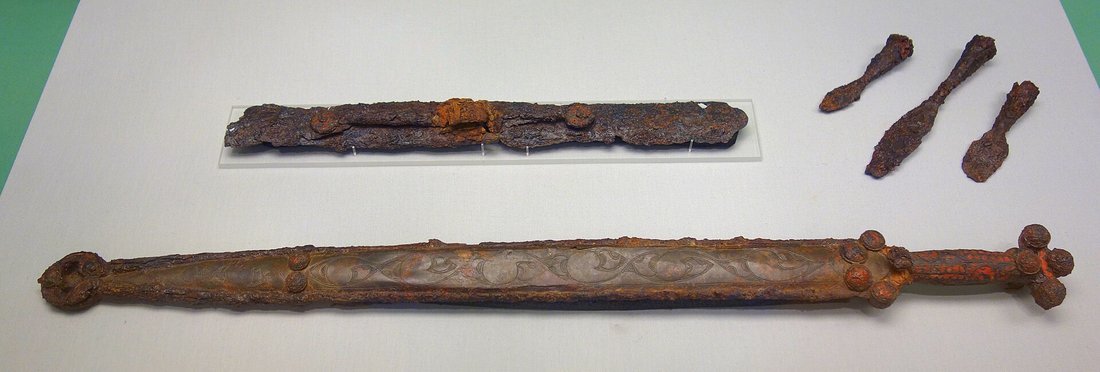
Precisely because the grip was perishable, it is easy to underestimate the effort that went into such a sword. The British showpiece from Kirkburn in Yorkshire shows how complex a hilt could be: it was assembled from thirty-seven separate pieces of iron, bronze and horn and then decorated with red glass. The British Museum calls it "probably the finest Iron Age sword in Europe". The blade measures barely seventy centimetres – and it can no longer be drawn, so firmly is it fused into its corroded scabbard.
Celtic swords had a dubious reputation in ancient literature: soft, bendable, useless after the first blow. Metallurgical studies of surviving blades paint a different picture. Already in Celtic times we find so-called piled structures: the smith welded together several iron rods of differing composition into one blade, thus combining the properties of different kinds of iron. A soft, tough core gave elasticity, harder outer layers held the edge.
This is the technical ancestor of what became, in the Roman period and later among the Germanic peoples, the art of pattern-welding. Not every blade was a masterpiece – there were undoubtedly variations in quality, and mass-produced ware forged from soft iron could indeed bend. But the notion that Celtic swords were categorically inferior does not survive examination. Anyone wanting to dig deeper into weapon technology will find an overview in our weapon lore.
A sword ninety centimetres long at the hip has to be carried somehow. The Celts hung it on a chain of iron or bronze links, as a rule on the right side – unlike the later Roman and medieval custom. The Greek historian Diodorus Siculus noted in the 1st century BC that the swords of the Celts were as long as the javelins of other peoples and were worn on a chain on the right. The scabbard with its reinforced chape not only protected the blade, it was also the display side: whatever hung at the belt, everyone saw.
It is precisely this wearing on the right side that has long occupied research. For a right-hander, drawing a long blade from the right hip is awkward – it may be that one drew across the body, or guided the scabbard back with the left hand while drawing. Here too the rule holds: the finding is clear, its interpretation remains a matter for thought.
The Celtic craftsmen devoted almost as much attention to the scabbard as to the blade. It usually consisted of two iron plates, a front plate and a back plate, folded over and joined at the edges. Some scabbards carried a front plate of bronze instead of iron. At the lower end sat the chape, a metal reinforcement that protected the tip and was often elaborately shaped. The sword was worn on an iron chain or belt, usually on the right side.
It was on the front plate that the real art unfolded: the flowing, interweaving ornament we now simply call "La Tène art". Tendrils, spirals, palmettes and heavily abstracted animal bodies wound across the metal, engraved, punched or worked in relief. This visual language meets us again and again on Celtic metal – perhaps most impressively on the Gundestrup cauldron, even though that piece comes from a different milieu.
One motif stands out in particular: the so-called dragon-pair. At the upper end of the scabbard front plate sit two opposed, S-shaped animal bodies with their heads turned inwards. Whether these are dragons, griffins or pure creatures of fancy cannot be said – the beasts are highly stylised.
What is astonishing about the dragon-pair is its spread. It is found from south-east Britain across Central Europe and the Balkans as far as Iberia, a truly pan-Celtic sign. It was once read as an oriental or even Scythian influence; today, thanks to the many western finds, that derivation is regarded as obsolete. An example from grave 8 of Záluží in Bohemia revealed its engraved dragon-pair on the front plate only under X-ray – a hint of how much decoration lies hidden beneath corrosion. What the motif meant, whether the badge of a warrior band, a protective charm or pure ornament, remains open. It is exactly this restraint that separates honest scholarship from a good story.
A special group is formed by the anthropoid swords. Their hilt is shaped as a human figure: the pommel forms a head, the guard the outspread arms, the grip the torso with hinted legs. Such swords are rare and elaborate, often worked in bronze or decorated with bronze and enamel. They were no mass-produced ware but prestige objects of an elite that set itself apart from the crowd with a figural weapon.
Anyone who imagines today that every Celtic warrior carried such a showpiece is mistaken. The ordinary fighter bore a plain iron sword – and many warriors fought above all with spear and shield anyway. The anthropoid sword is the exception, not the rule.
Some La Tène blades bear small stamped marks, punches in the form of animals, symbols or abstract signs. They usually sit at the base of the blade and are taken as signatures or workshop marks. They show that behind the best swords stood specialised smiths whose products had a name. With that, the Celts stand at the beginning of a long European tradition of marked blades that later culminates in the Frankish Ulfberht swords.
The basic form of the La Tène sword is attested by thousands of original finds, above all the more than 2500 weapons from the site of La Tène itself and the precisely documented British pieces from Kirkburn and the Isleham region. The chronology from short thrusting blade to long slashing weapon is secured typologically and by grave contexts; de Navarro's scabbard catalogue of 1972 remains the standard work. Metallurgical analyses attest piled structures and deliberately combined iron grades. The dragon-pair is documented as a pan-Celtic motif from Britain to Iberia.
The Greek historian Polybius supplied the most famous – and most damaging – description of Celtic swords. Of the battle of Telamon in 225 BC he writes:
Only the first cut takes effect; after this the swords at once assume the shape of a strigil, so much do they bend both length-wise and side-wise, that unless the men are given leisure to rest them on the ground and straighten them with the foot, a second blow has no effect at all.Polybius, Histories II, 33 (own translation)
This passage shaped the image of the inferior Celtic sword for centuries. Yet it must be read with caution. Polybius wrote from a Greco-Roman perspective, about an enemy that was there to be diminished. The contrast with the short, stiff Roman gladius was part of a narrative of Roman superiority.
Myth check: The claim that Celtic swords bent after the very first blow is ancient enemy propaganda, not a finding. Metallurgical study of surviving blades shows predominantly serviceable, in part high-quality weapons. Some scholars even suspect that Polybius saw, or heard of, ritually bent swords: at offering places like La Tène weapons were deliberately bent and "killed" before being given to the water. Equally misleading is the notion that La Tène was simply a battlefield full of lost weapons – much speaks for deliberate deposition. And anthropoid hilts were rare elite pieces, not the norm.
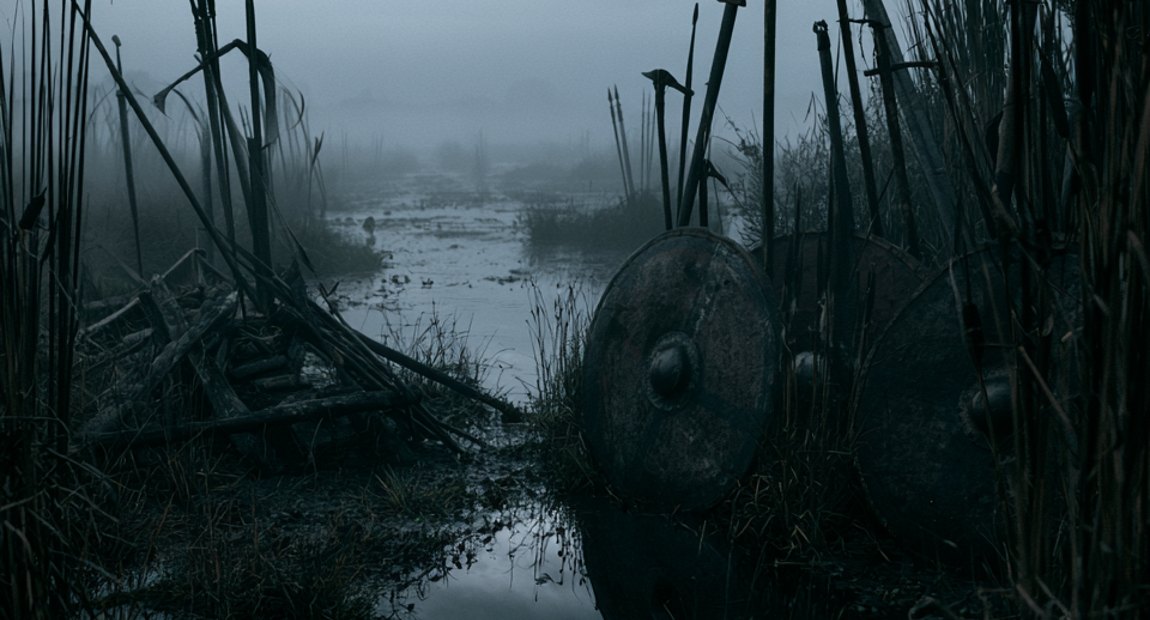
Why did thousands of swords lie in the shore-mud of Lake Neuchâtel in the first place? The older reading as a sunken arsenal convinces few today. Many weapons were bent or broken, some blades even unsharpened and evidently never used. That speaks for ritual deposition: one sacrificed the weapon by rendering it useless and handing it to the water. Together with human bones from the river channel, the picture that emerges is of a sanctuary, not a battlefield.
This bending is no Celtic peculiarity. From the "killing" of the weapon through water and bog offerings to the Germanic army sacrifices, the idea runs through European prehistory: that a person's weapon carries something of its bearer within it, and therefore must not simply be discarded, but handed over to the powers.
What has all this to do with our Norse workshop? More than one might think. The long, double-edged slashing sword of the Celts stands at the beginning of a line of development that runs by way of the Roman spatha to the Viking sword. The basic idea – a long, straight blade with parallel or slightly tapering edge, worn in a decorated scabbard, carried by a warrior elite – remains remarkably stable across more than a thousand years.
The union of weapon and ornament, of blade and art, likewise connects Celts, Germanic peoples and Vikings. The sweeping animal bodies of La Tène art are distant relatives of the animal styles that later travel through Norse ornament. And the custom of giving a weapon ritually to the water returns in the Viking age. Anyone who engraves a motif today that recalls these old blades stands in a very long line – and does well to keep evidence and legend apart.
The Celtic Warriors · Celtic War Chariots · The Viking Sword · The Gundestrup cauldron · Weapon Lore.
All History & Finds articles →
It is not two centimetres tall and weighs nine grams – and yet it set off one of the most exciting debates in Norse …
Read more →A monastery on a tidal island off the coast of Northumbria, a summer's day in 793 – and a shock that echoed all the way …
Read more →