The Lindisfarne raid of 793 – usually dated to 8 June – was an attack by pagan Scandinavian seafarers on the monastery of St Cuthbert off the Northumbrian coast, and it is traditionally taken as the start of the Viking Age. Monks were killed, carried off or drowned and the church treasury was stripped. It was not the first Viking contact with England. It became famous because it struck a holy place, and because a scholar at Charlemagne's court found words for it that still echo. Here is what the sources actually say.
Picture a low island of dunes and salt marsh, a grey sea that swallows the road to the mainland twice a day. On it stands a church of timber and stone, a few dozen monks, and a tomb that draws pilgrims from all over Northumbria. Then, one day in 793, sails on the horizon. What followed has echoed for twelve centuries: Lindisfarne is the date nearly every textbook uses to open the Viking Age.
Lindisfarne, also known as Holy Island, lies off the coast of Northumberland in the far north-east of England, not far from the Scottish border. It is a tidal island: at low water you can walk across, at high water it is cut off.
According to Bede, the monastery was founded in 635. King Oswald of Northumbria had invited the Irish monk Aidan from the island monastery of Iona to convert his kingdom. Aidan chose the island within sight of the royal fortress at Bamburgh. From here the north of England was evangelised; Lindisfarne became a bishop's see and one of the great religious centres of the British Isles.
Above all, the place was made famous by Cuthbert. Monk, long-time hermit on the tiny island of Inner Farne, and reluctant bishop of Lindisfarne from 685, he died in 687 and was buried on the island. When his tomb was opened in 698, his body was reportedly found incorrupt – so Bede tells us. Cuthbert became a saint of the first rank, his shrine a pilgrimage goal, and the monastery grew rich on gifts.
The same world produced the Lindisfarne Gospels, one of the most spectacular manuscripts of the early Middle Ages. The British Library dates it to around 715–720 and attributes it to Eadfrith, bishop of Lindisfarne from 698 to 721. That attribution comes from a tenth-century note by the priest Aldred, who also added an Old English translation between the Latin lines – the oldest surviving rendering of the Gospels into English. In short, Lindisfarne was no ordinary estate. It was wealthy, revered, unfortified and sitting right on the sea.
The raid hit a kingdom already busy wounding itself. In the late eighth century Northumbria's kings came and went fast – deposed, exiled, murdered. King Ælfwald I was killed in 788 by a nobleman named Sicga. Æthelred I, to whom Alcuin would address his famous letter, had been overthrown once before and was in his second reign in 793; in 796 he too was killed.
One detail in the annals reads like a dark prologue. Sicga, the king-slayer, died in February 793 – by his own hand, according to later annals – and was buried on Lindisfarne in April, only weeks before the raid. English Heritage points out that the chroniclers seem to have placed these events side by side on purpose. A medieval reader would draw the obvious conclusion: a murderer laid in holy ground, and then disaster.
The best-known account is in the Anglo-Saxon Chronicle, a set of year-by-year entries in Old English. One thing to keep in mind: the Chronicle was compiled only in the late ninth century at the court of Alfred the Great and then continued in several manuscripts. The detailed Lindisfarne entry appears in versions D and E, which draw on northern English annals.
In this year dire portents came over the land of the Northumbrians and miserably frightened the people: there were immense whirlwinds and flashes of lightning, and fiery dragons were seen flying through the air. A great famine soon followed these signs, and a little after that in the same year, on the sixth day before the Ides of January, the ravaging of heathen men miserably destroyed God's church on Lindisfarne by plunder and slaughter.Anglo-Saxon Chronicle, MSS D/E, entry for 793 (our own translation from the Old English)
Three things stand out. First, the portents: whirlwinds, lightning, fiery dragons, then hunger. This is a classic pattern in medieval annals, where signs in the sky announce calamity. Whether real observations lie behind them – storms, northern lights, meteors – we do not know. Second, the vocabulary: the attackers are not Danes or Northmen but simply "heathen men". For the chronicler, religion was what mattered. Third, the date.
"The sixth day before the Ides of January" is, in Roman reckoning, 8 January. That is what the Chronicle says. Yet almost everywhere you will read 8 June. Why?
The prevailing explanation is a copying error. The Ides of January (Ianuarii) and of June (Iunii) differ by only a few letters in abbreviated form, and a slip is easy to imagine. The editor and translator Michael Swanton treats January as a mistake and points to northern annal material giving June. There is also a practical argument: crossing the open North Sea in midwinter, with storms and short days, would have been risky, and early Viking raids typically happened in the sailing season. Encyclopædia Britannica likewise gives 8 June as the generally accepted date and calls January "probably" a scribal error.
A winter raid is not impossible – seafarers could use weather windows even then. And the Chronicle's own sequence (portents, famine, then "a little after" the raid) suggests a later point in the year rather than early January. Put honestly: 8 June 793 is the best reconstruction, not a date carved in stone.
The key witness is not a chronicler but a letter-writer. Alcuin of York (c. 735–804) was a Northumbrian, educated at the cathedral school of York and later its master. From the 780s he belonged to Charlemagne's inner circle of scholars and was one of the leading minds of the Carolingian Renaissance; from 796 he was abbot of Saint-Martin at Tours. When the news reached him, he wrote several letters. They are the only contemporary texts about Lindisfarne we have.
To King Æthelred of Northumbria he wrote the lines quoted in every account:
Behold, for almost 350 years we and our fathers have dwelt in this most lovely land, and never before has such terror appeared in Britain as we have now suffered from a pagan people. Nor was it thought that such a voyage could be made. Behold, the church of St Cuthbert, spattered with the blood of the priests of God, stripped of all its ornaments, a place more venerable than all in Britain, given over to pagans to be plundered.Alcuin, letter to King Æthelred of Northumbria, 793 (our own translation from the Latin, after Dümmler's MGH edition)
The "350 years" are Alcuin's count from the arrival of the Anglo-Saxons in Britain in the fifth century. The word we render as "voyage" is navigium in Latin – it can mean seafaring, but also a fleet. Either way, his point is that nobody had expected an attack from that direction.
Then it gets interesting. Alcuin looks for the cause not among the raiders but among his own people. He recalls a rain of blood seen dripping from the roof of St Peter's church in York during Lent and reads it as a warning. He accuses the king and nobles of luxury, injustice and fornication – and he criticises their fashion: they had wanted to look like the pagans in the trimming of their beards and hair. A fascinating detail, because it assumes that Northumbrians already knew and copied Scandinavian styles – contact existed long before blood was shed. For more on how Norse men and women wore their hair, see our article on Viking grooming and hairstyles.
A second letter went to Higbald, bishop of Lindisfarne, and the surviving brothers. Its tone is more consoling but no less stern. Its key points:
That last point matters, because behind the theology it shows the people. The raiders took not just gold and silver but human beings – young people, probably novices and pupils. Captives might be ransomed or sold as slaves. What became of them we are never told. How widespread human trafficking was in the Viking world is the subject of our article on slavery in the Viking Age.
Many of the most graphic details you meet in documentaries come from a later source. The Historia Regum ("History of the Kings") is traditionally attributed to the monk Symeon of Durham and took shape around 1100 and in the early twelfth century. It does, however, incorporate older eighth-century Northumbrian annals that are otherwise lost – which is why historians take it seriously.
There we read that the pagans came to the church of Lindisfarne, laid everything waste with cruel plunder, trampled the holy things underfoot, dug up the altars and seized the treasures. Some brothers they killed, some they took away in chains, many they drove out naked and insulted, and some they drowned in the sea. Symeon's history of the church of Durham tells it in similar terms.
How much goes back to early notes and how much to later embroidery cannot be settled in detail. Still, if you see a film in which monks are pushed into the sea one by one, remember that the scene rests on a text that reached its present form about three hundred years after the event.
The sources do not say. They speak of heathens, not homelands. Most historians consider Norway, specifically the fjord country of the south-west, the most likely point of departure, for three reasons. Geography: with a fair wind it is a voyage of a few days from western Norway across the North Sea to Scotland and Northumbria, and the early targets – Northumbria, the Hebrides, Ireland – lie exactly on that axis. The Chronicle itself: for the earlier Portland incident (more on that below), some manuscripts call the strangers men from "Hæreðaland", usually taken to be Hordaland in western Norway. And archaeology: graves in western Norway from around 800 onwards contain a striking amount of metalwork from the British Isles, including mounts taken from reliquaries and book covers and reworked as jewellery.
None of this is certain. Danes are possible too, and in 793 the line between "Norwegians" and "Danes" was no national border anyway. If the terms confuse you, our guide Vikings, Normans, Norsemen, Varangians: what is the difference? sorts them out. And for the different directions Danes, Swedes and Norwegians took, see Danes, Swedes, Norwegians: the three paths of the Vikings.
Why then? Again there is no single answer, only a bundle of factors debated by scholars: seaworthy clinker-built ships under sail that could land straight on a beach (more in our piece on dragon ships), growing wealth and rivalry among Scandinavian leaders who needed loot to reward followers, and knowledge of rich, unguarded targets that had travelled north along trade routes.
Lindisfarne was not the first clash. The Anglo-Saxon Chronicle records that during the reign of King Beorhtric of Wessex (786–802) three ships landed on the south coast. The king's reeve rode down to them, thinking they were traders he should take to the royal estate – and was killed. The chronicler adds that these were the first ships of Danish men to come to the land of the English. The later chronicler Æthelweard (tenth century) names the place, Portland in Dorset, and the dead man: Beaduheard. The incident is usually dated to 789, though the exact year is not secure.
Other hints show that the danger from the north was already known in the south. A charter of King Offa of Mercia from 792 obliges churches in Kent to contribute to defence against pagan seafarers. In the Baltic, the two boat burials at Salme on the Estonian island of Saaremaa – dated around 750 and holding dozens of slain warriors from the central Swedish region – prove that armed expeditions crossed the Baltic decades before Lindisfarne.
Period boundaries are tools, not natural events. The idea that the Viking Age "begins in 793" and "ends in 1066" is a convention, above all of English-language history writing: Lindisfarne at one end, the Battle of Stamford Bridge in 1066 at the other.
Scandinavian archaeologists often set the start more broadly, around 750 to 800, and stress that change within Scandinavia began earlier: trading places, new ships, concentration of power, raiding in the Baltic. Neil Price, in his major survey of 2020, presents the Viking Age as the outcome of long developments reaching well back before 793. Judith Jesch prefers to speak of a "Viking diaspora", a network of movements that cannot be switched on and off on a single day.
So why does 793 endure? Because it is the first event where contemporaries explicitly named what was new: attack from the sea, pagans, a sanctuary. Alcuin himself put the sense of an epochal break into words. As a symbolic date, Lindisfarne is well justified. As a precise starting gun, it is not.
Alcuin's fear that worse was coming came true quickly. For 794 the Anglo-Saxon Chronicle reports that the heathens ravaged Northumbria and plundered King Ecgfrith's monastery at the mouth of the Don – usually identified with Jarrow, Bede's home. This time it went badly for the raiders: one of their leaders was killed, ships were wrecked in a storm, many men drowned, and those who reached the shore alive were killed at the river mouth.
In 795 the heathens appear in the Irish annals: Rechru (probably Lambay or Rathlin) was burned and Skye laid waste; Iona, the mother house from which Aidan had once come to Lindisfarne, is also recorded as attacked in 795. In 802 Iona was burned, and in 806, according to the Annals of Ulster, raiders killed sixty-eight members of the community there. What happened next in Ireland and Scotland is told in our article on the Vikings in Ireland, Scotland and the isles.
The Frankish realm reacted too: around 800 Charlemagne had the coasts guarded and ships built because the sea facing Gaul was infested by pirates, as the Royal Frankish Annals note. Over the ninth century, isolated summer raids turned into a system: winter camps, larger armies, and finally settlement. In 865 the Great Heathen Army landed in England, led according to tradition by the sons of Ragnar such as Ivar and Halfdan. In 867 York, the heart of Northumbria, fell. For the full arc from 793 to 1066, see our overview The Vikings in England.
A common misconception says Lindisfarne was wiped out in 793. It was not. Bishop Higbald stayed in office, the community carried on, and Lindisfarne remained a bishop's seat for more than eighty years. But the pressure grew. When Halfdan's army ravaged Northumbria in 875, Bishop Eardwulf and the monks left the island. They took what mattered most: the coffin with Cuthbert's remains, other relics – by tradition including the head of King Oswald – and books.
What followed is described by later Durham texts as years of wandering through northern England. One legend tells that the monks tried to cross to Ireland, a storm washed a precious Gospel book overboard, and it was later found undamaged on the shore. Whether this refers to the Lindisfarne Gospels is a modern guess. In 883 the community settled at Chester-le-Street, and in 995 finally at Durham, where the cathedral rose over Cuthbert's tomb. He lies there still.
And the Gospels? They survived everything: the raid of 793 (if they were on the island then, which is likely but not proven), the wandering, the centuries. Today the book belongs to the British Library in London and is periodically displayed in north-east England.
Visit the small museum beside the priory ruins and you will meet a sandstone grave marker known as the "Domesday Stone" or "Viking Raiders Stone". It dates from the ninth century. On one face a line of warriors marches along, brandishing axes and swords. On the other you see a cross, sun and moon, two hands and two praying figures – usually read as the Last Judgement, "Domesday" in the old sense of the day of doom.
The obvious reading: a memorial to the raid of 793, the warriors being Norsemen. English Heritage puts it cautiously, saying the stone "may" commemorate the first raid. The armed procession could equally belong to the imagery of the end times – the nations marching at the end of the world – or simply depict the violent world against which faith stands. No inscription names the event. We think the "Viking stone" reading is possible but not proven.
If you plan a visit, the sea sets your timetable. Since 1954 a surfaced causeway has crossed the sands; it is open only for some hours at a stretch and closed from about two hours before to three hours after high water. Drivers who ignore the tide tables have to be rescued again and again. Alongside it, wooden posts mark the old Pilgrims' Way across the mudflats – best walked barefoot, with a guide or a very good grasp of the tides.
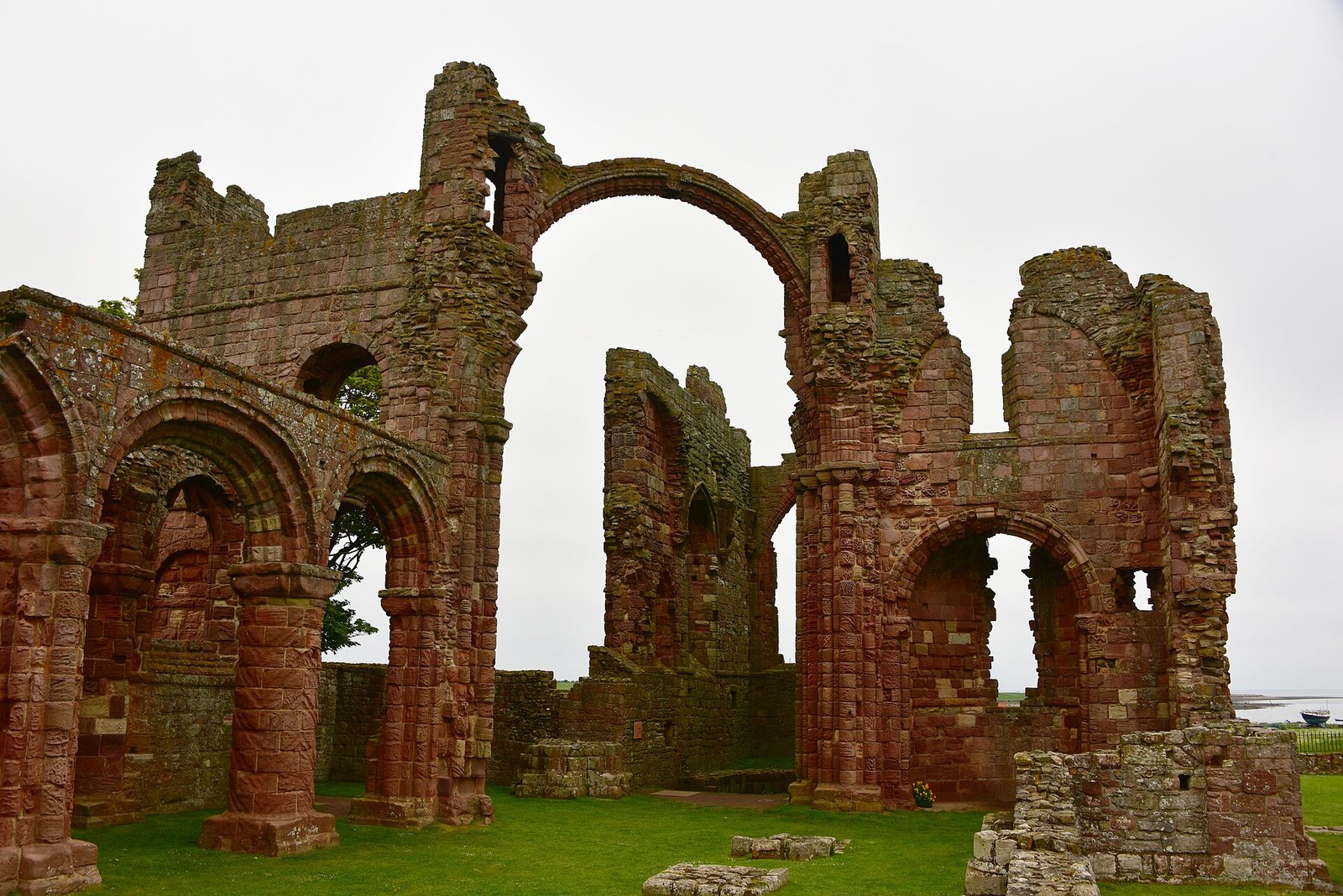
The priory ruins you see today, by the way, are not Aidan's and Cuthbert's monastery. They belong to a Benedictine priory built by monks from Durham from the late eleventh and into the twelfth century – including the famous "rainbow arch", a single surviving vault rib spanning the nave. The Anglo-Saxon monastery stood roughly on the same spot but has vanished above ground. The striking castle on its rock was built around 1550 as a fort and converted into a country house by Edwin Lutyens in the early twentieth century. Only about 150 people live on the island today. For other Viking places worth the trip, see Experience the Vikings: museums and sites.
For courage. For remembrance. For legends that live on.
When was the Viking raid on Lindisfarne? In 793. The Anglo-Saxon Chronicle says 8 January, but most historians treat that as a copying error and date the raid to 8 June 793.
Who attacked Lindisfarne in 793? The sources only call them "heathens". Most likely they were seafarers from western Norway, but their origin is not securely documented.
Was Lindisfarne the first Viking raid? No. Around 789 Norsemen killed a royal reeve at Portland, and armed expeditions crossed the Baltic as early as c. 750. Lindisfarne is the first famous raid on a monastery.
Why is 793 considered the beginning of the Viking Age? Because the attack on a sanctuary shocked contemporaries and is well attested by Alcuin's letters. It is a convention; many scholars place the start around 750–800.
Can you visit Lindisfarne today? Yes. Holy Island is reached by a causeway that floods at high tide, so always check the tide tables. You can see the priory ruins and museum, the castle and the village.
The Vikings before Aachen · The Great Heathen Army · Stamford Bridge 1066 · Viking traces in Germany · Ragnar's sons.
