Anyone sailing west out of Norway carried no compass and yet had a remarkably clear destination: the arc of islands between Shetland and Ireland. From the coastal monasteries to the trading towns on the Liffey to the windswept jarls' halls of Orkney, a world of its own grew up here — half Norse, half Gaelic, and thoroughly seaworthy. This page gathers what the Northmen did, built and left behind across the British Isles beyond England. (England has its own overview page with us; this one is about Ireland, Scotland, the Northern Isles, the Isle of Man and the Hebrides.)
The age of westward voyages opens with a date everyone knows: 793, the raid on Lindisfarne. But Lindisfarne was only the overture. Already in 795 the same fleets struck the monastic islands of the north — Rathlin off the Irish coast, Iona off Scotland. Iona was hit again and again; in 806 the annals record 68 monks killed there, and the community eventually moved part of its treasures and scriptorium inland to Kells.
It was chiefly Norwegians who took this Atlantic route, while the Danes turned more to the south and east — the rough division of labour we set out in more detail in our overview of the regional Vikings. The route ran in stages: from Bergen and the Sognefjord to Shetland, on to Orkney, down to the Hebrides, to Man and Dublin — and from there across the Irish Sea or straight on to Iceland. Every island was destination, base and springboard all at once.
None of this should be pictured as a single planned conquest. What looks in the annals like an onslaught was in truth a jumble of many small fleets — some out to raid, some to trade, some looking for land that had grown scarce back home. Summer visitors became overwinterers, overwinterers became settlers, and settlers in the end became kings and jarls. It is precisely this shift — from raid to rule, from foreign „heathen" to baptised neighbour — that makes the isles so fascinating: nowhere else can the transformation of the Viking world be read so clearly.
At first the Northmen came in summer and vanished in autumn. That changed in 841. In that year they built fortified ship-camps in two places, so-called longphorts: one at Linn Duachaill (Annagassan), the other at the mouth of the Liffey — Duibhlinn, the „black pool", beside the old ford of Áth Cliath. From this winter camp grew the most important Viking town on the island: Dublin, a hub for silver, slaves, amber and weapons linking Scandinavia, Britain and the Frankish realm.
Dublin was no isolated case. On the south coast rose Waterford (Old Norse Veðrafjǫrðr) — the trading site at Woodstown is older, but the town proper is traditionally dated to 914. In 922 came Limerick (Hlymrekr) on the Shannon, along with Wexford and Cork. These coastal settlements were Ireland's first towns in the full sense: with harbours, coinage, shipyards and dense building. Walk through Dublin today and you are treading a street plan whose core the Northmen laid down.
Dublin and much of the Irish Sea were ruled in the 9th century by a pair: Amlaíb (Old Norse Óláfr) and Ímar. Ímar — probably the same man Norse sources know as Ívarr the Boneless — died in 873; the annals call him „king of the Norsemen of all Ireland and Britain". His descendants, the Uí Ímair, became the mightiest sea-dynasty of the North Atlantic and at times held the kingship of York as well.
To this circle belongs Óláfr the White, a Viking king of Dublin. His wife Aud the Deep-Minded and their son Thorstein the Red tie Dublin, Scotland and Iceland into a single family story — a fine example of just how tightly this island world was woven together. In 902 the Northmen were driven out of Dublin, but returned in 917. The town reached its height under Sigtryggr Silkiskegg („Silkbeard"): around 997 he struck Ireland's first coins, made a pilgrimage to Rome in 1028 and founded Christ Church Cathedral. By then Dublin had long been Christian and Irish in character — and stayed so.
On Good Friday, 23 April 1014, two great hosts collided at Clontarf north of Dublin. On one side the High King Brian Bóruma (Brian Boru); on the other Máel Mórda, king of Leinster, allied with the Dublin Norse under Sigtryggr, the Orkney jarl Sigurðr, and Bróðir of Man. Brian's side won — but the aged High King fell, according to the saga in his tent. The battle became material for skalds and chroniclers, and the famous verses of the Darraðarljóð from Njáls saga show valkyries at the loom weaving the fate of the fight.
Wind we, wind we, web of darts, where the warriors' banners forge ahead.Darraðarljóð, from Njáls saga; trans. G. W. Dasent, 1861 (public domain)
Dramatic as that sounds, Clontarf was not a battle of „Irish against Vikings". Both sides fielded Irishmen and Northmen alike. Máel Mórda, Brian's chief opponent, was an Irish king; and Brian himself had Hiberno-Norse allies. If you want the full story with all its fronts, you will find it in our deep-dive on the Battle of Clontarf 1014.
The Northmen settled most densely in Orkney and Shetland. The place-names there are almost entirely Norse — a sign of how completely the newcomers reshaped both language and landscape. On Orkney a jarldom of its own arose, half independent, formally tied to the Norwegian crown. From the Orkneyinga saga we know a whole line of jarls, such as Sigurðr the Stout, who fell at Clontarf in 1014, and later Þorfinnr the Mighty, under whom the jarldom reached its greatest extent.
From the islands Norse influence spilled onto the Scottish mainland. Caithness and Sutherland bear Norse traces to this day — the name Sutherland means simply „southern land", seen from the Northmen's vantage point on Orkney. According to Landnámabók and Laxdæla saga, Thorstein the Red conquered large parts of northern Scotland before he fell through treachery. His mother Aud then set out and became one of the great first settlers of Iceland — another thread reaching from the isles into the North Atlantic.
Between Ireland, Scotland and England lies the Isle of Man — tiny, but a hub for the Viking world. A Norse legacy lives on here to this day: the Tynwald, the island's parliament, goes back to an Old Norse Þingvǫllr, a „Thing plain", and ranks among the oldest continuously functioning assemblies in the world.
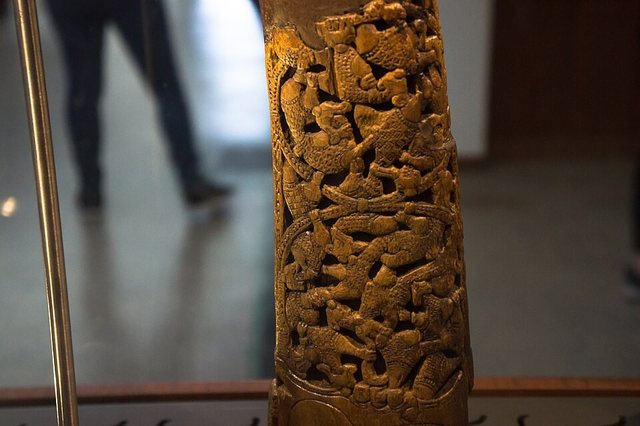
More striking still are the island's cross-slabs. Some bear runic inscriptions and the signatures of their carvers, such as Gaut Bjǫrnsson. And they show how the heathen and Christian worlds interlocked: on the famous Thorwald's Cross a figure with spear and bird battles a wolf that is devouring its leg — Odin, whom Fenrir swallows at Ragnarök — right beside Christian motifs. No contradiction for the people of the time, but the visible passage from the old faith to the new.
The Hebrides were called Suðreyjar by the Northmen, the „southern isles", as opposed to the Norðreyjar (Orkney and Shetland). In Irish their inhabitants were named Innse Gall, the „islands of the foreigners". Out of this region grew the Kingdom of the Isles in the 11th century, which Guðrøðr Crovan united — Man and the Hebrides — after the Battle of Skyhill in 1079. Later the region was shaped by Somerled, a ruler half Norse and half Gaelic.
This island kingdom stayed in Norse hands for a remarkably long time. As late as 1263 the Norwegian king Hákon Hákonarson tried to secure his claims with a great fleet; the indecisive Battle of Largs and his death on Orkney on the way home sealed the end. Only in 1266, by the Treaty of Perth, did Norway formally cede the Hebrides and Man to the Scottish crown — more than four centuries after the first sails crossed the North Sea. The Viking Age did not end here with a bang, but with a stroke of the pen.
Perhaps the most fascinating thing about this island world is not war, but fusion. From the mid-9th century the sources speak of the Gall-Gaedhil, the „foreign Gaels" — people of Norse descent who took on Gaelic language, names and customs without wholly shedding their Norse heritage. The Scottish region of Galloway is named after them.
This blend left traces you can still read today. In the Hebrides and Ireland place-names betray the two worlds: Norse endings such as -bost (farm), -dale (valley) or -ay (island) sit beside Gaelic names, often in the very same village. Personal names travelled back and forth too. Out of two cultures something third arose — not conquerors and conquered, but an Atlantic world all its own, whose heirs still live along these coasts.
Attested: The events of this island world are well documented: the Irish annals (above all the Annals of Ulster) for the longphorts, towns and Clontarf, the Orkneyinga saga for the jarls of Orkney, Landnámabók and Laxdæla saga for the ties to Scotland and Iceland, plus the runic cross-slabs of the Isle of Man and the dense Norse place-name landscape from Shetland to Galloway. Brian's death and the victory of his party at Clontarf in 1014 are undisputed; Dublin survived afterwards — Sigtryggr went on ruling for nearly two more decades.
Myth-check: Clontarf was not a national war of „Irish against Vikings", nor a liberation that „freed the island from the Northmen" — both armies were mixed, and the Viking town of Dublin remained standing. The image of an Irish war of freedom comes largely from the partisan chronicle Cogadh Gáedhel re Gallaibh (12th century, written in the interest of Brian's descendants) and from 19th-century nationalism. It is likewise only half true that „the Vikings founded Ireland's cities": they created the coastal towns of Dublin, Waterford, Limerick, Wexford and Cork — but the interior stayed rural and shaped by monastic settlements.
The Vikings before Aachen · Hedeby · Dorestad – the great trading place · The North Frisian ring forts · The Viking winter camps.
All History & Finds articles →
The Vikings came, raided – and stayed. Over the winter, at least. Instead of sailing home after every raid, they …
Read more →Many call the Varus battle the „big bang of Germany". Yet another battle shaped our lands far more deeply – one in …
Read more →High above the world of humans, beyond the burning rainbow bridge, lies Asgard – the fortified home of the Æsir. It is …
Read more →Almost 1,500 years before the first Germanic peoples entered Roman history books, a highly developed Early Bronze Age …
Read more →