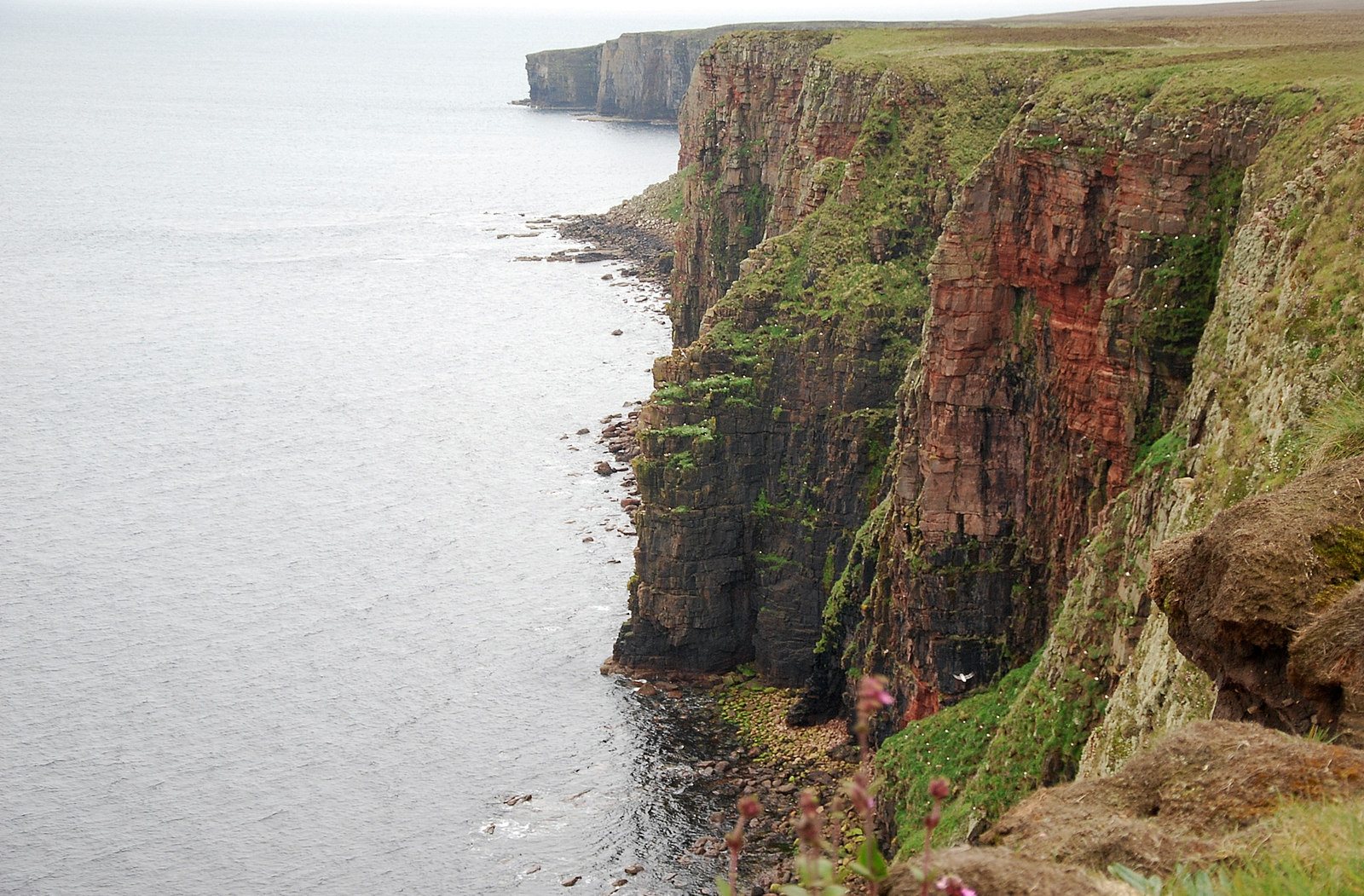
Thorstein the Red (Old Norse Þorsteinn rauðr) was, according to Icelandic tradition, the son of Olaf the White of Dublin and Aud the Deep-Minded who, in the late ninth century, conquered Caithness, Sutherland, Ross and Moray together with Earl Sigurd the Mighty of Orkney, ruled there as king and was killed when the Scots betrayed him. That is the story told by Landnámabók, Laxdæla saga and Orkneyinga saga, all written in the 12th and 13th centuries. No contemporary source names him with certainty – and that is where things get interesting.
Some Vikings we know from rune stones, some from graves, some from the monastic annals of the people they raided. Thorstein the Red belongs to a fourth kind: we know him almost entirely from the memories of his descendants. Icelandic scholars wrote down, some 250 to 350 years after his death, what their families told about him. And those families had every reason to be proud.
Thorstein stands at a crossroads of the Viking world in the West. His father is said to have ruled in Dublin, his maternal grandfather in the Hebrides. He himself fought in the far north of Scotland. One of his daughters became the ancestress of the Earls of Orkney, and his son Olaf Feilan founded one of the most powerful kindreds of Breiðafjörður in Iceland. Had Thorstein not died young, the saga says, his mother Aud would never have had a ship built in secret – and the settlement of Iceland would look a little different.
In this article we walk you through what has come down to us about Thorstein, where it comes from and how much weight it can bear. We keep three things strictly apart: what sources from the ninth century itself say; what the Icelandic texts of the 12th and 13th centuries tell; and what is modern interpretation – such as the theory that Thorstein is the same man as one Oistín, son of Amlaíb, who according to the Annals of Ulster was killed “by deceit” in 875.
All the Icelandic texts agree on his parentage. Thorstein’s father was Olaf the White (Óleifr or Óláfr inn hvíti), his mother Aud the Deep-Minded (Auðr in djúpúðga, called Unnr in Laxdæla saga), a daughter of Ketil Flatnose (Ketill flatnefr), who is said to have ruled the Hebrides. Landnámabók, the Icelandic “Book of Settlements”, sums up Olaf’s career in a few lines: as a war-king he raided in the West, won Dublin in Ireland and the land around it, and made himself king there; later he fell in battle in Ireland.
The term war-king (Old Norse herkonungr) matters, because it is used of Thorstein too. It describes a leader of royal rank who rules not over a fixed territory but over ships and sworn followers – a king at sea, whose power reaches exactly as far as his plunder and his alliances.
Whether this Olaf the White is the same man as the Amlaíb whom the Irish annals record from 853 as ruler of the Norse in Dublin is an old question and still an open one. Many historians consider the identification likely; others call it “frequently proposed and frequently rejected”. The contradictions are real. The annals name Amlaíb’s father as Gofraid, the Icelandic genealogies as Ingjald. Landnámabók has Olaf fall in Ireland, while a Scottish king-list chronicle reports that Amlaíb was killed by King Constantine I (Causantín mac Cináeda) while collecting tribute. And Aud appears in no Irish source at all. For the wider background, see our article on the Ostmen of Dublin, Waterford and Limerick.
After Olaf’s death, says Landnámabók, Aud and Thorstein went to the Southern Isles, the Suðreyjar – the Norse name for the Hebrides, which lay to the south when seen from Orkney and Shetland. Ketil’s kin lived there. There, too, Thorstein married: his wife was Thurid (Þuríðr), daughter of Eyvind the Easterner (Eyvindr austmaðr) and sister of Helgi the Lean (Helgi magri), who later settled Eyjafjörður in the north of Iceland.
That marriage shows how tightly woven the Norse world in the West was. Helgi’s mother, according to Landnámabók, was Rafarta, a daughter of Kjarval, “king of the Irish”. Scholars usually recognise behind that name Cerball mac Dúnlainge, king of Osraige in south-east Ireland, who is well attested in the Irish annals and died in 888. Whether the relationship is exactly right we cannot know. But the pattern is typical: Norwegian sea-warriors, Irish kings’ daughters, children with Gaelic nicknames. The Irish called such mixed groups the Gall-Goídil, the “foreign Gaels”. Even Thorstein’s son later bore the nickname feilan, usually derived from Gaelic fáelán, “little wolf”.
In the Hebrides, according to Landnámabók, Thorstein became a war-king himself. He “entered into partnership” – Old Norse réðst til félags – with Sigurd the Mighty (Sigurðr inn ríki), son of Eystein Glumra. In Orkneyinga saga Sigurd is the first Earl of Orkney from the house of Møre: King Harald Fairhair is said to have granted the islands to Sigurd’s brother Rognvald after a punitive expedition against Vikings, and Rognvald passed them on to Sigurd. We tell the full story of that dynasty in our article on the Earls of Orkney.
How much of this is history remains disputed. Harald’s great western expedition is not attested in any contemporary source, and some historians regard it as a later construction meant to justify Norwegian royal claims to the islands. That a powerful Orkney earl named Sigurd existed in the late ninth century, however, few doubt. Geography explains the partnership: Orkney controlled the sea route around Scotland’s northern tip, the Hebrides the west.
The key passage is in Landnámabók. Here it is in the original and in our own translation:
“Þeir unnu Katanes ok Suðrland, Ross ok Merrhæfi ok meir en hálft Skotland. Gerðist Þorsteinn þar konungr yfir, áðr Skotar sviku hann, ok fell hann þar í orrostu.” – They won Caithness and Sutherland, Ross and Moray and more than half of Scotland. Thorstein became king over it, until the Scots betrayed him, and he fell there in battle.Landnámabók (Sturlubók), section on Aud the Deep-Minded; our own translation
The place-names repay a closer look. Katanes, Caithness, is the “headland of the Cat people”, named after a Pictish district. Suðrland, Sutherland, simply means “South Land” – a name that only makes sense from Orkney and Caithness, because geographically the county lies in the extreme north of Britain. Ross is the country north of the Moray Firth, and Merrhæfi or Mærhæfi is Moray, the fertile coastal plain around Elgin and Inverness.
Orkneyinga saga tells the same conquest from Sigurd’s point of view. There Sigurd is the leader: he allied himself with Thorstein the Red, son of Olaf the White, and together they won all of Caithness and much else of Scotland, Moray and Ross. Sigurd had a fortification built in the south of Moray. The saga does not say where this borg stood; Burghead on the Moray coast, a large Pictish fort, is often suggested, but that is pure guesswork.
Laxdæla saga puts the stress elsewhere. Here Thorstein wins many battles, then makes peace with the Scots, receives half of Scotland and becomes king there. Sigurd is not mentioned at this point. And Eiríks saga rauða, the saga of Erik the Red, opens of all things with Thorstein’s family before it ever reaches Erik and Greenland – a sign of how firmly Thorstein was anchored in Icelandic pedigrees.
To understand why a sea-king could succeed in northern Scotland at all, you have to look at the other side. Ninth-century Scotland was not a unified state. In the east lay the kingdom of the Picts, which after 843 had come under the dynasty of Kenneth mac Alpin (Cináed mac Ailpín). In the west lay what remained of Dál Riata, in the south-west the British kingdom of Strathclyde. The far north – Caithness, Sutherland, Ross – lay a long way from the centres of power in the south.
And that south was under constant pressure. The Annals of Ulster record for 875, the same year as Oistín’s death: “The Picts encountered the dark foreigners in battle, and a great slaughter of the Picts resulted.” The “dark foreigners” (Dubgaill) were probably Halfdan’s army, which according to the Anglo-Saxon Chronicle raided the Picts and the Strathclyde Britons from Northumbria that year. Two years later King Constantine I himself fell fighting the Norse. In such a situation a determined leader on the north coast could take a great deal of land without any king from the south intervening.
Orkneyinga saga supplies an episode that shows how the sagas tell stories of “treachery”. Sigurd arranged a fight with a Scottish lord called Melbrigdi Tooth – Máel Brigte, nicknamed for a protruding tooth – with forty men on each side. But Sigurd put two warriors on every horse and arrived with eighty. He won, had the dead beheaded, and tied Melbrigdi’s head to his saddle. As he rode, the protruding tooth grazed his calf, the wound festered, and Sigurd died and was buried at Ekkjalsbakki on the banks of the River Oykel. In this story the oath-breaking came from the Norse side – and the saga tells it with open relish. Whether it happened cannot be tested. But it shows that in this frontier world both sides broke agreements: when the sagas say the Scots betrayed Thorstein, that is the losing side speaking.
About Thorstein’s end, the Icelandic texts are strikingly terse. Landnámabók says only that the Scots betrayed him and that he fell in battle. Laxdæla saga is more specific: the Scots broke the peace they had made, and – here the saga explicitly cites the scholar Ari Thorgilsson – Thorstein fell in Caithness. Eiríks saga rauða adds that his mother Aud was in Caithness when the news reached her.
When this happened, no source says. Historians usually place Thorstein’s death around 880 to 890, but that date rests on shaky scaffolding: on Sigurd’s time as earl, which depends on Harald Fairhair and the battle of Hafrsfjord, whose own date is disputed. Honestly: we do not know whether Thorstein died in 875, 885 or 895 – and anyone offering a detailed battle narrative is making it up.
Now to the most intriguing question: could Thorstein appear in a contemporary source after all? The Annals of Ulster, Irish year-books kept up over generations, contain this entry for 875:
“Oistin mac Amlaiph, ri Norddmann, o Albann per dolum occisus est.” – Oistín, son of Amlaíb, king of the Norsemen, was killed by deceit by Albann.Annals of Ulster, year 875 (U875.4); our own translation
A son of Amlaíb, killed by treachery, at a time when the Norse were fighting in Scotland – it sounds seductively like the saga Thorstein whom the Scots betrayed. The Irish scholar James Henthorn Todd proposed the identification in 1867 in his edition of Cogadh Gaedhel re Gallaibh, and older writers read “o Albann” as “by the men of Alba” – by the Scots. The circle seemed closed.
Look closer and it falls apart. First, Albann is, in current scholarship, not a country but a man: the Irish rendering of the name Halfdan. An “Albann, king of the dark foreigners” fell in battle in Ireland in 877 according to the same annals, and he is identified with the Halfdan whom English sources know as the brother of Ivar the Boneless. So Oistín was not killed by Scots but by another Viking leader – possibly even a kinsman, if Ímar and Amlaíb were indeed related to Ivar and Halfdan. Clare Downham therefore reads the killing as a dynastic power struggle. The legends of Ragnar Lodbrok and his sons hover in the background but do not help historically.
Second, the name does not fit. Oistín is the usual Irish form of Eysteinn, not of Þorsteinn. Third, the dates fit badly: if Thorstein fought alongside Sigurd of Orkney, and Sigurd only became earl after Harald’s western expedition, his death more likely falls after 875. Later historians rejected Todd’s proposal precisely because of this obvious discrepancy. And fourth, the annal does not even say where Oistín died.
What remains is a weaker version: if Amlaíb and Olaf the White really were the same man, then Oistín and Thorstein could have been brothers – two sons of one father, the Irish annals remembering one and the Icelandic families the other. That is conceivable, but it is only a possibility resting on another, equally unproven identification.
Because the boundaries blur so easily here, let us lay the sources side by side. Contemporary – written in the ninth century itself or in continuously kept annals – are: the Annals of Ulster entries on Amlaíb (853–871), his sons Carlus (868) and Oistín (875), the defeat of the Picts in 875 and the death of Albann in 877; the Anglo-Saxon Chronicle on Halfdan’s campaign against the Picts and Strathclyde in 875; and the Scottish king-list chronicle that reports Amlaíb’s death at Constantine’s hands, though in a later reworked form.
None of these sources names a Thorstein. None names Aud. None names Sigurd of Orkney with certainty. None speaks of a Norse king in Caithness.
From the Icelandic tradition, by contrast, come: Thorstein’s name and nickname, his parents, his marriage to Thurid, his children, the alliance with Sigurd, the conquests in Caithness, Sutherland, Ross and Moray, the kingship, the betrayal and the death in Caithness. The earliest of these texts – Ari Thorgilsson’s Íslendingabók and the lost original version of Landnámabók – date from the early 12th century; the surviving versions of Landnámabók, Laxdæla saga and Orkneyinga saga from the 13th.
One detail deserves particular attention. Ari Thorgilsson, the “father of Icelandic history-writing”, was himself a descendant of Thorstein. At the end of his Íslendingabók he lists his pedigree, and it runs through Olaf the White, Thorstein the Red, Olaf Feilan and his son Thord Gellir down to Ari’s father Thorgils – “and my name is Ari”. Laxdæla saga cites him, of all people, for Thorstein’s death in Caithness. That does not mean Ari lied. It means we are dealing with family memory, with everything that comes with it: pride, compression, polish. You can read more about these texts in our overview of the Sagas of Icelanders.
Thorstein’s death set off one of the best-known scenes of the settlement age. Aud was in Caithness when she learned that her son was dead. Her father Ketil was dead too, her husband Olaf long since fallen. In that situation, says Landnámabók, she had a knarr built secretly in the forest – a broad, high-sided cargo ship, not a slender warship like the famous longships. On board: twenty free men, her grandchildren, followers, and unfree people captured in the western raids.
The voyage went first to Orkney, then to the Faroes, and finally to Iceland. At each stop Aud married off one of her granddaughters – a grandmother distributing Thorstein’s legacy across the North Atlantic in the form of alliances. In Iceland she took land around Breiðafjörður and built her farm at Hvammur. We tell the full story of this remarkable woman in our article on Aud the Deep-Minded; the bigger picture is in the Vikings in the North Atlantic.
The first stop, Orkney, is perhaps the most important for Thorstein’s afterlife. There, according to Landnámabók, Aud married off Thorstein’s daughter Groa (Gróa). Orkneyinga saga names the husband: Dungad, earl of Caithness. The name is the Norse form of Gaelic Donnchad – a local lord, then, not a Norwegian. In Caithness of all places, where Thorstein had fallen, his daughter was joined to the native elite.
Groa’s daughter Grelod (Grélöð) in turn married Thorfinn Skull-splitter (hausakljúfr), Earl of Orkney and son of Torf-Einar. According to the saga, Thorstein’s blood thus entered the line of the Orkney earls: through Grelod’s son Hlodvir it leads to Sigurd the Stout, who fell at the battle of Clontarf in 1014, and on to Thorfinn the Mighty in the eleventh century. Historians such as William Thomson have pointed out that the link with Dungad’s house may later have given the Orkney earls claims on the Scottish mainland.
In the Faroes Aud married off Thorstein’s daughter Olof (Ólöf or Álöf); Laxdæla saga derives from her the Gotuskeggjar, one of the leading families of the islands.
Thorstein’s youngest son Olaf Feilan and the daughters not yet married came with Aud to Iceland. Laxdæla saga names six daughters in all: Groa, Olof, Thorgerd, Osk, Thorhild and Vigdis. Thorgerd married Koll, one of Aud’s followers, in Iceland and received Laxárdalur as her dowry; her son Hoskuld is the ancestor of the family at the heart of Laxdæla saga.
Olaf Feilan was Aud’s favourite. She named him heir to Hvammur, and according to Laxdæla saga she hosted his wedding to Alfdis, a woman from the Hebridean island of Barra – the feast during which old Aud died. Olaf’s son Thord Gellir became one of the most influential chieftains (goðar) of tenth-century Iceland; according to Ari’s Íslendingabók, his dispute before the Althing prompted the division of the country into quarters.
Nobody knows Thorstein’s grave, nor any inscription bearing his name. What archaeology can show is the setting: a Norse presence in the far north of Scotland that belongs to exactly this period. At Balnakeil near Durness on the north coast of Sutherland, the grave of a boy buried with weapons was found in 1991 and dated to the Viking Age. At Reay in Caithness, Norse graves have come to light on several occasions. In Orkney, the boat burial at Scar on Sanday shows how the new elite chose to be buried. For the settlements of Shetland, see our article on Jarlshof.
The place-names speak just as clearly. Sutherland still carries its Norse “South Land” name. Dingwall in Ross goes back to Old Norse þingvöllr, “assembly field” – a meeting-place on the Norse model, right in the area the sagas assign to Thorstein and Sigurd. And near Dornoch, not far from the Oykel, the farm of Cyderhall or Sidera has long been explained as Sigurðarhaugr, “Sigurd’s mound”; no surviving mound has actually been identified there, though.
None of these finds proves Thorstein’s conquests. But together they show that the saga narrative does not float in a vacuum: in the late ninth and tenth centuries the Norse established themselves on the northern Scottish mainland, and they stayed. For the whole network of islands and coasts, read our article The Vikings in Ireland, Scotland and the Isles.
Thorstein is no hero of grand speeches and no figure for heroic lays. The sources grant him barely a sentence of direct speech, no named weapon, no prophecy. He rose fast and fell fast – and he shows why you cannot glue Irish annals and Icelandic sagas together just because two names sound alike. His significance shows in his descendants: in the Earls of Orkney, in the chieftains of Breiðafjörður, in the scholar Ari, who wrote his name into the pedigree at the end of Iceland’s oldest work of history.
When we engrave a name into slate in our workshop, we sometimes think of figures like him. A name in stone is a request to the future to remember. Thorstein never got a stone – only a few lines in the books of his great-grandchildren. Even so, they have held for more than a thousand years.
For courage. For remembrance. For legends that live on.

Who was Thorstein the Red? Thorstein the Red (Þorsteinn rauðr) was, according to Icelandic sources, a Viking leader of the late ninth century, son of Olaf the White and Aud the Deep-Minded. Together with Earl Sigurd of Orkney he conquered parts of northern Scotland and became king there before he was killed through treachery.
What parts of Scotland did Thorstein the Red conquer? Landnámabók names Caithness, Sutherland, Ross and Moray, plus “more than half of Scotland”. The last claim is seen as exaggeration; a temporary lordship in the far north is plausible.
How did Thorstein the Red die? According to Landnámabók and Laxdæla saga, the Scots betrayed him and he fell in battle, in Caithness according to Laxdæla saga. The exact circumstances and year are not recorded; he is usually placed around 880–890.
Is Thorstein the Red the same person as Oistín mac Amlaíb? Probably not. Oistín was killed in 875 by “Albann” according to the Annals of Ulster, read today as the Viking Halfdan, and his name corresponds to Eysteinn rather than Thorstein. The identification dates from the 19th century and is rarely defended today.
Who were Thorstein the Red’s children? Laxdæla saga names his son Olaf Feilan and his daughters Groa, Olof, Thorgerd, Osk, Thorhild and Vigdis. Through Groa the sagas trace the Earls of Orkney back to him, and through Olaf Feilan powerful Icelandic families.
Which sources mention Thorstein the Red? Landnámabók, Íslendingabók (Ari’s pedigree), Laxdæla saga, Eiríks saga rauða and Orkneyinga saga – all Icelandic, from the 12th and 13th centuries. No contemporary source names him.
Aud the Deep-Minded · Olaf the White · Erik the Red · Leif Erikson · Ragnar's sons.
All History & Finds articles →
A king raises a stone for his wife and calls her on it “Denmark's adornment.” A son sets both parents an even greater …
Read more →A lake named after a god. A lord’s hall the size of a church. Weapons sunk in the water, and a gold ring heavier than …
Read more →Its name means “the god's lake.” On the shore of Tissø on the Danish island of Zealand lay, for centuries, one of the …
Read more →Sometimes a whole world of gods sits on a thumb-sized piece of bronze. The four Torslunda dies from the island of Öland …
Read more →