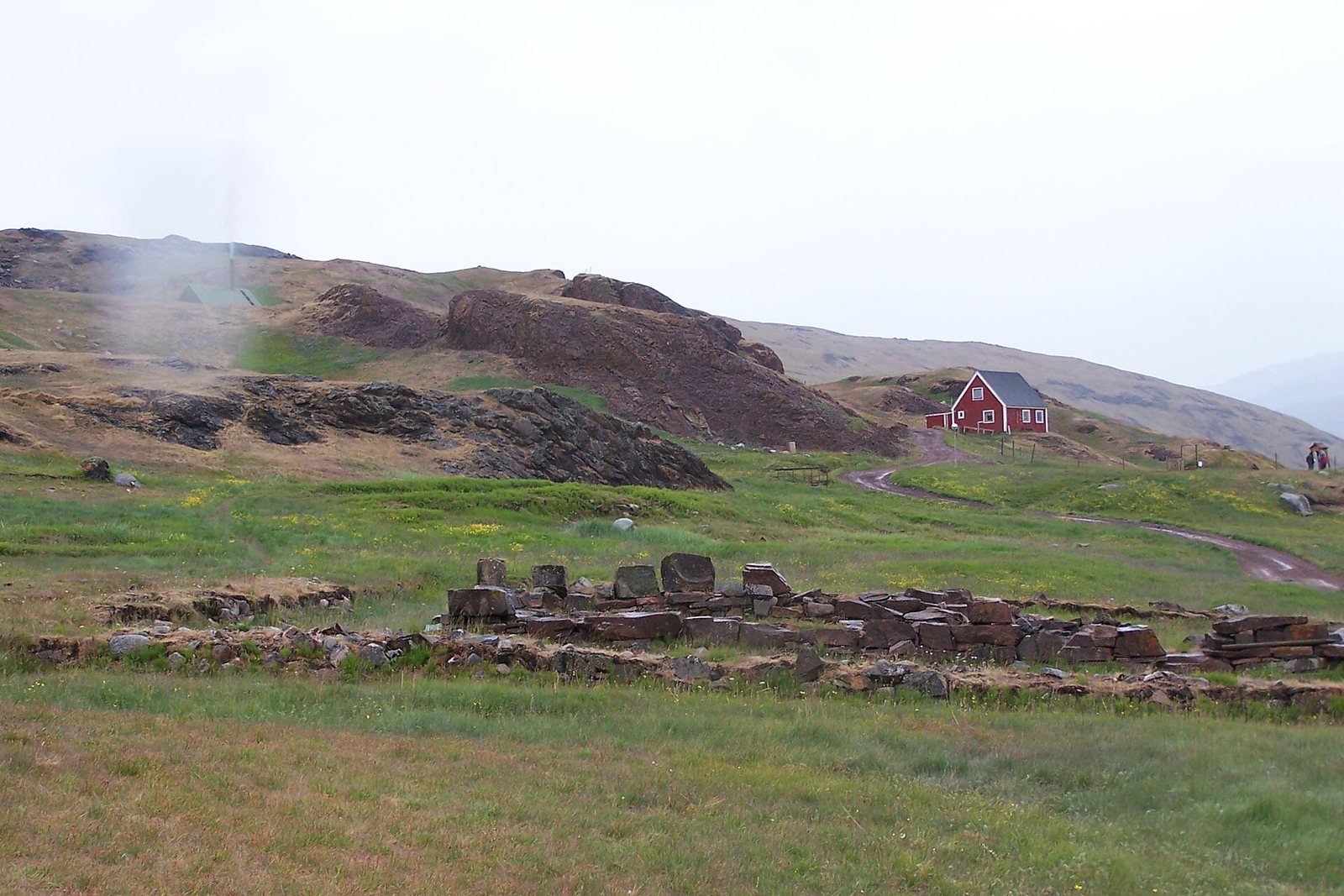
Erik the Red (Old Norse Eiríkr rauði) was the Icelander who explored Greenland from around 982 and founded its first permanent Norse settlement around 985/986 – though Gunnbjörn Úlfsson had sighted the island before him, and Palaeo-Eskimo peoples had lived there for millennia. Erik arrived as an outlaw: first his family fled Norway after killings, then he was sentenced in Iceland. He turned three years of exile into a colony that lasted almost five centuries. Here is what the sources actually say, what excavations show, and where the legend runs ahead of the evidence.
Most biographies open with a birth. Erik the Red's opens with a court verdict – two of them, in fact. And it closes with a country that still carries the name he gave it. So anyone who asks who discovered Greenland ends up, sooner or later, with this red-haired Icelander. The honest answer is a little more tangled than the school version, and that is exactly what makes the story worth telling.
Before we set sail, a word on sources, because Erik makes no sense without them. Everything we know about him as a person comes from Icelandic texts of the 12th and 13th centuries. The oldest is the Íslendingabók ("Book of the Icelanders") by Ari Þorgilsson, written between roughly 1122 and 1133. Fuller accounts come from the Landnámabók ("Book of Settlements", a register of Iceland's first settlers), the Eiríks saga rauða (Saga of Erik the Red) and the Grœnlendinga saga (Saga of the Greenlanders). The two sagas are often called the "Vinland sagas"; they were probably written in the 13th century, some two hundred years after the events, and they disagree on many details. So everything below comes with a label: saga, chronicle or spade. For more on the genre, see our overview of the Sagas of Icelanders.
Erik was born around the middle of the 10th century. No source gives a year; modern reference works such as the Store norske leksikon suggest "about 940", others nearer 950. According to Eiríks saga, Grœnlendinga saga and Landnámabók, his home was Jæren (Old Norse Jaðarr), the flat coastal district south of present-day Stavanger, all moorland and pasture. His father was Þorvaldr Ásvaldsson.
Eiríks saga dispatches the family's fate in a single line. In John Sephton's public-domain translation of 1880, father and son moved "from Jadar (in Norway) to Iceland, because of manslaughters". Who was killed, the saga does not say. A man who had killed in Norway and could not settle with the victim's kin did well to put an ocean between himself and the avengers.
The catch was that the good land was taken. Þorvaldr and Erik claimed land on the Hornstrandir in Iceland's far north-west and lived at Drangar – one of the bleakest corners of the island, driftwood and bird cliffs rather than lush valley meadows. How Iceland was organised in those decades is the subject of our article on the Icelanders, their chieftains and the Althing.
After his father's death, Eiríks saga says, Erik married Þjóðhildr, daughter of Jörundr Atlason. The match connected him to a better-placed family, and he moved west to the valley of Haukadalr off Hvammsfjörður. There he cleared land and built a farm still known as Eiríksstaðir.
Then came the chain of events that would take him to Greenland. Landnámabók tells it in most detail. Erik's thralls set off a landslide that damaged a neighbour's farm. A kinsman of that neighbour, Eyjólfr saurr ("the Foul"), killed the thralls in return. Erik answered as everyone expected: he killed Eyjólfr, and a man called Hólmgöngu-Hrafn ("Hrafn the Duellist") as well. Sephton's translation of Eiríks saga notes it tersely: "Eirik slew Eyjolf the Foul; he slew also Hrafn the Dueller". The victims' kinsmen forced Erik out of Haukadalr.
He moved to islands in Breiðafjörður and walked straight into the next quarrel. This time it was about furniture – or more precisely carved high-seat posts (setstokkar) that Erik had lent to a neighbour named Þorgestr. When he asked for them back, Þorgestr refused. Erik took them by force, a fight followed, and two of Þorgestr's sons died along with other men.
The end was legal. Eiríks saga, in Sephton's words, says simply: "Eirik and his people were outlawed at Thorsnes Thing." At the Þórsnesþing, the regional assembly on the Þórsnes peninsula, he was outlawed. What a thing was and how cases were heard there is explained in our article on the Thing. The usual interpretation is that this was "lesser outlawry" (fjörbaugsgarðr), three years' banishment from Iceland. The sources do not use the technical term, but the length fits what followed: Erik stayed away three years and then returned unmolested.
Erik was not sailing into a total blank. A story circulated in Iceland about Gunnbjörn Úlfsson, son of Úlfr kráka ("Crow"). According to Landnámabók and Eiríks saga, he had been driven off course on his way to Iceland, far to the west, and had sighted land and small islands thereafter called Gunnbjarnarsker, "Gunnbjörn's skerries". No source dates the voyage precisely; the early 10th century is the usual guess. Tradition does not say that Gunnbjörn ever went ashore.
Landnámabók also records a second attempt: a man called Snæbjörn galti is said to have sailed to Gunnbjarnarsker with companions and wintered there. Modern accounts often date it to the 970s, but that is a reconstruction, not something the source states.
So if you want to know who "discovered" Greenland, you need at least three answers: Gunnbjörn, who saw it first; Erik, who explored and settled it; and the people who had lived there thousands of years before. Ari Þorgilsson notes in Íslendingabók that Erik's people found traces of earlier inhabitants in both east and west – remains of dwellings, fragments of skin boats and stone tools. He linked them to the people the Greenlanders called Skrælingar. Today those traces are attributed to Palaeo-Eskimo cultures such as the Dorset; the Thule culture, ancestors of today's Inuit, reached Greenland later. The story of those encounters is told in our article on the Norse Greenlanders.
By the usual reckoning the sentence fell in 982. Erik fitted out a ship. The route ran west from Snæfellsjökull. He struck Greenland's east coast, where ice and glaciers reach the sea, followed it south, rounded the southern tip and worked his way up the west coast. How anyone crossed the North Atlantic without a compass is the subject of our piece on Viking navigation.
Eiríks saga gives a small itinerary in which every place carries Erik's name. He spent the first winter on Eiríksey ("Erik's Island"), the second on the Eiríkshólmar near Cape Hvarf at the southern tip, and in the third summer sailed far to the north. Along the way he named fjords and landmarks – Eiríksfjörður (today Tunulliarfik) is the most famous. He was looking for grazing: sheltered fjord heads with grass and fresh water.
And he found it. The inner fjords of south-west Greenland are still the only part of the island where sheep are farmed. Erik had not lied. He had simply been selective about what he mentioned.
In the summer of 985 Erik was back in Iceland, recruiting settlers. The centrepiece of his campaign was the name. The oldest source, Íslendingabók, says in effect (our own rendering): he gave the land a name and called it Greenland, and said that people would be much more eager to go there if the land had a good name. Eiríks saga repeats it almost word for word.
"Because," said he, "men will desire much the more to go there if the land has a good name."Eiríks saga rauða, ch. 2, trans. J. Sephton, Liverpool 1880 (public domain)
What stands out is that Ari, writing around 1125, already presents the name as a deliberate choice rather than a plain description. Whether Erik really calculated like that, or whether Icelanders two centuries later wanted a neat explanation, cannot be settled. Either way, the name was not pure invention: in summer the inner fjords really are green.
The pitch worked. The following summer – according to Landnámabók "fifteen winters before Christianity was made law in Iceland", so around 985 or 986 – a fleet left Breiðafjörður and Borgarfjörður. Íslendingabók counts "fourteen or fifteen winters" before Iceland's conversion in the year 1000 and cites an informant who is said to have sailed with Erik himself.
The texts disagree on the number of ships. Landnámabók gives 25 ships, of which 14 arrived; some were driven back, others were lost. The Grœnlendinga saga in Flateyjarbók speaks of 35 ships, again with 14 arrivals. The 25 from Landnámabók is the figure usually quoted; the 14 arrivals appear in both. The kind of vessel that could manage this is described in our piece on Viking ship types: these were high-sided cargo ships of the knarr type, not warships. Eleven ships out of twenty-five failed to arrive – the Greenland run was a wager with lives as the stake.
Erik took the best piece: the inner Eiríksfjörður. His farm was called Brattahlíð, "steep slope". Its ruins lie at the modern settlement of Qassiarsuk on Tunulliarfik, across the water from Narsarsuaq airport, on a moraine plain about three kilometres long. More than sixty Norse structures have been recorded there, spread over several farm groups.
Around Brattahlíð grew the Eastern Settlement (Eystribyggð) in the area of today's Qaqortoq and Narsaq – "eastern" is misleading, since it lies in the south of the west coast. Some five hundred kilometres further north the smaller Western Settlement (Vestribyggð) grew up in the fjords around present-day Nuuk. According to Landnámabók, Erik also owned a farm there, Sandnes.
In this society Erik was what Icelanders called a chieftain: the most respected farmer, host of great feasts, arbiter of disputes. He was no king, and there was none. Greenland took over Icelandic institutions with its own thing; only in 1261 did the Greenlanders submit to the Norwegian king. What the settlers lived on is covered in more depth in our article on what the Vikings ate – although in Greenland the menu shifted dramatically, as we will see.
According to the sagas, Erik and Þjóðhildr had three sons – Leifr, Þorvaldr and Þorsteinn – and a daughter, Freydís. Leif became more famous than his father, and his voyages have their own article: Leif Erikson. Here a different question matters: where did Erik stand on the new faith?
Eiríks saga says that around the year 1000 Leif was baptised at the court of King Olaf Tryggvason in Norway and sent back to Greenland to preach Christianity. Erik was unenthusiastic; Þjóðhildr converted at once and had a little church built, at some distance from the houses. Then comes one of the most human lines in the whole saga, in Sephton's version: "After she accepted the faith, Thjodhild would have no intercourse with Eirik, and this was a great trial to his temper."
Grœnlendinga saga, by contrast, says nothing about Leif's mission. Historians therefore tend to see the mission scene in Eiríks saga as a later embellishment meant to burnish Leif and the missionary king Olaf. That Erik stayed pagan until his death is only implied in Eiríks saga.
A generation later Greenland was unmistakably Christian, and in the 1120s it received its own bishopric at Garðar (today Igaliku).
When and how Erik died is told differently in the two sagas – and here a common account needs correcting. The explicit report of his death is not in Eiríks saga but in Grœnlendinga saga. There Erik at first intends to lead Leif's voyage west, but on his way to the ship his horse stumbles, he falls and hurts his foot. After Leif returns from Vinland, a severe sickness breaks out over the winter among the crew of a shipwrecked man named Þórir, whom Leif had rescued; Þórir and many of his men die. "That same winter Erik the Red also died," the saga says, without ceremony.
The saga gives no year. Modern estimates usually put his death around 1000 to 1003, depending on how Leif's voyage is dated. Eiríks saga, on the other hand, still has Erik alive when the Icelander Þorfinnr Karlsefni winters at Brattahlíð. The two versions cannot be fully reconciled. What is certain is only this: Erik died in Greenland, probably at Brattahlíð, around the turn of the millennium. No grave can be attributed to him. What happened next, westward from Greenland, is told in our article on Vinland.
The sagas end with Erik. Archaeology is only getting started.
First, the settlers' own bones. A major isotope study led by Jette Arneborg of the National Museum of Denmark, published in 2012 in the Journal of the North Atlantic, analysed 437 samples, including 118 Norse individuals from 19 sites. The ratio of certain carbon and nitrogen isotopes in bone shows whether someone lived mainly on land or marine animals. The first generations still ate largely like farmers. Over the centuries the share of marine food rose sharply, above all seals. In the 14th and early 15th centuries some individuals got 50 to 80 per cent of their food from the sea. The Greenlanders were not the stubborn farmers refusing to touch seal or fish that popular books long made them out to be.
Then there is the commodity that made Greenland interesting to Europe: walrus ivory. The Greenlanders hunted walrus in far northern hunting grounds they called Norðrsetr and shipped tusks, often still set in the upper jaw, to Europe. They were carved into croziers, crosses and gaming pieces – the famous Lewis chessmen are walrus ivory. A 2018 study by Bastiaan Star, James Barrett and colleagues used ancient DNA to show that walrus ivory in Europe before the 1120s came mostly from other sources, but afterwards overwhelmingly from Greenland; the authors consider it possible that Greenland was effectively the sole supplier between the 1120s and the 14th century. A follow-up study in 2020 found signs that over time ever smaller animals were taken from ever more remote areas – a hallmark of over-exploitation.
So Erik's colony was not just a farming outpost at the end of the world but a raw-material supplier for Europe's churches – its prosperity hanging on a luxury good.
The Western Settlement was abandoned first, around the middle of the 14th century. A Norwegian cleric named Ívar Bárðarson, who lived in Greenland at the time, reported finding it deserted, with only feral livestock left. The Eastern Settlement held on longer.
The last secure written sign of life is a wedding. In September 1408, in the stone church at Hvalsey, the Icelander Þorsteinn Ólafsson married Sigríðr Björnsdóttir. Letters later attesting the marriage in Iceland survive. Hvalsey church is today the best-preserved Norse ruin in Greenland and part of the UNESCO World Heritage site Kujataa, which since 2017 has protected the farming landscape of South Greenland – Brattahlíð's ruins included.
After that, silence. Radiocarbon dates show that the Eastern Settlement was abandoned around the middle of the 15th century. Why remains disputed. Candidates include the cooler climate of the so-called Little Ice Age, the collapse of the ivory trade, ships from Norway ceasing to come, conflict or contact with the Thule Inuit, drought, and rising sea level flooding coastal pastures – the last two were the subject of studies published in 2022 and 2023. The team around Arneborg and Niels Lynnerup found no trace of sudden catastrophe and think gradual emigration more likely. Probably several factors worked together. The romantic image of the last Vikings starving in the snow, at any rate, is not supported by evidence. The full five-century story is in our article The Greenlanders – five hundred years and an end, and in the wider context of the Vikings in the North Atlantic.
An odd kind of hero story: twice cast out for violence – and yet without him there would have been no Norse society in Greenland, no voyages to Vinland, no five centuries of life on the edge of the ice sheet. For us in the workshop, Erik stands for an idea that runs through many Norse stories: that a defeat can be turned into a beginning. A verdict sends you away – and you come back with a new country.
Who discovered Greenland? According to Icelandic tradition, Gunnbjörn Úlfsson sighted it first after being blown off course on his way to Iceland. Erik the Red explored the coast from about 982 and founded the first Norse settlement around 985/986. Palaeo-Eskimo peoples had lived there long before.
Why is Greenland called Greenland? According to Íslendingabók and Eiríks saga, Erik the Red named it "Green Land" because a good name would attract settlers. The inner fjords in the south really are green in summer.
Why was Erik the Red banished? After killings in Haukadalr and a feud with Þorgestr over borrowed high-seat posts, he was outlawed at the Þórsnes Thing in Iceland – on the usual interpretation for three years.
Where did Erik the Red live in Greenland? On his farm Brattahlíð on Eiríksfjörður, at today's Qassiarsuk in South Greenland. The ruins are part of the Kujataa UNESCO World Heritage site.
When and how did Erik the Red die? According to Grœnlendinga saga he died in the winter after Leif's return from Vinland, when an epidemic broke out – so around 1000 to 1003. No source gives an exact year.
For courage. For remembrance. For legends that live on.
Leif Erikson · Harald Hardrada · Cnut the Great · Rollo of Normandy · Hedeby.
All History & Finds articles →
Some 1,700 years ago a man from the Near East settled in a Germanic village in present-day Thuringia – and rose into …
Read more →Two horns of heavy gold, covered all over with puzzling figures, and on one of them a line of runes in which, for the …
Read more →The Roman Tacitus praised Germanic women as chaste, honoured and even brave at the edge of battle. But above all he was …
Read more →Somewhere a story must begin. For the kingdom of Denmark this beginning is a man named Gorm – Gorm the Old, the first …
Read more →