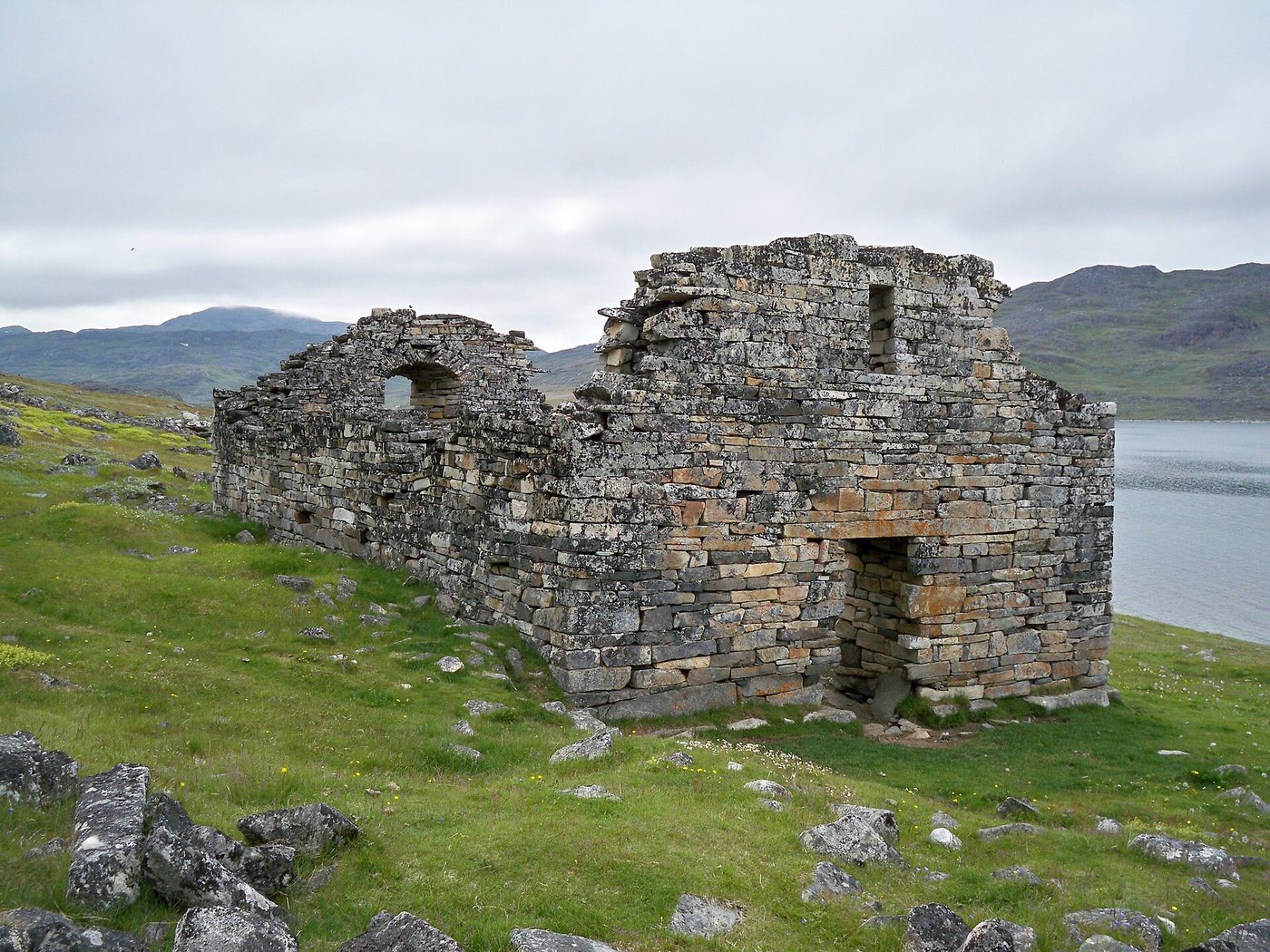
On Sunday, 16 September 1408, an Icelandic man and an Icelandic woman were married in the stone church at Hvalsey. The banns had been read on three Sundays. We know this because years later the couple had the marriage confirmed in Iceland. After that the written sources fall silent about the Norse in Greenland. They had lived there for almost half a millennium, with a bishop, churches and an export in demand across Europe. Why they vanished is still an open question. There are answers. Just not one.
The oldest account of the settlement of Greenland comes from Ari Þorgilsson, who wrote the Book of the Icelanders in the 1120s. He gives the matter a whole chapter, and it opens with a famous piece of reasoning:
Hann gaf nafn landinu ok kallaði Grænland ok kvað menn þat mundu fýsa þangat farar, at landit ætti nafn gott.
"He gave the land a name and called it Greenland, and said people would be keen to go there if the land had a good name."Ari Þorgilsson, Íslendingabók, ch. 6; our translation
The man is Eiríkr inn rauði, Erik the Red, an Icelander from Breiðafjörður. Ari dates his departure to fourteen or fifteen winters before Iceland accepted Christianity, so around 985 or 986. And Ari names his source: a man who had sailed with Erik himself and told the story to Ari's uncle Þorkell Gellisson in Greenland. Norse tradition seldom gets closer to a tenth-century event.
The same chapter holds a second remarkable sentence. Erik and his people found traces of humans in both east and west, fragments of boats and stone tools. From this it was concluded that the same people had been there who lived in Vinland and whom the Greenlanders call Skrælingar. Archaeology bears Ari out: before the Norse, the south-west coast had been inhabited by Palaeo-Eskimo cultures whose remains the settlers were bound to find.
The background is told by the Book of Settlements and Eiríks saga rauða. Erik was outlawed for three years for killings, used the time to explore the west coast, and then came back to recruit settlers. According to the Book of Settlements, twenty-five ships set out in the summer of the emigration; fourteen arrived, the rest turned back or were lost. How many people that was, nobody knows.
Two settlement areas grew up, soberly named after the points of the compass. The Eastern Settlement, Eystribyggð, lay among the fjords of the southern tip around today's Qaqortoq and Narsaq. Here Erik took land at Brattahlíð, today's Qassiarsuk. The Western Settlement, Vestribyggð, lay some 500 kilometres further north in the fjords around today's Nuuk. Archaeologists have recorded about 500 farm sites in the Eastern Settlement and around 95 in the Western. Population is an estimate: 2,000 to 3,000 at the peak is often quoted, with recent work leaning towards about 2,500.
From Greenland people sailed further west. That is the story of Leif Eriksson and Vinland, which we tell elsewhere, along with the wider arc of the Vikings in the North Atlantic.
Erik's wife Þjóðhildr is said to have been baptised and to have built a small church, according to the saga. In 1961 the remains of a tiny turf church with a churchyard were found at Qassiarsuk. Whether it is hers cannot be proven, though the identification is tempting. Later there were some sixteen churches in the two settlements, plus chapels.
Greenland got its own bishop in the twelfth century. The first, Arnaldr, arrived in 1126 and resided at Garðar, today's Igaliku. How it came about is told in a short thirteenth-century narrative, the Grænlendinga þáttr: a Greenlander named Einarr Sokkason went to Norway and brought the king walrus tusks and a live polar bear to win him over to the idea of a bishop. That is tradition, not a record. But it tells us what Greenland paid with.
The church grew rich. By the mid-fourteenth century it apparently owned the largest farm and much of the best grazing. The church at Hvalsey, built of fieldstone in the early fourteenth century and measuring about sixteen by eight metres, is the best-preserved Norse ruin in Greenland. In 1261 the Greenlanders submitted to the Norwegian king, a year before the Icelanders began to do the same. The last bishop who actually lived in Greenland died in 1377. His successors were consecrated but never set foot on the island.
What could Greenland offer Europe? It lacked timber and iron and could hardly grow grain. But it had walrus. Their tusks were a sought-after raw material in the high Middle Ages for carvings, gaming pieces, crucifixes and croziers. Add walrus hide, cut into strong ship's ropes, polar bear skins, narwhal tusks sold as unicorn horn, and gyrfalcons.
The hunting took place far north of the settlements, in an area the sources call Norðrseta. How far people went is shown by a small stone. In 1824 a runestone was found on the island of Kingittorsuaq near Upernavik, almost at 73 degrees north. On it three men, Erlingr Sighvatsson, Bjarni Þórðarson and Eindriði Oddsson, report that they built cairns on the Saturday before Rogation Day. The stone is usually dated to the thirteenth or early fourteenth century.
How important Greenland was to this trade was shown in 2018 by a study led by James Barrett and Bastiaan Star. It examined ancient DNA from walrus remains found at trading sites from Dublin and London to Schleswig, Bergen and Sigtuna. The result: from the twelfth century onward, the ivory came almost exclusively from a walrus lineage found only in the waters between Greenland and Canada. Greenland had the European market in its hands. After 1400 hardly any imports are found.
The settlers came as livestock farmers with cattle, sheep and goats. A farm's standing depended on its cows. The bones, however, tell a different story. In 1999 Jette Arneborg and colleagues measured carbon isotopes in skeletons from churchyards, which reveal whether a person lived mainly on land or sea food. Their finding: around 1000 the marine share of the diet was about 20 per cent, towards the end about 80.
A larger follow-up study of 80 individuals, published in 2012, refined the picture. Even the first generations ate a lot from the sea, above all seals. By the fourteenth century seals made up 50 to 80 per cent of the diet. The old idea that the Greenlanders perished because they clung to a European farming life does not hold up. They adapted. The question is whether it was enough.
The same research group points to another finding: young women are strikingly rare in the late graves. That may be chance in the sample. But it also fits the idea that it was the young who left.
The first news of the end concerns the Western Settlement. It comes from Ívar Bárðarson, a Norwegian cleric who worked for the bishop in Greenland from 1341 and returned to Norway in the 1360s. He says he sailed with others to the Western Settlement to drive out the Skrælings, but found no people there, neither Christian nor heathen, only cattle and sheep running wild.
The account has a catch. The original is lost; what survives is a sixteenth-century Danish translation, known from seventeenth-century copies and probably containing later additions. Archaeology supports the core: at the farm known to researchers as "Gården under Sandet", animals were left behind, and the settlement was abandoned around the middle of the fourteenth century. Whether people moved away, starved or were killed, the evidence does not clearly show.
Under the year 1379 Icelandic annals report that Skrælings attacked the Greenlanders, killed eighteen men and carried off two boys. It is the only report of its kind. The Thule Inuit had been moving south since the thirteenth century and now lived in the same fjords. What their coexistence looked like – trade, conflict or both – is disputed.
We owe the last scene to a ship that went off course. In 1406 a ship bound for Iceland was driven off course to Greenland. On board were Icelanders, among them Þorsteinn Ólafsson, who married Sigríðr Björnsdóttir there. The wedding took place in the church at Hvalsey on the Sunday after the feast of the Exaltation of the Cross, 16 September 1408. The couple stayed until 1410, travelled via Norway to Iceland and had witnesses confirm the lawfulness of their marriage there. The letters about it, written between 1409 and 1424, are the last written news of the Greenlanders.
A darker report comes from the same setting. According to an Icelandic annal, in 1407 a man named Kolgrímr was burned at Hvalsey for having seduced a married woman by sorcery. So the community still worked: with church, banns and court.
After that the record breaks off. The latest radiocarbon dates from the Eastern Settlement reach into the first half or the middle of the fifteenth century. The clothing from the churchyard at Herjolfsnes, excavated in 1921, shows cuts like those worn in Europe. Contacts continued until late, but they grew rarer.
Hardly anyone today names a single cause. There were factors that worked together, and their weight is judged differently.
Climate. From the late thirteenth century the North Atlantic grew cooler and less predictable. Shorter summers mean less hay, and less hay means fewer animals through the winter. Recent studies also point to drought and rising sea levels.
Trade. Walrus tusks lost value as African ivory reached Europe more easily and tastes changed. At the same time, from 1349 the plague hit Norway, Greenland's only trading partner, hard. The ships stopped coming.
Isolation and emigration. A small population that loses its young people cannot hold on. Those who left sent no word back. The absence of traces of fighting and the cleared-out houses fit a slow departure better than a catastrophe.
The Inuit. From the fourteenth century they lived as neighbours of the Norse. The report of 1379 shows violence; other finds suggest exchange. Destruction by war cannot be demonstrated.
In his 2005 book Collapse, Jared Diamond painted a society that failed because of its own values. Many archaeologists now think that too simple, not least because of the isotope results. On one point there is agreement: the Greenlanders were not helpless victims. They held out for more than four hundred years in a place where Europe ended.
Archaeological evidence is the two settlements with hundreds of farms, the churches with Garðar and Hvalsey, the Kingittorsuaq runestone, the shift to marine food, Greenland walrus ivory in Europe and the end of the settlements in the fourteenth and fifteenth centuries.
Contemporary sources are the church documents, the Icelandic annals and the letters about the wedding of 1408. Ívar Bárðarson's account is close in time but survives only in a later translation.
Later tradition is Ari's chapter on Erik, the Book of Settlements, the Vinland sagas and the Grænlendinga þáttr with its polar bear for the king.
Modern interpretation covers every explanation of the end. None is proven; several are well founded.
What remains is a wedding in a stone church by a fjord and a farewell nobody wrote down. Where the settlers came from we tell with the Icelanders. For courage. For memory. For legends that live on.
Erik the Red · Vinland · The Vikings in the North Atlantic – Iceland, Greenland & Vinland · The Icelanders · The Faroese · Indigenous DNA in Iceland.

