The Faroes carry their history in their name. Færeyjar means sheep islands, and there were sheep there already when an Irish scholar wrote about the islands in the north around 825. Who had brought them, he apparently did not know. The Icelanders who wrote down the history of the Faroese three hundred years later named a man called Grímr Kamban as the first settler. For some years now, burnt barley grains and sheep DNA from a lake have argued otherwise. The Norse were not the first. But they made the islands what they are today.
The Irish monk Dicuil lived at the Carolingian court and around 825 wrote a book on the measurement of the world, Liber de mensura orbis terrae. Most of it is copied from ancient authors. In a few places, though, he speaks from his own knowledge, and one of them concerns islands north of Britain that can be reached in two days and nights under full sail:
… in quibus in centum ferme annis heremitae ex nostra Scotia navigantes habitaverunt, sed, sicut a principio mundi, desertae semper fuerunt, ita nunc causa latronum Normannorum vacuae anachoritis, plenae innumerabilibus ovibus ac diversis generibus multis nimis marinarum avium.
"… on which for almost a hundred years hermits lived who had sailed there from our Scotia. But just as they had always been uninhabited since the beginning of the world, so now, because of the Norse robbers, they are empty of anchorites, full of countless sheep and of very many kinds of seabirds."Dicuil, Liber de mensura orbis terrae VII, 3; our translation
By "Scotia" Dicuil means Ireland; that is what the island was called then. Which islands he is describing he does not say. Most scholars think of the Faroes, because distance, position and sheep fit. It cannot be proven. If it is right, we have a source from the time itself: hermits from Ireland who gave way to the Norse, and sheep that someone must have brought.
For a long time Dicuil's account was a nice anecdote without any finds to back it. That has changed. On the island of Sandoy, at the site of Á Sondum, a team led by Mike Church and Símun V. Arge examined layers of windblown sand. In them lay burnt peat ash with charred barley grains, waste from domestic hearths. The grains were radiocarbon dated. The 2013 study found two phases, one in the fourth to sixth and one in the sixth to eighth centuries. People used grain and burned peat there three to five hundred years before the Norse.
In 2021 a second, independent finding followed. A team led by Lorelei Curtin and Jostein Bakke cored the bed of the lake Eiðisvatn on the island of Eysturoy. In the sediments they found sheep DNA and faecal biomarkers, molecules from the digestive tracts of mammals. Both appear around 500, with a range of roughly 370 to 610. Sheep do not swim across the Atlantic. Someone brought them.
Who these people were, nobody knows. The obvious candidates are people from the British Isles, Irish or Scots, perhaps the hermits Dicuil mentions, perhaps farmers. Graves, houses or names from this period are still missing. The excavators suspect the traces lie beneath the Viking Age farms or were destroyed by them.
The Faroese themselves left no medieval historical writing. We know their early history from the Færeyinga saga, written by an Icelander around 1200 to 1220. It begins briefly:
Maðr er nefndr Grímr kamban; hann byggði fyrstr manna Færeyjar.
"There was a man called Grímr Kamban; he was the first to settle the Faroe Islands."Færeyinga saga, ch. 1; our translation
Then we are told that in the days of Harald Fairhair many fled his tyranny, some of them to the Faroes. By this sequence Grímr comes before Harald. His nickname is not a Norse word. It has been explained from Gaelic; if so, Grímr was a man from the Norse-Gaelic world of the Irish Sea, like the Gall-Goídil. That is a well-founded guess, nothing more. The saga itself knows nothing about him beyond its first sentence.
A second trail points the same way. Laxdæla saga says that Aud the Deep-Minded, on her voyage from Scotland to Iceland, stopped in the Faroes and married off her granddaughter Ólöf there. From her, it says, descended the most distinguished family of the islands, the people of Gøta. That too is saga, but it shows how the Icelanders saw the connections: the Faroes lay on the route between Norway, Scotland, Ireland and Iceland.
Genetics confirms the mixture in its own way. Studies of present-day Faroese show mainly Scandinavian origin in the paternal lines and mainly British and Irish origin in the maternal lines. The difference is even greater than in Iceland. The men came mostly from the north and many of the women from the west, however that happened in each case.
How these settlers lived is best shown by Toftanes near Leirvík on Eysturoy. Between 1982 and 1987 an entire farm was excavated here: a longhouse with thick, curved walls of stone and turf around a timber frame, benches along the walls, a hearth about five metres long in the middle, and several outbuildings. The radiocarbon dates point to the tenth century.
Because the ground was waterlogged, wood survived, and that makes Toftanes special. There were bowls, gaming boards for hnefatafl and nine men's morris, cords of twisted juniper and two small wooden crosses. There were also hundreds of pieces of soapstone vessels. There is no soapstone in the Faroes; the pots and bowls came from Norway. The people here were farmers who kept sheep, grew some barley, fished and caught birds, and got their household goods from across the sea.
Other finds fit the picture. At Tjørnuvík in the north of Streymoy a ringed pin of a type made in Dublin around 900 was found in a woman's grave in 1956. At Sandur on Sandoy the islands' only known silver hoard came to light in 1863, with 98 coins of the eleventh century. The Faroes were not remote. They were a waypoint.
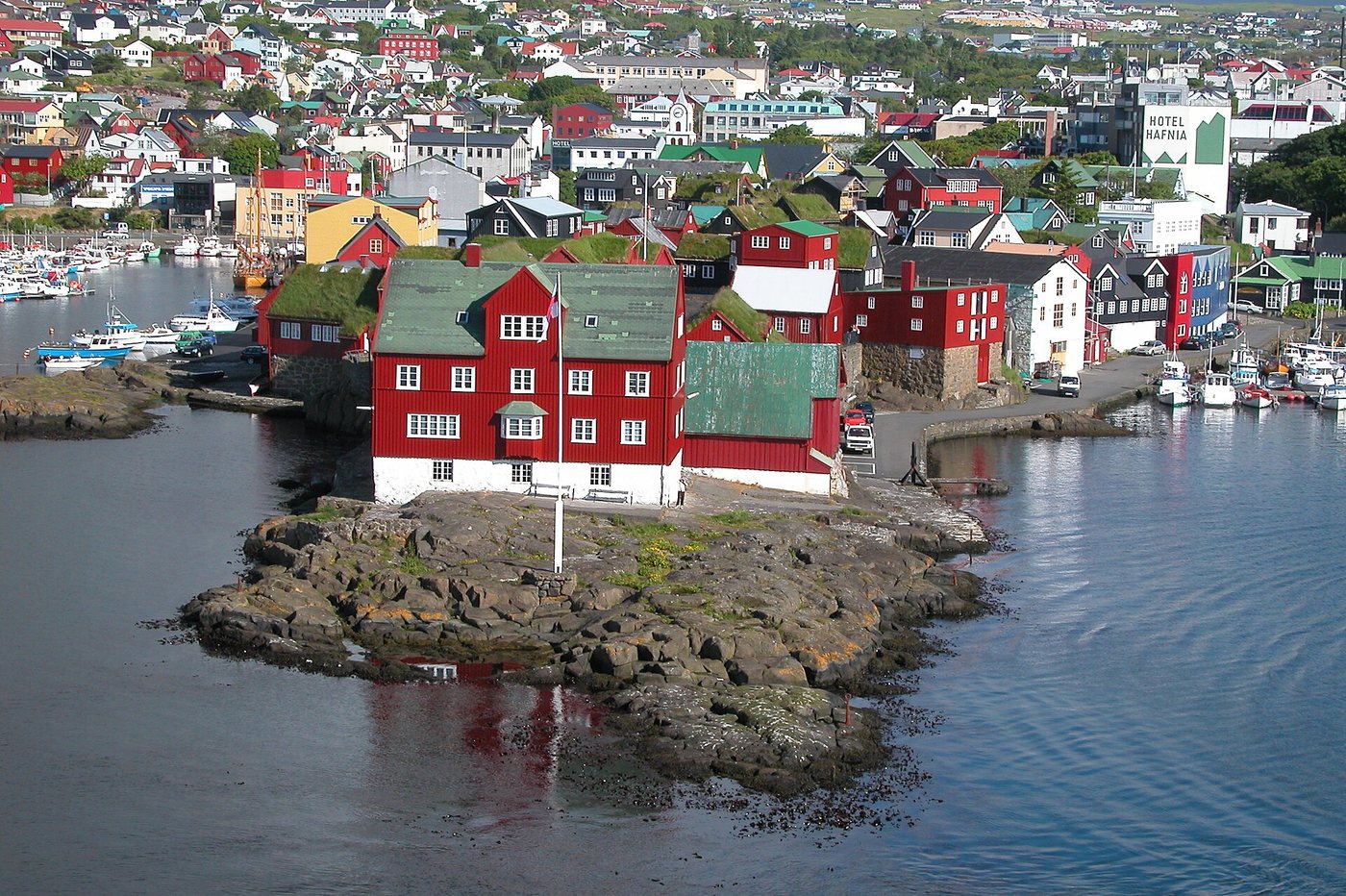
Like Iceland, the Faroese settled their affairs at an assembly. According to the saga it met at Þórshöfn on Straumey, today's Tórshavn on Streymoy. The meeting place was a flat rocky tongue in the harbour still called Tinganes, assembly headland. The Faroese government sits there to this day.
You often read that the Faroese Løgting is one of the oldest parliaments in the world. What is true is that there has been an assembly on Tinganes since the Middle Ages and that the tradition never quite broke off. But there is no founding year like Iceland's 930, and what the Viking Age assembly actually was we know almost only from the saga. For more on the assembly and law in the north, see the Icelanders.
The Færeyinga saga does not survive as a book of its own. It is embedded in sections of larger works on the Norwegian kings, above all the great saga of Olaf Tryggvason and Flateyjarbók, an Icelandic compilation manuscript of the late fourteenth century. It was Carl Christian Rafn who in 1832 assembled the pieces into a continuous saga. What we read today is thus a modern reconstruction from fourteenth-century manuscripts.
The story is a feud across two generations. On one side stands Þrándr í Gøtu, a clever, grasping, dangerous man of the Gøta family. On the other stands Sigmundr Brestisson of Skúvoy. As boys, Sigmundr and his cousin Þórir lose their fathers in a feud in which Þrándr has his share, and he has them taken out of the country. Sigmundr grows up in Norway, serves Earl Hákon, goes raiding and comes home a made man. It is a revenge story, but one in which Þrándr never quite loses. The saga dislikes him and admires him all the same.
According to the saga, Sigmundr was baptised at the court of King Olaf Tryggvason in Norway and charged with converting the Faroes. The date 999 comes from modern chronology; the saga counts in kings, not years. Sigmundr put the message to the assembly and was nearly killed for it. So he changed his method. He sailed with armed men to Gøta, broke into Þrándr's house by night and gave him the choice: baptism or death. Þrándr was baptised. How seriously he meant it, the saga leaves open, and it does so on purpose.
The quarrel went on. Around 1005, by modern reckoning, Þrándr's men attacked Sigmundr at night on Skúvoy. He escaped into the sea with two companions and swam for the neighbouring island of Suðuroy. The companions drowned; he reached the shore at Sandvík exhausted. There a farmer called Þorgrímr killed him for his gold arm-ring. Later, the saga says, it was Þrándr who uncovered the murder. This is great storytelling, written two hundred years later in Iceland. Whether the conversion happened like this, or whether Sigmundr existed as described, cannot be checked. Archaeology shows only that Christian signs such as the wooden crosses of Toftanes were on the islands before the year 1000.
The first document to deal with the Faroes themselves is not a heroic poem but a grazing ordinance. On 28 June 1298 Duke Hákon Magnússon, later King Hákon V of Norway, issued the Seyðabrævið, the Sheep Letter. It had been drafted by Bishop Erlendur of the Faroes and Sjúrður, the lawspeaker of Shetland. It supplements the Norwegian national law for the islands' particular conditions.
Its content is sober and revealing. Who owns a sheep before it is slaughtered? How are animals marked? Who is liable when a dog kills sheep? How much livestock may graze a common pasture? How is a stranded whale divided? Add rules for tenants and farmhands. It is the portrait of a society whose wealth ran about the hillsides on four legs. Two medieval manuscripts survive, one in the Faroese National Archives in Tórshavn, one in Lund University Library. Parts of its rules remained in force into the nineteenth century.
That a lawspeaker from Shetland helped write it is no accident. The islands of the North Atlantic, from Orkney by way of Shetland to the Faroes, belonged to a Norwegian legal and church world held together across the sea.
Archaeological evidence is human activity and sheep from the fourth to sixth centuries, Norse settlement with farms like Toftanes by the tenth century at the latest, contacts with Norway and Dublin, and Christian symbols before 1000. Genetics shows Norse fathers and many mothers from the British Isles.
Contemporary is Dicuil's account of around 825, if it refers to the Faroes, and for the later Middle Ages the Sheep Letter of 1298.
Later tradition is the Færeyinga saga, written around 1200–1220 in Iceland and preserved in fourteenth-century manuscripts: Grímr Kamban, Þrándr, Sigmundr, the baptism at sword-point and the murder on the beach at Sandvík.
Modern interpretation covers the identity of the first settlers, Grímr's Gaelic background and the year 999.
What remains are islands where the sheep are older than the history, and a saga that made a people out of a feud. More on the neighbours to the west in our piece on the Vikings in Ireland, Scotland and the Isles. For courage. For memory. For legends that live on.
The Icelanders · The Greenlanders · The Earls of Orkney · The Gall-Goídil · The Vikings in the North Atlantic – Iceland, Greenland & Vinland · Aud the Deep-Minded.