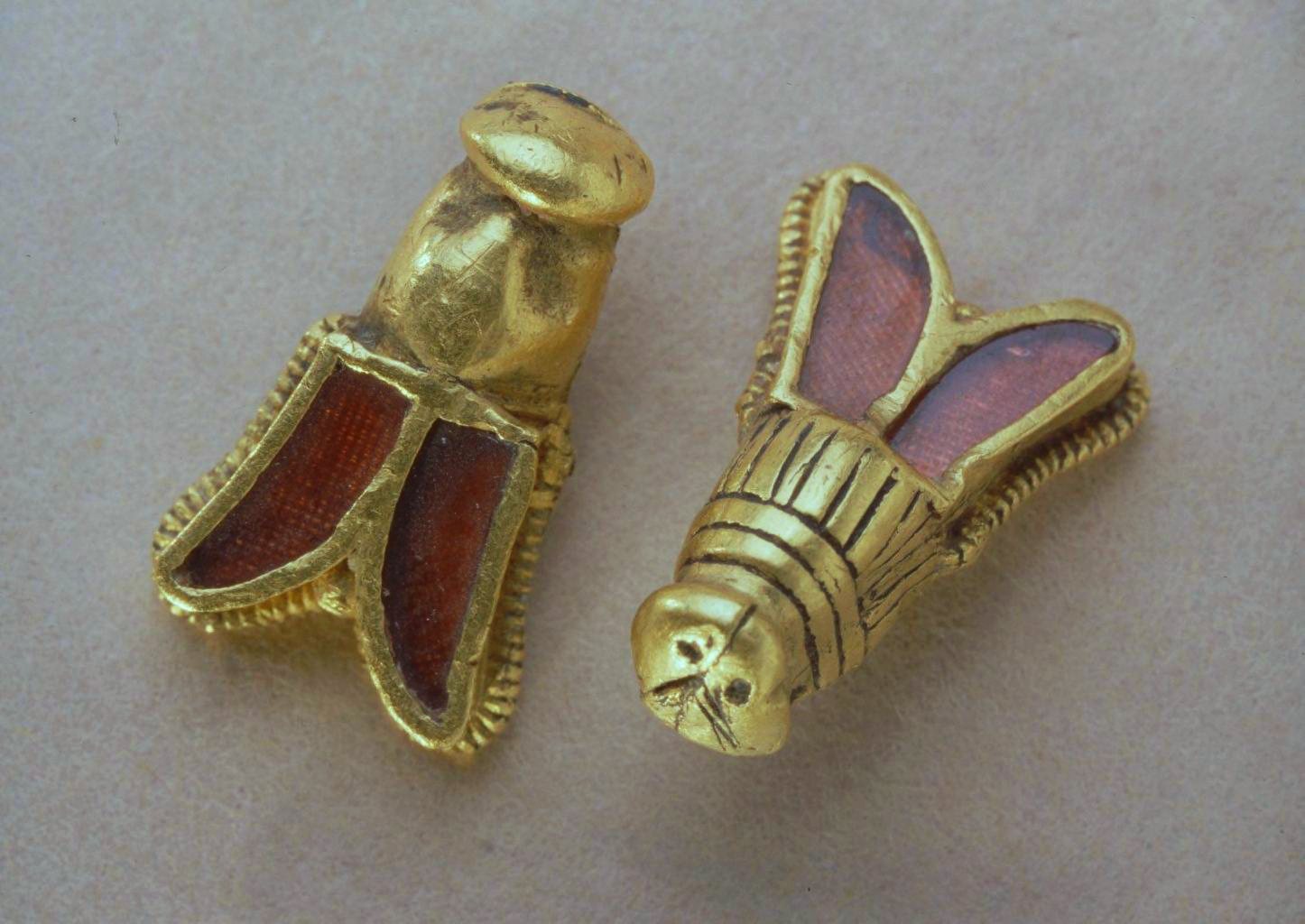
Image credit (header image): “Abeilles de Childéric Ier”, Unknown authorUnknown author, public domain (Wikimedia Commons).
Step out of our workshop in Alsdorf and look west, and you are looking at the heartland of a power that grew out of a loose crowd of Rhine tribes and in the end reached from the North Sea to Rome. The Franks are not just one Germanic people among many. They are what was left after Rome ended - and the material Europe was built from.
And they are thoroughly misunderstood. Not a blood-people. Not a tribe. Not "the Germans" and not "the French". What the Franks actually were can be reconstructed well enough from the sources - you only have to be willing to give up a few comfortable sentences.
In the 3rd century a new collective name turns up in Roman texts: Franci. Before that it appears nowhere. That is remarkable, because Rome had known the tribes on the Rhine fairly precisely since Caesar and had a separate name for each of them.
So the name does not appear because a new people had migrated in, but because something new had formed on the lower right bank of the Rhine for which the old names no longer fitted. From the Roman point of view what stood there were no longer Sugambri, Chamavi, Bructeri and Chattuarii, but "the Franks".
This is where most accounts get sloppy. The Franks were a confederation, not a tribe: a joining-together of smaller groups on the lower Rhine that grew over generations and that new groups kept joining. Sugambri, Chamavi, Bructeri, Chattuarii, Ampsivarii, later the Salians - all of them disappear into this one name.
The Romans soon distinguished two large blocks: the Salian Franks in the north-west, in Toxandria between Meuse and Scheldt, and the Rhenish Franks or Ripuarians around Cologne, whose territory reached into our region. Anyone living in the Rhineland today lives on Ripuarian ground - the name survives in the name of the dialect.
The Franks begin as a problem. In the 3rd century they cross the Rhine, plunder Gaul and push as far as Spain. Rome answers the way Rome answers: with campaigns - and then with treaties.
Because the empire needed soldiers. Whole Frankish groups were settled on imperial soil as foederati, on condition that they supply troops. In 358 the emperor Julian allowed the Salian Franks to stay in Toxandria as allies. That was not weakness alone but calculation: securing the frontier with the people who had been threatening it.
And then comes the part you rarely read in school books. Frankish officers rose right to the top of the late Roman army. Arbogast, a Frank, became magister militum of the West, installed an emperor in 392 and in effect brought down another. Bauto, also a Frank, was consul in 385 - the highest civil office in the empire. Richomeres, his relative, likewise.
In 1653 workmen in Tournai struck a grave that changed everything. In it lay weapons, gold ornaments, horse harness, some three hundred small golden cicadas or bees inlaid with garnet - and a signet ring showing a long-haired warrior with the legend CHILDIRICI REGIS: "of King Childeric".
It was the grave of Childeric I, father of Clovis, who died around 481/482. So for the beginning of the Merovingians we have not only stories but a find. And it shows a man who was both: a Germanic warrior king and a Roman office-holder - the grave goods mix Frankish and late Roman design as though that were self-evident. To him it evidently was.
Most of the treasure was stolen from the Paris national library in 1831 and melted down. What survives are drawings, a few original pieces and replicas. By then the golden bees had already made a second career: Napoleon took them into his coat of arms - he wanted to place himself in a line older than that of the Bourbons.
His son Clovis - German Chlodwig, and essentially the same name as Ludwig or Louis - took over part of the Salian Frankish confederation around 481. When he died thirty years later, the Frankish kingdom existed.
486: Soissons. Clovis defeats Syagrius, the last Roman power-holder in northern Gaul. Roman rule north of the Loire therefore ends not in a collapse but in a battle against a Frank.
To this period belongs the best-known anecdote in Frankish history: the vase of Soissons. A warrior smashes a valuable vessel rather than let the king have it - booty was drawn by lot, after all, and the king is only first among equals. Clovis says nothing. A year later, at the muster, he finds the same man's equipment wanting, throws it on the ground, and as the warrior bends for it, splits his skull. "So you did to the vase at Soissons."
The story is in Gregory of Tours, written some eighty years after the events. Whether it happened that way nobody knows. What it shows is historically interesting all the same: the shift from a war-band king bound by rules to a ruler standing above them.
The Alemannic war. Clovis's victory over the Alemanni is traditionally attached to Zülpich - Tolbiacum. Except that Gregory of Tours, the main source, names no place at all. The link comes from later tradition. That there was a battle and that the Alemanni lost is certain; where exactly is not.
The baptism. Clovis was baptised at Reims by bishop Remigius - and as a Catholic, not an Arian like most other Germanic kings of his day. It was the most consequential decision of his life: it made him the legitimate lord in the eyes of the Gallo-Roman population and the bishops, while Visigoths and Vandals remained heretics to their own subjects. The year is disputed - 496, 498/499 or as late as 508 have all been argued.
507: Vouillé. Clovis defeats the Visigoths under Alaric II and takes almost all of southern Gaul from them. With that the kingdom is complete.
The Lex Salica. Frankish law was written down in his time - a sober catalogue of fines for manslaughter, theft and injury, down to the price of a stolen pig. No heroic epic, but one of the best sources for everyday life we have from this period.
Clovis died in 511 and the kingdom was divided among his four sons. That was not a blunder but Frankish inheritance law: a kingdom was property, and property is divided among the sons. Which is exactly why the pattern repeats for centuries - division, war between brothers, reunification, next division.
Out of these divisions grow the names that will stay: Austrasia in the east, centred on the Meuse, Moselle and Rhine - our region - Neustria in the west around Paris, and Burgundy in the south-east.
One picture clings to the late Merovingians: soft idlers carted about the country on ox-waggons while the mayors of the palace governed. The rois fainéants, the do-nothing kings.
That picture has an author and a purpose. It stands like that in Einhard, biographer of Charlemagne - written after the Carolingians had deposed the Merovingians. Whoever topples a dynasty has to explain why it deserved toppling. The ox-waggon is good propaganda.
Scholarship sees it more carefully: the Merovingians lost power because the nobility and the mayors of the palace systematically built up their own positions, and because some kings died young or came to the throne as children - not because they were an unfit line. Einhard is worth reading. He is just not worth believing on everything.
Charles Martel, mayor of the palace and de facto ruler, defeated an Arab-Berber army at Tours and Poitiers in 732 - the dating wavers between 732 and 733. The battle has a reputation larger than its documented yield: whether it "saved Europe", as the 19th century liked to write, is disputed; it was probably a large raid rather than a campaign of conquest. What is not disputed is that the victory consolidated Charles's position in the kingdom.
His son Pippin drew the conclusion in 751 and had himself raised to king - with backing from the pope, who answered the question whether the man who actually holds power should not also be called king in the expected way. The last Merovingian was shorn and sent to a monastery. Long hair was the mark of kingship among the Merovingians; taking his hair was the actual removal from office.
Pippin's son is the best-known Frank of all: Charlemagne. And he chose a principal seat that is a quarter of an hour from our workshop.
Aachen was at first one palace among several, but from the 790s it became his permanent residence - for the hot springs, for the central position in the Austrasian heartland, for the good hunting. What was built there was an attempt to build Rome once more: a palace complex with royal hall and chapel, with columns and marble brought in specially from Ravenna and Rome.
The Palatine Chapel, the octagonal core of today's cathedral, still stands. Walk into it and you are standing in a Carolingian building, not a reconstruction. On Christmas Day 800 Charlemagne was crowned emperor in Rome; the governing was done from here.
And it was not only about power. At Charlemagne's court, texts were copied, collected and standardised on a large scale. The Carolingian minuscule, the script developed there, is the reason we write capitals and lower case the way we do. A considerable part of ancient literature survives only because it was copied once more in this period.
Here the admiration stops, and we say so plainly, because it belongs to our subject.
From 772 to 804 Charlemagne waged war against the Saxons - over thirty years, with the declared aim of subjection and conversion. It began in 772 with the destruction of the Irminsul, a sanctuary whose exact form we do not know. Whether it was a cult pillar or the emblem of a central Saxon assembly place is an open question in scholarship - in the second case the blow struck not only the faith but the political assembly of the Saxons.
What followed was religious law with the death penalty. The Capitulatio de partibus Saxoniae made it a capital offence to kill a priest, to desecrate a church, to eat meat in Lent - and to cremate the dead in the old way instead of burying them in a Christian cemetery. A funeral rite that had been self-evident for centuries was declared a capital crime.
And then there is Verden, 782. The Frankish royal annals report that Charlemagne had 4,500 Saxons beheaded in a single day on the river Aller. If that is accurate, it is one of the largest mass executions of the early Middle Ages.
Here we have to stay honest, even if it takes the edge off the outrage. Scholarship has debated this report for a long time. Many hold the figure of 4,500 to be exaggerated, as medieval numbers often are. No archaeological trace of a massacre on that scale has ever been found at Verden. And there is the suggestion that in the manuscript tradition delocabat - "he resettled" - may have become decollabat - "he beheaded". Against that stands the fact that resettlements of Saxons are reported elsewhere explicitly as such, and that a scribal error of this kind is hard to explain.
For us this is not a marginal topic. A great deal of what we write about in this blog - the gods, the signs, the burial customs - did not simply fade. Across much of the continent it was pushed out of daily life by laws and armies. That so much of it survived anyway, in place names, in weekdays, in customs reinterpreted as Christian, is the genuinely astonishing part. More in our article on the Christianisation of the Germanic peoples.
The Franks left something behind in weaponry that is named after them. The francisca, the Frankish throwing axe, has a short haft and a curved blade drawn upwards. It was thrown before contact - in close formation, at short range, against shields. An axe stuck in a shield makes it useless, and the man behind it stands exposed. Isidore of Seville writes in the 7th century that the axe is called that because the Franks used it.
With it went the ango, a long throwing spear with barbs and an iron shank running far down the shaft - the same principle as the Roman pilum: it could not be pulled quickly out of a shield, and anyone who failed to get rid of it fought with a spear hanging off his arm.
At close quarters they carried the sax, a single-edged fighting knife that came in every size up to the langsax, and - for those who could afford it - the spatha, the long double-edged cavalry sword inherited from the Roman army, in use throughout the migration period. The sword of the Viking Age develops out of it.
And then the hair. Merovingian kings wore it long and uncut as the visible mark of their claim - the reges criniti, the long-haired kings. This was never a question of fashion. How seriously it was meant shows in what happened to the last Merovingian: they shore him. That settled the matter without any blood.
Two country names. Francia became France - the country named after a Germanic confederation although a Romance language is spoken there. And the region of Franconia in southern Germany carries it too.
Words in French. French took a whole basic vocabulary from Frankish: guerre for war, blanc for white, jardin for garden, choisir for to choose. Learn French and you are learning Germanic loanwords along the way.
The language here. The dialect between Aachen, Cologne and Bonn is called Ripuarian in linguistics - after the Rhenish Franks. The Aachen dialect is not an accidental regional sound but a direct continuation of what has been spoken here since the early Middle Ages.
The map. Place names ending in -heim, -ingen, -weiler and -dorf mark Frankish settlement. Look at a road sign in our area and you are often reading Frankish history.
"The Franks came from Troy." This origin legend stands in the Fredegar chronicle of the 7th century and was taken seriously for centuries. It is pure scholarly construction on the Roman model - as Rome attached itself to Troy through Aeneas, so did the Franks. Historical value: none. It is revealing all the same, because it shows what they wanted to attach themselves to.
"The Franks were a people of common descent." No. They were a political alliance that could be joined and that very different groups did join - and in Gaul the Frankish upper class grew together with the Gallo-Roman population. "Frank" was a belonging, not a bloodline. Anyone making a community of descent out of it has the sources against them.
"The Franks were the Germans" - or "the French". Both wrong, and both asserted eagerly in the 19th century on either side of the Rhine. After the divisions of the 9th century the Frankish kingdom produced both the West Frankish realm that became France and the East Frankish one from which the later German lands emerged. The Franks are the shared prehistory of both countries, not the property of either.
We write a great deal about the north - about Odin, runes and the Edda. The Franks are the other chapter, and it lies directly outside the door. Between Alsdorf, Aachen and Cologne ran no ordinary provincial border but the heartland of Austrasia, where the Carolingians came from.
And the two stories touch: in 881 Vikings came up the Rhine and burned Aachen - Charlemagne's Palatine Chapel is said to have served them as a stable. What one strand of our subjects built, the other burned down. Both happened here.

The Franks were not a tribe, not a bloodline and not a people with a clear border. They were an alliance that worked - long enough to build a new power out of the rubble of a world empire. And the most astonishing part is how close all of it lies: no distant steppe, no legendary north, but the Rhine, the Meuse and a chapel that is still standing.
For courage. For remembrance. For legends that live on.
The Sugambri · The Chamavi · The Ubii · The Alemanni · The Saxons · Zülpich · The Irminsul · Christianisation of the Germanic peoples · Vikings before Aachen · Carolingian warfare.
Sources: Ammianus Marcellinus, Res gestae (Salian Franks in Toxandria, 358); Gregory of Tours, Historia Francorum, 6th c.; Lex Salica, early 6th c.; Fredegar chronicle, 7th c. (Trojan legend); Annales regni Francorum (Verden 782); Capitulatio de partibus Saxoniae; Einhard, Vita Karoli Magni, after 814; Isidore of Seville, Etymologiae. Archaeology: grave of Childeric I, Tournai 1653. Scholarship: Ulrich Nonn, Die Franken; Matthias Becher, Charlemagne; Patrick J. Geary, Before France and Germany. The dating of Clovis’s baptism, the significance of Tours and Poitiers 732/733 and the number executed at Verden are all disputed.
All History & Finds articles →
Some 1,700 years ago a man from the Near East settled in a Germanic village in present-day Thuringia – and rose into …
Read more →Two horns of heavy gold, covered all over with puzzling figures, and on one of them a line of runes in which, for the …
Read more →