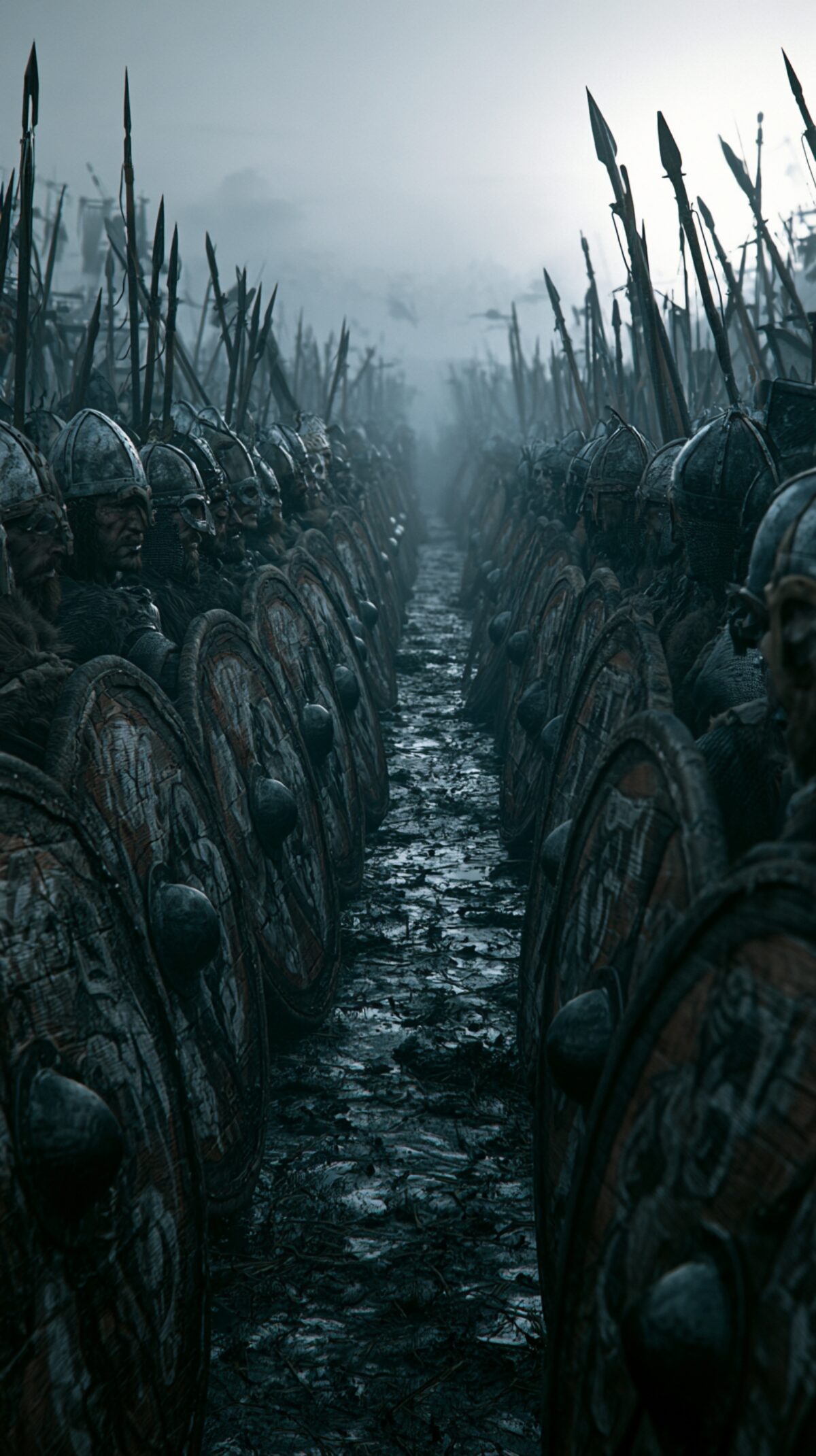
When we picture the Viking Age we see longships, dragon prows and burning monasteries. Yet on the Rhine, the Meuse and the Seine an enemy was waiting who was itself a great power: the army of the Franks. How was it organised? Who had to march? And why could this vast apparatus still barely stop the Northmen for so long? An honest look behind the capitularies – between what was ordered and what actually happened.
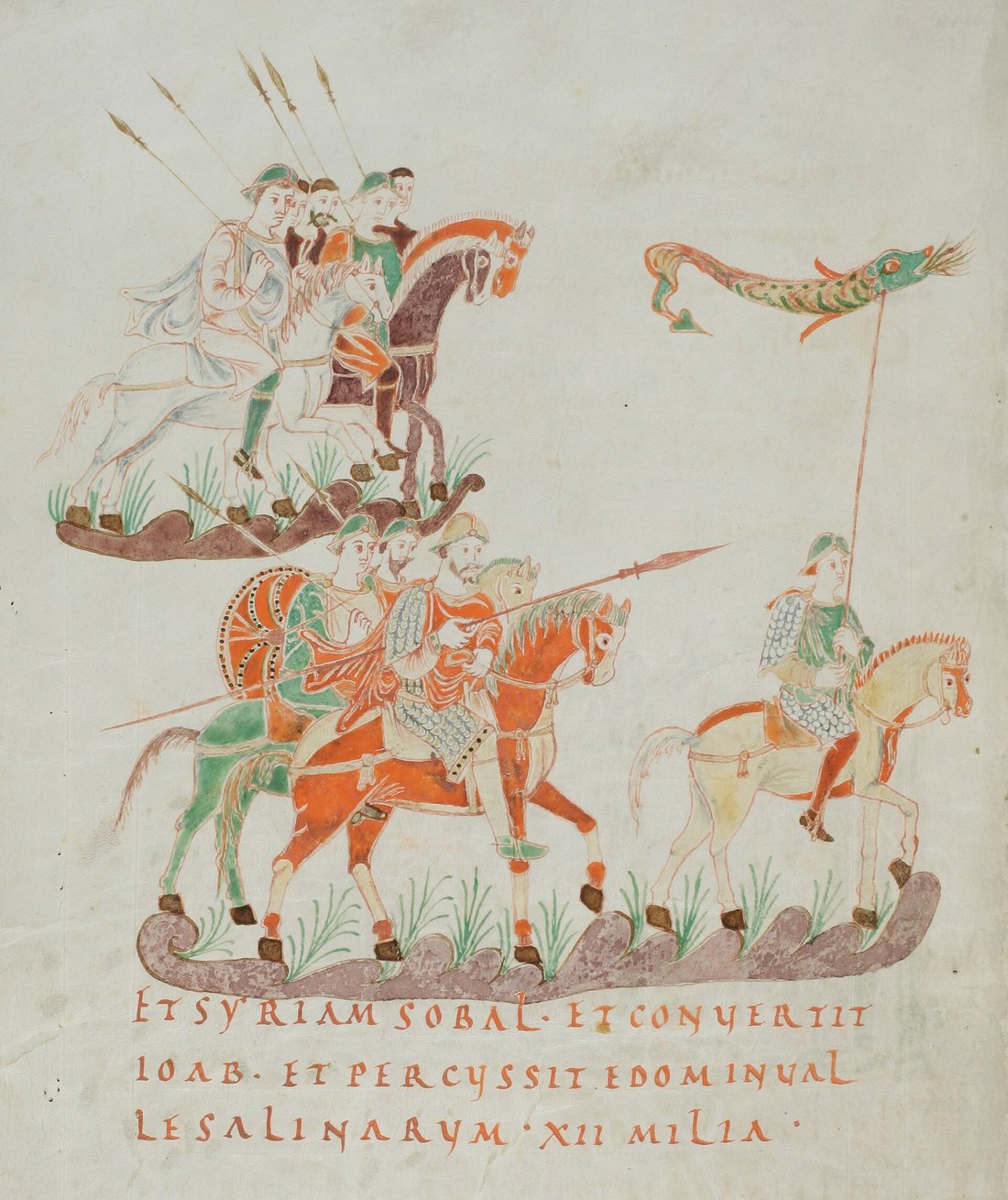
In the 8th and 9th centuries the Franks were the dominant power in Western Europe. Under Charlemagne their empire reached from the Pyrenees to the Elbe, from Brittany into central Italy. You did not hold such an empire together with a professional army – there simply was no standing army. War was a seasonal enterprise: you marched out in spring when the grass grew for the horses, and came home before winter.
When the first great Viking fleets sailed up the rivers in the 830s and 840s, the fast, mobile warfare of the Northmen met a military machine built for entirely different tasks: campaigns against Saxons, Avars, Lombards and Muslims, pitched battles and long sieges. Against an army that appeared overnight, plundered, and vanished again before the levy had even assembled, this machine was at first astonishingly helpless.
The backbone of the Frankish army was the levy (Latin heribannum): the royal right to summon free men to military service. In principle every free Frank was liable to bear arms. But the fundamental problem showed itself early: a smallholder who went to war for months at his own expense ruined both himself and his farm. An army of impoverished freemen was of use to no one.
So the levy was never a people's army in the romantic sense. The great men of the realm – counts, bishops, abbots – brought their followers; the individual farmer, if he came at all, served in the contingent of his lord or his count. The crown set the framework through its decrees, the capitularies. They are our most important source – and at the same time our greatest trap, because a capitulary is an order, not a status report.
Whoever failed to answer the summons paid for it. The fine for staying home without leave – the heribannus in the narrow sense – was the full rate of 60 solidi. Capitularies of 801 and 811 name this sum expressly: a summoned free man who did not appear owed the sixty shillings; if he could not raise them, he had to give himself as a pledge into the prince's service until the debt was worked off.
Sixty solidi were a fortune – roughly the value of a whole farm's equipment or a small estate. The fine was therefore ruinously high, and precisely for that reason it is a clue to how hard it was to get people to turn up at all. You do not threaten ruin when everyone marches out willingly anyway.
Charlemagne drew the consequences. A famous capitulary usually dated to 808 tied the duty of service to landholding. The measure was the mansus – the hide, the working unit of a farm. Whoever held four fully equipped hides (mansi vestiti), whether as property or as fief, marched to war in person and equipped. Whoever held less joined together with others: several poorer freemen equipped one man between them and sent him in their stead.
This is a remarkably modern system – a military tax by economic capacity. But honesty is required here: this key capitulary survives in a single manuscript only. Whether the four-hide rule applied across the whole empire, whether it stayed in force for long at all, or whether it was a regional order for one particular campaign, we simply do not know. A single textual witness carries a very large historical burden here.
Why war was an affair of the propertied is shown by no text as soberly as the Lex Ribuaria, the law of the Rhenish Franks. It fixes what things were worth in a dispute – and thereby what equipment cost. A brunia, a mail shirt, was valued at around 12 solidi. A horse likewise at around 12 solidi. A sword with scabbard came to about 7 solidi, helmet and greaves to further sums.
Add up the full cavalry kit – horse, mail, helmet, sword, shield, spear – and you easily reach the value of several dozen cattle. Anyone who owned all that belonged to the rural upper class. The image of an army of simple free peasants all turning up in mail and on horseback is a myth: the fully equipped rider was the expensive exception, not the rule. More on mail, sword and shield in our weapons guide.
Alongside the ponderous mass levy stood the scara: smaller, highly mobile units, often mounted elite warriors from the retinue of the king and the great men. They could strike quickly without mobilising the whole imperial levy – exactly the capability needed against the Vikings.
This is at the heart of the whole story: numbers were not the Franks' problem, time was. A levy needed weeks to assemble; the Northmen needed hours to land, plunder and put out again. Where the Franks had a scara on the spot, they could hit hard. Where they first had to call up the levy, they fought against empty camps. That is exactly why the Frankish answer shifted over the 9th century away from the great campaign and towards fixed defence: castles and bridges.
An often underestimated instrument of Frankish warfare was the arms embargo. The capitulary of Thionville (Diedenhofen) of 805 expressly forbade merchants to sell weapons and mail shirts (arma et bruniae) to the Slavs and other outsiders. Anyone caught doing so faced confiscation of his entire property.
The same motive returns decades later: the Edict of Pîtres of 864 under Charles the Bald again prohibited the sale of horses and weapons to the Northmen and threatened offenders with death. Frankish blades were famous and coveted – think of the Ulfberht swords found in large numbers in Scandinavian graves. The crown knew perfectly well that it must not put its best weapons into the hands of its enemies. That the same ban had to be repeated several times, however, also shows how little it could be enforced.
Because the Vikings could rarely be brought to battle in the open field, the Franks turned to blocking the rivers against them. The Edict of Pîtres of 864 is the key document for this: Charles the Bald ordered fortified bridges at strategic points on the rivers to stop the longships from sailing on – floating barriers with bridgeheads in which a garrison waited.
The idea was brilliant, the execution laborious: of the many bridges ordered, only a few were actually completed, chief among them the installation at Pont-de-l'Arche on the Seine. But the principle took hold – fortified places, controlled crossings, fixed defence. It is the same logic the Danes pursued with their own border rampart, the Danevirke. Both sides learned that you answer movement with walls.
An army marches on its stomach, and the Carolingian administration knew it. Capitularies prescribe exactly what a summoned man had to bring: rations for a set period, tools, carts of flour, wine and equipment, even whetstones and axes. Provisioning was partly the business of the royal estates along the march routes, partly the duty of the summoned men themselves.
It is precisely this logistical constraint that explains the seasonality of war. A large army could be kept in the field only for a few weeks before supplies and fodder ran out. The Vikings, who supplied themselves from their ships and wintered in fortified winter camps, had a decisive advantage here: they were bound neither to the harvest nor to the grazing year.
How helpless the great apparatus could be showed itself in our own home region. In the winters of 881 and 882 the Northmen sailed up the Meuse and the Rhine and laid waste the heart of Charlemagne's former empire: Aachen, where – so the later tradition runs – they stabled their horses in Charlemagne's own palace chapel, along with Cologne, Jülich, Bonn, Zülpich and the monastery of Prüm in the Eifel.
The alarming thing is not that the Vikings came, but that for so long no one seriously opposed them. The empire had fallen apart under Charlemagne's heirs, the great men quarrelled, and no effective supra-regional levy came together. At Asselt on the Meuse the campaign of 882 ended not with a victory but with a bargain: the Northmen were bought off with silver and treaties. The mightiest military apparatus of the West had failed through its own inertia and division.
It could be done differently. In 891 the East Frankish king Arnulf confronted a Viking army on the Dyle near Louvain (Leuven in present-day Belgium). Instead of a sluggish mass levy he led a resolute, mobile force – and had his horsemen dismount to storm the fortified Northmen's camp on foot. The victory was annihilating.
Tanta autem strages ex eis facta est, ita ut cadaveribus interceptum alveum amnis siccum appareret. — So great was the slaughter among them that the river's channel, choked with corpses, appeared to lie dry.Annales Fuldenses, for the year 891 (own translation)
The Dyle shows that the Frankish army could indeed beat the Vikings – when leadership, resolve and mobility came together. It was no miracle of organisation, but the will of a single king to be in the right place at the right moment. After the victory Arnulf, entirely in the spirit of Pîtres, had a fortress built on an island in the river.
What we know for certain. On the Carolingian military system we are comparatively well informed – through two kinds of source. The capitularies (the royal decrees) name the levy, the 60-solidi fine, the hide rule of c. 808 and the weapon-export bans of Thionville 805 and Pîtres 864. The tribal laws, above all the Lex Ribuaria, put a price on mail, horse and sword. And the imperial annals – the Annales Fuldenses, the Annales Vedastini, the chronicle of Regino of Prüm – narrate the campaigns, from 881/882 on the Rhine to the Dyle in 891. Where these three kinds of source agree, we stand on firm ground.
Careful, legend. A capitulary is an order, not a photograph of reality – a repeated ban proves neither that it was obeyed nor that it was futile. There was no standing army; the troop numbers of the chronicles are rhetoric, not head-counts. Nor were there yet any "knights" in the 9th century: knighthood is a development of the High Middle Ages, centuries later. And the popular thesis that the stirrup alone created heavy feudal cavalry (Lynn White Jr.) is regarded by scholars as refuted (Bernard Bachrach, 1970): the stirrup was there, but it "invented" neither feudalism nor the cavalry charge.
The Carolingian military system was no fantasy army of gleaming knights, but a tough, expensive, seasonal machine of summoned landholders, mounted elite troops and an administration that tried to cast everything into decrees – and often failed against reality. The Vikings were not wild barbarians against a superior order. They were faster, more mobile and less dependent on the harvest – and they met an empire that could only rarely bundle its enormous strength in time. Only when the Franks answered movement with walls, bridges and resolute leadership did the tide turn. The Dyle was not the end of the Viking Age, but it was the proof that the war machine of the Franks worked – when it was allowed to.
The Vikings before Aachen · The Viking winter camps · The Franks · The Danevirke · Weapon Lore.
All History & Finds articles →
Long before the Vikings they settled between the Eifel and the Danube, leaving behind gold hoards and princely graves …
Read more →