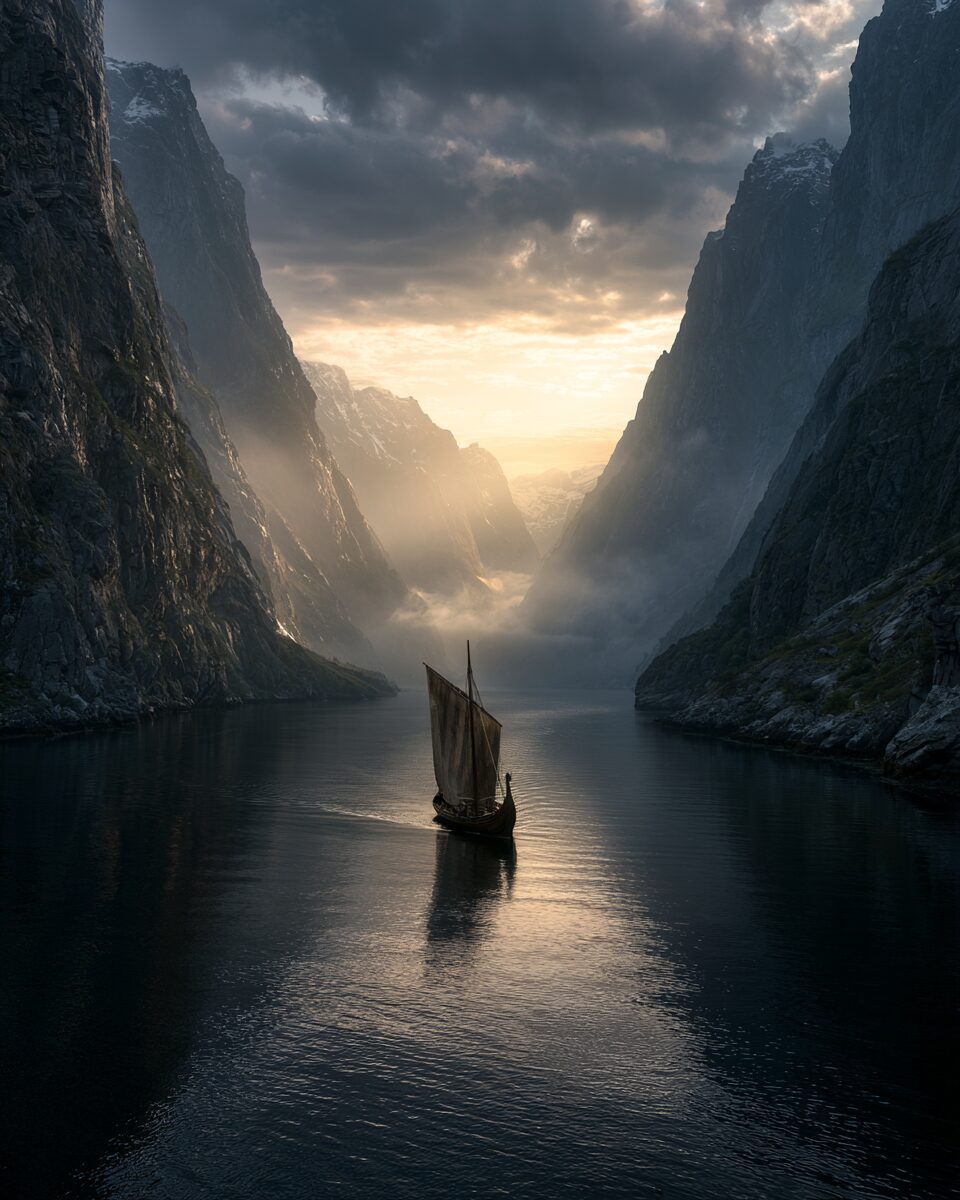
The Vikings came, raided – and stayed. Over the winter, at least. Instead of sailing home after every raid, they settled into fortified camps on the Rhine and Meuse and even made themselves comfortable in the emperors’ palaces.
For decades the rule held: the Northmen came in spring, raided through the summer and sailed home before winter. But in the late 9th century they changed strategy – and that is exactly what made them so dangerous. Instead of returning home, they built fortified winter camps in the middle of enemy country and stayed. Such a camp was a town on time: rampart and ditch all around, the ships drawn up on the bank, plus workshops, storage pits, stables and quarters for warriors, followers and captives. From here a whole land could be plundered systematically for months.
The great rivers were both lifeline and escape route. Rhine and Meuse carried the shallow, fast ships deep inland, and where a Frankish levy needed weeks to muster, the Northmen were long gone. A winter camp on a navigable river was therefore the ideal base – close to the water, hard to besiege, in the midst of rich booty from monasteries and palaces.
The Northmen took up winter quarters and laid waste the land all around with fire and sword.paraphrased from the Frankish annals (public-domain translation)
The best-known of these bases lay on the Meuse: the fortified camp at Elsloo and neighbouring Asselt (near today's Roermond). From here the raiding parties struck inland in the winter of 881/882 – up the Rhine and along the old Roman roads to the gates of Aachen. For us in Alsdorf this is no distant history: Jülich and Zülpich, the Eifel and the monasteries of Prüm, Kornelimünster, Stavelot and Malmedy all lay within reach of these camps. What sounds in the chronicles like grand imperial history played out on the very roads we know today.
In the autumn of 880 the Northmen took up winter quarters in Charlemagne’s palace at Nijmegen (the Valkhof). In spring they moved on – and burned the complex down. That is why almost nothing of Charlemagne’s palace at Nijmegen survives to this day.
After his return from Italy, Emperor Charles III gathered a great army in 882 and besieged the fortified Viking camp at Asselt on the Meuse. But instead of storming it, he negotiated. The Annals of Mainz even claim that a bribed adviser (Liutward of Vercelli) talked the emperor into peace just as the camp was about to fall. The leader Godfrid had himself baptised, received Frisia as a fief and the Frankish princess Gisela as his wife; the rest were paid off with silver. Charles’s reputation as a man who “bought his way out” was born.
The peace did not last long: in 885 Godfrid was lured into a trap over a conspiracy and slain.
The turning point came from the east of the empire. In 891 a Viking army had entrenched itself in a camp on the Dyle near Leuven (in present-day Belgium). King Arnulf of Carinthia had the fortification stormed and drove the Northmen into the river, where many drowned. Two “kings” fell, and 16 banners were captured. The great mainland raiding wave was broken.
The victory on the Dyle broke the striking power of the great army – but the danger did not vanish overnight. The following year, 892, the Eifel abbey of Prüm was struck a second time. In the same year, however, the starving army, weakened by defeat and driven by a severe famine in the Frankish empire, left the Continent again for England. Only after that did the great campaigns into the Rhineland finally ebb away. No single blow ended the threat, but the combination of military defeat, hunger and the prospect of more rewarding targets across the Channel.
The winter camps on Meuse and Rhine are a piece of local history that hardly anyone knows. The North did not stay "somewhere far away in the north" but camped, raided and negotiated in the middle of the Rhineland – at Nijmegen, on the Meuse, before Aachen, in the Eifel. It is exactly this forgotten piece of home that our Norse engravings carry within them: no pathos, but respect for a history that really happened here. More in the main article 881 – when the Vikings stood before Aachen, including an interactive campaign map.
How the Vikings reached Aachen, you can read in the post 881 – when the Vikings stood before Aachen.
All History & Finds articles →
Many call the Varus battle the „big bang of Germany". Yet another battle shaped our lands far more deeply – one in …
Read more →High above the world of humans, beyond the burning rainbow bridge, lies Asgard – the fortified home of the Æsir. It is …
Read more →Almost 1,500 years before the first Germanic peoples entered Roman history books, a highly developed Early Bronze Age …
Read more →Between the world of humans and the world of the gods a bridge of light is stretched: Bifröst, the rainbow. It is the …
Read more →