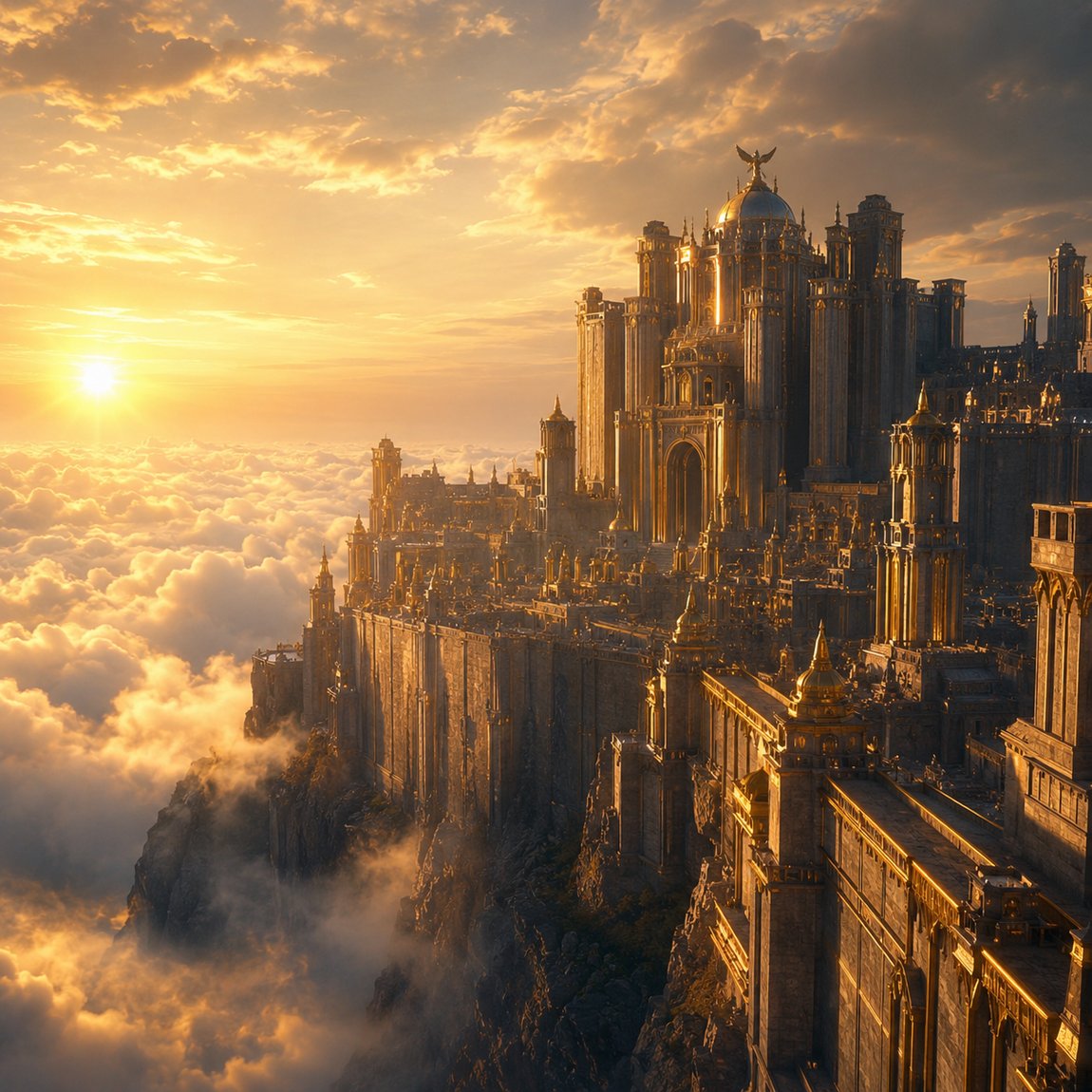
Asgard (Old Norse Ásgarðr, “enclosure of the Æsir”) is the fenced-in home of the Æsir in Norse mythology – the gods around Odin, Thor and Frigg. Their halls stand there, they hold council on the plain of Iðavöllr, and Odin watches every world from his high seat Hliðskjálf. Yet for all its fame, the name appears only twice in the Poetic Edda. Most of what we “know” about Asgard comes from one thirteenth-century Icelander – who, at one point, moved the home of the gods to Troy.
Picture an Icelandic farm around the year 1000. Longhouse, byre, storehouse, all huddled together, and around them a fence of turf and stone. Inside the fence: fire, order, law. Outside: bog, lava field, mountains nobody wants to live in. That image sits right inside the word Asgard. The gods of the North do not live in some distant, radiant paradise. They live on a farmstead – a very large, very golden farmstead, admittedly, but one with a fence. And anyone with a fence has to defend it.
Old Norse Ásgarðr is built from two words. Áss (plural æsir) means a god of the Æsir, the divine family of Odin, Thor, Týr, Baldr and Frigg. Garðr means “fence, enclosure”, and from there “the enclosed space”: a yard, a farmstead, a fenced-off precinct. English still has the word in “yard” and, via French, in “garden”. So Asgard literally means “the enclosure of the Æsir” – not “heaven” and not “the realm of the gods” in any modern, cosmic sense.
The word becomes really interesting next to its siblings. Midgard (Miðgarðr) is the “middle enclosure”, the fenced-in world of humans. Útgarðr, the “outer enclosure”, stands for the outside: the land of giants and chaos. As early as 1969 the Russian medievalist Aaron Gurevich argued that the Old Norse picture of the world was organised around exactly this contrast between inside and outside – order within the fence, threat beyond it. Seen this way, Asgard is first of all a concept rather than a spot to pin on a map: the protected, cultivated centre where the gods live.
Here is the first surprise. The Poetic Edda, the collection of mythological and heroic poems preserved in the Codex Regius manuscript of around 1270, mentions Asgard by name in just two places. Neither the Völuspá, the great poem of the world's beginning and end, nor the Grímnismál with its famous catalogue of divine halls uses the name at all.
In Hymiskviða Asgard is nothing more than a starting point. The gods want to brew ale for a feast at the hall of the sea-giant Ægir and need a gigantic kettle. In Bellows' public-domain translation: “From Asgarth came they to Egil's home”, where Thor leaves his horned goats. No description, no walls, no gold.
Þrymskviða gives us more, precisely because of its dry humour. The giant Þrymr has stolen Thor's hammer and demands Freyja as his bride. Freyja refuses with a snort so furious that her necklace bursts. So Thor himself will have to travel to giant-land in a wedding dress. Thor protests that everyone will call him unmanly. Loki's reply, in Bellows' wording: “Else will the giants in Asgarth dwell if thy hammer is brought not home to thee.”
That one line says a lot. Asgard is a settlement that can be occupied. It has borders, and those borders are not held by magic but by Thor's hammer. The home of the gods is vulnerable – an idea that runs through nearly every Asgard story we have.
The fully painted picture of Asgard comes from Snorri Sturluson (1179–1241), Icelandic scholar, poet and politician. In his Prose Edda, written around 1220, the section called Gylfaginning (“the beguiling of Gylfi”) sends a Swedish king named Gylfi to Asgard to question the Æsir. Gylfi sees a hall so high he can barely make out the top, roofed with golden shields laid like shingles.
In chapter 9 Snorri tells how the world was made. After Odin and his brothers have shaped earth, sea and sky from the body of the primeval giant Ymir and built Midgard as a rampart for humankind, the text goes on, in Brodeur's 1916 translation: “Next they made for themselves in the middle of the world a city which is called Ásgard; men call it Troy.” Keep that last clause in mind. It will come back to haunt us.
The same chapter introduces the high seat Hliðskjálf: when the All-father sits there he looks out over all the worlds and sees what everyone is doing. The poems know Hliðskjálf too. In the prose introduction to Grímnismál, Odin and Frigg sit on it together and gaze across the world; in Skírnismál, Freyr climbs onto it without permission, spots the giantess Gerðr and falls hopelessly in love.
In chapter 14 the gods gather on the plain of Iðavöllr, “in the midst of the town”. There they build the hall Glaðsheimr, with a high seat for the All-father and twelve more seats, gold inside and out – the finest house on earth, says Snorri. For the goddesses they build Vingólf. Add a smithy where the gods make tools and treasures of gold, and you have what Snorri explicitly calls the Age of Gold. It ends when women arrive from the land of the giants.
Snorri is leaning on the Völuspá here. Its seventh and eighth stanzas describe the Æsir meeting on Iðavöllr, raising altars and temples, building forges, working gold and playing board games happily in the meadow – until three mighty giant-maidens appear. The Völuspá never says “Asgard”. It is Snorri who fuses the gods' plain and their stronghold into one coherent place.
Grímnismál is a strange poem. Odin, disguised as Grímnir, sits tortured between two fires for eight nights in King Geirröðr's hall and reveals the lore of the gods. At its heart is a list of the gods' dwellings, numbered like entries in a land register. Odin never uses the word Asgard; the dwellings lie in a “holy land hard by the gods and the elves”. Scholars such as Rudolf Simek still assign most of them to Asgard – cautiously.
That list alone shows why Asgard should not be pictured too literally as a walled city. In the other stories Þrymheimr lies in the mountains of giant-land – Skaði is a giantess, after all. Njörðr's Nóatún sits by the sea, Ullr's yew dales sound like forest. Grímnismál describes a landscape of the gods, not a castle courtyard. Snorri later fitted it into his Asgard and added buildings such as Gimlé, the fairest hall at the southern end of heaven.
To reach Asgard you need a road. In Snorri, that road is the bridge Bifröst. Chapter 13 of Gylfaginning says the gods built a bridge from earth to heaven; it has three colours, is immensely strong and made with more skill than any other work. Even so, it will break when the sons of Muspell ride over it. At the bridgehead, “at heaven's end”, stands Heimdall's Himinbjörg, where he keeps watch against the mountain giants.
Every day the Æsir ride over Bifröst to their court at the well of Urðr beneath one of the roots of the world tree Yggdrasil. Only Thor has to walk and wade through rivers, because the bridge would otherwise burst into flame under his thunder.
The second connection is the world tree itself. In Grímnismál its three roots reach Hel, the frost giants and humankind; Snorri places one of them “among the Æsir”. How the world of the gods fits into the scheme of the nine worlds is not settled in the sources. The familiar diagrams with Asgard perched at the top of the tree are a modern synthesis, not an original blueprint.
The most famous Asgard story is the building of the wall, told by Snorri in chapter 42 of Gylfaginning. Right at the start, when the gods had established Midgard and built Valhalla, a craftsman arrived and offered to build them a stronghold so solid that neither mountain giants nor frost giants could get in. His price: Freyja as his wife, plus the sun and the moon.
The gods debated and agreed, on one condition: he must finish in a single winter without anyone's help. If any part were unfinished on the first day of summer, he would lose his reward. The builder asked only for the help of his stallion Svaðilfari – and on Loki's advice, it was granted. By night the stallion hauled rocks twice the size of anything his master could shift. Three days before summer, the wall had almost reached the gate.
The gods panicked and blamed Loki, who turned himself into a mare, lured the stallion into the woods, and the work ground to a halt. When the builder realised he would fail, he flew into a giant's rage – revealing that he was in fact a mountain giant. The Æsir called for Thor, who was off in the east killing trolls, and Thor paid the builder's wages with his hammer. Some time later Loki gave birth to a grey foal with eight legs: Sleipnir, the best horse among gods and men. We tell the whole tale, twists and all, in our article on the building of Asgard's wall.
Snorri supports the story with two Völuspá stanzas in which the gods hold council over who mixed the air with poison and gave Óðr's maiden to the giants – and in which Thor breaks oaths. The Völuspá itself never narrates the wall-building, though; the link is Snorri's. Another Völuspá stanza is intriguing: in the first war in the world, between the Æsir and the Vanir, the “plank wall of the Æsir's stronghold” is broken. It is possible that the builder story was meant to explain or repair exactly that breach. We cannot be sure.
Now back to that clause: “men call it Troy.” Snorri was a Christian writing for a Christian audience, and he needed to explain why his ancestors had believed in Odin and Thor for so long. His solution was euhemerism, named after the Greek writer Euhemerus (around 300 BC): the old gods were really outstanding human beings who came to be worshipped after their deaths.
In the Prologue to the Prose Edda, Snorri spells this out at length. Near the middle of the world lay a great city called Troy, in the land “we call Turkland”, with twelve kingdoms and one high king. A grandson of Priam named Trór, “whom we call Thor”, conquered Thrace – which, we are told, is called Þrúðheimr. From his line descends Odin, who travels north with a great following: through Saxland to Reiðgotaland (Jutland) and finally to Sweden, where King Gylfi grants him land and Odin founds the town of Sigtuna. The newcomers are called Æsir because they came from Asia – a folk etymology that is linguistically wrong but suited Snorri perfectly.
The end of Gylfaginning closes the frame. When Gylfi has heard everything, he suddenly finds himself standing on an open plain: no hall, no castle. It was all illusion. According to Snorri's epilogue, the Æsir then told the stories in such a way that people would take them for the real gods, and passed names from the Troy legend on to their own people. A thirteenth-century reader was allowed a smile: Gylfi was fooled – you are not.
The Troy idea was less exotic then than it looks today. Since the early Middle Ages half the peoples of Europe had claimed Trojan ancestors: the Franks in Fredegar's chronicle in the seventh century, the Britons through the legendary Brutus, most famously in Geoffrey of Monmouth around 1136. Snorri's Asgard-as-Troy is therefore not a relic of pagan belief but a piece of learned European history-writing – and an elegant way to record the old myths without having to believe them.
The picture gets even clearer in Snorri's history of the Norwegian kings, Heimskringla (around 1230). Its first part, the Ynglinga saga, opens with a geography lesson. A river once called Tanakvísl or Vanakvísl – the Don, ancient Tanais – divides Europe from Asia and flows into the Black Sea. The land to its west is Vanaheim, home of the Vanir. East of it, in Asia, lies Asaland or Asaheim, and its chief city is called Asgard.
In this Asgard Odin rules as a mighty chieftain, flanked by twelve temple priests who lead the sacrifices and judge the people; they are called díar or drótnar. There is a war with the Vanir and an exchange of hostages – Njörðr and Freyr come to the Æsir. Then Odin emigrates: first west to Garðaríki (Russia), then south to Saxland, and finally via Funen to Sweden and Lake Mälaren, where he settles at “Old Sigtuna”. He leaves his brothers Vili and Vé behind in Asgard. In the end Odin dies in his bed, is cremated, and the Swedes believe he has gone back to old Asgard to live there forever.
This is euhemerist history in its purest form. The seat of the gods becomes a city on the Don, the war of the Æsir and Vanir becomes a border conflict, and Odin becomes an immigrant king who founds a realm through sorcery and charisma.
So where does the “real”, mythic Asgard lie? The honest answer: the sources do not allow a consistent location. Snorri himself says both things. In chapter 9 Asgard is built “in the middle of the world”, with Midgard around it and, beyond, at the edge of the ocean, the land of the giants. In chapter 17, on the other hand, Breiðablik, Glitnir and Himinbjörg lie explicitly “in heaven”, and Bifröst runs “from earth to heaven”.
Scholars read this in different ways. One approach takes the horizontal order seriously: centre against edge, farm against wilderness, as the names Asgard, Midgard and Utgard suggest. The vertical order, with gods up in the sky, is seen by many as an inheritance from the Christian world view Snorri knew well, since it is hard to find in the older poetry. In 2014 the Norwegian scholar of religion Eldar Heide argued that Norse cosmology may look contradictory yet still has a logic of its own. Others warn against looking for a single map at all: oral traditions spread across centuries and regions never had to fit together geographically.
Was Asgard part of lived belief at all? The halls point that way. Archaeologists have excavated great Iron Age and Viking Age halls across Scandinavia – at Lejre on Zealand, Uppåkra in Scania and Gudme on Funen, among others – centres of power and cult where rulers feasted, judged and sacrificed. Many scholars suspect that the images of Valhalla, Glaðsheimr and Bilskirnir draw on that world of chieftains' halls. Asgard would then be the heavenly, gilded version of everything a Viking Age person understood as the essence of power and community.
No fence lasts forever. At Ragnarök the sons of Muspell ride over Bifröst, the bridge breaks, Odin falls to the Fenris wolf, Thor dies of the World Serpent's venom, and Surtr's fire swallows the world. The sources contain no separate account of Asgard's destruction. But Snorri drops a telling remark in chapter 53: after the cataclysm, Víðarr and Váli dwell on Iðavöllr, “where Ásgard was before”. Thor's sons Móði and Magni bring the hammer, and Baldr and Höðr return from the underworld.
The Völuspá paints the same scene: the gods meet again on Iðavöllr, talk over the deeds of old and find in the grass the golden game pieces they played with at the dawn of time. The circle closes on the same field where everything began. Asgard the stronghold is gone – the place remains, and with it the memory. What happens next is the subject of our article What comes after Ragnarök?
Marvel made the name known worldwide. Thor first appeared in Journey into Mystery #83 in 1962, and since the films began in 2011 many people picture Asgard as a glittering sci-fi city in space that blows up in Thor: Ragnarok (2017). That has little to do with the sources, where Asgard is a farmstead of halls, plain and fence, not a skyscraper metropolis, and Bifröst is no teleporter. We separate what Marvel got right from what it invented in our Marvel Thor fact-check.
Here in Alsdorf, Asgard often ends up on slate – and rarely as a fantasy city. What the sources themselves offer works far better: a row of halls with crossed gable boards, recalling the great longhouses, under the arc of Bifröst. Or the fence itself as a motif – an interlace border running all the way round, with a name or a house motto at its centre. That makes a particularly fitting door sign or house plaque, because that is exactly what Asgard was: a farmstead with a boundary that promised protection.
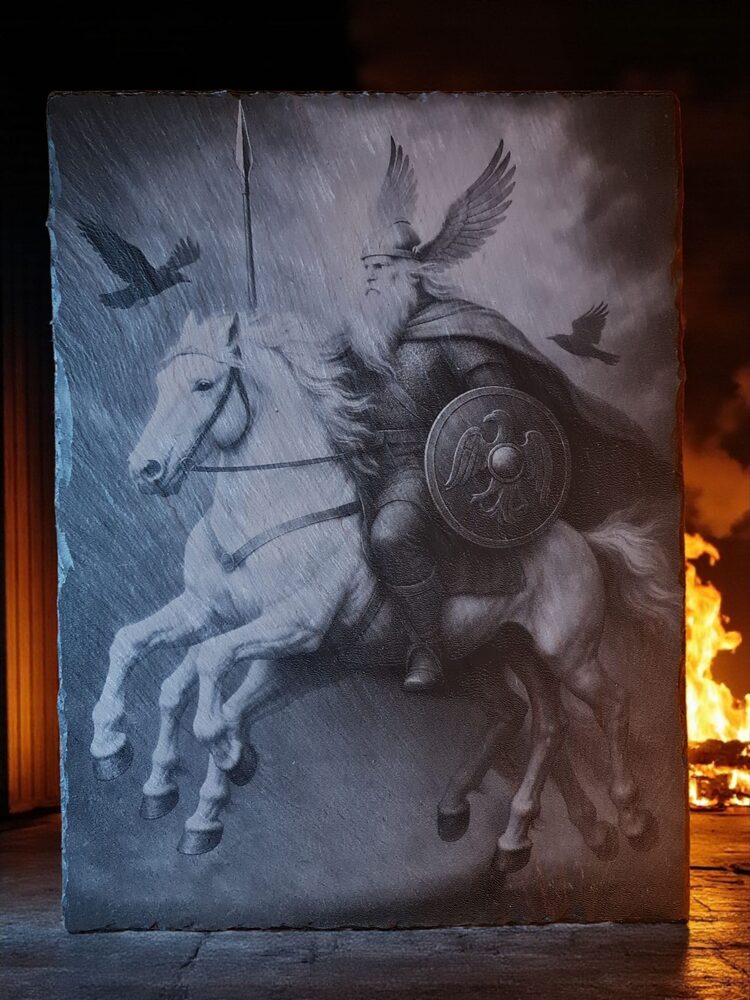
If you prefer words, pick a line from the sources: Loki's warning from Þrymskviða as a tongue-in-cheek house rule, Snorri's “stronghold in the middle of the world” for the family table, or the hall names – Breiðablik, Glitnir, Fólkvangr – as house names. Slate provides the right dark, stony ground; how we work natural stone with the laser is explained on our page about slate engraving. For fans of Odin on Sleipnir, the foal born of the wall story, we have a dedicated motif.
What does Asgard mean? The name comes from Old Norse Ásgarðr, “enclosure of the Æsir”. Garðr is the fence around a farmstead, related to English “yard”.
Who lives in Asgard? The Æsir: Odin, Frigg, Thor, Týr, Baldr, Heimdall and their families. After the war with the Vanir, Vanir such as Njörðr, Freyr and Freyja live there too, as hostages and allies.
Is Valhalla the same as Asgard? No. Valhalla is one of Odin's halls, which Grímnismál places in Glaðsheimr and Snorri places in Asgard. Asgard is the whole divine homestead with many halls.
Where is Asgard in Norse mythology? Snorri puts it in the middle of the world in one passage and in the sky in another, reached by the bridge Bifröst. The sources do not yield a single consistent map.
Why did Snorri say Asgard was Troy? As a Christian scholar he explained the gods as deified humans from Asia and followed the European fashion of tracing one's origins to Troy. It is a learned construction of the thirteenth century, not ancient belief.
Is Asgard destroyed at Ragnarök? Indirectly, yes: according to Snorri the surviving gods afterwards live on Iðavöllr, “where Ásgard was before”. The stronghold is gone, the field remains.
For courage. For remembrance. For legends that live on.
Valhalla · Bifröst · The nine worlds · Odin & Sleipnir · Loki · Hlidskjálf & the treasures.
All History & Finds articles →
Almost 1,500 years before the first Germanic peoples entered Roman history books, a highly developed Early Bronze Age …
Read more →Between the world of humans and the world of the gods a bridge of light is stretched: Bifröst, the rainbow. It is the …
Read more →Long before the Edda was written down, the people of Gotland told their stories in stone – in images that still puzzle …
Read more →Since 1878, Birka’s grave Bj 581 had been the textbook example of a high-status Viking warrior – the „ultimate Viking" …
Read more →