Most people know Ragnarök only as a world-fire: gods die, the sun goes out, the earth sinks. Yet the great world-poem of the seeress does not stop here. From the sea a new, green earth rises – and the question that holds the whole Norse myth together is: is Ragnarök an end? Or a beginning?
It is one of the great misunderstandings about Norse mythology that it ends in downfall. In truth Ragnarök is only the darkest point of a cycle. The Völuspá, the prophecy of the seeress, leads beyond the last battle – to a reborn world, to returning gods and to a human couple who survived the world-fire. This piece tells what comes after – and asks, at the end, the honest question of how much of it is old belief and how much later influence.
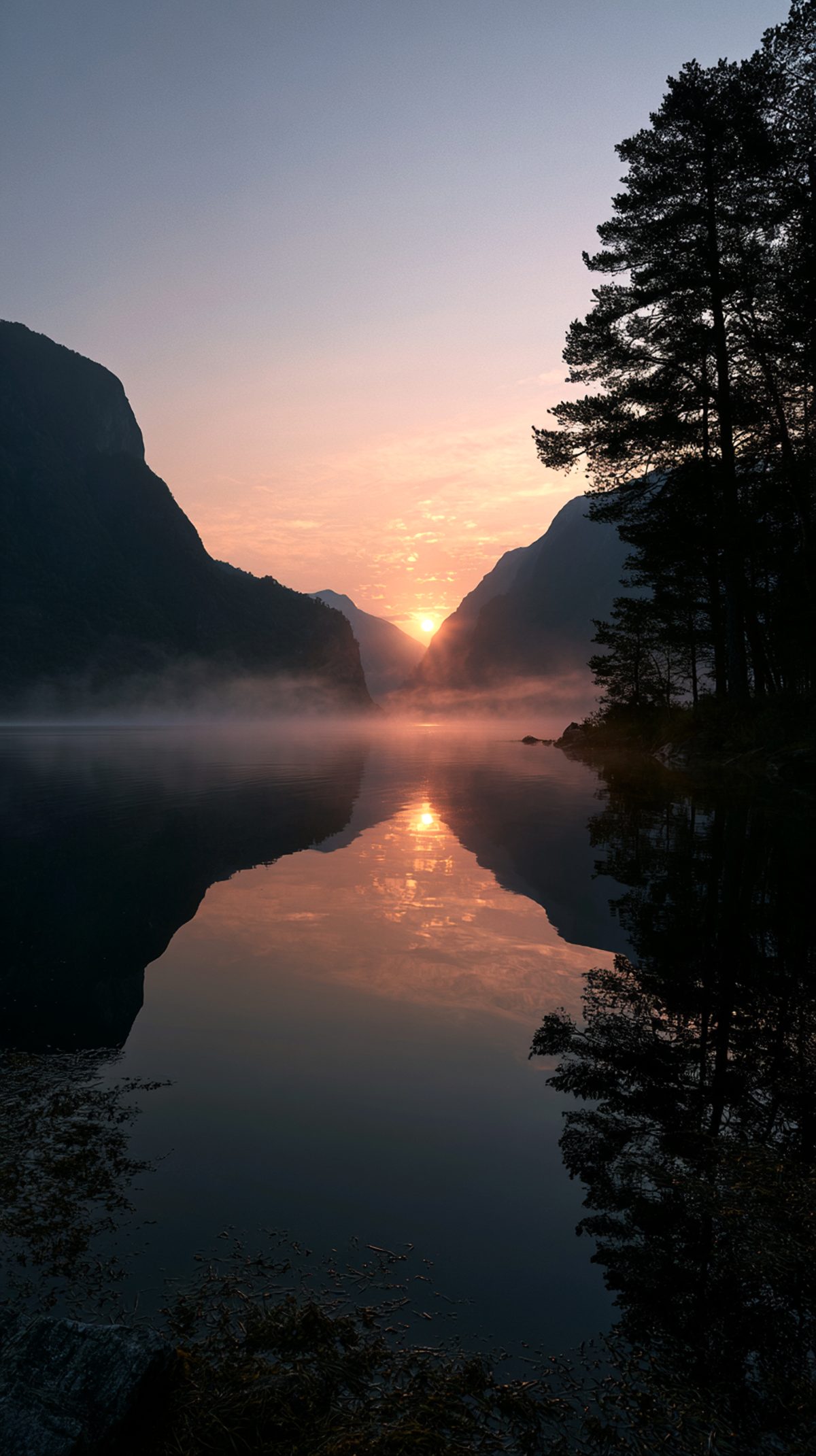
After fire and flood it grows still. And then, says the seeress, the earth lifts a second time out of the water – green, young, fertile. Waterfalls plunge, an eagle flies and catches fish in the hills. The fields bear fruit unsown. It is the image of an innocent, unspoiled new beginning.
“Now do I see the earth anew / rise all green from the waves again; / the cataracts fall, and the eagle flies, / and fish he catches beneath the cliffs.”Völuspá 59, translation after Henry Adams Bellows (public domain)
Not all the gods are dead. A younger generation survives – and with it the best of the old world. Vidar and Vali, Odin’s sons and avengers, live; Modi and Magni, Thor’s sons, now carry the hammer Mjölnir. And the greatest wonder: Baldr, the shining god, returns from the realm of the dead – together with his blind brother Höðr, who once (through Loki’s cunning) had killed him. The two are reconciled. The murder with which the end began is healed at the end.
The surviving gods gather again on Iðavöllr, the plain at the heart of old Asgard, where the young Æsir had once begun their golden age. And there, in the grass, they find again the golden game-pieces that had been theirs in the primal age. It is an image of incomparable tenderness: the lost happiness lay in the grass all along.
“In wondrous beauty once again / shall the golden tables stand mid the grass, / which the gods had owned in the days of old.”Völuspá 61, translation after Henry Adams Bellows (public domain)
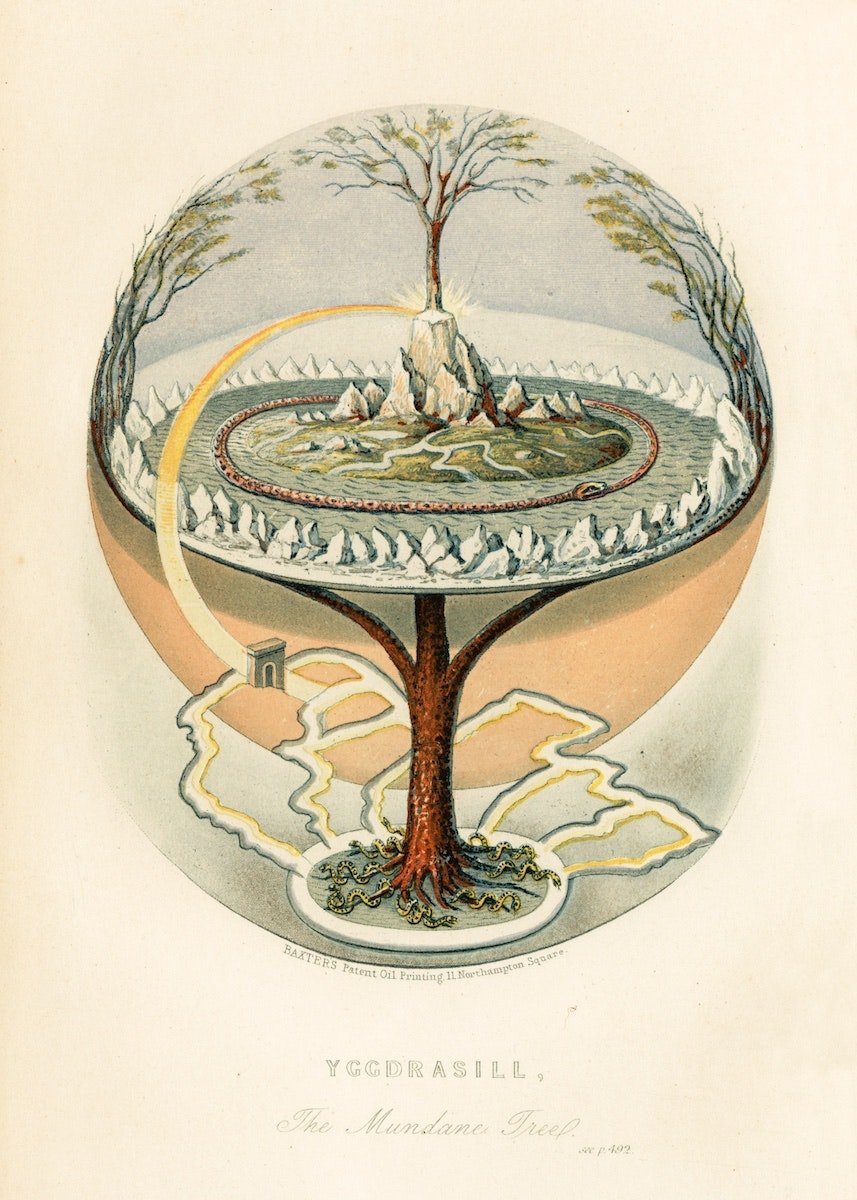
Humankind, too, does not die out. A couple hides, while the Fimbulwinter rages and Surt’s fire devours the world, in a wood called Hoddmímis holt – ‘Hoddmimir’s wood’, which scholarship usually equates with the world tree Yggdrasil itself. There they feed on the morning dew. Their names: Líf (‘life’) and Lífthrasir (roughly ‘the one striving for life’). When the new sun shines they step forth – and from them descend all future generations.
“In Hoddmimir’s wood shall hide themselves / Lif and Lifthrasir then; / the morning dews for meat shall they have, / such food shall men then find.”Vafþrúðnismál 45, translation after Henry Adams Bellows (public domain)
Life, then, literally winters over in the lap of the tree. And a new sun crosses the sky – the daughter of the old sun, born before the wolf devoured her mother. So even the light is not lost, only passed on.
The new world is not only beautiful – it is also just. The Völuspá names halls in which people fare according to their worth. In the heavens stands Gimlé, ‘fairer than the sun, roofed with gold’, where the righteous hosts shall dwell; and the hall Brimir at the place Ókólnir (‘the never-cold’), and the golden hall Sindri in the dark mountains. Against them stands the dark counter-world: a hall on Náströnd (‘corpse-shore’), turned from the sun, its door facing north, its walls woven from the spines of serpents; venom flows in streams through it, and perjurers and murderers must wade it, while the dragon Níðhöggr gnaws the dead.
“A hall I saw, far from the sun, / on Nastrond it stands, and the doors face north; / venom drops through the smoke-hole down, / for around the walls do serpents wind.”Völuspá 38, translation after Henry Adams Bellows (public domain)
Here a moral seriousness shows that the supposedly merely ‘warlike’ North is not often credited with: loyalty and honesty are rewarded, perjury and murder punished – beyond the end of the world.
So we stand before the real question. Is Ragnarök an end – or a beginning? The honest answer is: both, and that is exactly the point. The Norse worldview is cyclical. Just as the world once arose from the clash of fire and ice in the yawning void and was shaped from the body of the primal giant Ymir, so it goes down in fire – and rises green again. Downfall is not the opposite of creation but its precondition. Whoever knows the cold values the first green blade.
Perhaps it is this ending that makes Norse mythology so unforgettable. It promises no immortality and does not gloss over the downfall. But it says: after the end, life returns. The shining god comes home, the enemies are reconciled, the lost happiness lies already in the grass. It is comfort without kitsch – hard-won, and for that very reason believable. ‘For courage. For remembrance. For legends that live on.’
The whole arc: Ginnungagap · Ymir & the making of the world · The Norse pantheon · Yggdrasil · Ragnarök. Also: Valhalla · The Norns & fate · The Edda as a source.
Poetic Edda (Codex Regius / Hauksbók): Völuspá (st. 38, 59–66), Vafþrúðnismál (st. 45). Snorri Sturluson, Prose Edda / Gylfaginning (ch. 53), c. 1220. English public-domain translation: Henry Adams Bellows, The Poetic Edda (1923). Scholarship: Ursula Dronke (ed.), The Poetic Edda, Vol. II: Mythological Poems; Rudolf Simek, Dictionary of Northern Mythology (s.v. Gimlé, Náströnd, Líf and Lífþrasir, Iðavǫllr); John Lindow, Norse Mythology (2001). Evidence and interpretation – especially the question of Christian influence – are kept apart.
Norse cosmology knows not heaven and earth but nine worlds – strung along the world tree Yggdrasil, which runs through …
Read more →Above the gods stands something to which even Odin bows: fate. And fate has three shapes – the Norns, who sit at the …
Read more →It is perhaps the most famous bargain in all of mythology: the highest of the gods gives up an eye – willingly – for a …
Read more →Can a poem save a life? In the North, yes. The skald Óttarr svarti („the Black") had drawn the wrath of King Óláfr the …
Read more →