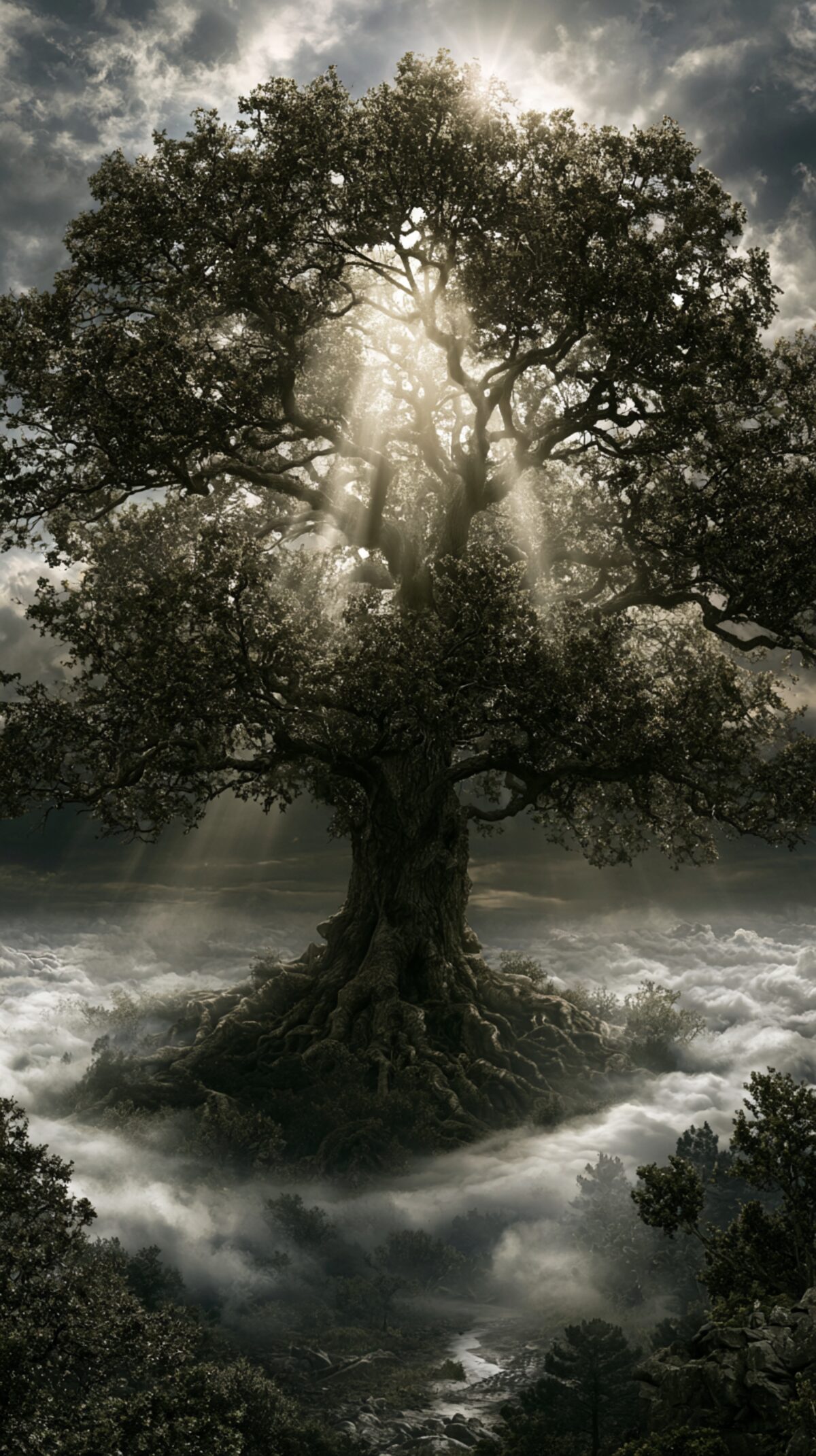
Yggdrasil is the world tree of Norse mythology: a vast ash that holds up the nine worlds and links them together. No image from Norse mythology is as powerful, as often engraved, and as thoroughly misunderstood as Yggdrasil, the world ash. It is more than a tree: it is the backbone of the cosmos, the axis from which all the worlds hang like dewdrops on a bough. So let us take an honest look at the sources — and cleanly separate what the old poems really say from what later interpreters and modern romanticism have made of it.
This piece is long because the subject carries it. If you only want one answer, it is here – the full treatment follows below.
What is Yggdrasil? The world tree of Old Norse cosmology: an immense ash from which the worlds hang and beneath which the gods hold their daily assembly.
What kind of tree is Yggdrasil? An ash. The sources say askr throughout. The popular yew theory rests on the tree being called "evergreen" – it is not attested.
How many worlds hang from it? Nine. The sources say níu heimar but nowhere list them in full. Any list of exactly nine names is a modern reconstruction.
Which animals live in the tree? An unnamed eagle in the crown with the hawk Veðrfölnir between its eyes, the squirrel Ratatoskr running messages, the dragon Níðhöggr at the root, and four harts browsing the branches.
Where does it stand? On three roots above three wells: the Well of Urðr, Mímir's Well and Hvergelmir. Poem and prose disagree on which root goes where.
What does the name mean? Most likely "Odin's horse" – Yggr is a name of Odin, drasill a poetic word for steed. In skaldic language the gallows was the hanged man's horse, and Odin hung nine nights on this tree.
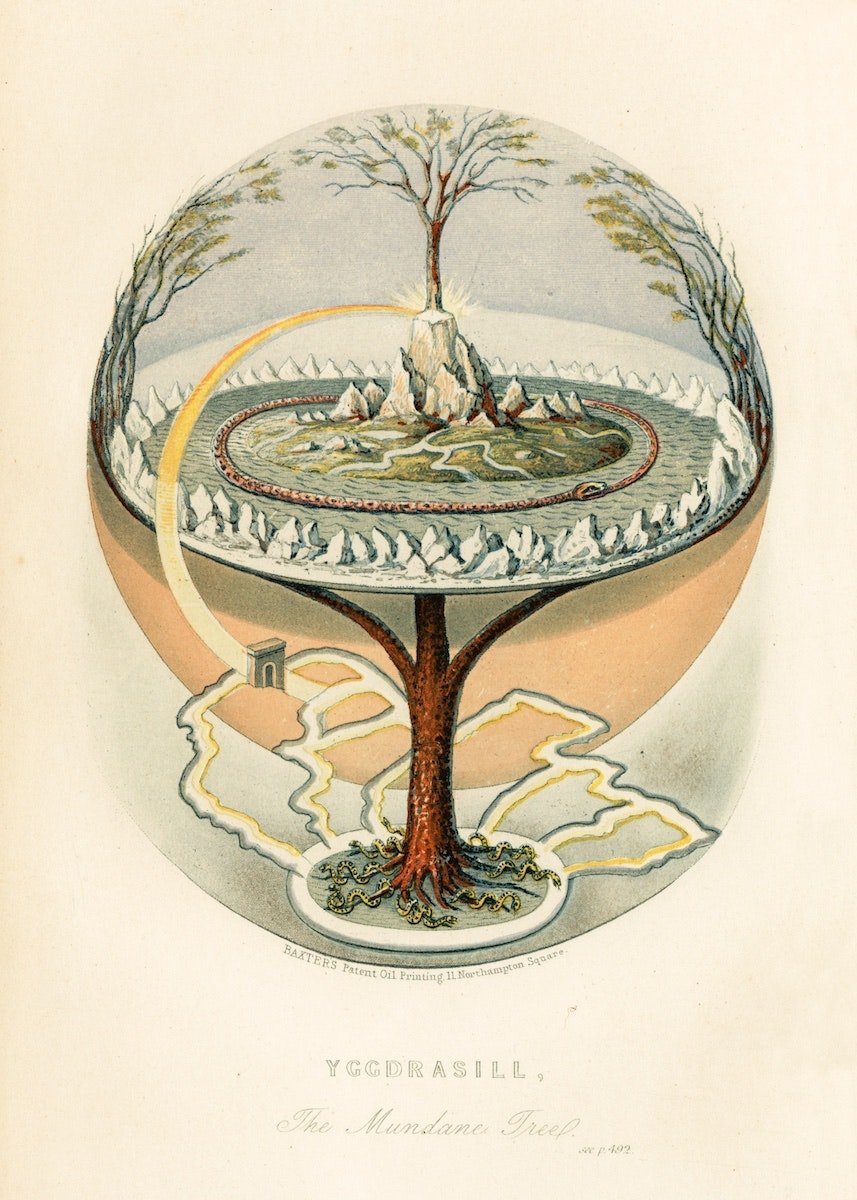
Yggdrasil is the world tree of Old Norse cosmology: an immense, evergreen ash whose roots and branches run through and hold together every realm of existence. It is the axis around which the cosmos is ordered — the crown in the heavens, the roots in the land of the dead, and the world of humans in between. Gods, giants, dwarves, the dead and the living are all bound together through this tree. It is also the gods' court: each day they ride across the bridge Bifröst to their assembly beneath the ash.
The tree is attested above all in the Poetic Edda (especially Grímnismál 29–35 and Völuspá) and in Snorri Sturluson's Prose Edda (Gylfaginning). Snorri gathers the scattered statements of the older poems into an orderly system — enormously helpful, but to be taken with caution, since he writes around 1220, a good two centuries after the Christianisation of Iceland.
The name Yggdrasill most likely combines Yggr — a byname of Odin, roughly „the Terrible One" — with drasill, a poetic word for „horse" or „steed". Literally, then: „Odin's steed". This sounds puzzling at first, but it makes sense once you know that in skaldic imagery the gallows could be described as the „horse of the hanged". The tree is Odin's „mount" because Odin hung upon it — willingly, in self-sacrifice, to win the runes.
I ween that I hung / on the windy tree, / Hung there for nights full nine; / With the spear I was wounded, / and offered I was / To Othin, myself to myself, / On the tree that none / may ever know / What root beneath it runs.Hávamál 138, transl. Henry Adams Bellows 1923
The etymology is plausible but not certain. Other readings take Yggr as „terror" itself and translate „tree of terror" or „terrible pillar". Still others link the element to an old word for yew. What is fixed is only this: the poem expressly ties the tree to Odin's self-sacrifice — the reading „Odin's gallows-steed" fits most beautifully here, yet remains a scholarly reconstruction.
The sources consistently call the tree askr — ash. And yet the debate goes on. For Yggdrasil is described as evergreen, while the ash sheds its leaves in winter. The evergreen yew fits an „ever-green" world tree better botanically, and yews were indeed prized as sacred and long-lived in the Germanic world.
It is a charming thesis, but no more than that. The texts say „ash", and no one should pretend they say „yew". It is quite possible that the poets mixed poetic traits (evergreen, imperishable) with the real image of an ash — myth rarely follows the tree nursery. So let us be clear: attested fact = ash; the yew argument = modern botanical interpretation.
The tree rests on three roots that run in three directions. Grímnismál states this plainly:
Three roots there are / that three ways run / 'Neath the ash-tree Yggdrasil; / 'Neath the first lives Hel, / 'neath the second the frost-giants, / 'Neath the last are the lands of men.Grímnismál 31, transl. Henry Adams Bellows 1923
In the Gylfaginning, Snorri assigns a well to each of the three roots: the Urðarbrunnr (Well of Urd) in the realm of the gods, where the Norns dwell and the gods hold court; the Mímisbrunnr (Mimir's Well) among the frost-giants, in which wisdom lies hidden and for which Odin pledged his eye; and Hvergelmir in icy Niflheim, the seething spring from which all rivers rise and at whose root the dragon Níðhöggr gnaws.
Here poem and prose diverge. Grímnismál lets the third root reach the world of men — Snorri instead leads it to Niflheim and Hvergelmir. Whether Snorri here preserves an older tradition or steps in as an ordering hand is an open question. The famous, tidy „three roots = three wells" scheme is therefore essentially Snorri's system, not the wording of the older poems.
Yggdrasil connects the „nine worlds" (níu heimar). The number nine is sacred in Norse poetry and recurs again and again — nine nights Odin hung, nine steps Thor took as he died. Among the worlds commonly named are Asgard (the Æsir), Vanaheim (the Vanir), Alfheim (light elves), Midgard (humans), Jötunheim (giants), Svartalfheim/Nidavellir (dark elves/dwarves), Muspelheim (fire), Niflheim (ice and mist) and Hel (the realm of the dead).
A caution: the sources speak repeatedly of „nine worlds", but nowhere list them fully and consistently. The fixed list of nine found everywhere today is a modern reconstruction, assembled from scattered mentions. On the exact composition (Vanaheim versus some other world, for instance) the texts alone cannot give a final verdict.
The world tree is a whole cosmos in itself, densely populated. Only in overview here — each of these beings deserves its own study, and for each we have a dedicated article:
A nameless eagle sits in the branches and knows much; between its eyes perches the hawk Veðrfölnir. The eagle is, as it were, lord of the heights.
The squirrel Ratatoskr darts up and down the trunk, carrying spiteful messages between the eagle above and the dragon Níðhöggr below — surely the most honest gossip-bearer in world literature.
Four harts nibble at the shoots and buds of the crown: Dáinn, Dvalinn, Duneyrr and Duraþrór. They graze the tree from above.
Below, more serpents coil around the roots than a fool would believe, and the dragon Níðhöggr („the one who strikes with malice") gnaws them from beneath.
The hart Eikþyrnir and the goat Heiðrún feed on the tree's foliage above the hall of the slain; from Heiðrún's udder flows the mead of the einherjar, and from Eikþyrnir's antlers drips the water from which the rivers spring.
The three Norns — Urd, Verdandi and Skuld — water the tree daily with water from the Well of Urd and with white clay (aurr), so that its branches will not rot. Without this daily care even the world tree would decay.
Yggdrasil bears the cosmos — and suffers for it. It is grazed from above, rots at the side, and is gnawed from below. Grímnismál captures this image of stubborn endurance:
The ash Yggdrasil / suffers anguish, / More than men do know; / The hart bites its top, / its trunk is rotting, / And Nithhogg gnaws beneath.Grímnismál 35, transl. Henry Adams Bellows 1923
This is one of the most striking images in the whole treasury of myth: the order of the world is no rigid structure but a living being under constant strain — threatened, gnawed, worn down, and yet standing, so long as the Norns tend it.
When the world's end draws near, the tree quakes to its roots. Völuspá makes it groan as if the very foundation of the world were coming loose:
Yggdrasil shakes, / and shiver on high / The ancient limbs, / and the giant is loose;Völuspá 47, transl. Henry Adams Bellows 1923
And yet — this is the consoling twist — the tree does not break for good. Under its shelter two humans survive the world-fire: Líf and Lífþrasir hide in „Hoddmímir's wood" and become the ancestors of a new human race.
In Hoddmimir's wood / shall hide themselves / Lif and Lifthrasir then; / The morning dews / for meat shall they have, / Such food shall men then find.Vafþrúðnismál 45, transl. Henry Adams Bellows 1923
Whether „Hoddmímir's wood" is to be equated with Yggdrasil itself the text does not expressly say; many scholars, however, read it as the world tree carrying humanity like an ark through the end. Either way: the tree is not only the axis of the old world but also the cradle of the new.
Yggdrasil does not stand alone. The image of a world axis — a tree, mountain or pillar joining heaven, earth and underworld — meets us all around the globe. A tour is worthwhile, especially for us here in the Rhineland, where a Germanic relative of the world tree once stood.
Closest to home is the Irminsul, the „great pillar" of the Saxons — a wooden world-pillar which, according to the chroniclers, „upholds the universe". Charlemagne had it felled and destroyed in 772 during the Saxon Wars. So here, in the very heart of our homeland between Rhine and Weser, we have the continental Germanic counterpart to Yggdrasil — a pillar instead of an ash, but the same basic idea of the world axis.
In the Bhagavad Gita (chapter 15) appears Ashvattha, the fig tree whose roots point upward and whose branches point downward — an inverted world tree „whose leaves are the Vedas". Alongside it stands the world mountain Meru as the axis of the cosmos: tree and mountain as two images of the same connecting centre.
In Zoroastrian Iran the white Haoma tree Gaokerena grows in the midst of the world sea. It grants healing and immortality — and, just like Yggdrasil, is threatened by an evil creature: a lizard of Ahriman gnaws at its root.
Among the Turkic and Mongolic peoples of Siberia the world tree is the path along which the shaman's soul travels between upper, middle and lower worlds. Its notches or branches are the levels of the heavens, which the shaman „climbs" in trance.
The Maya world tree Wacah Chan — often depicted as the sacred ceiba — connects the heavens above, the human world in the middle, and Xibalba, the underworld, below. A bird thrones in the crown while the roots reach into the depths.
In Lithuanian and Latvian tradition Austras koks, the „tree of the dawn", stands at the edge of the sky where the sun rises — a shining world tree of gold and silver in the old folk songs.
In the Garden of Eden the Tree of Life stands beside the Tree of Knowledge. In the Jewish mysticism of Kabbalah the Etz Chaim, the „Tree of Life" of ten Sephiroth, unfolds as a diagram of the divine order of the world — a tree as a map of creation.
In Chinese mythology Fusang, the mulberry sun-tree, grows in the east, from which the suns rise; Jianmu is regarded as a „ladder to heaven", a tree at the world's centre by which gods and rulers pass between heaven and earth.
One motif recurs strikingly across cultures: the bird in the crown against the serpent or dragon at the root. In Yggdrasil it is the eagle and Níðhöggr; in India the sun-bird Garuda against the Nāgas; similar oppositions appear in many tales. Above and below, sky-creature and earth-creature, meet at the world axis.
This is crucial: all of this consists of typological similarities, not proof of contact, borrowing or common descent. The historian of religion Mircea Eliade coined the term axis mundi — „world axis" — for this recurring image and saw in it a basic pattern of the human sense of space and world. That is a helpful modern interpretation, but a model, not a historical link. That Vikings, Maya and Zoroastrians all knew a world tree does not mean they copied from one another. People often arrive at the same image on their own for the same basic experience — sky above, earth below, and the human being in between.
Before we climb deeper into the branches, it is worth an honest look at the ground everything grows from: our sources. For as naturally as Yggdrasil appears today in books, series and engravings, we know the world tree from surprisingly few texts – and not one of them was written by someone who still believed in it. That is no cause for disappointment, but every cause for care. Whoever knows where the tradition comes from reads the old verses with sharper eyes.
The heart of it all is the so-called Poetic Edda, a collection of Old Norse songs about gods and heroes. Almost everything we have of it hangs on a single manuscript: the Codex Regius, catalogued as GKS 2365 4to. This unassuming little parchment was written down only around 1270 in Iceland, a good two and a half centuries after the island's official conversion to Christianity around the year 1000. The poems themselves are older – handed down by mouth, altered, smoothed, some perhaps composed in heathen times – but the pen that fixed them belonged already to a Christian-trained scribe. Between the last true blót beneath an ash tree and the ink on the Codex Regius lies a long, silent gulf.
The second great source is the Prose Edda of the Icelandic chieftain, poet and scholar Snorri Sturluson, written around 1220. Snorri was a brilliant mind, an orderer and systematiser – and therein lies both the charm and the danger of his work. He wanted to save the old poetic art for young skalds, and to do so he had to bring the scattered fragments of mythology into a clean, comprehensible whole. Where the songs hint, Snorri explains. Where they mutter in contradiction, he smooths them out. That makes him the most important narrator of the Norse cosmos – and at the same time the author one may least trust blindly.
An ash I know, | Yggdrasil its name, / With water white | is the great tree wet; / Thence come the dews | that fall in the dales, / Green by Urth's well | does it ever grow.Völuspá 19, translation Henry Adams Bellows 1923
Even this one famous verse from the Völuspá shows how sparingly the songs deal in explanation. The seeress names the tree, the dew, the well – and lets the image stand for itself. Set three core sources side by side and it becomes clear how differently they draw the tree: the Völuspá gives us the terse, powerful images of a world-vision; the Grímnismál delivers the densest detail about the animals, roots and sufferings of the tree, but in the form of riddling lists; and only Snorri's Gylfaginning fits these splinters into the coherent geography we know today as „the" cosmology.
Established: The Codex Regius (GKS 2365 4to) was written around 1270; Snorri's Prose Edda around 1220. The Yggdrasil passages that survive stem from the Christian era of recording. The three main sources – Völuspá, Grímnismál, Gylfaginning – differ in the scope and portrayal of the tree.
Interpretation: How much of Snorri's ordered cosmology is old belief and how much learned reconstruction of the 13th century cannot be cleanly separated. Every smooth, „complete" map of Yggdrasil is already a piece of interpretation – the songs themselves remain far barer and more open.
„Yggdrasil" is the name everyone knows today – but it is by no means the only one the sources use for the great tree. Old Norse poetry loved circumlocution, and depending on which poem you open, the world tree wears a different garb. Whether it is always the same tree, or related but originally independent conceptions, is among the loveliest of the open questions in the field.
Closest to Yggdrasil stands the name askr Yggdrasils, „the ash of Yggdrasil" – so the Völuspá calls it expressly. Alongside it, the poem Fjölsvinnsmál names a mysterious tree called Mímameiðr, „Mimir's tree". It spreads its branches over all lands, no fire and no iron can harm it, and in its boughs sits a golden-combed cock. Much of this sounds like Yggdrasil – yet the name links the tree with Mimir, that being of wisdom also bound up with the tree's root and well. Is Mímameiðr merely another name for Yggdrasil? Much speaks for it; nothing proves it.
A third tree bears the name Læraðr. In the Grímnismál it grows above the hall of Valhalla, and from its branches feed the goat Heidrun and the hart Eikþyrnir – the very animals bound elsewhere to Yggdrasil.
Heithrun is the goat | who stands by Heerfather's hall, / And the branches of Lærath she bites; / The pitcher she fills | with the fair, clear mead, / And ne'er can it e'er run dry.Grímnismál 25, translation Henry Adams Bellows 1923
Because the same animals nibble here at Læraðr and there at Yggdrasil, it is natural to conclude that Læraðr is a byname of the world tree – the ash seen from Valhalla. This too is a plausible but unproven identification.
Hardest of all is the expression mjǫtviðr from the second stanza of the Völuspá, often rendered „measuring tree" or „tree of fate". The seeress recalls the primeval age and the mjǫtviðr mærr, the „glorious measuring tree", which lay beneath the earth before the world was ordered. Does the word mean „tree that sets the measure of the world", a kind of cosmic backbone of creation? Or is it an independent image that only later merged with Yggdrasil? Philologists still dispute the precise derivation.
Established: The sources use several tree-names: askr Yggdrasils (Völuspá), Mímameiðr (Fjölsvinnsmál), Læraðr (Grímnismál 25–26) and mjǫtviðr (Völuspá 2). Heidrun and Eikþyrnir are named at Læraðr in the Grímnismál.
Interpretation: That all these names mean one and the same world tree is the common but unprovable assumption. Equally, originally distinct tree-conceptions may have flowed together here, which Snorri and later readers fused into a single image.
Scarcely a scene of Norse mythology is as haunting – and as often misunderstood – as Odin's sacrifice on the tree. It stands in the Hávamál, the „Sayings of the High One", precisely at the threshold where the poem passes from worldly-wise counsel into rune and magic. The highest god hangs for nine nights in a windy tree, pierced by a spear, without food or drink – and what he gains is no power over others, but knowledge. It is the moment when the world tree turns from the mere scaffolding of the cosmos into the place of deepest insight.
I ween that I hung | on the windy tree, / Hung there for nights full nine; / With the spear I was wounded, | and offered I was / To Othin, myself to myself, / On the tree that none | may ever know / What root beneath it runs.Hávamál 138, translation Henry Adams Bellows 1923
These words must be read slowly, for a paradox lies in every line: „myself to myself" – Odin sacrifices himself to himself; the god is at once priest, offering, and the deity who receives the offering. The tree, on which none can see from which root it grows, is in all likelihood Yggdrasil itself, even though the text does not name it here. And the spear, the nine nights, the hanging – these are no chance images. Odin bears the byname Yggr, „the terrible one", and men were consecrated to him by hanging and by the spear. On the tree, the god performs upon himself the very rite that was otherwise offered to him.
None made me happy | with loaf or horn, / And there below I looked; / I took up the runes, | shrieking I took them, / And forthwith back I fell.Hávamál 139, translation Henry Adams Bellows 1923
At the lowest point, starved and bled out, the motion reverses: Odin looks downward, seizes the runes, „shrieking" he takes them up – and falls back to the earth. It is no gift handed to him, but a thing won, wrested from the greatest suffering. In the following stanzas the poem tells how he learns nine mighty spell-songs and drinks of the mead of poetry. From the tree, the gallows, the place of death, grows the knowledge of writing and magic – a thought one can hardly frame more movingly.
Established: Hávamál 138–141 describe how Odin hangs nine nights on the windy tree, wounded by the spear, „given to himself", without loaf or mead, and takes up the runes. The byname Yggr is attested for Odin; the consecration of men to Odin by spear and noose is witnessed in the tradition.
Interpretation: That the tree of the Hávamál is expressly Yggdrasil is a reasonable inference, but the text does not say so. Whether the scene reflects a real heathen ritual or is a purely mythic image – and whether Christian theology of the cross shaped the later recording – is judged differently in scholarship.
Not everything about the world tree is suffering, root and cosmic burden. There is also a quiet, almost tender image, easily overlooked: from the branches of Yggdrasil falls a dew, sweet as honey, and on this dew the bees live. Snorri records it in the Gylfaginning – a detail that suddenly makes the vast tree seem near and earthly. Anyone who has stood on a summer morning beneath an old linden and heard the bees hum in the scent of blossom senses why the old tellers took up this touch: the world tree feeds not only gods and monsters, but also the smallest, most diligent life.
This „honey-fall", as Snorri calls the dew, belongs to a greater cycle of care that keeps the tree alive. For Yggdrasil does not simply stand there – it is tended. The Norns, the women of fate at the well of Urd, draw water daily from the holy spring and pour it over the tree, mixed with the white clay, the aurr, that lies about the well. Snorri describes that everything which comes into contact with this water turns as white as the membrane that lies within an eggshell. A delicate, concrete image: the mightiest tree of all worlds, overlaid white as if by an egg's skin, tended by three women with a wooden pail.
Thence come the dews | that fall in the dales, / Green by Urth's well | does it ever grow.Völuspá 19, translation Henry Adams Bellows 1923
Thus a circle closes: from the well the water rises into the tree, from the tree the dew falls into the dales, feeds the bees and waters the earth – and the Norns draw water up anew. In this image the world tree is no rigid monument but a living organism in an eternal cycle of giving and sustaining. It is precisely this motif – care, nourishment, whitening, dew and bee – that shows how warm and vivid the Norse conception of the cosmos could be.
Established: Snorri's Gylfaginning (ch. 16) reports that the dew from Yggdrasil is called „honey-fall" and that the bees live on it; that the Norns pour water and white clay (aurr) from the well of Urd over the tree; and that everything touched by this water turns white like the inner membrane of an eggshell.
Interpretation: The image of dew, honey and bees is found in this fullness above all in Snorri. How old this embellishment is and whether it goes back to earlier oral tradition cannot be said with certainty.
To the three roots of the world tree belong three springs, and each of them is a cosmos in itself. We have introduced them elsewhere – here a closer look repays the effort, for much is decided at these wells: law and fate, wisdom and sacrifice, origin and end. We have treated them at length in our piece on the three wells beneath Yggdrasil. But in connection with the tree they deserve their fixed place here.
Beneath the root that reaches to the Æsir lies the well of Urd (Urðarbrunnr). Here the gods hold court daily, and here dwell the three Norns – Urd, Verdandi and Skuld – who determine the fate of all beings. Their names are often read as „that which has become", „that which is becoming" and „that which shall become", yet this neat threefold division of past, present and future is more an ordering offered by later interpreters than something the songs prove. What is certain: at the well of Urd sits the power that stands even above the gods, and from it the Norns draw the water with which they tend the tree. Law, fate and care fall together here in a single holy place.
Beneath the root that reaches to the frost giants lies the well of Mimir, in which wisdom and understanding are hidden. Whoever drinks of it gains knowledge – but Mimir gives nothing for free. Odin himself, Snorri tells, left an eye behind as a pledge in the well to receive a single draught. The highest god pays for wisdom with half his sight: an image of harsh consequence that carries the same core thought as the sacrifice on the tree – true knowledge costs, and the price is renunciation.
The third root reaches down into Niflheim, the mist-cold realm, and beneath it seethes Hvergelmir, the „roaring cauldron". From it spring the Élivágar, the icy primeval streams, and with them ultimately all the waters of the world. Yet Hvergelmir is no peaceful spring: within it dwells the dragon Níðhöggr, who together with countless serpents gnaws unceasingly at the tree's root. Here, at the coldest and darkest of the three springs, sits the destructive force that assails the tree from below – counterweight to the Norns' care at the well of Urd.
Established: The sources know three wells at the three roots: the well of Urd (Norns, the gods' court), Mimir's well (wisdom, Odin's eye-pledge per Snorri) and Hvergelmir (origin of the Élivágar and all streams, Níðhöggr). Grímnismál and Gylfaginning supply the assignment of roots and wells.
Interpretation: The tidy equation „Urd = past, Verdandi = present, Skuld = future" is a later, etymologically suggested reading, not a statement of the songs. The precise arrangement of roots, worlds and wells also varies between the sources – the seemingly clear geography is in part Snorri's ordering achievement.

Anyone searching for an image of the world tree from the Viking Age makes a sobering and at once fascinating discovery: there is not a single find on which „Yggdrasil" is written. No runestone, no picture stone, no carved portal bears an inscription that would tell us: „This is the world tree." Everything interpreted in that direction is exactly that – interpretation. This does not make the matter worthless, quite the opposite. But it demands honesty.
A frequently cited example is the tapestry of Överhogdal from Swedish Härjedalen, probably from the 11th to early 12th century. On it appear animals, people, ships and a great, branching tree. Some scholars recognise in it Yggdrasil with the animals that live upon it; others see a Christian or mixed pictorial world. The tapestry does not tell us – the Yggdrasil reading is possible, but not secured.
It is much the same with the great Norse animal styles. In the Oseberg style of the early 9th century, and still more in the Urnes style of the 11th, slender animal bodies, tendrils and ribbons wind into an endless interlace that reminds many of roots, branches and the serpents at the foot of the tree. The famous portal of the stave church of Urnes in Norway is the prime example: a tangle of quadrupeds and serpents, elegant and enigmatic. Whether the carvers meant to depict the world tree or simply cultivated the rich formal language of their age, we do not know.
Especially instructive is the stone cross of Gosforth in Cumbria, England, from the 10th century. It is a Christian high cross – and at the same time bears scenes one believes one knows from Norse mythology, among them images recalling Ragnarök. Gosforth is the model case of the age of transition: heathens and Christians lived side by side, and in the stonework the pictorial worlds mingle, without any inscription relieving us of the interpretation. It is precisely such objects that teach us how closely the old and the new were interwoven then – and how cautious we must be with unambiguous attributions.
Established: No archaeological find exists that is expressly labelled „Yggdrasil". The Överhogdal tapestry (c. 11th–12th c.), the animal styles of Oseberg and Urnes, and the Gosforth cross (10th c., Cumbria) are real and datable.
Interpretation: Identifying the tree on the Överhogdal tapestry as Yggdrasil, reading the animal-style interlace as the world tree, and assigning individual Gosforth scenes to particular myths are interpretations of scholarship – reasonable, but not proven by the objects themselves.
When scholars think about Yggdrasil, it is rarely the question „whether it existed", but rather how the ancient people thought with this image – and there it grows exciting, because the interpretations diverge widely. It is worth knowing these readings, for they show that „the world tree" is not a fixed fact but a rich, many-sided image at which keen minds have been working for over a hundred years.
The first great point of dispute concerns orientation: is Yggdrasil a vertical cosmology – the eagle above, humans in the middle, the dragon below, a cosmic axis from heaven to underworld? Or is it thought of more horizontally? For the three roots do not all run downward but outward: one to the Æsir, one to the frost giants, one to Niflheim. In the songs the nine worlds often lie beside one another, separated by seas, rivers and fences, not stacked above one another. Some scholars suspect that the beautiful vertical tiered image only became so orderly through later systematisation – not least Snorri's – while the older conception was rather a juxtaposition of realms, connected by the tree as their centre.
A second, especially contested reading links the world tree with shamanism. In many north-Eurasian cultures the world tree is regarded as the shaman's path of ascent, a ladder between the spheres – and Odin's hanging on the tree, his ride to Hel, his knowledge of hidden things remind some scholars of shamanic practices. The thought is attractive, yet it is delicate: the evidence is indirect, and the line between an illuminating comparison and an overreaching back-projection is thin.
Names like Rudolf Simek, Margaret Clunies Ross and John Lindow stand for the sober, source-critical direction of modern scholarship. They warn again and again to caution: that much we take for ancient world-knowledge only found its form in Christian times; that Snorri was an author with a will of his own to shape; that a single image from a single poem does not yet make a „system". We gladly follow this stance – not because it takes away the magic, but because it makes it honest.
Established: The songs locate the nine worlds partly beside one another (separated by seas, rivers, fences), not consistently above one another; the three roots run in different directions. Simek, Clunies Ross and Lindow are among the leading scholarly voices of modern Edda research.
Interpretation: Whether Yggdrasil is to be thought of primarily vertically or horizontally, and whether shamanic conceptions lie behind it, are scholarly interpretations, not established facts. They help understanding but should not be presented as final truth.
The idea that a single tree bears, binds or orders the world is not confined to the North. Beyond the familiar overview it is worth glancing at further cultures in which similar images appear – not to make everything the same, but to show how deeply the motif is rooted in human thought.
In ancient Mesopotamia a Sumerian text tells of the Huluppu tree, which the goddess Inanna rescues from the bank of the Euphrates and plants in her garden, meaning one day to gain from it a throne and a bed. In its roots, its trunk and its crown three beings settle, until the hero intervenes. A tree as axis between the spheres, inhabited from top to bottom – the parallel to the inhabited world tree is plain, however different the narratives may be in detail.
In Slavic tradition we meet a world tree, often a mighty oak, in whose crown the eagle dwells and at whose root the serpent lurks – an image strikingly close to the Norse opposition of eagle and Níðhöggr. The tree is at the same time bound up with the thunder god Perun, whose holy tree was the oak; lightning and tree, heaven and earth meet here.
In the Finnic-Baltic sphere we find the conception of a world pillar or world column that bears the sky and around which the firmament turns – the pole star as „nail of heaven", the pillar as centre of the universe. Related to it is the enigmatic Sampo of the Finnish epic, a world-sustaining wonder-mill whose „many-coloured lid" was sometimes connected with the turning starry sky.
Among the Turkic-Mongolic peoples of Central Asia the Bai Terek, the „rich" or „holy poplar tree", stands at the centre: its roots reach into the underworld, its crown into the sky, and up it the hero or the shaman climbs between the worlds – a world tree as path of ascent, as suits shamanic thought.
And finally the Bodhi tree, beneath which the historical Buddha attained enlightenment. It is often called the „tree of knowledge" and has become one of humanity's great holy trees. Here, however, caution is needed: the Bodhi tree is the place of an inner enlightenment, not primarily a world axis that bears and orders the cosmos. The kinship lies in the motif of the holy tree and of knowledge – not in the architecture of the world.
Interpretation: All these parallels – Huluppu, Perun's oak, the Finnic-Baltic world pillar, Bai Terek, Bodhi tree – are typological similarities in the sense of a worldwide conception of the world axis (axis mundi), as described for example by Mircea Eliade. They are NO proof of a historical connection between these cultures. That people independently arrive at the image of the world tree shows rather how deeply this image sits in human thought than that it wandered from one people to another.
A tree that carries everything needs a place to stand: the middle. In the sources Yggdrasil is not just any tree at the edge of the world, but the fixed point around which everything else is arranged. Above, the crown in which an eagle sits; high up, the halls of the gods; in the middle, the world of humans; below, the roots, the wells, the dead. To understand the world-tree, you first have to grasp it as an axis – the line along which above, middle and below are ranged.
Even the name of the human world betrays this way of thinking about order. Miðgarðr literally means „middle enclosure" or „middle yard": a fenced, protected zone in the centre. The word garðr shares its root with the English yard and with German „Garten" – it means a fence, an enclosed piece of land. The world of humans is thus imagined from the outset as something bounded, an inside set off against an outside. And the tree stands in the middle of that inside and holds it together.
Scholars often capture this thinking with a pair of terms drawn from Old Norse itself: innangarðr and útangarðr – „inside the fence" and „outside the fence". Inside is the tamed, familiar, ordered realm: the farm, the field, humans, the gods in their halls. Outside begins the wild and unbridled: the wasteland, the sea, the mountains – and the giants (jötnar), who dwell there in „giant-home", Jötunheimr. Between the two runs a border that is crossed again and again: gods travel out to woo giantesses or steal wisdom; giants push in to threaten what is well-ordered within. The tree is the still point of reference in this constant traffic – the vertical axis from which the horizontal order of inside and outside hangs.
The gods too seek the middle. In the Völuspá and in Snorri the Æsir gather day after day at the foot of the tree, by the well of the Norns, to take counsel and give judgement. The tree is therefore not merely a piece of cosmic furniture but a place of assembly – much as earthly thing-sites often lay by a striking tree or stone. Whoever holds court at the centre keeps the order together. And whoever links the three levels – the eagle in the crown, humans in between, the roots above the wells and above Hel – makes visible that heaven, earth and underworld all hang from a single trunk. How many realms follow from this is a chapter of its own; we count them in the nine worlds.
This image of the tree as the world's centre has relatives in many cultures: the world-pillar, the world-navel, the column that holds heaven and earth apart. It is tempting to place Yggdrasil in that lineup. But here a little caution pays off – because between what the sources actually say and the tidy system we like to read into them lies a good deal of modern interpretation.
Attested: The word Miðgarðr („middle enclosure") is attested in Old Norse and cognate with Gothic midjungards and Old English middangeard – so the idea of a fenced human world in the centre is old and widespread. The Völuspá and Snorri's Gylfaginning report that the gods hold their place of judgement at the foot of the ash, by the well of the Norns. Also attested are the three roots of the tree over different wells and the eagle in its crown. The contrast between giants outside and gods/humans inside runs through the whole of the Poetic and Prose Edda.
Myth-check: The neat scheme „world-tree = world-axis (axis mundi) with three levels ranged along it" derives, in this clear form, largely from the religious studies of the 20th century – especially from Mircea Eliade (Le mythe de l'éternel retour, 1949), who made the „centre of the world" into a universal religious pattern. It is a brilliant ordering idea, but not an Old Norse body of doctrine: the sources offer vivid images – tree, roots, eagle, well, fence – but no ready-made three-level system with a label attached. The pair innangarðr/útangarðr, too, is a modern analytical tool (used notably by Margaret Clunies Ross, Prolonged Echoes, 1994) that the Norse never formulated as a „teaching". Rudolf Simek, in his Lexikon der germanischen Mythologie, urges similar care: much of what looks today like a closed „worldview" was first assembled by Snorri's ordering hand and by later scholars. In short: the centre is real – the tidy diagram around it is interpretation.
Picture the World Tree not as a silent emblem in the mist but as a courthouse. Beneath one of its roots lies the Well of Urðr, and to that well the gods ride every single day — not to feast, but to work. There the Æsir hold judgement and counsel, in Old Norse dómr, a word that means both verdict and gathering. Yggdrasil is therefore not mere scenery. It is a place of law: the holiest thing-site the North could imagine.
The road there is Bifröst, the trembling bridge that links the worlds to the roots. For every god but one, the crossing is easy. Only Thor may not ride: he has to wade on foot through roaring rivers, because the bridge stands in flame the moment he would set hoof on it. It is a charming detail the Eddic poets clearly relished — the strongest of the gods is also the only one who gets wet feet every morning.
At the same well dwell the three great Norns. Day by day they draw water and white clay over the root so the tree will not wither, and they lay the ørlǫg, the primal law, the fate of gods and mortals alike. This overlap is no accident of the telling: law and fate sit literally at one and the same spring. Whoever speaks justice speaks at the very place where the lot is cast. You can read more about these powers of destiny in our piece on the Norns.
For the medieval audience, gods holding their assembly under a tree was not a distant fantasy but daily life writ large. Across the Germanic and Norse world, trees and sacred groves were places of gathering and judgement. In the eleventh century Adam of Bremen describes the great evergreen tree beside the temple at Uppsala, where sacrifices were made. In Iceland the Althing met from 930 at Þingvellir, in the open air at a striking point in the landscape. Later law-texts still know the court-tree as a fixed meeting place. The World Tree as world-court is thus the cosmic magnification of what people actually did: come together at a sacred, immovable point to speak the law.
Yet this peace carries an expiry date. Bifröst, the road to the court, is as beautiful as it is treacherous — at Ragnarök it will shatter under the onrushing sons of Muspell. When the bridge breaks, the daily ride to the well ends with it. The gods' assembly is mighty but not eternal: even the place where fate is judged is, in the end, subject to fate.
Attested: That the gods ride daily over Bifröst to the Well of Urðr, and that Thor must wade the rivers because the bridge burns, is stated in Grímnismál 29–30 (Poetic Edda). Snorri Sturluson summarises it in Gylfaginning (ch. 15) and says plainly that there the gods have "their place of judgement" (þar eigu goðin dómstað sinn); the Norns dwell at the same well and tend the tree. The sacred tree as a cult and assembly site is attested by Adam of Bremen for Uppsala (11th c.); Þingvellir and the court-trees of the law-texts show the earthly practice. Discussed by Rudolf Simek, John Lindow and Anders Hultgård, among others.
Myth-check: The Poetic Edda mostly gives us fragments — the daily ride, the burning bridge, the rivers to be waded. The neat formula "World Tree equals world-court" is largely Snorri's ordering: writing in the thirteenth century as a Christian-trained scholar, he wove scattered lines into a system. That thing, tree and well of fate line up so cleanly is therefore part sharp observation, part learned tidying. What is secure is the real idea of speaking law beneath a sacred tree. Exactly how the gods pictured it in detail remains reconstruction, not a court record.
When we speak of the World Tree, we think first of the nine worlds it carries in its branches. Yet the North tells a second, quieter story about tree and life – one in which we ourselves appear. For the first man and the first woman, according to the sources, came not from clay or a rib, but from wood. Their names were Askr and Embla, and with them the human race begins.
The oldest version stands in the Völuspá, the Seeress's Prophecy of the Poetic Edda. There three gods walk along the seashore and find two tree-trunks, without strength and without fate. What follows is one of the loveliest scenes of quickening in Germanic poetry: each of the three gives the pair something that turns dead wood into a living human being.
Soul they had not, sense they had not, / heat nor motion, nor goodly hue; / soul gave Othin, sense gave Hönir, / heat gave Lothur and goodly hue.Völuspá 18, translation Henry Adams Bellows 1923
In the language of the poem: Odin gives ǫnd (breath, the breath of life), Hœnir gives óðr (mind, mental stirring), and Lóðurr gives lá ok litr (living warmth and healthy colour). Only together do these gifts make what we call a human – a being that breathes, thinks and feels. Snorri Sturluson tells the same scene a little differently in his Gylfaginning: for him it is the three sons of Borr – Odin, Vili and Vé – who grant the two trees on the shore breath, awareness and the senses.
The real twist, though, lies in the name. Askr simply means "ash tree." The first human is, linguistically, a tree – and the very species that many sources also name for Yggdrasil. Humankind quite literally descends from wood. With Embla the matter is murkier: the name cannot be securely explained. Some scholars read it as "elm," others as "vine" or as the fire-stick with which one kindles flame – a fine image, for then the first woman would be the tinder on which life catches fire. Only one thing is certain: Embla too belongs to the realm of trees.
This tree-descent of humankind is not a Norse peculiarity. The Greeks knew it too: in Hesiod the bronze, warlike race of men springs from ash trees, and the Meliae, the ash-tree nymphs, count as ancestresses. From trees the human being grows, across many cultures of old Europe. For the North a circle thus closes: the World Tree bears the worlds – and the human is made of the same stuff as it. To touch an ash, in this imagery, is to touch a piece of kinship. Read more about the first two and their gifts in our article on Askr and Embla; how the nine worlds hang in the branches is shown in our piece on the nine worlds.
Attested: The creation of Askr and Embla appears in the Völuspá (stanzas 17–18) and, in a differing form, in Snorri's Gylfaginning (chapter 9). Askr = Old Norse "ash tree" is linguistically secure; the three animating gifts of breath/mind/living warmth are explicitly named in the poem. The tree-descent of humankind has a parallel in Hesiod (the bronze race from ash trees, the Meliae). Cf. Rudolf Simek, Dictionary of Northern Mythology (entry "Askr and Embla"), as well as de Vries and John Lindow.
Myth-check: That Askr is the "ash" is undisputed – that this directly means Yggdrasil, however, is stated in no source. The Völuspá says only that the gods found two strengthless trunks on the shore; whether one should picture living world-trees or simply driftwood is interpretation. The equation "first human = World Tree" is thus an appealing thought, not a transmitted dogma. Likewise the translation of "Embla" (elm, vine or fire-stick) remains uncertain to this day – whoever settles it is interpreting rather than proving.
We tend to picture Ragnarök as the absolute end: the sun devoured, the stars snuffed out, the earth ablaze and sinking beneath the sea. And yet the Norse tradition does not close on nothingness. After the conflagration the land rises again from the waves, green and new, and two human beings step out of hiding into the morning light: Líf and Lífþrasir. Their names carry the whole message already – Líf simply means „life", while Lífþrasir can be read as „the one who strives after life" or „the life-yearning one". The pair are no afterthought; they are the bridge across which a new world can be peopled at all.
The decisive twist of the story is their place of refuge. While fire and water consume everything, Líf and Lífþrasir conceal themselves in a place called Hoddmímis holt, „the wood" or „grove of Hoddmímir". There they outlast the Fimbulvetr, the mighty winter before the doom, and the catastrophe itself. Their sustenance, the verses state expressly, is the morning dew alone. No storehouse, no fire, no tools – only the dew that forms anew each dawn while the world outside comes apart. From these two, the verses say, the coming generations of humankind descend.
And this is precisely where our World-Tree grows interesting. What is this „wood of Hoddmímir"? Old Norse holt means a grove, a small wood – and Mímir is inseparably bound in the North to the tree and the well. Beneath one of Yggdrasil's roots lies Mímisbrunnr, the well of wisdom; and in another poem the World-Tree itself is called Mímameiðr, „Mímir's tree". The prefix Hodd- („hoard, treasure") fits seamlessly with a Mímir who guards the most precious treasure of all: the knowledge at the spring. Many scholars draw the obvious conclusion – that „Hoddmímis holt" is none other than Yggdrasil itself.
If that holds, the image is one of striking consequence: humankind survives the end of the world inside the World-Tree. The tree that bears the nine worlds, that the stag gnaws, at whose root the dragon lies, and which greens on despite all its suffering – this tree becomes, in the final hour, an ark, a hollow chamber full of life while all around it burns. Yggdrasil carries life not only through the everyday of the gods but straight through the apocalypse. Whoever steps onto the new green earth after Ragnarök comes, quite literally, out of the tree. A great circle closes here, one you will also find in our overview of the nine worlds: the tree is beginning and refuge in one.
Líf and Lífþrasir, then, are best imagined not as heroes who fight but as the quiet ones who endure – fitting for the name of the life-yearning one. It is not the loudest blade that saves the world, but the stubborn persistence of survival in hiding, the patience of a drop of dew. Anyone who wants the fuller story of the two will find it in our dedicated piece on Líf and Lífþrasir.
Attested: Líf and Lífþrasir are named in Vafþrúðnismál 44–45 of the Poetic Edda, where Odin asks the giant Vafþrúðnir who survives the „Fimbulwinter". Snorri Sturluson quotes the same stanza in Gylfaginning 53 of his Prose Edda. Expressly given there are: the refuge „Hoddmímis holt", the food of morning dew, and the statement that the future human race descends from the two.
Myth-check: That „Hoddmímis holt" equals Yggdrasil is a widespread and well-argued interpretation (discussed by Rudolf Simek and John Lindow, among others) – but the sources never say it in so many words. The text names only a „wood of Hoddmímir"; the equation with the World-Tree is drawn by interpreters, resting on Mímir's closeness to tree and well. It remains a strong inference, not a quotation. Likewise, „morning dew as their only food" is literally transmitted – the romantic overtone („humankind grows out of the tree") is our modern synthesis, not the plain wording of the Edda.
Why did the ash of all trees become the World Tree? Anyone who wants to understand the myth should first know the tree that the people of the North saw every day and held in their hands. The common ash (Fraxinus excelsior) was no exotic growth but a familiar companion of daily life – and that is exactly what makes it so convincing as an image for the framework of the world.
The ash is a tall, brightly leaved deciduous tree. It grows slender and high, spreads a light, far-reaching crown, and is common across much of northern and central Europe. In a land where many forests are dominated by pine, birch and spruce, such a tree stands out: upright, strong, visible from afar. When the Gylfaginning calls Yggdrasil the greatest and best of all trees, it describes an idea that anyone understood who knew a great free-standing ash on the farm.
Above all, though, the ash was a workhorse among trees. Its wood is tough, elastic and shock-resistant – a rare combination. It does not break easily, it flexes under load, and it withstands blows. For the people of the Iron and Viking Ages this was no botanical detail but a matter of life and death: ashwood is the ideal material for a spear shaft. A shaft must take the impact without splintering and vibrate along with the throw without shattering. That is exactly what the ash delivers.
This close bond between tree and weapon left a deep mark on the language. In Old Norse the word askr first of all simply means „ash". In poetic language, however, it also stands for the spear itself – the part (the wood) naming the whole (the weapon). And there is more: askr could also denote a small ship or boat built from such wood. From this meaning comes the byname under which Frankish and Saxon chroniclers knew the Norse seafarers. Adam of Bremen records in the 11th century the term Ascomanni – literally „ash men", the men in the ash-wood ships.
The uses of the ash were far from exhausted with that. Because of its toughness it was worked into tool handles for axes, hatchets and hammers that had to endure the hard blow. It went into wagon parts, into boat ribs, and everywhere that wood had to bend and bear without breaking. For the bow people reached rather for yew, whose wood is even better suited to draw and snap-back – the ash remained the wood of shafts, handles and load-bearing parts. And where a trunk no longer served any of these purposes, it still gave good, evenly burning firewood.
A tree that carried weapon, tool, wagon and boat, that grew tall and visible from afar and was known everywhere – not a bad candidate for the image of the one tree that holds all worlds together. Against this background, choosing the ash as the World Tree looks less like chance than like very human logic: for the greatest thing one can imagine, one takes the best and most familiar thing one knows.
A fine snag remains, however. Snorri describes Yggdrasil as evergreen: the tree stands „æ yfir grœnn Urðarbrunni" – ever green over the Well of Urd. The ash, though, is summer-green; in winter it stands bare. This contradiction is one of the reasons why some scholars think of the evergreen yew when the World Tree comes up. We treat this question of identification more fully elsewhere; here it is enough to note that poetry and botany do not always line up neatly.
This old pairing of tree and meaning still moves us today. Wood carries history – it grows over decades, shows its own path in every grain, and warms under the hand. That is why we like to work with real tree slices, which we leave in their natural shape, hand-sanded and oiled, before we laser-engrave Norse motifs onto them. If you like, you will find our engraved tree slices in the shop – a piece of living wood that, like the ash of old, is both image and material at once.
Attested: Old Norse askr means both „ash" and, poetically, „spear" as well as a small type of ship; the Gylfaginning calls Yggdrasil the greatest and best of all trees and describes it as evergreen over the Well of Urd. Adam of Bremen records in the 11th century the name Ascomanni („ash men") for the Norse. Ashwood (Fraxinus excelsior) is indeed tough, elastic and shock-resistant and was a favoured material for spear shafts, tool handles and load-bearing timbers.
Myth-check: The neat chain „askr = ash = Yggdrasil = Ascomanni" is tempting, but partly poetic transfer: that one word can mean tree, spear and boat at once is a linguistic image, not proof that every source means the same tree. Whether the World Tree was botanically really an ash remains open – Snorri's „evergreen" fits the yew better. And the fact that the ash is the ideal spear wood does not automatically make it the intended World Tree; that is a plausible connection, not a documented equation.
From cosmic tree to heartfelt motif: Yggdrasil is today one of the most beloved symbols of connection, roots and transformation — and thus a wonderful motif for engravings on natural material, for instance on a tree slice or as a pendant, where the world tree fittingly finds its place on real wood.
The world of the Vikings is, quite literally, built from a corpse. From the slain primal giant Ymir the first gods …
Read more →Once a year the gods brewed not mischief but beer. The sea-giant Ægir welcomed them into his hall on the sea-floor …
Read more →Few stories in Norse tradition trail so much ruin behind them as this one: a careless throw, a dead otter, an …
Read more →It is the moment when laughter vanishes from Asgard. The death of the shining Balder is the most moving legend of the …
Read more →Yggdrasil is the vast world-ash of Norse mythology that connects and supports all nine worlds. It is the axis of the cosmos – Odin hangs on it for nine nights to win the runes.
Sources name Asgard (Æsir), Vanaheim (Vanir), Midgard (humans), Jötunheim (giants), Niflheim, Muspelheim, Alfheim, Svartalfheim and Helheim. Snorri orders them systematically – the exact list is partly reconstruction.
An eagle in the crown, the dragon Níðhöggr at the root, the squirrel Ratatöskr as messenger between them, and four stags browsing the shoots.